Why the real finds beat the theories
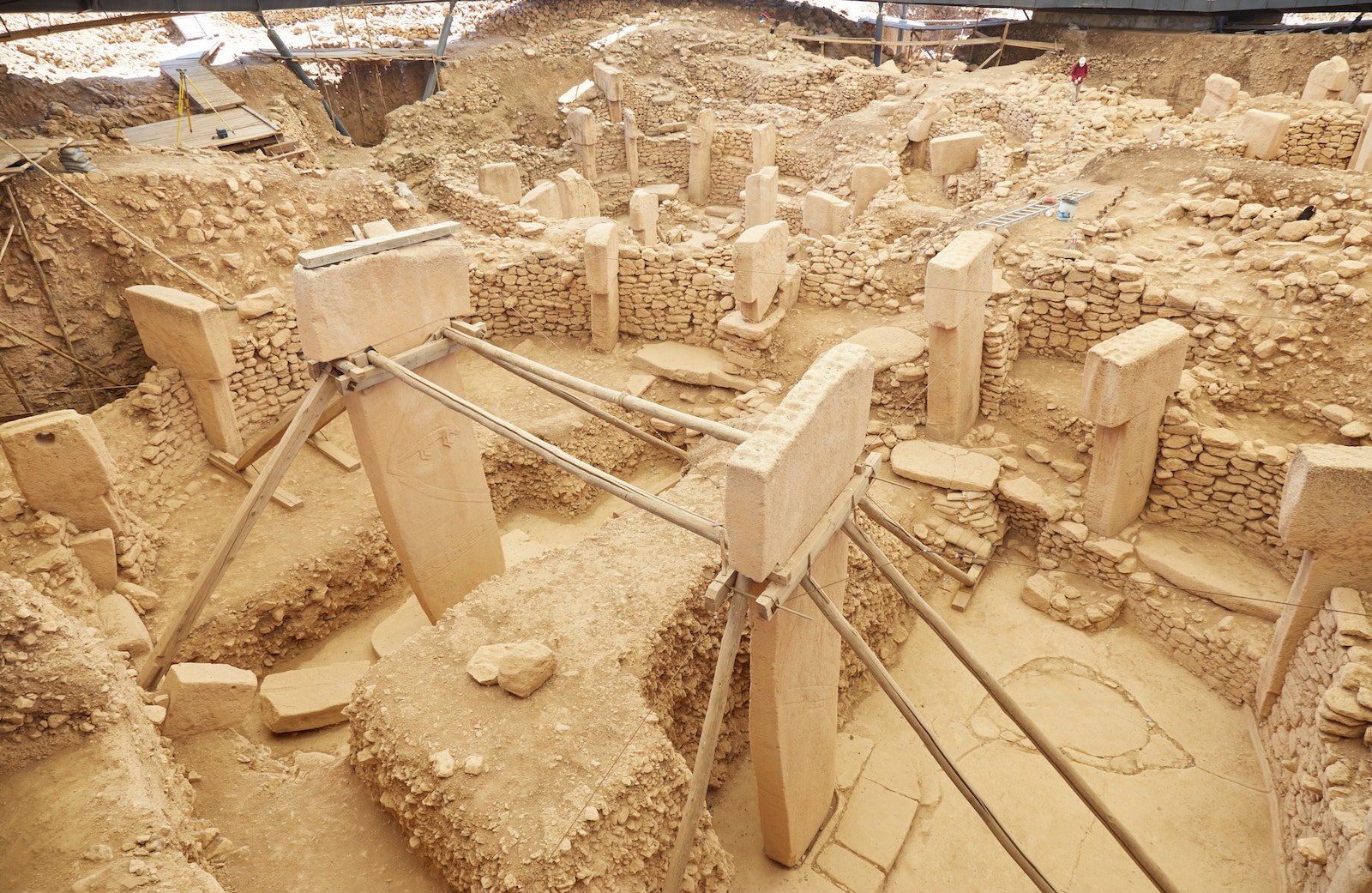
Göbekli Tepe is famous for arguments — lost civilisations, comets, star maps. But spend time with the actual objects coming out of the Taş Tepeler and you stop needing the theories. The real finds are stranger, and they have the enormous advantage of being real. Here are the ones that stay with you.
A note on honesty: some of these have been published in peer-reviewed journals and are rock-solid. Others are fresh from a current excavation season, announced by the Turkish ministry or the dig teams but not yet formally written up. We mark those as preliminary, because the difference matters.
The flint still inside the bone
In 2009, in the last few centimetres of soil above bedrock in Enclosure D, excavators found a bone from an aurochs — a wild bull — with a fragment of a flint projectile point still lodged inside it. The tip had struck at almost a right angle and snapped off. Crucially, the bone shows no healing: the animal was, in the excavators' words, 'hunted down' soon after the hit.
It is about as close as archaeology comes to watching a Neolithic hunt happen. A weapon, a wild animal, a missed-then-fatal shot — and the bone carried the evidence for twelve thousand years.
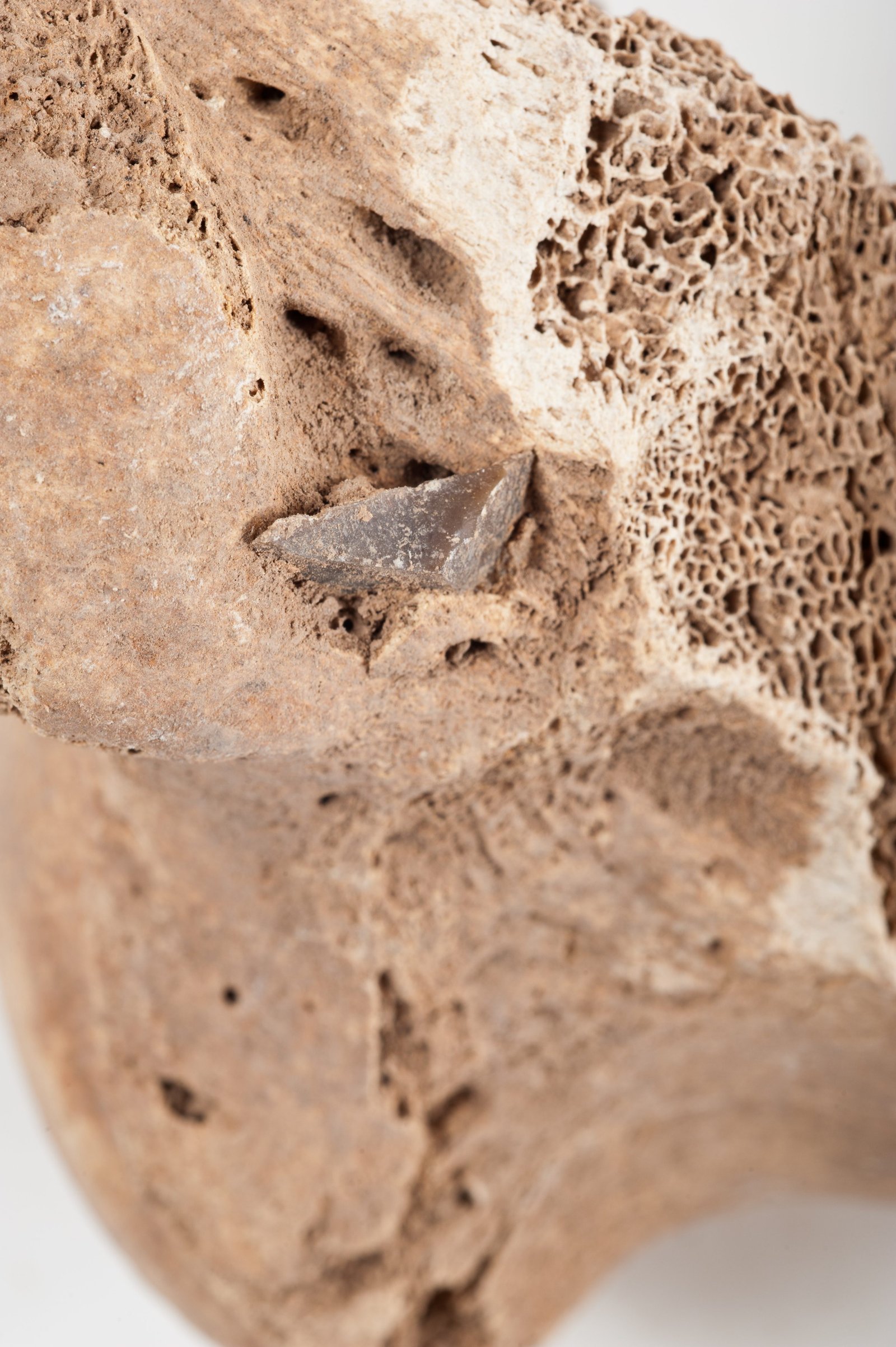
German Archaeological Institute, Göbekli Tepe Project, Aurochs bone with embedded flint projectile, Göbekli Tepe, Copyright: DAI — used with permission, via .
A hunter's flint, snapped off inside a wild bull, and kept by the bone for twelve thousand years. The Taş Tepeler are full of moments like this — the real thing, stranger than the myths.
Human skulls, carved and drilled to be hung up
Göbekli Tepe has produced hundreds of fragments of human bone, but no ordinary graves. Among them are pieces of three skulls that were deliberately worked: after the heads were defleshed, someone cut deep grooves along the top of each cranium with a flint tool, and drilled a hole through one of them. On one, traces of red ochre survive.
Published in Science Advances in 2017, this is the earliest evidence of its specific kind — a 'skull cult' in which select individuals' heads were carved, perhaps painted, and most likely suspended and displayed. Whether they were honoured ancestors or dispatched enemies, the archaeologists cannot yet say.
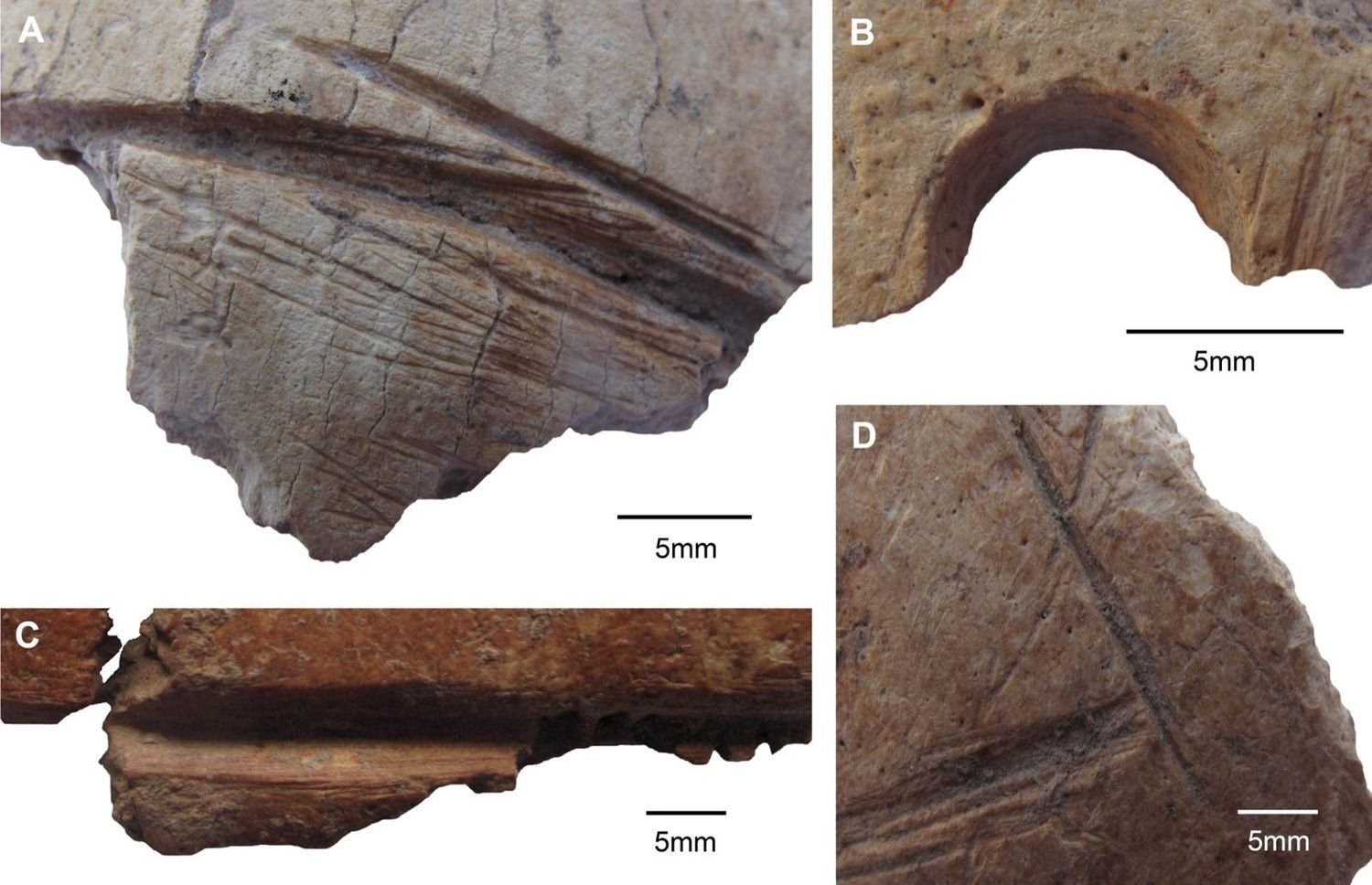
German Archaeological Institute, Göbekli Tepe Project, Modified human skull fragments, Göbekli Tepe, Copyright: DAI — used with permission, via .
A severed head among the beasts
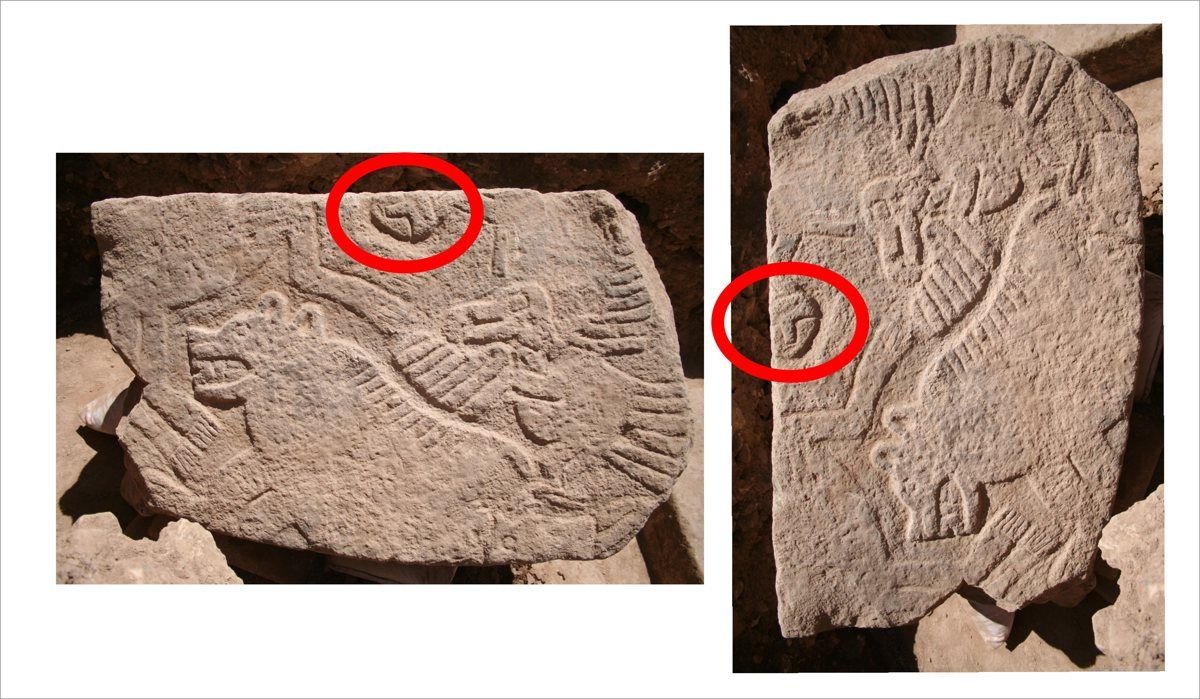
Also in Enclosure D, a large decorated slab was found lying face-down immediately beside the central Pillar 18. When it was turned over it showed animals — and, at its broken edge, a detached human head. Its position, pressed against a central pillar like the site's other placed heads, marks it as a deliberate act, not rubble.
It ties the art directly to the skull cult: the same fascination with the severed head that runs through the bones runs through the carvings too.
A carved bone that may show the enclosure in miniature
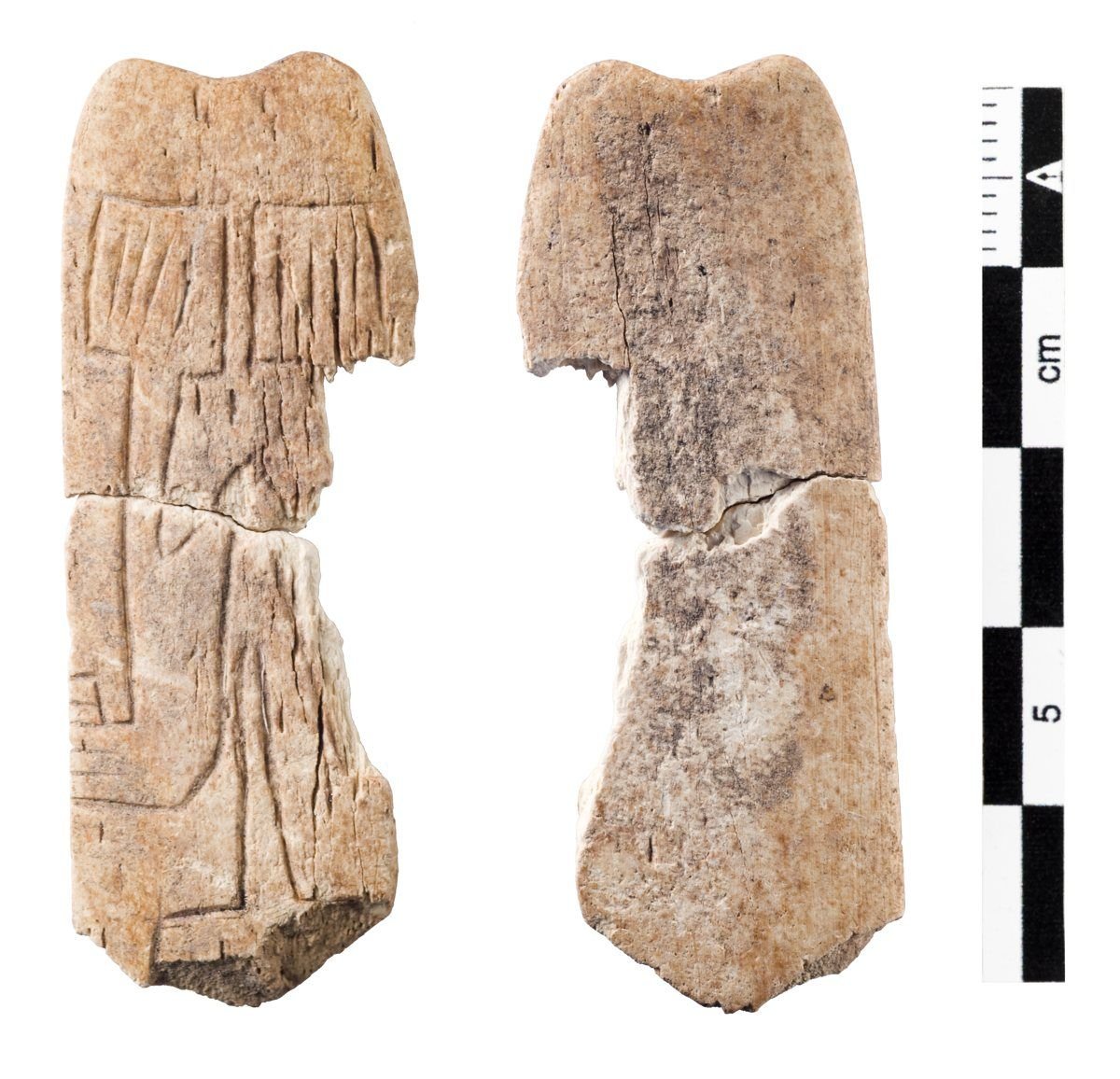
Among the small finds from Göbekli Tepe is an enigmatic worked bone 'spatula' carrying a faint carved image. Oliver Dietrich and Jens Notroff, who published it, suggest the worn design may be an abbreviated depiction of the enclosures themselves — what could be one or two T-shaped pillars shown with an arm, a belt, and a hanging fringed skin, the same body-language the great central pillars wear.
If that reading is right, it would be a rare case of the Neolithic builders portraying their own monuments in miniature — the enclosure carved onto a hand-held object. The carving is worn and only partly preserved, so the excavators are careful to call it a possibility, not a certainty.
Miniatures of their own monuments
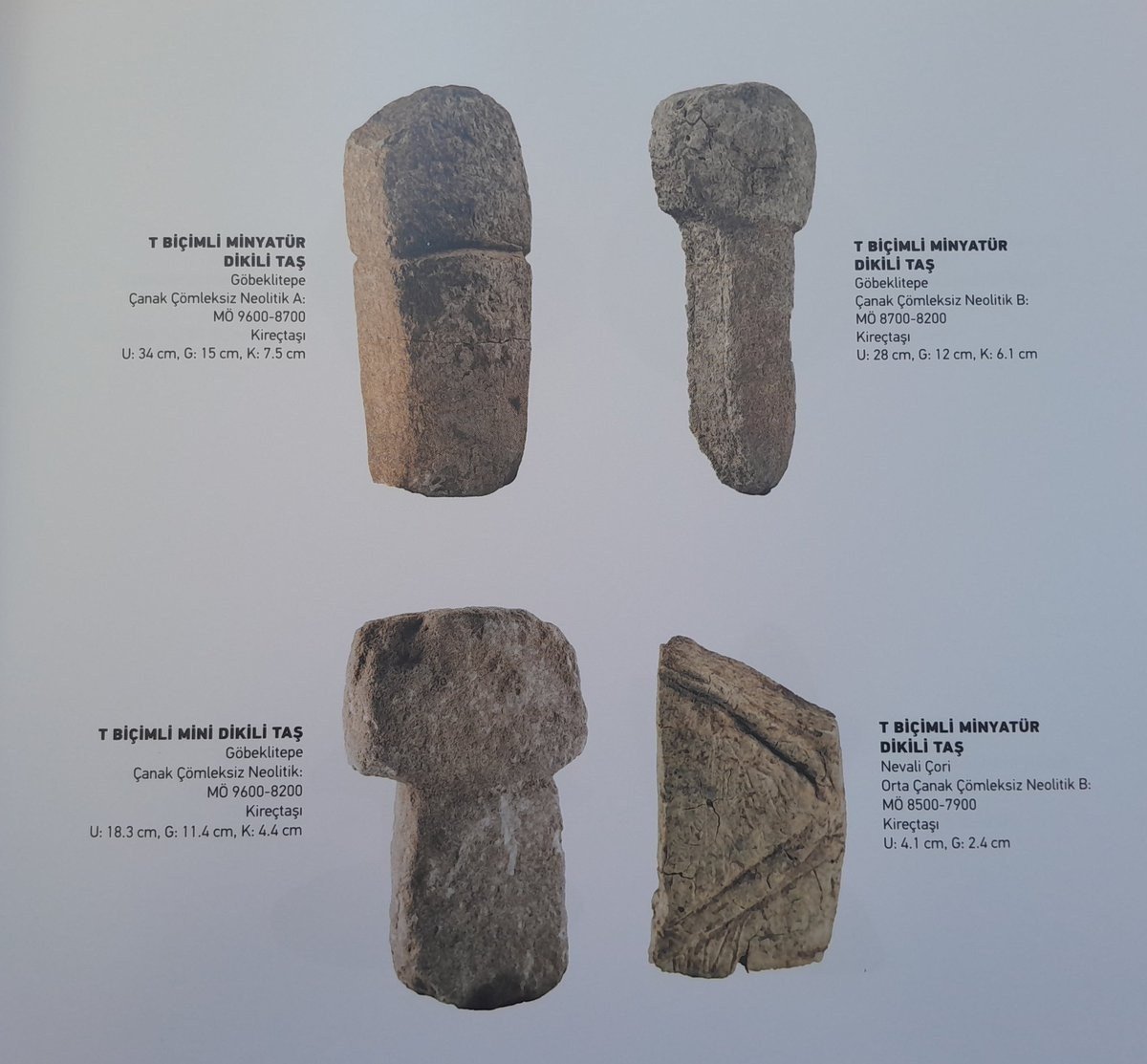
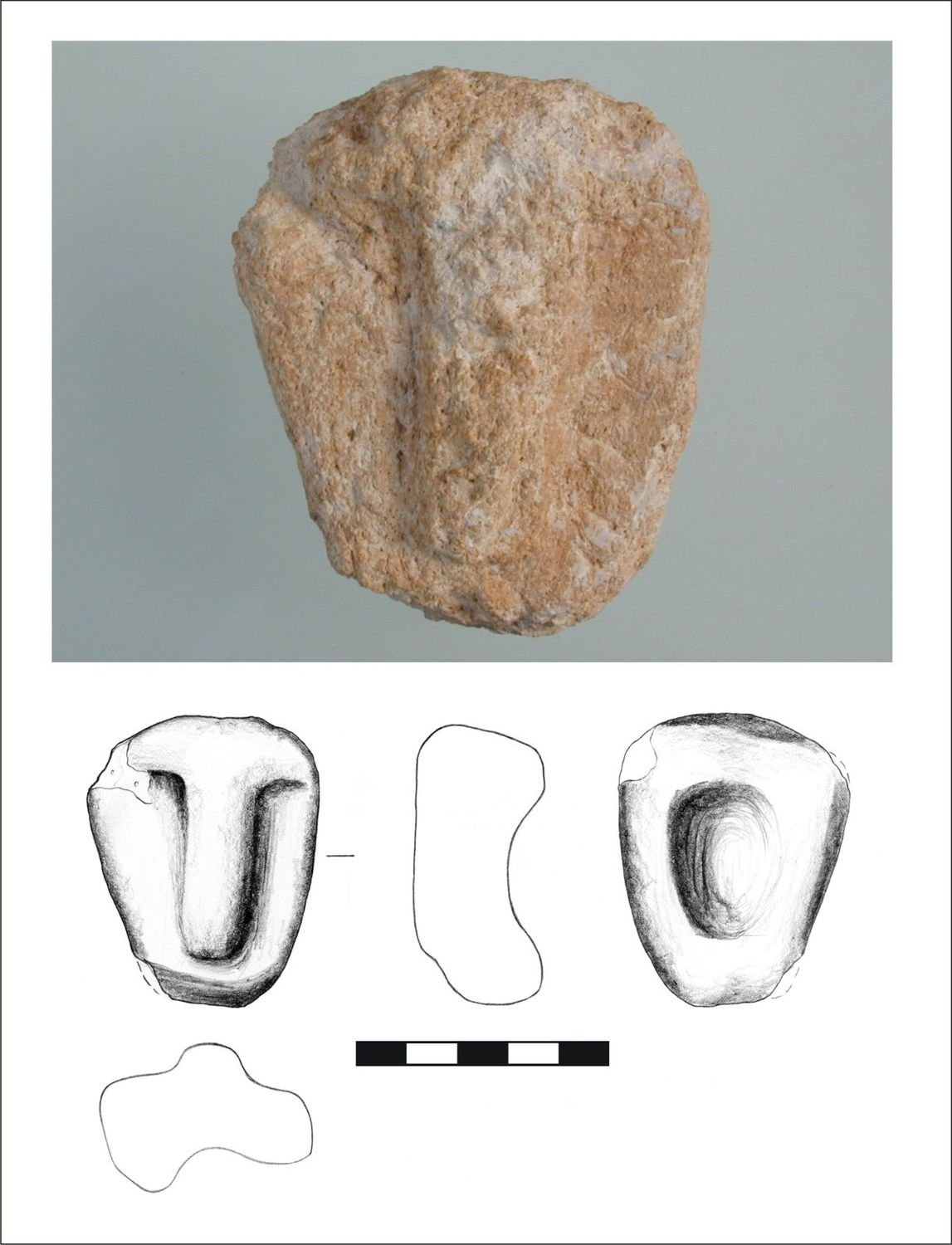
The bone is not the only place the giants shrink. The same communities that raised ten-tonne T-pillars also carved them in pocket form — hand-sized T-shaped standing stones in the same limestone, catalogued in the Şanlıurfa Museum from about 34 centimetres down to roughly 4 centimetres. There are miniature porthole stones, too, and, from neighbouring Çayönü, a tiny model building. The monument echoed in something you could close a hand around.
Why they did it is genuinely unresolved — design models, charms, ritual objects, even apprentice or children's pieces are all possibilities, none proven. And it is not only a Taş Tepeler habit: making small clay or stone models of buildings is a recurring feature of the Neolithic, from these Şanlıurfa hills to the later clay house models of Neolithic southeast Europe (Thessaly and the Balkans), which archaeologists read as abstract images of houses and use to reconstruct the architecture itself. We follow the whole strange habit in a dedicated deep-read, Miniature Göbekli Tepe: the tiny monuments no one can explain, linked below.
A statue buried face-down in a sealed room
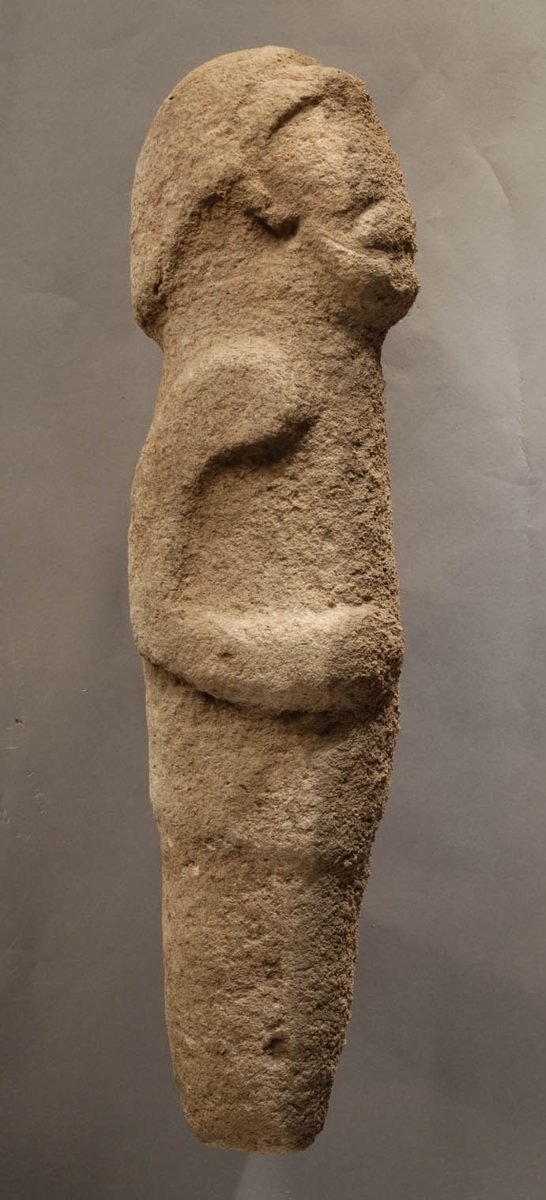
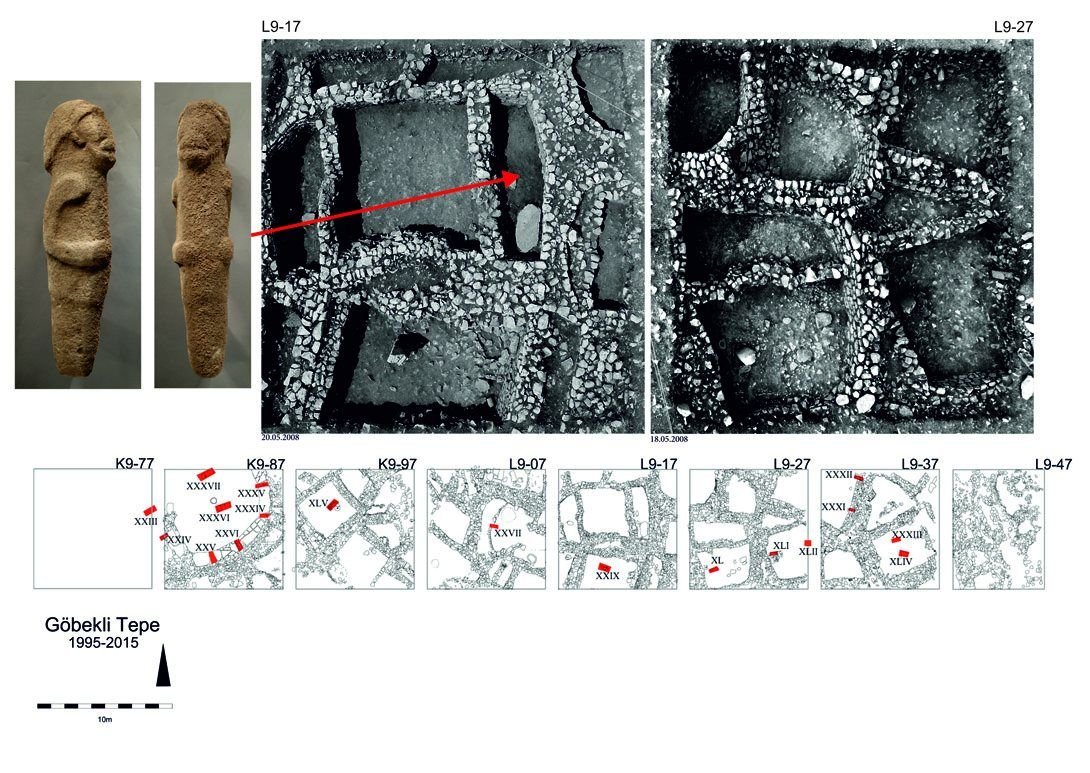
On the south-western hill, in a room with no obvious doorway, excavators found a complete limestone statue of a person — arms bent, hands brought together at the belly, wearing a cap — lying face-down beside a pillar. The room was then filled in and closed.
Nobody knows why. A figure laid deliberately on its face and hidden reads less like display than like burial, or decommissioning — a statue put to rest.
A totem pole, eleven thousand years too early
A nearly two-metre sculpture from Göbekli Tepe stacks figures one above another: a carnivore over a human, with further heads and arms below in low relief. A close cousin was found at nearby Nevalı Çori, where a vulture perches over two humans.
The word 'totem pole' is borrowed and imperfect, but the idea it captures — beings fused and stacked into a single upright monument — is unmistakable, and it appears at more than one Taş Tepeler site.
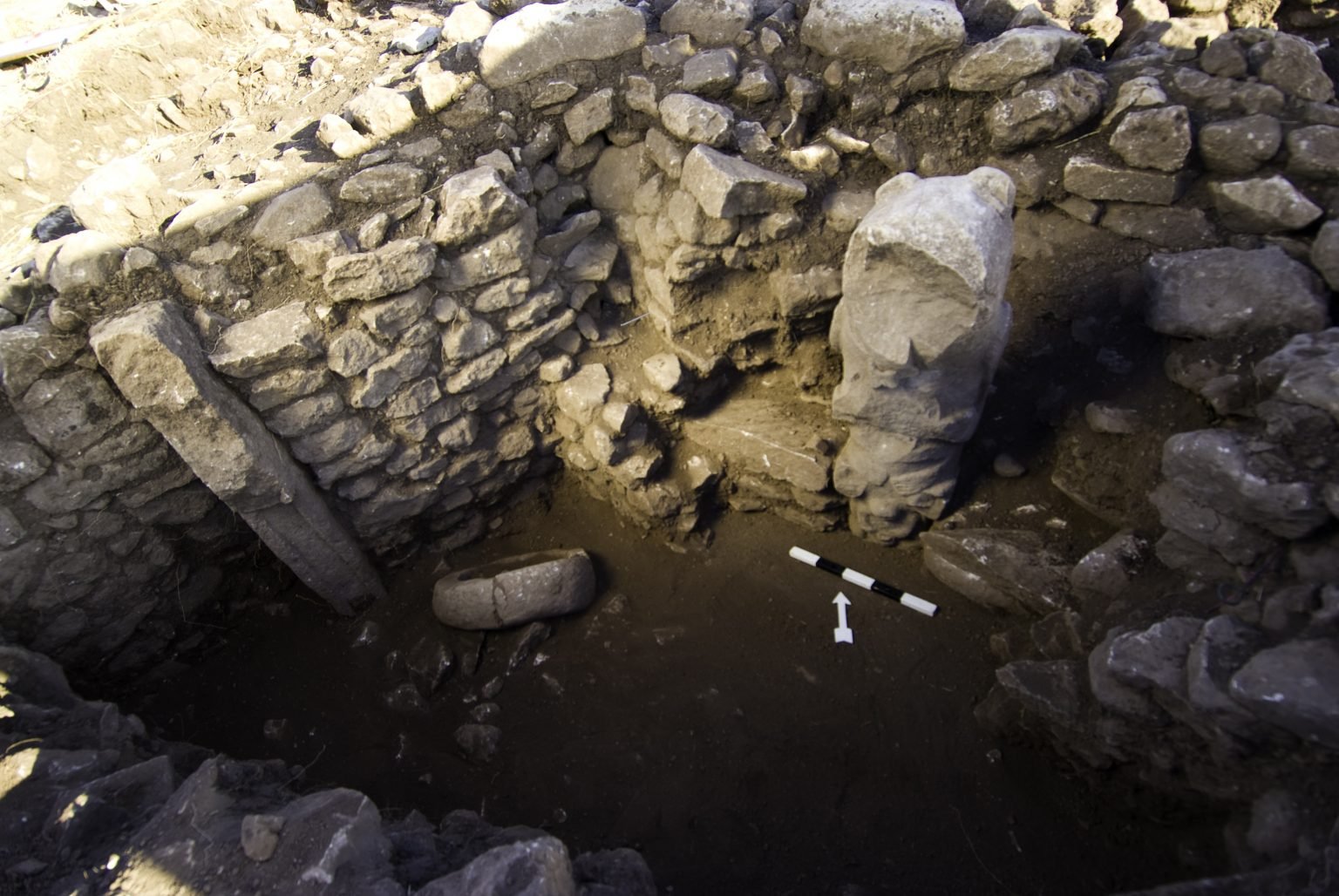
German Archaeological Institute, Göbekli Tepe Project, The Göbekli Tepe 'totem pole', find situation, Copyright: DAI — used with permission, via .
Doorways to nowhere
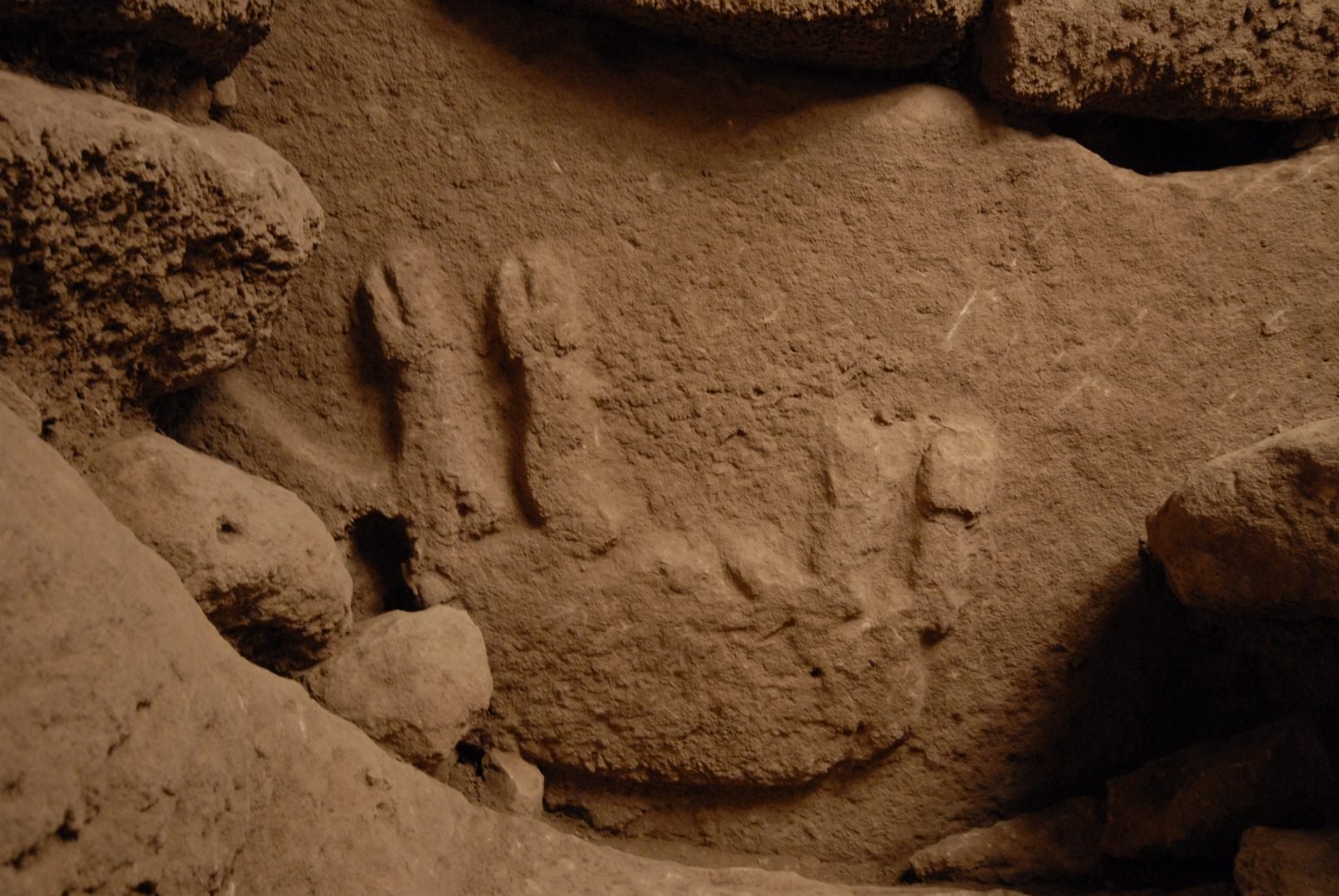
Several sites have porthole stones: thick slabs pierced with a round hole. Some sit in walls like windows between rooms; one at Göbekli Tepe is framed by a carved boar, as if guarded; others are too small to climb through at all. They appear at Göbekli Tepe and at Karahan Tepe.
Passageways, symbolic thresholds, viewing holes for something now gone — their purpose is genuinely unresolved. They are doorways whose destination we have lost.
German Archaeological Institute, Göbekli Tepe Project, Boar relief on a porthole stone, Göbekli Tepe, Copyright: DAI — used with permission, via .
From the newest trenches: a leopard-rider and a stitched mouth
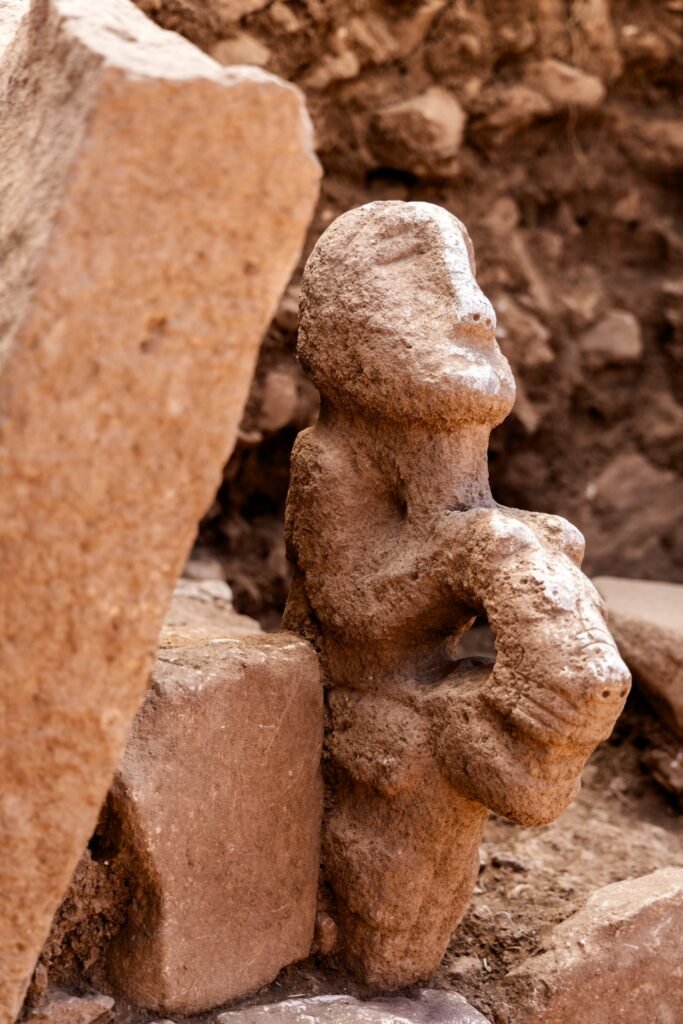
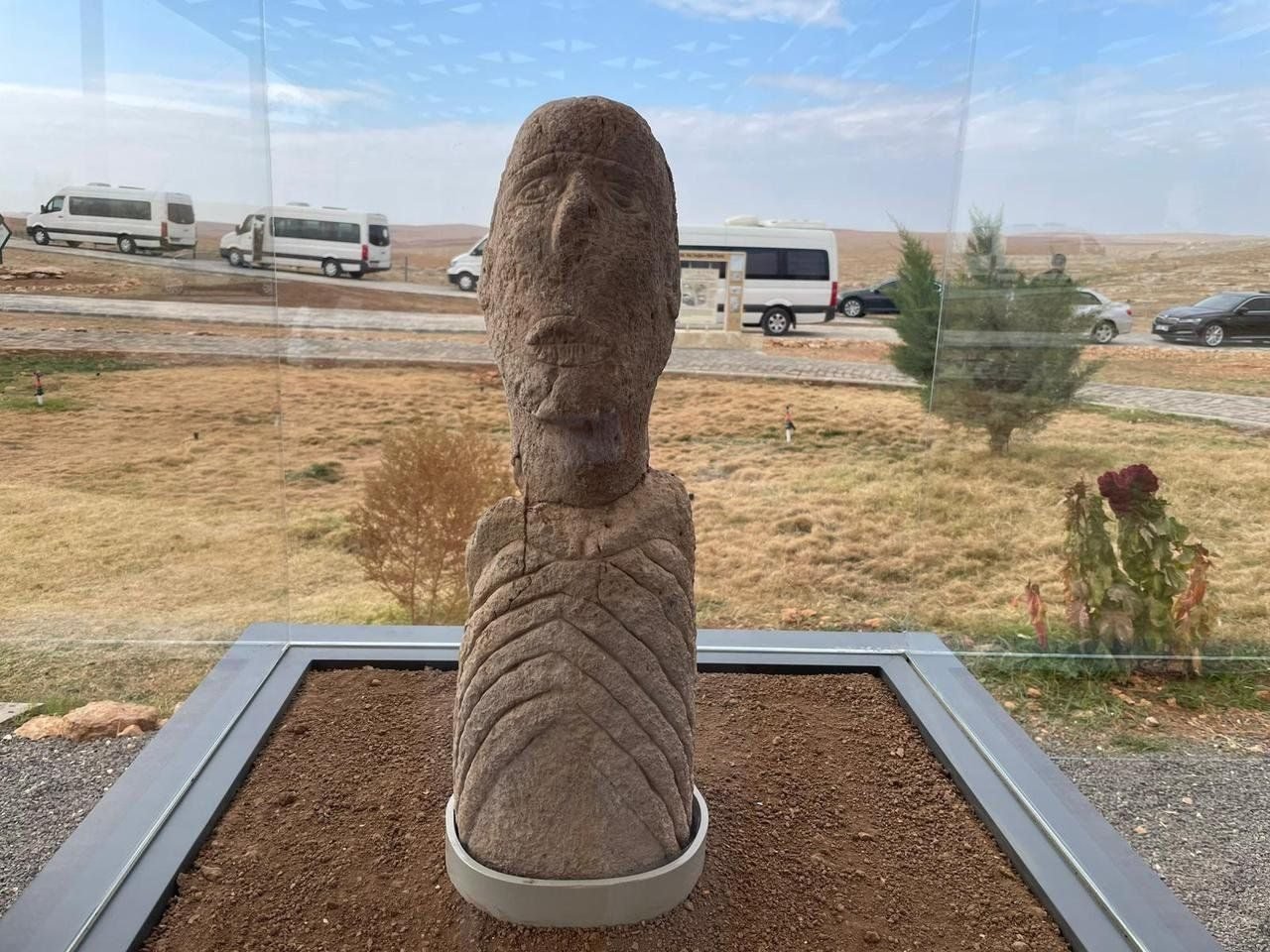
The current seasons keep producing the uncanny. At Karahan Tepe in 2026, a ~70 cm statue of a person seated on the back of a leopard was lifted from its platform — a composition the excavators say has no known parallel, and a reversal of the older regional image of a human carrying a leopard. At Sayburç, a figure has surfaced with its mouth carved as if stitched shut, ribs marked down its body.
Both are extraordinary, and both come with a caveat we will always give you: they are current-season finds, announced by the dig teams and the ministry but not yet formally published. The objects are real; the interpretations, and even some of the measurements, may be refined as the work is written up.
Skulls of another kind: the burnt gazelle deposit
Not all the heads are human. At Çakmaktepe, one of the older sites in the group, excavators have reported a band of more than thirty burnt gazelle skulls, horns still attached, laid deliberately along the outside of a special building, with wild-sheep heads nearby. It looks like a structured deposit — animals' heads placed with the same care given elsewhere to people's.
This one, too, is reported from recent fieldwork rather than a final publication, so we hold it lightly. But it fits a wider Taş Tepeler habit that the finds above keep circling back to: an intense, deliberate concern with heads — human and animal — and with the dead.
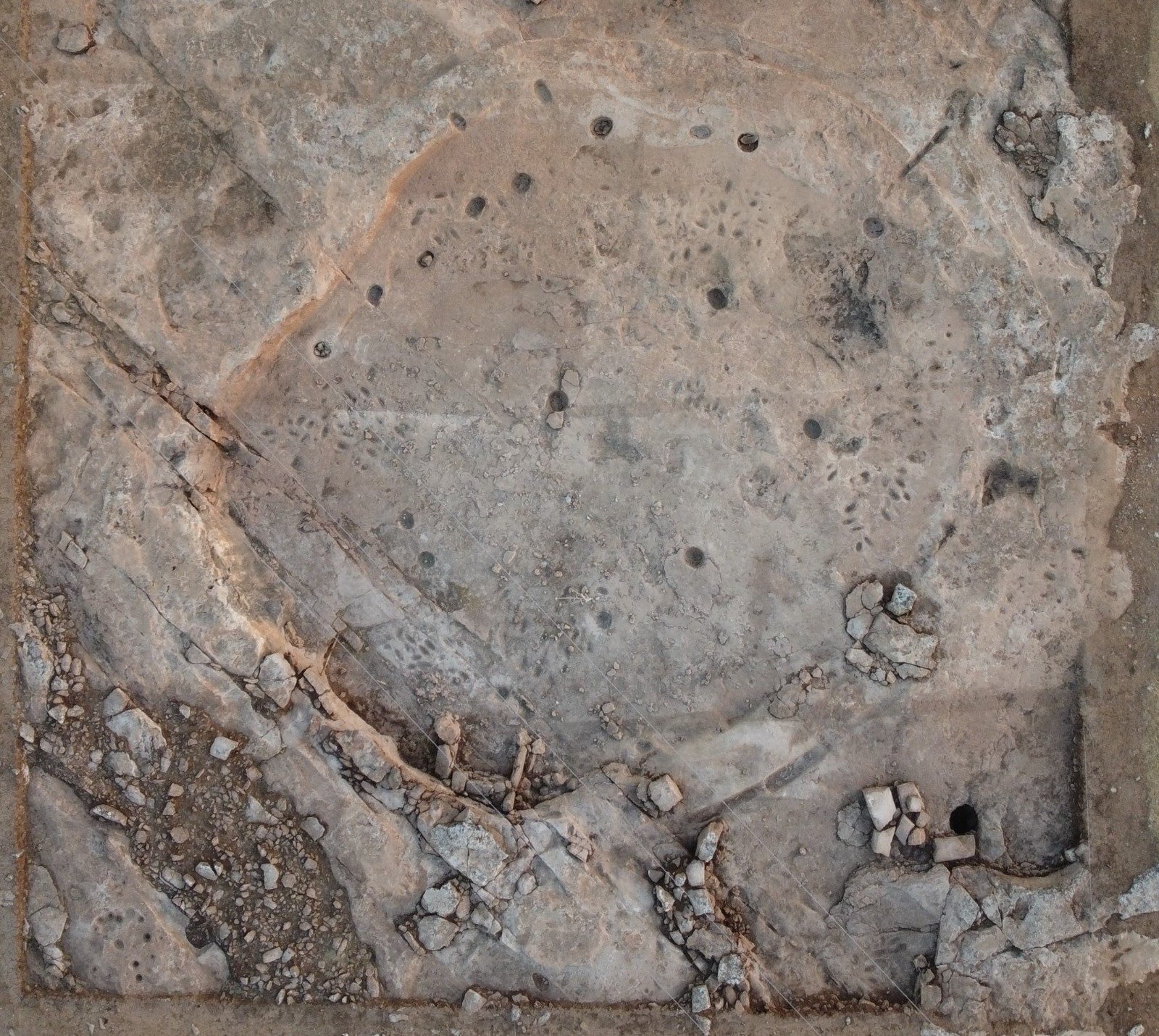
Ödüllü, Cakmaktepe building 10, CC BY-SA 4.0, via Wikimedia Commons.
A story told in three dimensions
At Karahan Tepe, excavators lifted a vessel that turned out to be a container within a container: a larger stone bowl holding a lidded box, and inside it a plate arranged with three miniature carved animals — a fox, a vulture and a wild boar, each only about three and a half centimetres long.
The excavator Necmi Karul has called it, cautiously, something like the earliest story told in three dimensions — a scene deliberately composed and sealed away. The objects are securely recorded; the reading as a 'narrative' is his interpretation, and a lovely one: a tiny theatre of the same animals that dominate the giant pillars, packed into a box and buried.
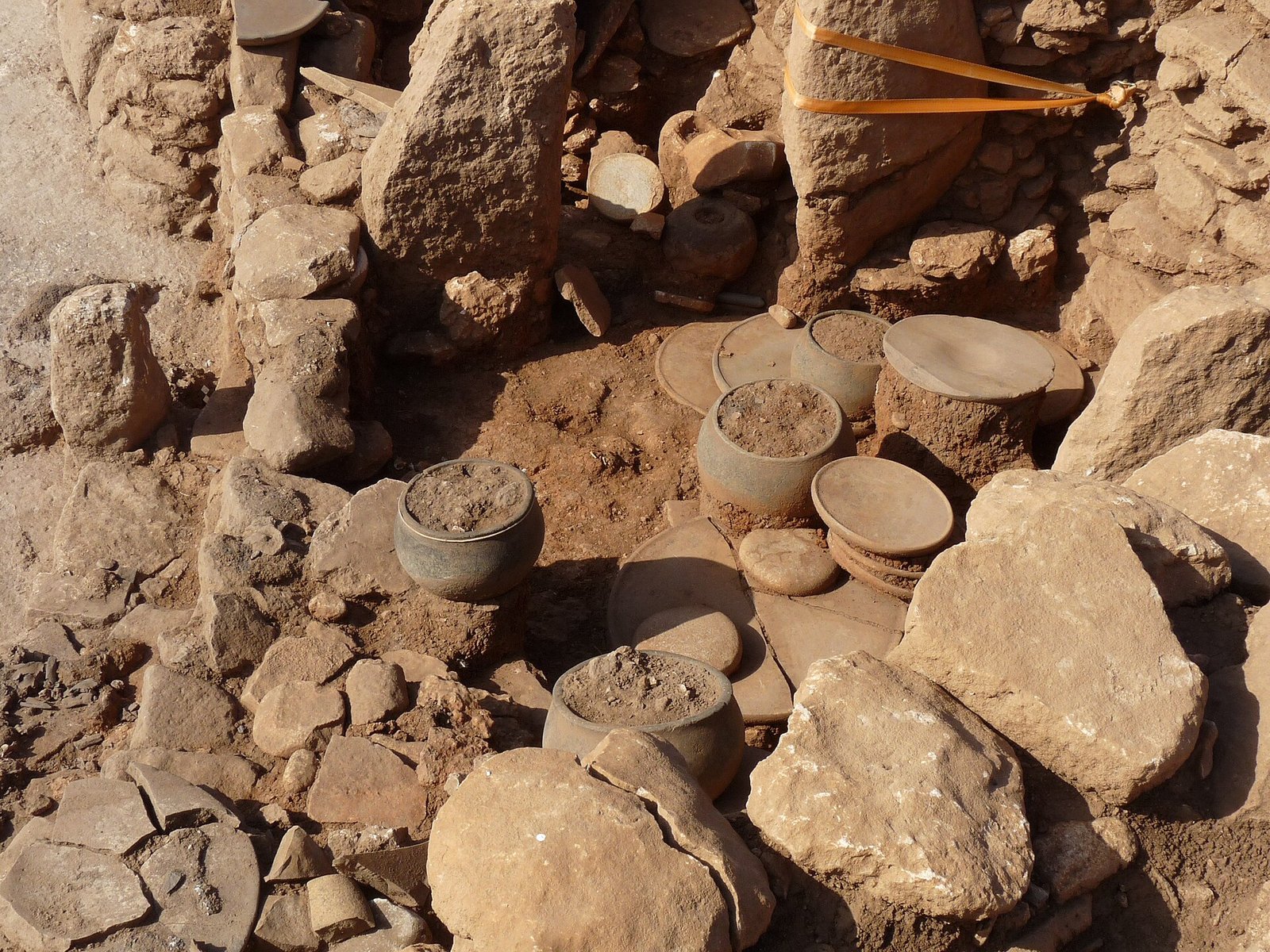
Frantisek Trampota, Karahan Tepe in-situ small stone vessels, Public domain, via Wikimedia Commons.
The ribbed man of Karahan
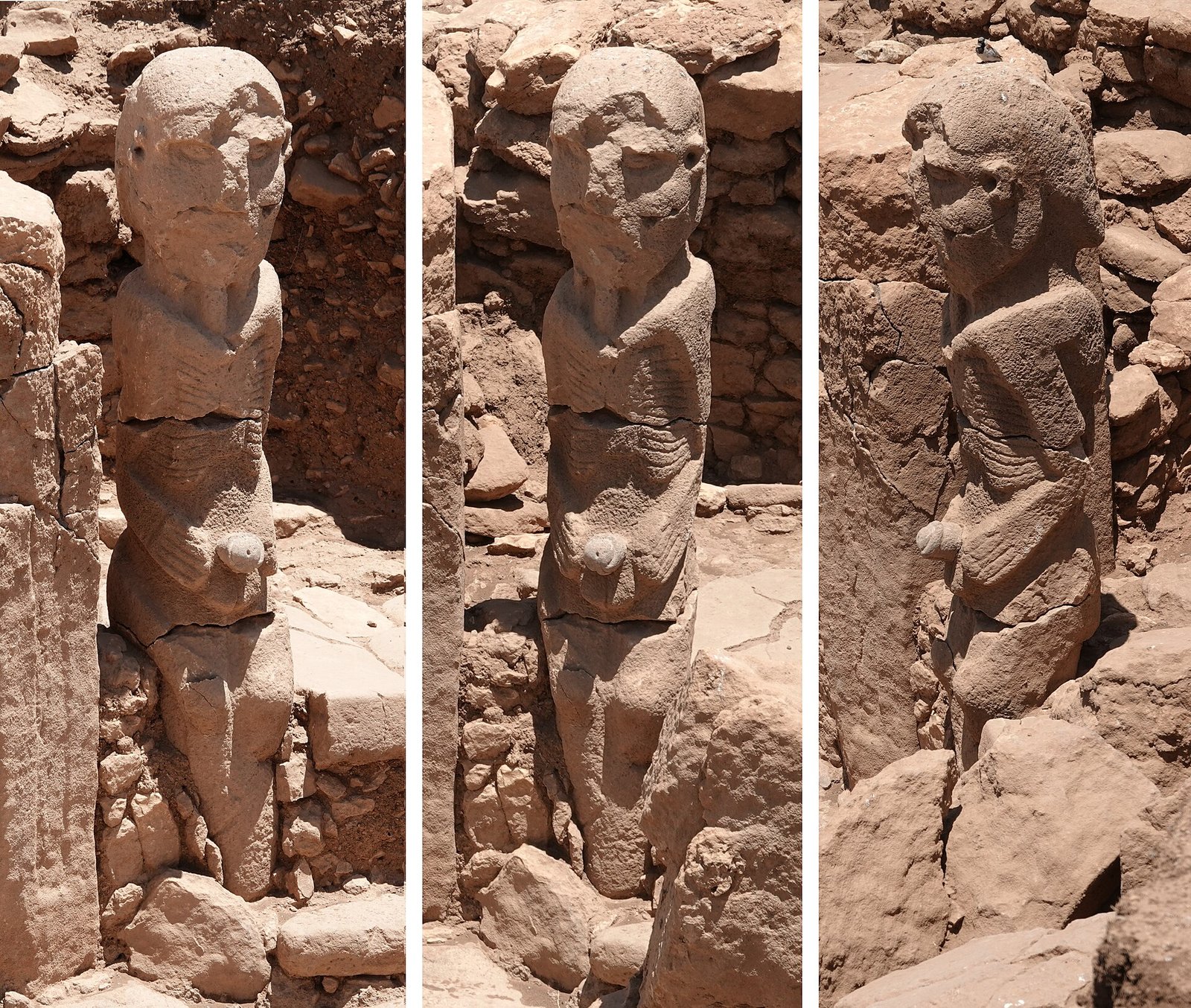
In a bench inside one of Karahan Tepe's buildings sits a 2.3-metre human statue so gaunt its ribs and spine are carved as deep ridges, its genitals emphasised, its expression fixed. A stone vulture was set nearby. Discovered in 2023, it reads as a body caught between death and potency — the skeleton showing through, the phallus pronounced.
It belongs to the same regional family as the Sayburç and Karahan seated figures: naked, frontal, intense. But the visible ribs give it a corpse-like quality the others lack — another of the Taş Tepeler's insistent images of the dead among the living. Like the leopard-rider, its final publication is still to come.
The animal that is everywhere: the fox
Not the lion, not the leopard, but the small, unthreatening fox is the most persistent animal across these sites. It runs along the twin central pillars of Göbekli's Enclosure B, appears on Pillar 2 in Enclosure A, and turns up again at Karahan Tepe. On one central pillar an articulated fox tail — the bones still in order — was found lying at the base, hinting the stone once wore a fox-fur loincloth, or had one laid beside it.
Why a scavenger that lives at the edge of human settlements should be so central — carved again and again, and its tail laid at the foot of a great pillar — is one of the site's quieter mysteries. It is less spectacular than a comet, and far better evidenced.
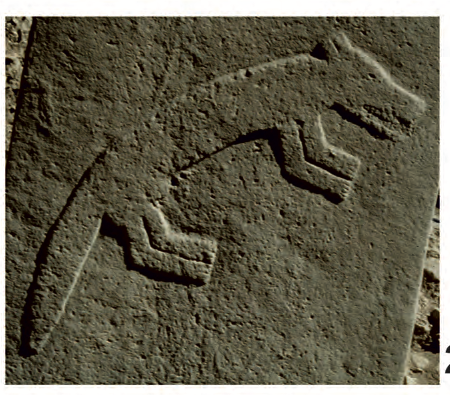
German Archaeological Institute, Göbekli Tepe Project, Fox relief, Pillar 9, Enclosure B, Göbekli Tepe, Copyright: DAI — used with permission, via .
The giant left unfinished in the quarry
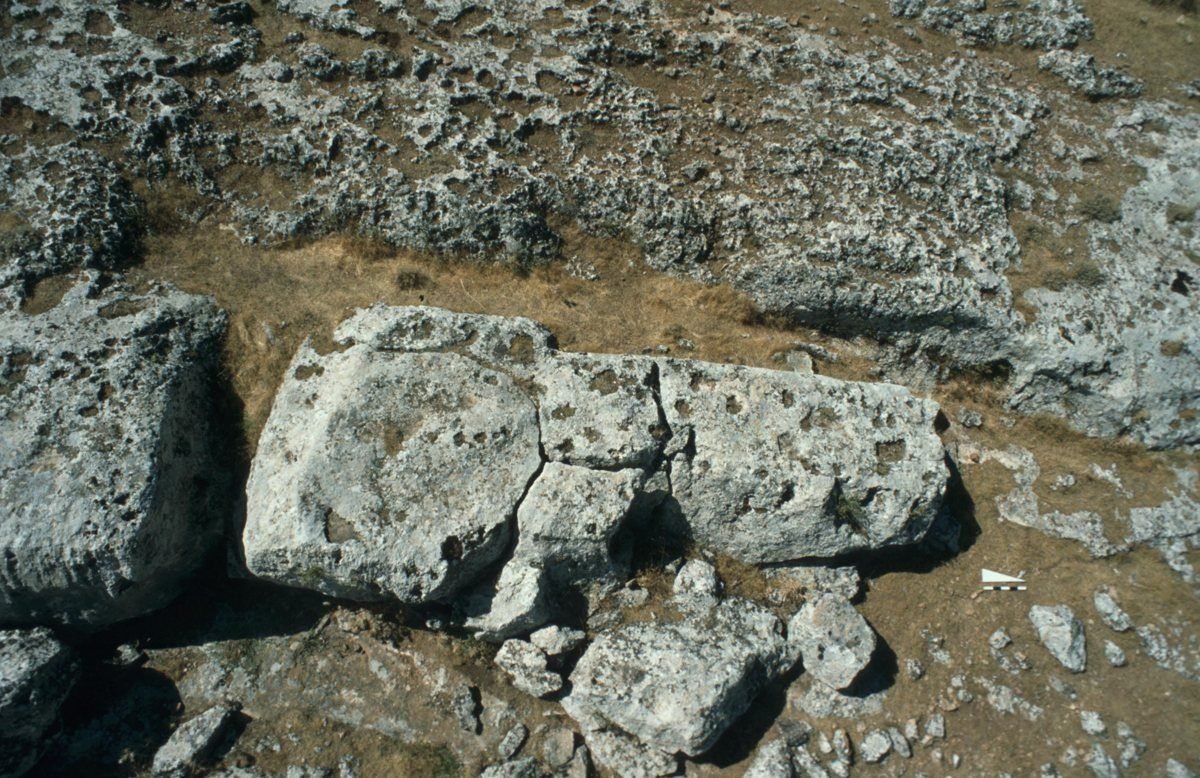
Not every strange thing at Göbekli Tepe was buried. On the limestone plateau around the mound, still lying where it was being cut, is an unfinished T-pillar — one of the largest known, around seven metres long, never separated from the bedrock. You can see the channels where workers were carving it free before, for reasons unknown, they stopped and walked away.
It is a strangely human thing to find: an abandoned project, frozen mid-task, eleven thousand years ago. It also answers a practical question the finished monuments raise — where did the stones come from? — with startling directness. They were quarried on the spot, by hand, with stone tools, and moved into place by people who had not yet invented the wheel or tamed a single draft animal.
One stone, fifty-five animals
Everyone who reads about Göbekli Tepe knows the Vulture Stone. Almost nobody knows Pillar 56, in Enclosure H — and it may be the single busiest carving at the whole site. One broad face carries fifty-five separate animals, packed edge to edge: snakes, birds and quadrupeds crammed together with almost no blank stone left between them. Along its narrow front, a bull's head is clamped between two snakes.
It is a different order of density from the famous pillars, and it quietly undercuts the idea that any single stone is a special 'message' waiting to be decoded. Fifty-five animals on one face is not a cipher; it is a whole teeming world, carved into limestone by people who had the time and the will to fill every inch of it.
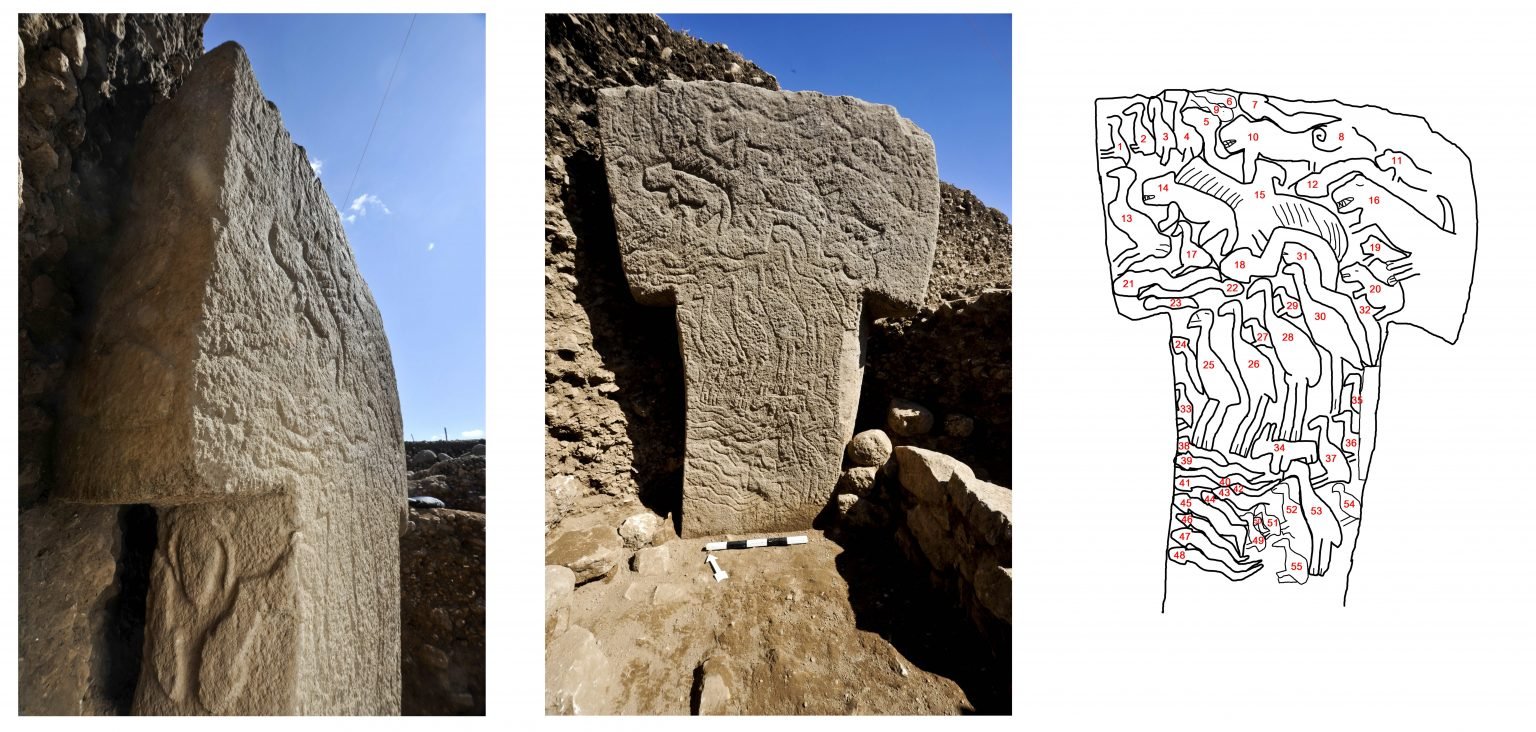
German Archaeological Institute, Göbekli Tepe Project, Pillar 56, Enclosure H, Göbekli Tepe, Copyright: DAI — used with permission, via .
A floor set with the parts of predators
At Karahan Tepe, the excavation led by Necmi Karul — the head of the Taş Tepeler project — reports something genuinely macabre worked into the fabric of a building: a deposit of selected animal parts, placed with striking care. Among them are wolf jaws, leopard bones, vulture remains, a fox pelt, and bull horns and skulls set into a floor.
These are not the bones of dinner. They are the dangerous animals — the killers — chosen and built into the space where people gathered: heads, jaws and horns laid into the ground underfoot. It is a current-season find and its full meaning is still the excavators' to work out, but a floor set with the jaws of wolves and the horns of wild bulls is exactly the sort of thing no visitor imagines when they picture the Stone Age.
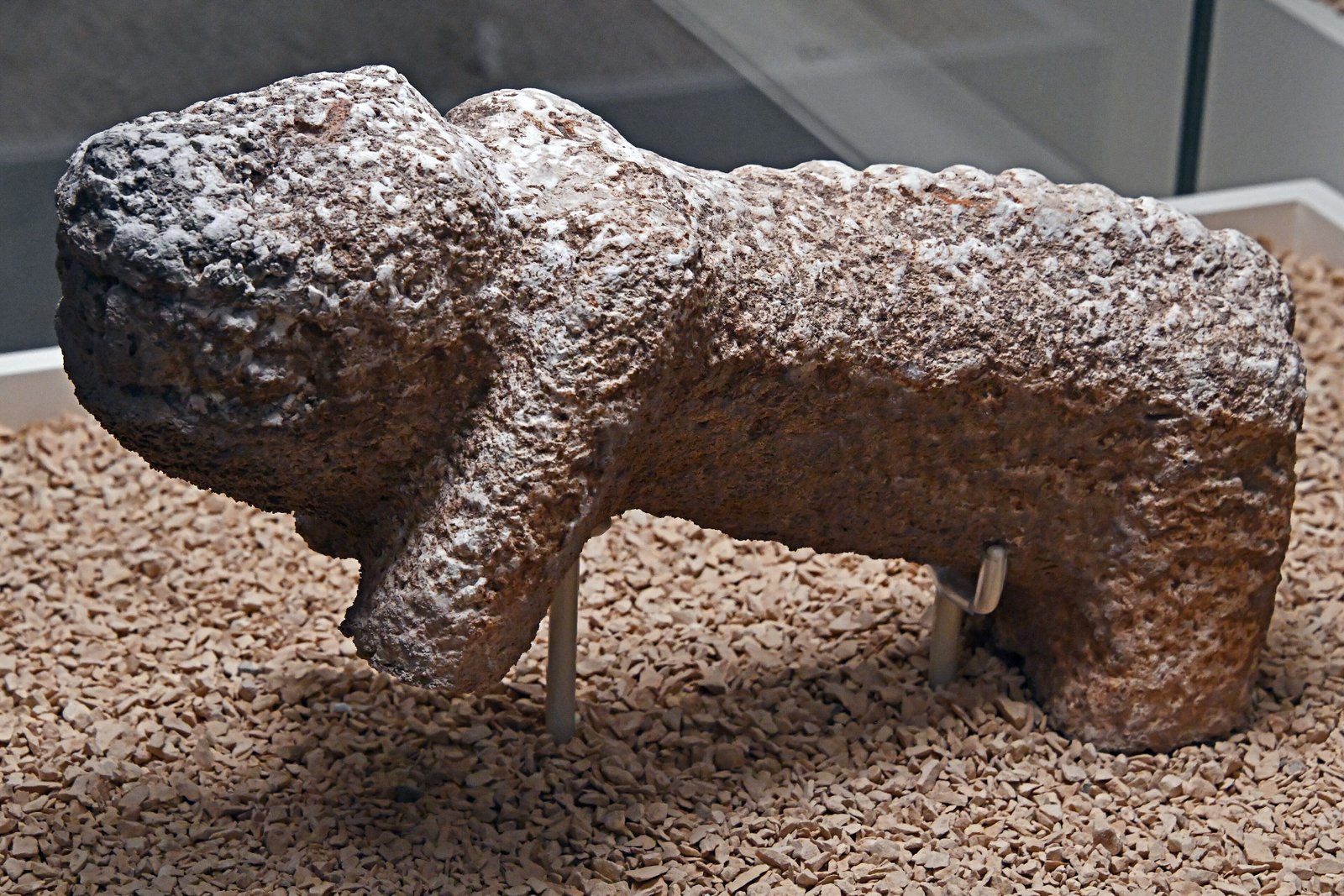
Dosseman, Urfa museum Karahantepe Statue of leopard Neolithic age in 2024 7304, CC BY-SA 4.0, via Wikimedia Commons.
Masks for faces we will never see
Among the sculptures at Göbekli Tepe are stone masks — some miniature, at least one larger than life — several of them deliberately deposited beside the central pillars when a building was backfilled and closed. A mask is a strange thing to carve in stone: heavy, hard to wear, useless as a disguise.
The likeliest reading is that these stone masks are copies of real ones — masks of wood, hide or basketry that were actually worn in performance and have long since rotted away. If so, they are the fossil shadow of Neolithic theatre: the durable echo of costumes and rituals we can otherwise only guess at. It is the same logic as the human-legged cranes carved on the pillars, often read as masked dancers imitating the birds.
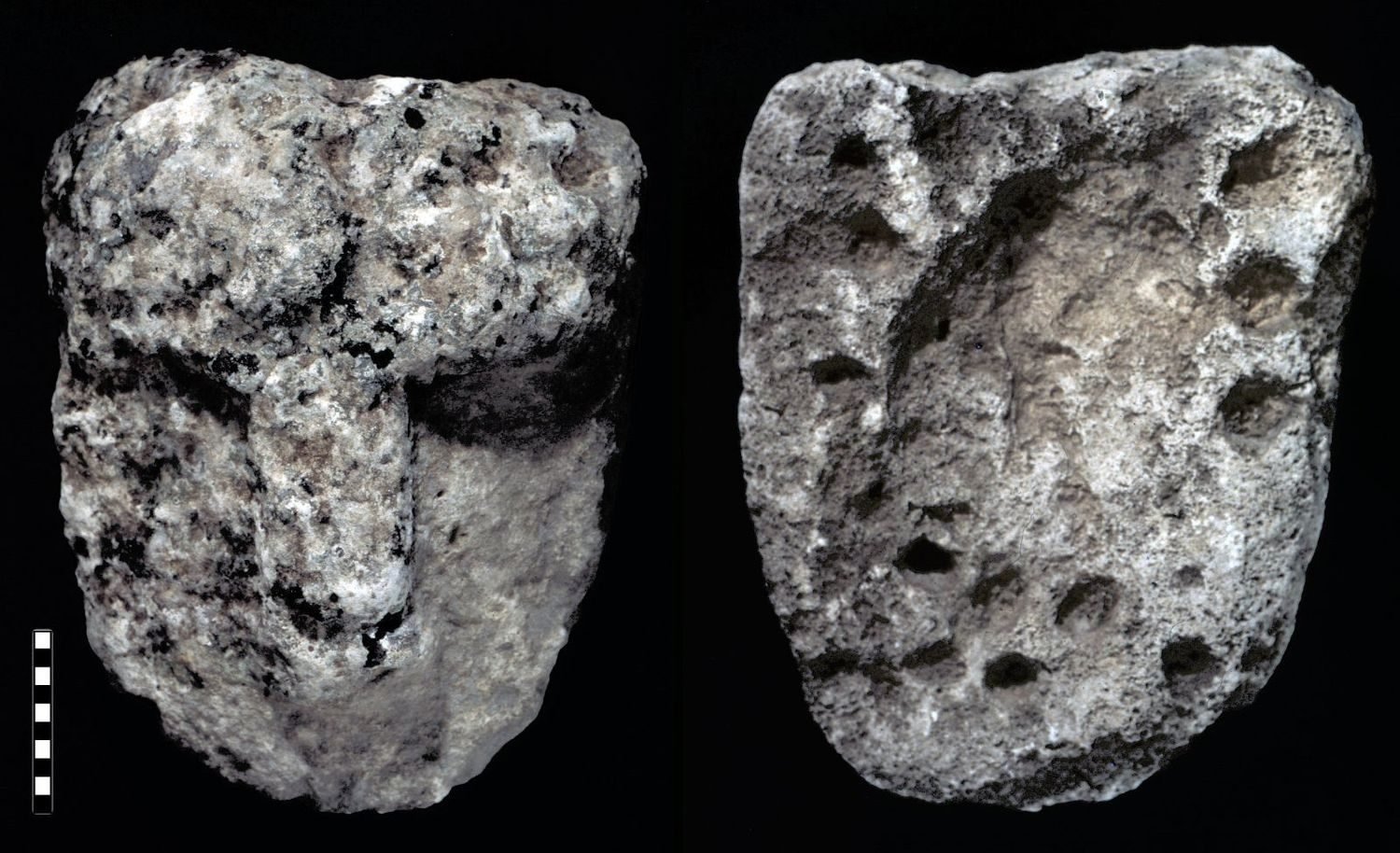
A statue that kept its paint
For most of the last century everyone assumed the Neolithic carvings were bare grey stone. Then, in 2023, a life-size wild boar — about 1.35 metres of limestone, set on a decorated bench between two pillars in Göbekli Tepe's Building D — came out of the ground still wearing its original paint: red on the tongue, black and white on the body.
It is the first painted Neolithic statue known, and it quietly rewrites how you should picture the whole site. The great enclosures were not the austere grey ruins we see today. They were coloured — pillars and animals picked out in red, black and white, lit by fire. We have been looking at a bleached skeleton of something that was once vivid.
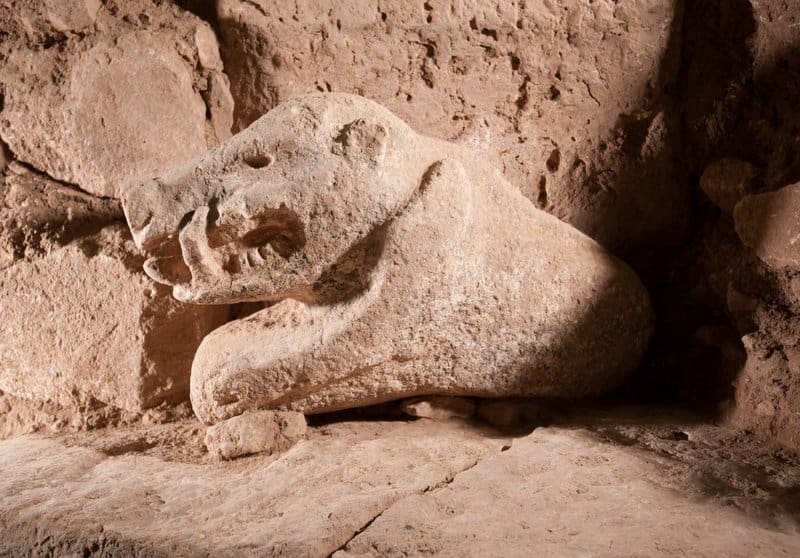
German Archaeological Institute, Göbekli Tepe Project, Limestone boar statue, Göbekli Tepe, Copyright: DAI — used with permission, via .
Vats for the oldest party
Among the finds at Göbekli Tepe are six enormous limestone tubs, the biggest holding around 160 litres — barrel-sized stone vessels, some lined with a grey-black crust. When the excavators tested that residue, it came back partly positive for calcium oxalate, a chemical that forms when cereal grains are steeped, malted and left to ferment.
In other words, these may be vats for the world's oldest beer — brewed not to get drunk at dinner but for the great communal feasts that drew people to the hill. It is deliberately held as a cautious reading: oxalate is only a proxy, and the excavators call it preliminary. But a Stone-Age site with 160-litre fermentation tubs is a strange and wonderful thing to stand next to.
And it reframes the strangeness of everything else. A drilled skull, a painted boar, a 160-litre stone tub: these are not random curiosities but pieces of the same event — scattered groups gathering on a hill to build, carve, eat, drink and bury their dead, at the very moment human beings first learned to gather at all.
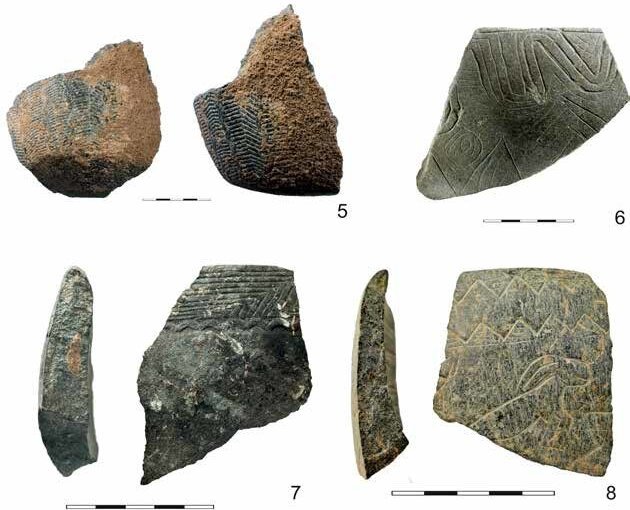
German Archaeological Institute, N. Becker, O. Dietrich, I. Wagner N., K. Schmidt, Greenstone-vessels-from-Goebekli-Tepe-shapes-graphics-L-Dietrich-photos-German (cropped), CC BY 4.0, via Wikimedia Commons.
What is uncertain
The honest divide here is between the published and the preliminary. The aurochs bone, the carved skulls, the severed-head slab, the face-down statue, the totem pole, the masks, Pillar 56, the boar-at-its-meal and the painted boar are documented in peer-reviewed papers and the excavators' own reports — solid ground. The leopard-rider, the ribbed man, the nested vessel, the stitched-mouth figure, the predator-part floor and the gazelle-skull deposit come from recent or current seasons — reported by the excavation teams but not yet in a formal publication; the finds are real, but figures and readings may be refined. The 'beer' is a real find (the vats and the oxalate residue) with a contested interpretation — flagged as such above.
And with every one of these, there is a second kind of uncertainty: we can describe what was found far better than why it was made. A drilled skull, a hidden statue, a guarded doorway — the objects are vivid and the meanings are open. That gap is not a weakness of the archaeology. It is the honest edge of what the Taş Tepeler will tell us, so far.
Common questions
What is the strangest thing found at Göbekli Tepe? Strong candidates are the three human skulls deliberately carved with grooves and drilled to be displayed (the oldest evidence of its kind), and an aurochs bone with a hunter's flint still embedded in it.
Are these finds real or theories? Real. Every object here is an excavated find. The published ones (skulls, aurochs bone, face-down statue, totem pole) are solid; a few of the newest (the Karahan leopard-rider, the Sayburç stitched-mouth figure, the Çakmaktepe gazelle skulls) are preliminary, from current seasons.
Why are there so many heads and skulls? The Taş Tepeler sites show a repeated, deliberate concern with the human head and with the dead — carved skulls, detached heads set against pillars, headless figures in the art. It is one of the defining features of this Neolithic world, though its exact meaning is still debated.
Key takeaways
- The real Taş Tepeler finds outshine the myths: an aurochs bone with the hunter's flint still inside, three human skulls carved and drilled to be hung, a statue buried face-down in a sealed room.
- A recurring thread runs through them — an intense, deliberate concern with heads and the dead, human and animal.
- The published finds (Gresky et al. 2017 and the excavators' reports) are solid; the newest — the Karahan leopard-rider, the Sayburç stitched-mouth figure, the Çakmaktepe gazelle skulls — are flagged as preliminary, pending formal publication.
- For almost all of them, we can describe what was found far better than why — and that open edge is the honest state of the research.
Sources
- Gresky, J., Haelm, J. & Clare, L. (2017). Modified human crania from Göbekli Tepe (skull cult). *Science Advances*
- Dietrich, O. (2018). On the hunt 12,000 years ago: an aurochs bone with hunting lesion. Tepe Telegrams (DAI)
- Göbekli Tepe Research Project (DAI). The 'totem pole', the face-down statue, and Pillar 18's severed-head slab — Tepe Telegrams (2017)
- Anatolian Archaeology (2026). 11,000-year-old statue of a human on a leopard, Karahan Tepe
- Türkiye Today (2025). Gazelle skulls reveal prehistoric rituals at Çakmaktepe
- German Archaeological Institute (2023). Life-size painted wild boar statue from Göbekli Tepe, Building D
- Dietrich, O. et al. (2012). The role of cult and feasting in the emergence of Neolithic communities (Göbekli Tepe 'beer' vats). *Antiquity* / Tepe Telegrams
This article is written from the primary literature and excavators' reports cited above. Interpretations are attributed; uncertainties are stated in the text.