Göbekli Tepe's giants, shrunk to the hand
The Taş Tepeler — the cluster of early Neolithic sites around Şanlıurfa in south-eastern Türkiye — are famous for scale: T-shaped pillars weighing several tonnes, raised in rings inside stone enclosures at Göbekli Tepe, Karahan Tepe, Sayburç and their neighbours, some 11,000 years ago. What is far less known is that the same world also produced the opposite of monumental: hand-sized T-pillars, carved in the same limestone, that shrink the giant down to the palm.
The clearest evidence sits in one display case. The Şanlıurfa Archaeology Museum holds four miniature T-pillars from Göbekli Tepe and Nevalı Çori, catalogued and measured, from a near-forearm-length block down to a pebble. This post is about that finding — what a miniature T-pillar is, the four museum examples, and why the question of their purpose is still open. (For the wider habit of Neolithic model-making, of which these are one striking strand, see our learn page Miniature architecture in the Neolithic, linked below.)
What a T-pillar actually is
To see why a miniature matters, you have to know what the full-size T-pillar is. It is not simply an abstract marker. The excavators of Göbekli Tepe, beginning with Klaus Schmidt, read the T-shape as a stylised human body seen from the side — the broad horizontal 'head' is literally a head, and the tall shaft is the torso. On the richest examples this is explicit: pillars carry arms bent down the sides of the shaft, hands brought together low on the 'belly', and a belt with a hanging animal-skin or fox-pelt loincloth carved in low relief. The central pillars of the great enclosures are, on this reading, towering anthropomorphic beings.
That is the point of the miniature. A hand-sized T-pillar is not just a small stone cut in a distinctive shape; it is a pocket-sized version of the same 'being' that stands three or four metres tall in the enclosure. Whatever power or identity the monument embodied, the miniature carries it in a form you can close a hand around. (The anthropomorphic reading is the DAI team's interpretation — set out across the project's Tepe Telegrams and Schmidt's own writing — and it is the mainstream view, though how literally to take the 'being' remains a matter of scholarly debate.)
They raised stones as tall as a house, and then they carved the same stone small enough to close a hand around. The reason is one of the Neolithic's quietest unsolved puzzles.
Not unique to Göbekli Tepe — a whole region of T-pillars
The monumental T-pillar is not a one-site phenomenon. It is the shared architectural idiom of a whole cluster of Urfa-region Neolithic sites. Besides Göbekli Tepe, T-shaped pillars (standing, fallen, or reused in later walls) have been recorded at Nevalı Çori, Sefer Tepe, Karahan Tepe, Hamzan Tepe, Harbetsuvan Tepesi, Taşlı Tepe, Urfa-Yeni Yol, Gusir Höyük and others — the DAI's own 2016 survey of "the current distribution of sites with T-shaped pillars" lists a growing roster across the plain, and later reviews of Göbekli Tepe and the sites around the Urfa plain have extended it further.
This is the backdrop that makes the miniatures legible. The small T-pillars are not local curiosities echoing a single building; they are portable versions of a monumental idiom shared across an entire landscape of related communities. The same 'being-in-stone' was raised at scale on hill after hill — and, somewhere in that same world, shrunk to the size of a hand.
The four in the Şanlıurfa Museum
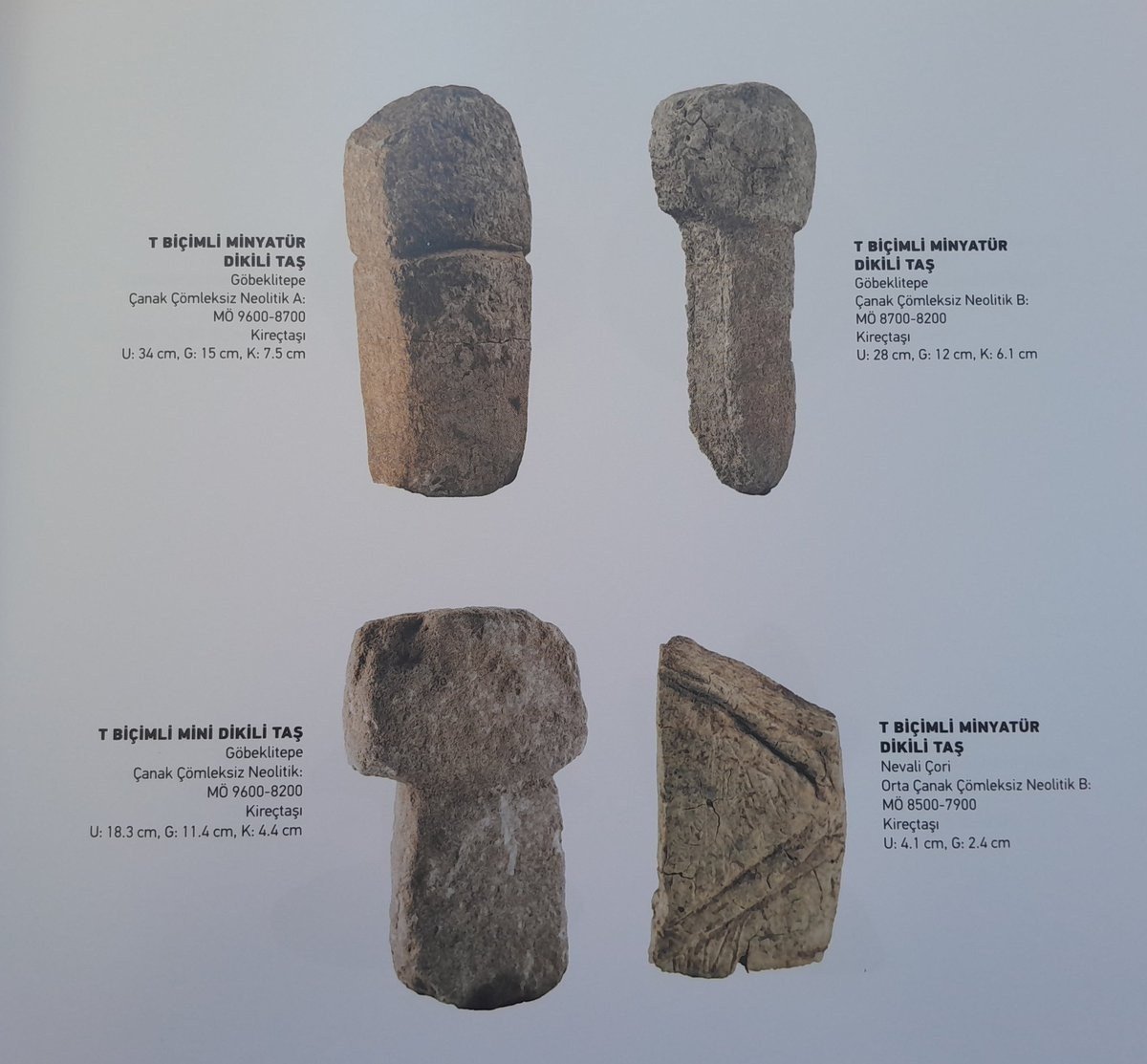
The clearest case is the miniature T-pillar: a small, free-standing stone cut to the same unmistakable T-profile as the monuments — a wide 'head' set across an upright 'body' — but sized to sit in the palm. The Şanlıurfa Archaeology Museum displays four of them together, all in limestone (Kireçtaşı), the same rock the great pillars are quarried from. According to the museum's own labels, they are:
• Göbekli Tepe, PPNA (Çanak Çömleksiz Neolitik A, c. 9600–8700 BCE) — 34 × 15 × 7.5 cm; • Göbekli Tepe, PPNB (c. 8700–8200 BCE) — 28 × 12 × 6.1 cm; • Göbekli Tepe, PPN (c. 9600–8200 BCE) — 18.3 × 11.4 × 4.4 cm; • Nevalı Çori, Middle PPNB (c. 8500–7900 BCE) — just 4.1 × 2.4 cm, small enough to lose in a pocket.
The range matters. These are not one freak object but a recurring form, made across several centuries and at more than one site, from a near-forearm-length block down to a pebble. Whatever a miniature T-pillar was for, it was a thing people made again and again — a small echo of the monument that defines the whole culture.
The companions — in brief
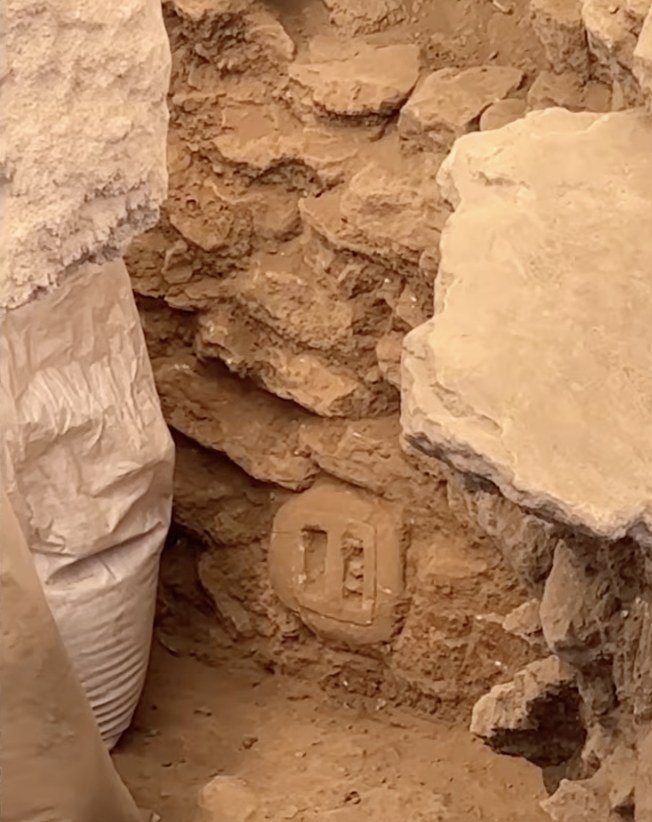
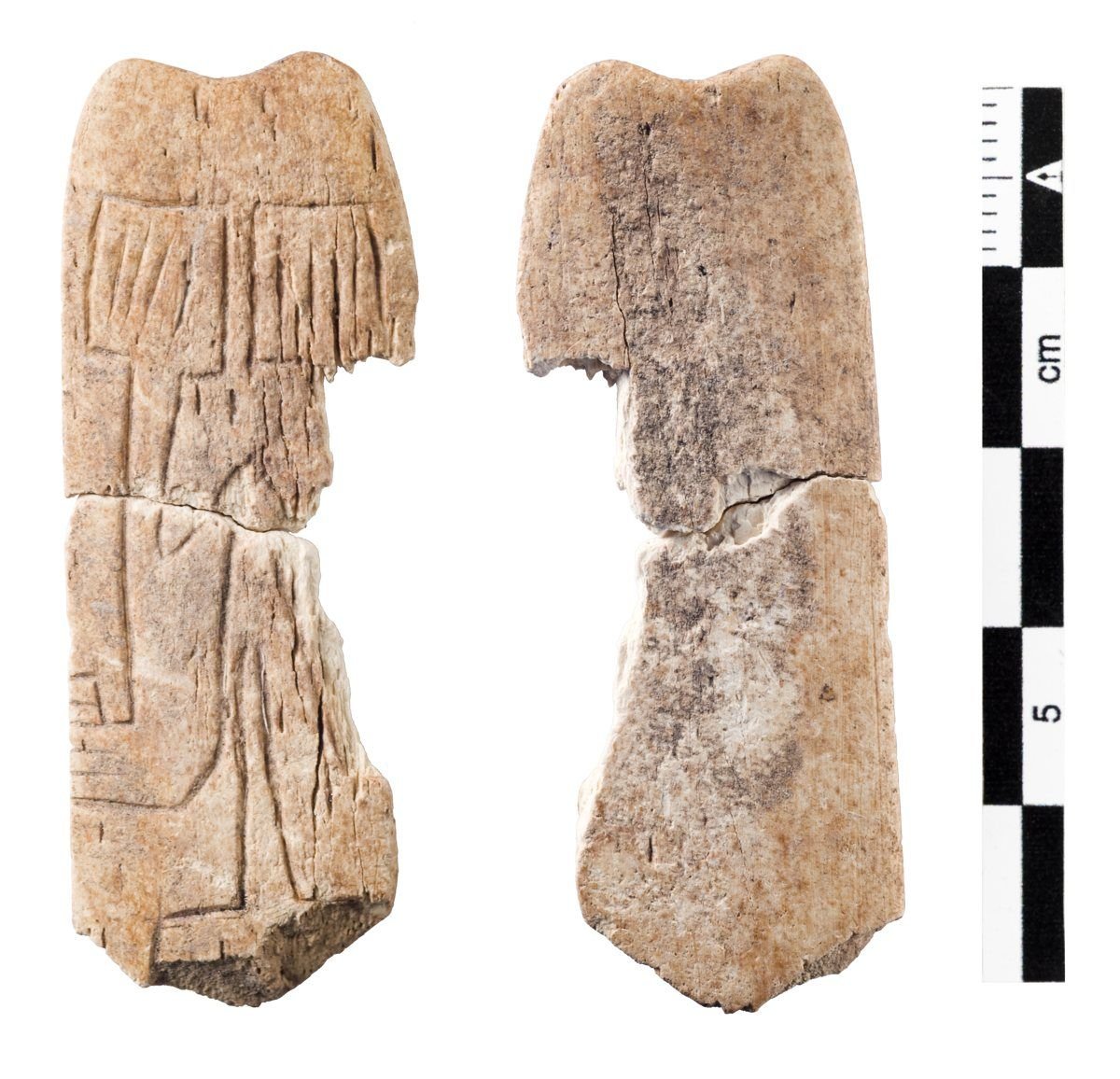
The mini T-pillars do not stand alone. The same world shrank other pieces of its architecture too: a miniature porthole stone recorded in situ at Sayburç reproduces, in the palm, the big pierced threshold slabs of the monumental buildings; a worn, decorated bone 'spatula' from Göbekli Tepe may carry an abbreviated two-dimensional drawing of the enclosure's own T-pillars (a tentative reading by Dietrich and Notroff); and, in the neighbouring Diyarbakır region, the small house models of Çayönü — the most complete reported in 2025 as the world's oldest architectural model — show the same impulse aimed at an ordinary building.
Each of these belongs to a much wider Neolithic habit of making small versions of architecture, which we trace in full — the clay house models of southeast Europe, the Çayönü models, and how the Taş Tepeler fit in — on our learn page Miniature architecture in the Neolithic (linked below). Here they matter simply as company: the mini T-pillars are one member of a small family of shrunken monuments.
Why make them? What is uncertain
This is where honesty matters most. The objects are secure — the four mini T-pillars are catalogued and measured in the Şanlıurfa Museum. But why anyone made a monument in miniature is genuinely unresolved. Every possibility is interpretation, not fact: they may have been design or teaching aids, portable cult objects or amulets carrying the power of the 'being' a T-pillar embodies, tokens of belonging or identity, votive or grave goods, or the practice-pieces of apprentice carvers (or even things made by and for children). We honestly cannot choose between them.
And it is not only a Taş Tepeler habit: the impulse to shrink architecture recurs across the Neolithic world, and a single object could have shifted role across its life, so no one explanation need cover every case. We set out these competing readings in full on our learn page Miniature architecture in the Neolithic (linked below). The plain state of the evidence is that the Taş Tepeler shrank their own monuments, repeatedly and deliberately — and that we can describe the objects far better than we can explain them. That open edge is the honest answer.
Common questions
Did the Taş Tepeler really make miniature T-pillars? Yes. The Şanlıurfa Archaeology Museum displays four hand-sized T-shaped standing stones in limestone, from Göbekli Tepe and Nevalı Çori, ranging from about 34 cm down to roughly 4 cm.
What is a T-pillar, and why does a tiny one matter? The T-pillar is read by its excavators as a stylised human body — a 'being' in stone. A hand-sized one is therefore a pocket-sized version of the same being that stands three or four metres tall in the enclosures.
Why did they make them? Nobody knows for sure. Suggestions range from design and teaching models to charms, tokens, ritual deposits, or practice pieces — all interpretation, not established fact. We weigh the readings, and the wider Neolithic habit of model-making, on our miniature-architecture learn page (linked below).
Key takeaways
- A T-pillar is a stylised human body in stone — so a hand-sized one is a pocket version of the same 'being' the monuments embody.
- The Şanlıurfa Museum holds four catalogued mini T-pillars from ~34 cm down to ~4 cm, from Göbekli Tepe and Nevalı Çori, spanning the PPNA–PPNB.
- Monumental T-pillars occur across the Urfa-region Neolithic, so the miniatures echo a shared architectural idiom, not a single building.
- They have companions — a miniature porthole at Sayburç, a possibly-carved bone, the Çayönü house models — all part of a wider habit set out on our miniature-architecture learn page.
- Why they were made is genuinely open: design aids, charms, tokens, ritual objects or apprentice pieces are all possibilities, none proven.
Sources
- Şanlıurfa Archaeology Museum — object labels for the miniature T-shaped standing stones (Göbekli Tepe and Nevalı Çori), with dimensions and periods
- Arkeonews (2025). World's Oldest Architectural House Model from 12,000-Year-Old Çayönü Hill Now on Display in Türkiye (Diyarbakır Museum; 17 house models; excavations led by Assoc. Prof. Savaş Sarıaltun)
- Dietrich, O. & Notroff, J. (2016). A decorated bone 'spatula' from Göbekli Tepe — a possible depiction of the T-pillars. Neo-Lithics 1/16; see DAI Tepe Telegrams
- German Archaeological Institute (DAI) — Göbekli Tepe Research Project (porthole stones and the monumental enclosures)
- Sayburç excavations / Arkeolojihaber — a miniature porthole stone recorded in situ at Sayburç
- DAI Göbekli Tepe Project — Tepe Telegrams, "The current distribution of sites with T-shaped pillars" (2016): the spread of monumental T-pillars across the Urfa-region Neolithic (Nevalı Çori, Sefer Tepe, Karahan Tepe, Hamzan Tepe, Harbetsuvan, Taşlı Tepe, Urfa-Yeni Yol, Gusir Höyük and more)
- DAI Göbekli Tepe Project — Tepe Telegrams / K. Schmidt: the T-pillar read as an abstract human body, with arms, hands, belt and loincloth in low relief on the richest examples
- "Göbekli Tepe and the Sites around the Urfa Plain: Recent Discoveries and New Interpretations" — regional review of the T-pillar sites and their shared monumental idiom
- Banning, E. B. (2011). "So Fair a House: Göbekli Tepe and the Identification of Temples in the Pre-Pottery Neolithic of the Near East." Current Anthropology 52(5): the temple-vs-house debate, and stelae as images of ancestors or gods
This article is written from the primary literature and excavators' reports cited above. Interpretations are attributed; uncertainties are stated in the text.