Klaus Schmidt1953–2014
The man who understood Göbekli Tepe
Others had seen the hill. A 1960s survey walked over it and read its broken limestone as a medieval cemetery. It was Klaus Schmidt who, in 1994, looked at the same flint and worked stone and understood what they were — and who then gave the rest of his life to it.
From 1995 until his death he directed the excavations at Göbekli Tepe, and in doing so overturned one of archaeology's oldest assumptions: that monuments needed farming, and farming needed cities. His hill proved that hunter-gatherers built the first temples first. He wrote the foundational book on the site, argued its case to a sceptical field, and lived to see it recognised — the UNESCO World Heritage listing he had worked toward came in 2018, four years after he was gone.
He died of a heart attack on 20 July 2014, aged 60, on holiday in Germany. Everyone working in these hills today is, in some sense, working in his footprints.
In memoriam — Tepe Telegrams (DAI) →Klaus Schmidt — Wikipedia →
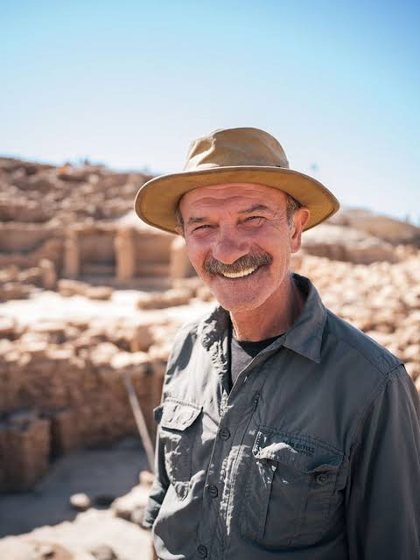
Necmi Karul
Coordinator of the whole Taş Tepeler programme; director at Karahan Tepe
If Schmidt made Göbekli Tepe famous, Necmi Karul is the one turning it into a landscape. As head of Istanbul University's Department of Prehistoric Archaeology, he coordinates the twelve-site Taş Tepeler programme and directs the dig at Karahan Tepe.
It is his fieldwork — the pillar rooms cut into bedrock, the carved head in the wall, the little sealed scene of a fox, a vulture and a boar — that keeps rewriting the story season after season. And it is his line that best sums up what the whole region means: that settled life "begins when humans were still hunter-gatherers, and that agriculture is not a cause, but the effect, of settled life."
Istanbul University — Prehistory (academia.edu) →Interview — Karahan Tepe's latest discoveries (The Collector) →
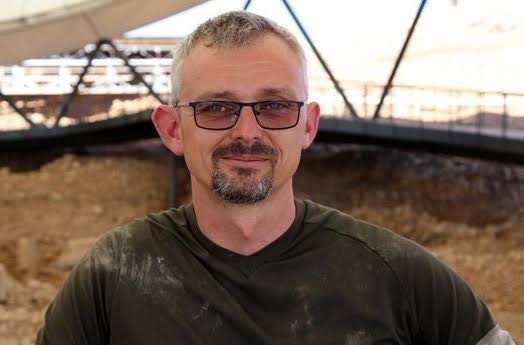
Lee Clare
Coordinator of the Göbekli Tepe Research Project
Since 2015, Lee Clare has coordinated the Göbekli Tepe Research Project — the careful, unglamorous work of running a world-famous excavation in the years after its founder's death. Much of what we now understand about how the site actually formed, including the hard question of whether its enclosures were deliberately buried or slowly filled, comes from work he has led.
He is also one of the field's most patient public voices, forever gently correcting the wilder claims made about the hill while insisting on how much remains genuinely unknown.
Lee Clare — DAI (academia.edu) →Tepe Telegrams — the project's blog →
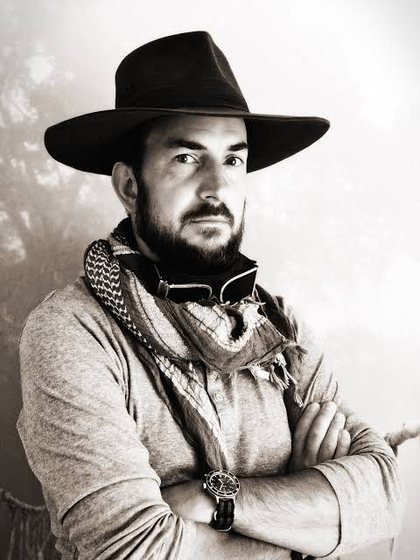
Jens Notroff
Göbekli Tepe researcher and the project's public voice
If you have ever read a clear, generous, myth-busting explanation of Göbekli Tepe online, there is a good chance Jens Notroff wrote it. A researcher on the project, he is also the driving force behind the Tepe Telegrams blog — the single best window the public has onto the actual archaeology, written by the people doing it.
His work is a quiet argument that a dig owes the world an honest account of itself. This whole site owes his openness a debt.
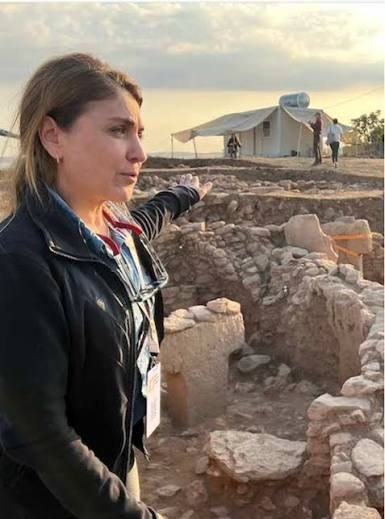
Eylem Özdoğan
Director at Sayburç
In 2021, digging at Sayburç inside a living village, Eylem Özdoğan uncovered a carved bench that may hold the oldest story ever told in stone — a man gripping his sides between two leopards, facing a charging bull. Her publication of it in the journal Antiquity framed it, carefully, as the earliest known narrative scene: not a decoration but a scene, with characters and tension.
It is one of the most quietly electrifying finds of the whole region, and a model of how to make a big claim without overstating it.
Eylem Özdoğan — ResearchGate →The Sayburç reliefs — Antiquity (2022) →
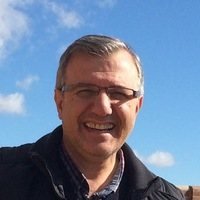
Bahattin Çelik
The archaeologist who found Karahan Tepe
Before Karahan Tepe was a headline, it was a scatter of stone tips on a hillside that one person recognised for what they were. In 1997, on a surface survey, Bahattin Çelik spotted the tops of T-shaped pillars in the Tek Tek hills and introduced Karahan Tepe to the scholarly world.
He has since documented a string of other Neolithic sites across the Şanlıurfa region, including Harbetsuvan — the patient survey work that quietly built the map everyone else now digs.
"A New Early Neolithic Settlement: Karahan Tepe" (Çelik, 2000) →
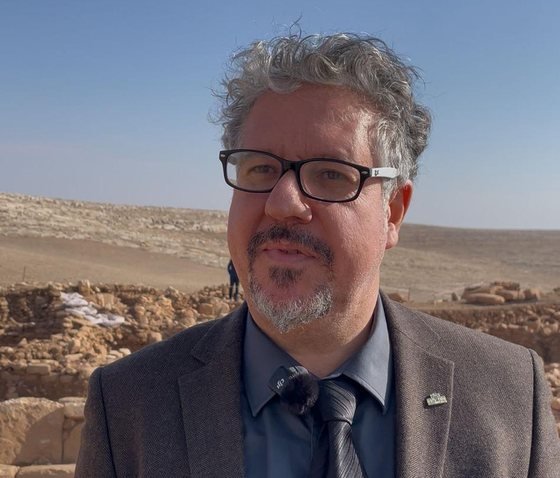
Emre Güldoğan
Director at Sefertepe
At Sefertepe, on the eastern edge of the Taş Tepeler world, Emre Güldoğan's team has uncovered the things that make the smaller sites matter: a room of curated human skulls, a double-faced bead small enough to hold, imported jade and labradorite that prove this was no isolated village.
His insistence on the evidence — beads and skulls and stone, catalogued and dated — is a reminder that the region's story is written as much in tiny finds as in great pillars.
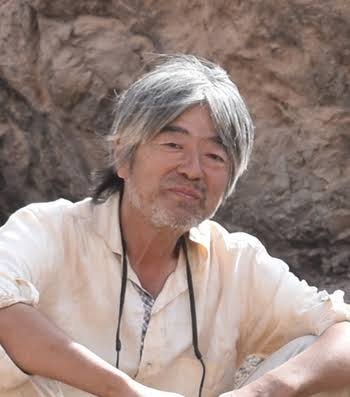
Yoshihiro Nishiaki
Leads the Turkish–Japanese excavation at Ayanlar Höyük
The newest chapter in the region is being written with Japan. Yoshihiro Nishiaki, of the University of Tokyo, leads the Turkish–Japanese excavation at Ayanlar Höyük — a partnership with roots deep in decades of Japanese scholarship on the ancient Near East.
It is a reminder that these hills belong, intellectually, to the whole world: researchers from Türkiye, Germany, Japan and beyond, all bent over the same twelve-thousand-year-old ground.
And the many more
No list like this is complete. Behind every name above stand field teams, students, conservators and specialists — and the wider institutions that make the work possible: the **Turkish Ministry of Culture and Tourism**, which runs the Taş Tepeler programme; **Istanbul University** and **Harran University**; the **German Archaeological Institute**; the **University of Tokyo** and the **Chiba Institute of Technology**; and researchers from across the world who have given seasons of their lives to this ground.
And the people of **Şanlıurfa** — the villages of Sayburç and beyond, on whose land these sites sit, and who have lived alongside them long before any of us arrived.
A note, and an invitation
We have written these summaries from published sources, and linked only to accounts and pages we could verify are genuinely each person's own — official university and institute profiles, ORCID and Google Scholar, and the handful of public professional accounts these researchers run themselves. Photographs are used with attribution to their source; Klaus Schmidt's memorial entry uses no image.
If you are one of these researchers — or work with one — and would like your entry corrected, expanded, a photograph changed or removed, or a link updated, we would be glad and honoured to do so. Write to us at info@thecommunitygarden.org.
Last reviewed 26 July 2026. Something wrong?