What do we even mean by 'shamanism' — and why is it so hard to prove?
Stand at the rail above the great circular enclosures of Göbekli Tepe and the question everyone asks is the same: what happened down there? We can see what the builders made — rings of five-metre T-shaped pillars, benches, and surfaces crawling with carved animals — but the rites performed inside have always been the hardest thing to recover.
'Shamanism' is the word most often reached for, and it is a slippery one. In its strict sense it names a specific complex: a ritual specialist who enters an altered state to travel between worlds, guided by animal helper-spirits, on behalf of the community. The trouble is that archaeologists have applied the label so loosely — as a 'one-size-fits-all' explanation for anything mysterious — that some scholars, like Alice Kehoe, argue it should barely be used at all outside its original Siberian setting.
In 2023 the archaeologist Oliver Dietrich, who has worked on the Göbekli material for over a decade, tried to make the question testable. Rather than assume shamanism, he assembled a checklist of features that ethnography and the history of religions treat as diagnostic — helper spirits, ritual costume and staffs, altered-state postures, a tiered cosmos, spaces built for transformative performance — and asked, item by item, whether Göbekli Tepe's material actually meets them. The results, he argued, came back positive across most categories. That is the case worth taking seriously — and testing hard.
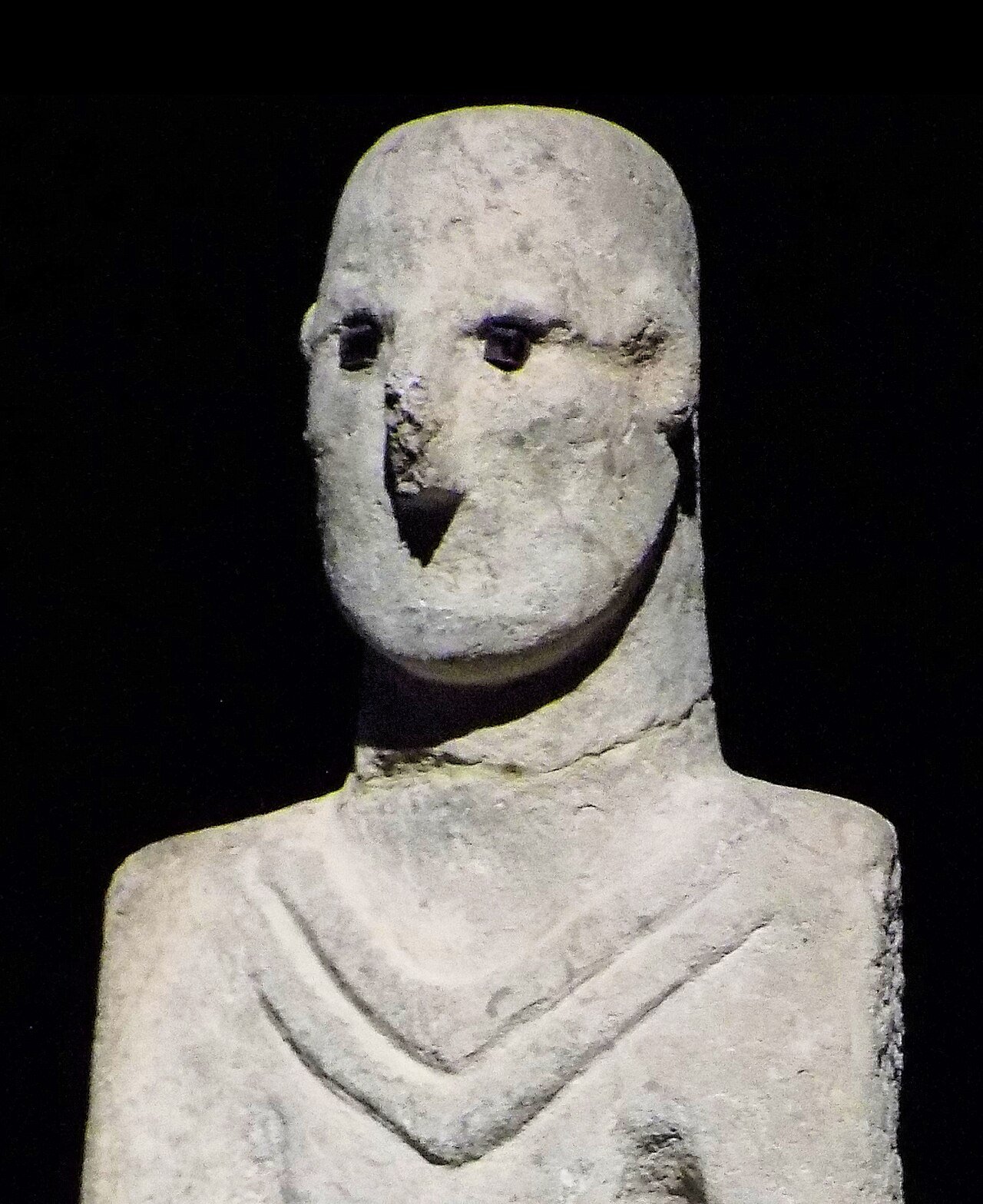
Cobija, Urfa man portrait, CC BY-SA 4.0, via Wikimedia Commons.
The figures: bodies held in tension
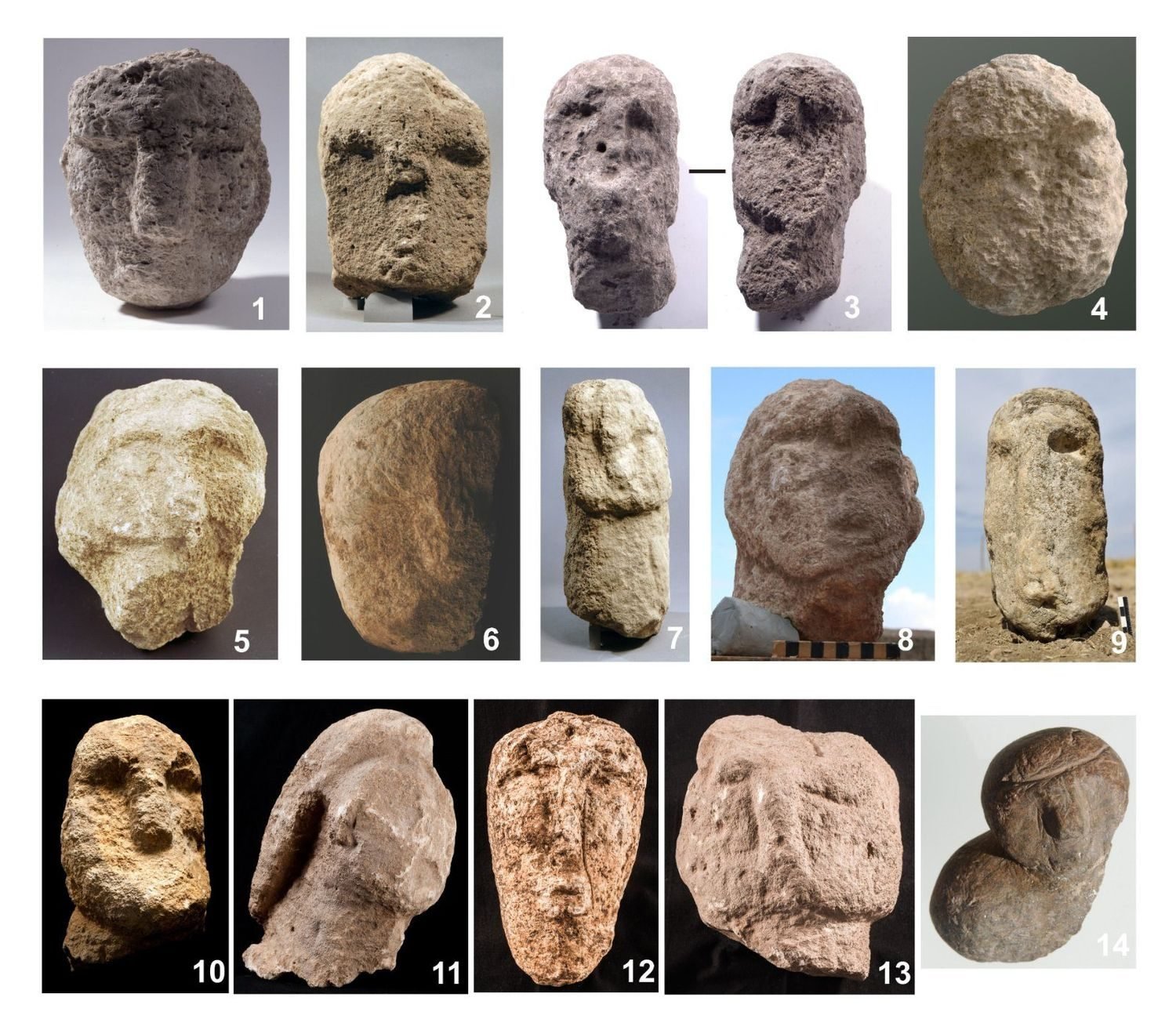
Göbekli Tepe has yielded 63 anthropomorphic sculptures, and they are not serene. Their faces follow a fixed canon — a T-shaped brow and nose, and one of five combinations of eyes and mouth, several of which show slit or closed eyes above a round open mouth or clenched teeth. Dietrich's argument is that this is a face under stress, and that some postures — arms clamped to the body, hands gripping the knees, arms wrenched behind the back — resemble the trance postures that the anthropologist Felicitas Goodman documented in living ritual traditions.
That last step is interpretation, and it should be flagged as such: you cannot excavate an altered state of consciousness. What you can describe plainly is the body-idiom itself, and it is remarkably consistent. The clearest single example is Urfa Man — a life-size statue, roughly 9000 BCE, hands clasped over the phallus, a V-shaped collar at the neck, and deep eye-sockets still inlaid with black obsidian, so that the figure appears to be staring. Whatever it meant, it was built to fix a viewer with a gaze.
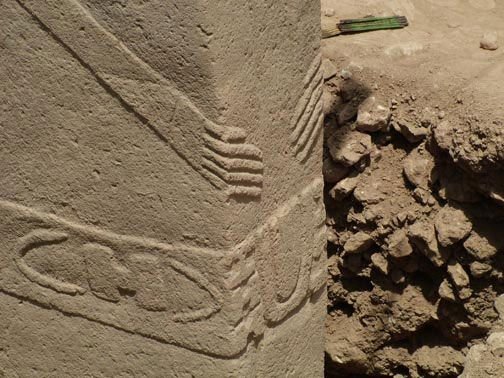
The most monumental figures of all are the pillars. The two central stones of each enclosure carry carved arms bending down their sides, hands meeting over a belt, and — on Pillar 31 in Enclosure D — a fox-pelt loincloth held in place by those hands. These are stone bodies. The animals covering them, on this reading, are not wallpaper but the equipment of the being depicted.
Read one way, the pillars are not columns holding up a roof. They are the ritual specialist's own body — robed, belted, and hung with the animals that give him power.
A cast of dangerous animals: spirit helpers, or something else?
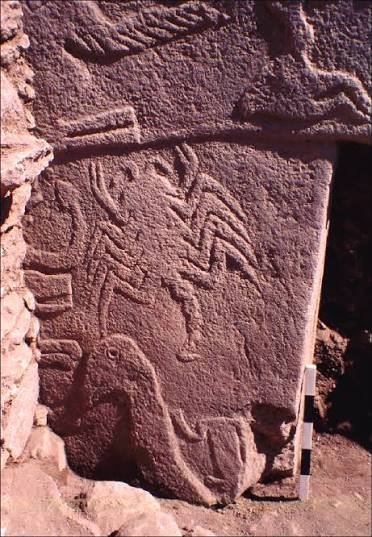
The animals at Göbekli Tepe were chosen with care, and the choosing is itself an argument. Each enclosure has a dominant creature — snakes in Building A, foxes in Building B, wild boar in Building C, leopards in Building H — while Enclosure D mixes snakes, foxes and birds. Individual pillars then carry their own personal combinations, different from their neighbours: on Dietrich's reading, each pillar is a distinct figure with its own assembly of animal allies.
The strongest hint that this is symbolic rather than practical is a mismatch. The animals carved on the stones — snakes, raptors, big cats — are largely not the animals people actually ate, which the bone record shows were mostly gazelle, aurochs and wild ass. A menu would look different. A bestiary of powerful and dangerous beings looks like meaning.
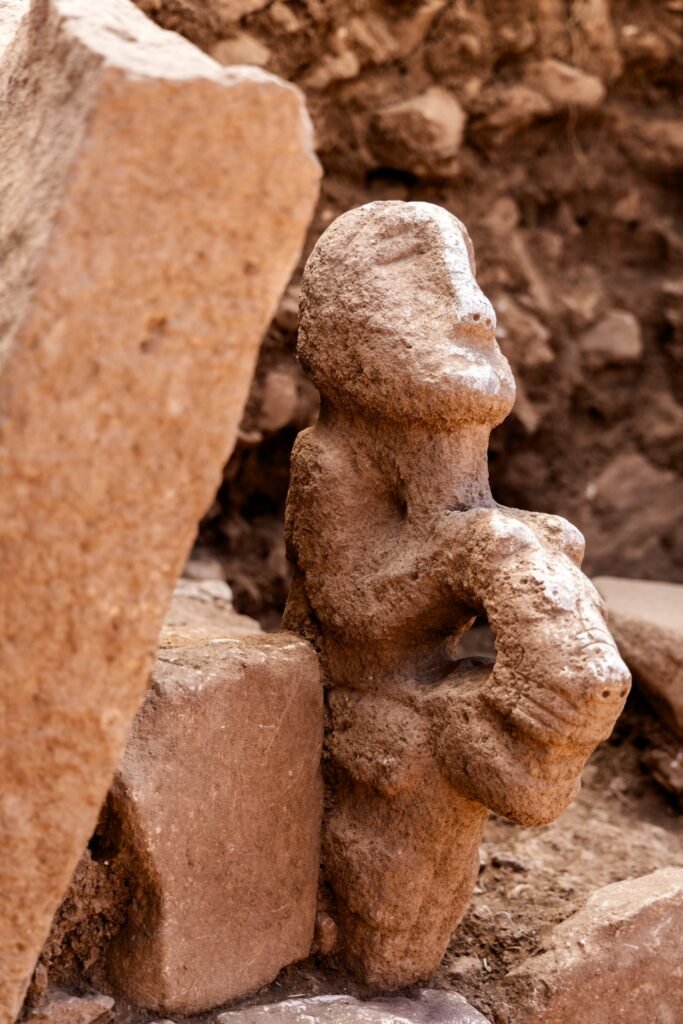
There is one small object that the shamanic reading leans on heavily, and it is worth being precise about it. A 5.1 cm figurine found on the surface in 2012 shows a seated, ithyphallic person looking upward, with a quadruped crouched on the left shoulder in a notably un-aggressive pose. It is genuinely striking. But the excavation note that first published it could not identify the animal — 'a large feline or bear', not a confirmed leopard — and read the piece cautiously as a metaphor of human–animal relationship. The leap to 'a shaman and his spirit helper' is Dietrich's later gloss, not an established fact.
Costumes, staffs and masks
If ritual specialists performed here, they should have left the props behind, and some candidate props exist. Besides the belts and loincloths on the central pillars, excavators found an articulated fox tail lying beside Pillar 18 — bones still in anatomical order — hinting that real garments of fox fur were once worn or deposited here.
There are also zoomorphic stone staffs — the so-called 'Nemrik scepters', cylindrical stones topped with carved vultures or other animals, too soft to be useful tools — found at Göbekli and across a string of contemporary sites. There are carved stone masks, some deposited beside the central pillars when the buildings were backfilled. And there are decorated perforated bone objects that were first published as 'spatulae' and later re-interpreted as possible bullroarers, the spinning noise-makers used in ritual worldwide.
Each of these is a real object; each function is a proposal. The bullroarer reading in particular is contested — there is literally a scholarly paper warning about 'the pitfalls of iconographic interpretation' of exactly these bone pieces. The honest position is that the sacra a shaman would need are present at Göbekli Tepe, but their identification as such is an argument, not a caption.
Buildings designed to change you
The most powerful part of the case is not any single artefact but the architecture. The enclosures are semi-subterranean and benched, entered — in Building C especially — through a deliberately awkward, corridor-like approach with steps and blinds that would disorient anyone coming in. You move from daylight into a dark, enclosed space populated by carved animals bristling in attack, and arrive before two looming human pillars.
Sound was part of the design. An acoustic and spatial study by Alexis McBride (2014) modelled how the large buildings would have carried the human voice, and concluded that a speaker near the central pillars would have been well heard but poorly seen by parts of the audience — a voice seeming to come from the stones themselves — with the space suited to only a modest gathering, perhaps a few dozen people.
That is exactly the recipe anthropologists describe for high-intensity, memory-burning ritual: a difficult descent, sensory constriction, an unsettling encounter, a disembodied voice. Whether or not you call the result 'shamanic', these rooms were engineered to do something to the people inside them.
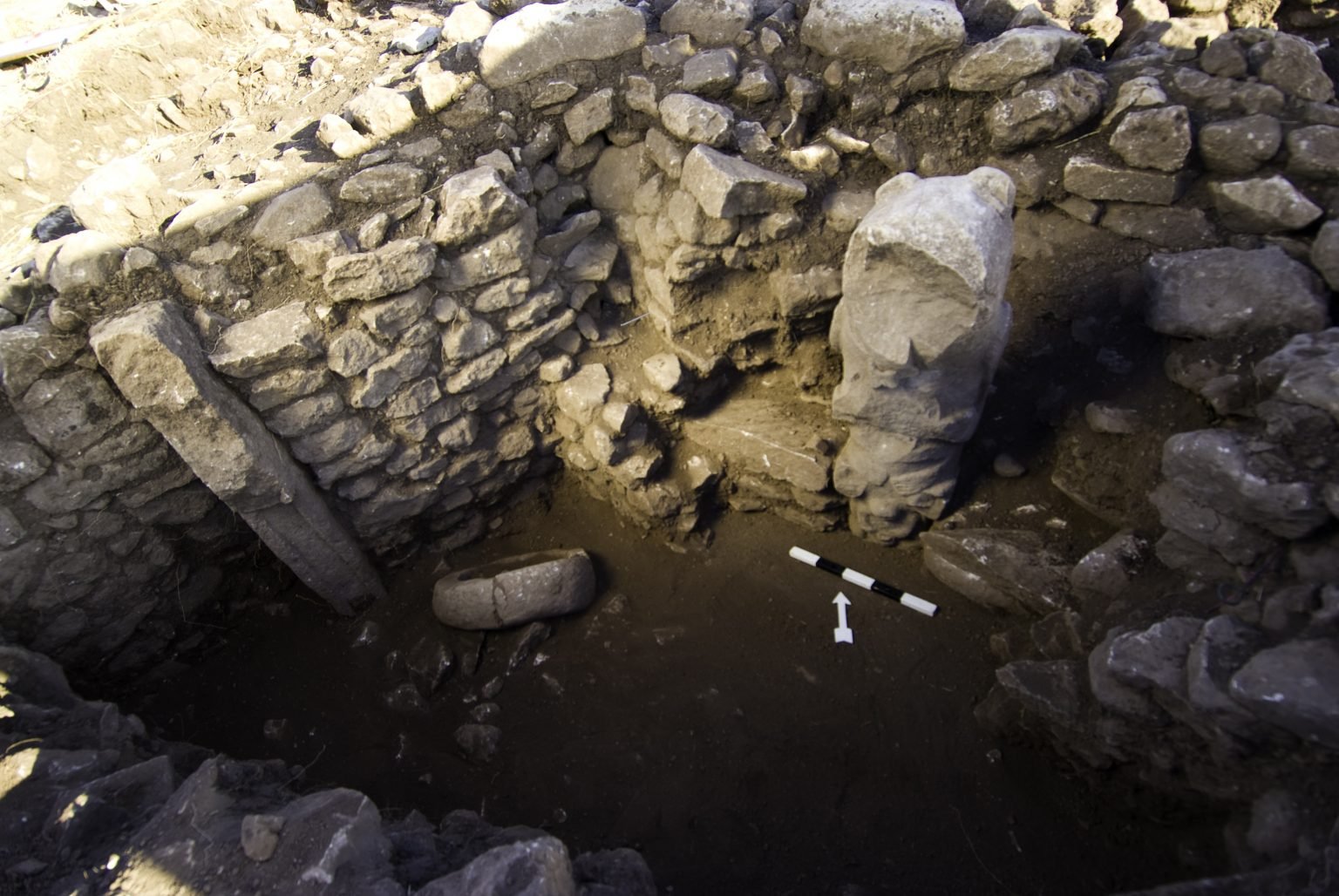
German Archaeological Institute, Göbekli Tepe Project, The Göbekli Tepe 'totem pole', find situation, Copyright: DAI — used with permission, via .
Not just Göbekli: the pattern across the Taş Tepeler
Here is where the single-site version of this story sells itself short. The most convincing evidence for structured, transformative ritual in the Neolithic north is that it is regional — the same ideas surface across the Taş Tepeler, at sites dug by different teams.
The recurring human figure is the clearest thread. Urfa Man, the principal Sayburç relief figure, and the seated statue found at Karahan Tepe in 2023 are all the same being: a naked male, frontal, hands to the phallus, a collar at the neck. That is not a Göbekli mannerism; it is a shared regional idiom of potency and presence.
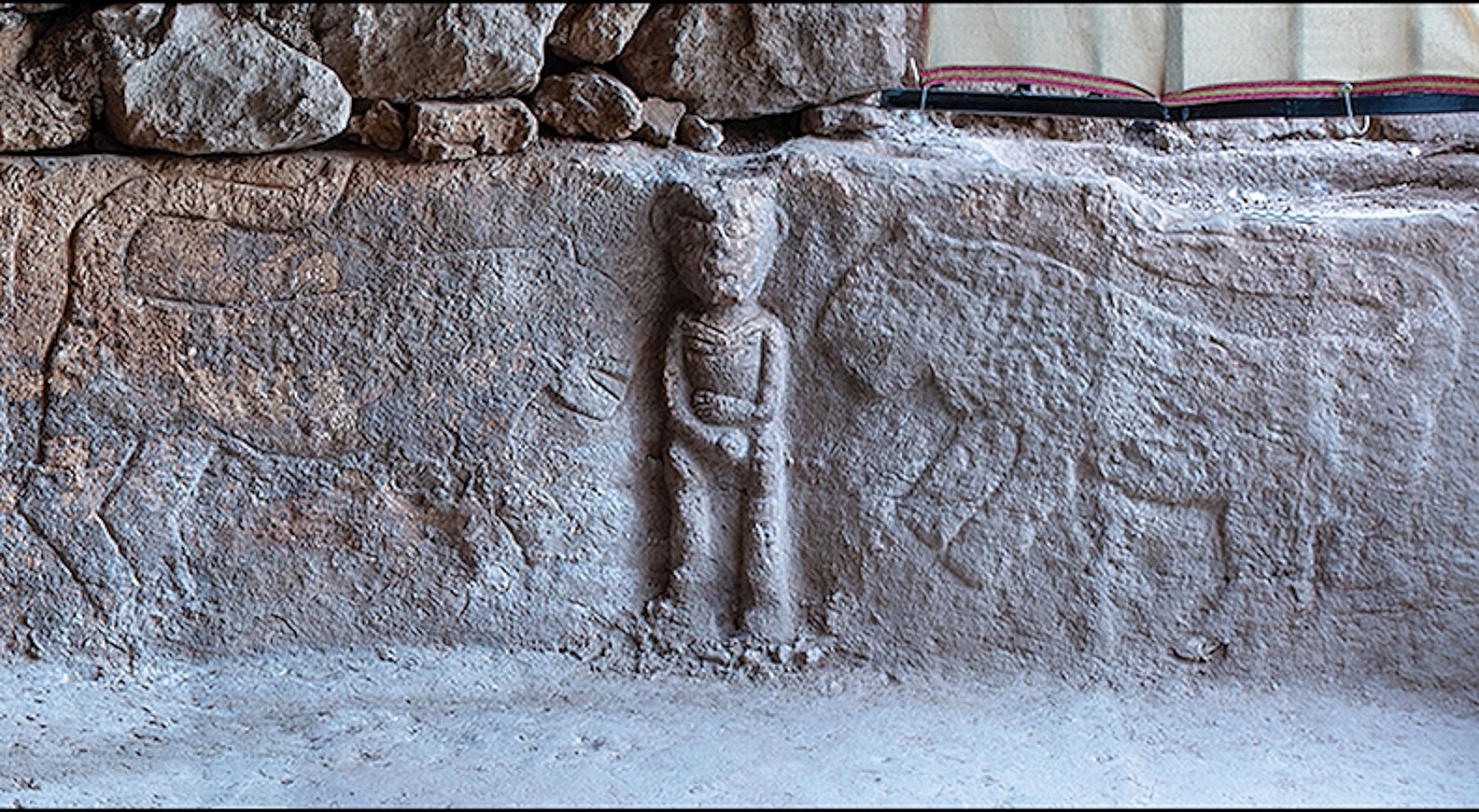
So is the theme of a human among dangerous animals. At Sayburç, Eylem Özdoğan published a bench relief in 2022 as the oldest known narrative scene: on one side a man between two leopards; on the other, a man beside a huge aurochs, one hand raised with six fingers, the other holding a snake — or, Özdoğan suggests, a rattle. At Karahan Tepe, a rock-cut chamber of phallic pillars is watched over by a human head with a serpent's neck, and in 2026 excavators lifted a statue of a person riding on a leopard's back. At Nevalı Çori, a 'totem pole' stacks a vulture over two humans. Across the region, again and again, a person is shown mastering, merging with, or confronting a predator.
None of this proves trance or soul-flight. But it does something more useful than a single spectacular find: it shows a shared symbolic system, worked out across a landscape of sites over centuries — the strongest ground on which the ritual argument can stand.
Dancing as the animal
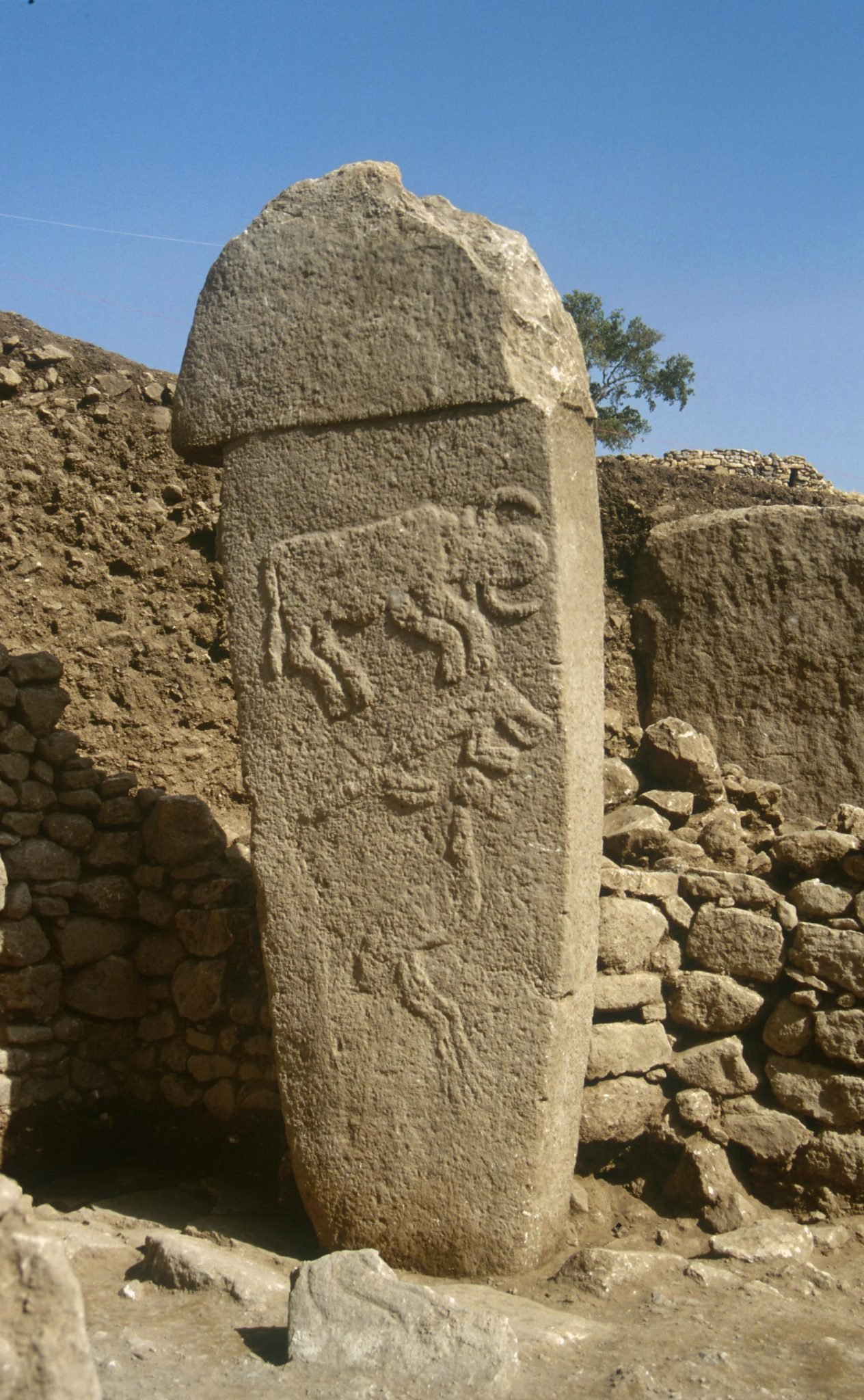
One strand pushes past 'symbol' toward 'performance'. Several Göbekli pillars (2, 33 and 38) carve cranes with thick, human-like knees and legs — birds that stand like people. Klaus Schmidt and others read them as masked humans imitating the crane's famous courtship dance: people becoming birds.
The supporting evidence for that specific idea comes, tellingly, from outside the Taş Tepeler — from later Çatalhöyük in central Anatolia, where archaeologists recovered articulated crane wing-bones with cut marks, read as the remains of a costume. It is an analogy, not a Taş Tepeler find, and should be labelled as one. But combined with the region's stone masks and its snake- and bird-headed human sculptures, it sketches a world in which the boundary between person and animal was something people could put on and take off.
What is uncertain
It would be easy to end on a drumbeat. The honest ending is a list of doubts — and Dietrich, to his credit, supplies most of it himself.
First, 'trance posture' is a reading, not a finding: no excavated object proves a depicted altered state. Second, a key ingredient of the classic shamanic model is missing entirely at Göbekli Tepe — the geometric 'entoptic' patterns that vision-states produce in other traditions simply are not there. Third, the whole enterprise rests on ethnographic analogy stretched across eleven thousand years, and the same symbol need not carry the same meaning — a snake in Neolithic Türkiye and a snake in a Siberian séance may have nothing to do with each other.
And there is a more basic dissent. Not everyone agrees these were ritual buildings at all: Ted Banning has argued that Göbekli's enclosures may have been roofed domestic houses — elaborately decorated, but lived in — rather than temples. If he is right, much of the 'ritual theatre' framing softens. The fair verdict is the one the evidence supports: the objects — the figures, the animals, the sacra, the modified skulls — are real and remarkable and regional. 'Shamanism' is the best available shorthand for what they might mean. It is a strong, well-argued case. It is not a closed one.
Common questions
Is there proof of shamanism at Göbekli Tepe? No — 'proof' is the wrong word for prehistoric ritual. There is a systematic 2023 study (Dietrich) showing that Göbekli's material meets most of the standard criteria used to identify shamanism, plus supporting finds across the Taş Tepeler. The objects are certain; the interpretation is a leading hypothesis, not an established fact.
What is the evidence? Anthropomorphic figures in tense, fixed postures; a chosen bestiary of dangerous animals distributed by enclosure; possible costumes, animal-headed stone staffs and masks; semi-subterranean buildings with disorienting entrances and voice-throwing acoustics; and, region-wide, human-and-predator scenes and ritual treatment of the dead.
Is it only at Göbekli Tepe? No — that is the strongest part of the case. The same frontal, phallus-holding figures and human–animal scenes recur at Sayburç, Karahan Tepe, Nevalı Çori and in the Urfa Man statue, across sites excavated by different teams.
Why are scholars cautious? Because 'shamanism' has been over-used as a catch-all; because a core feature of the classic model (entoptic imagery) is absent here; because the same symbol can mean different things in different cultures; and because some archaeologists argue the buildings were houses, not temples.
Key takeaways
- A 2023 study by Oliver Dietrich put Göbekli Tepe through a formal checklist for shamanism — figure postures, a chosen bestiary, costumes and staffs, and purpose-built ritual architecture — and found matches across most categories.
- The case is strongest as a regional pattern: the same naked frontal figures, human-and-predator scenes and ritual handling of the dead recur across Göbekli Tepe, Sayburç, Karahan Tepe, Nevalı Çori and Urfa.
- The buildings themselves are the best evidence — semi-subterranean, hard to enter, and acoustically built to throw a voice to a small audience.
- But the objects are far more certain than the label: Dietrich lists the gaps (no entoptic imagery), and Ted Banning argues the enclosures may have been roofed houses, not temples at all.
Sources
- Dietrich, O. (2023). Shamanism at Early Neolithic Göbekli Tepe. *Praehistorische Zeitschrift* (DOI 10.1515/pz-2023-2033)
- Peters, J. & Schmidt, K. (2004). Animals in the symbolic world of Pre-Pottery Neolithic Göbekli Tepe. *Anthropozoologica* 39(1)
- Özdoğan, E. (2022). The Sayburç reliefs: a narrative scene from the Neolithic. *Antiquity*
- Gresky, J., Haelm, J. & Clare, L. (2017). Modified human crania from Göbekli Tepe (skull cult). *Science Advances*
- Dietrich, O. & Schmidt, K. (2017). A short note on a new figurine type from Göbekli Tepe. *Neo-Lithics* 1/17
This article is written from the primary literature and excavators' reports cited above. Interpretations are attributed; uncertainties are stated in the text.
Go deeper
 Dances with cranes: a Neolithic animal masquerade →
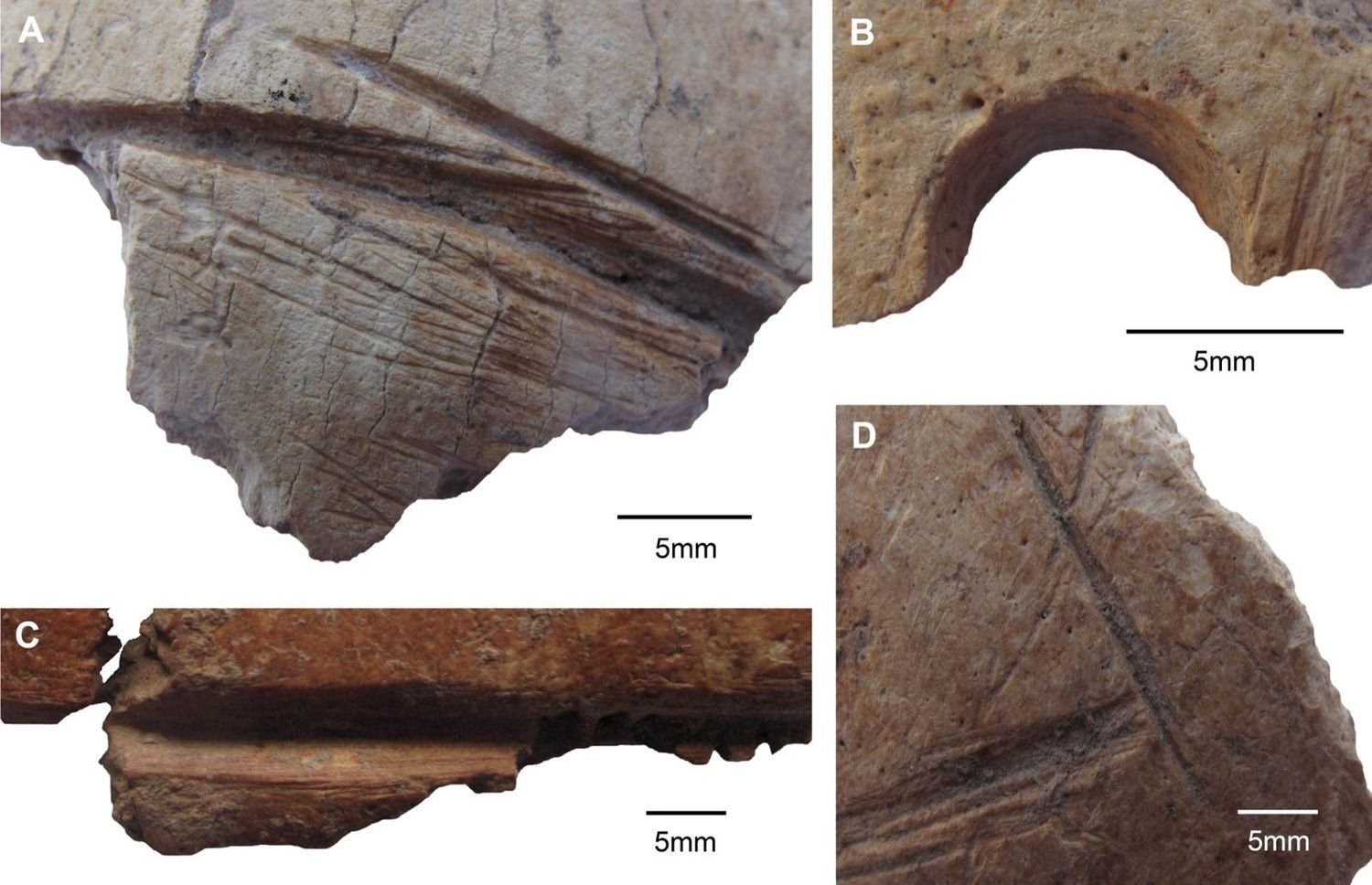 The missing heads: Göbekli Tepe's skull cult, across every site →
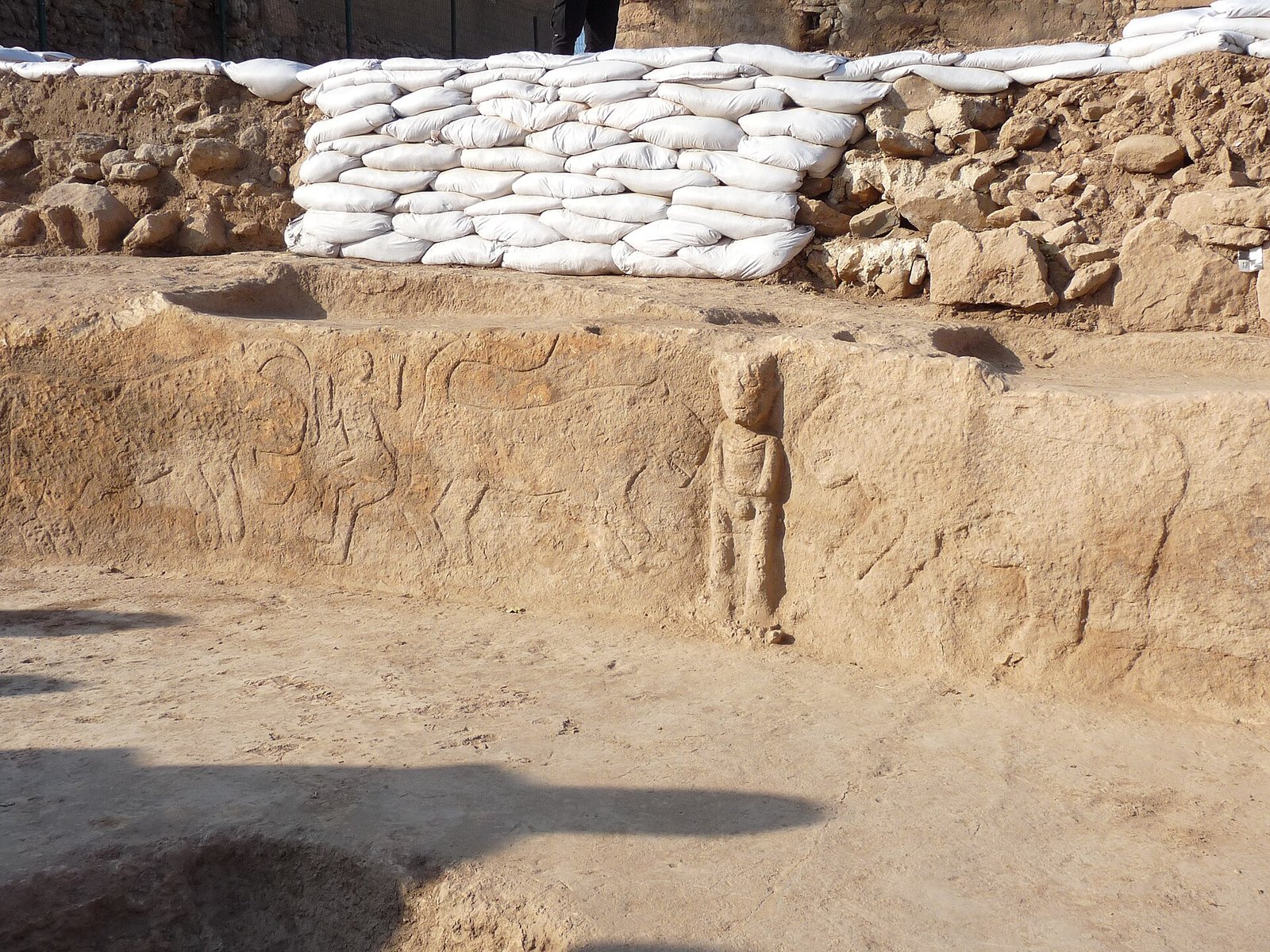 Sayburç's relief: the oldest known narrative scene →Did visions build Göbekli Tepe? The Neolithic-mind theory →What do the animal carvings mean? →The skull cult of the Taş Tepeler →