An arm, a hand, a belt
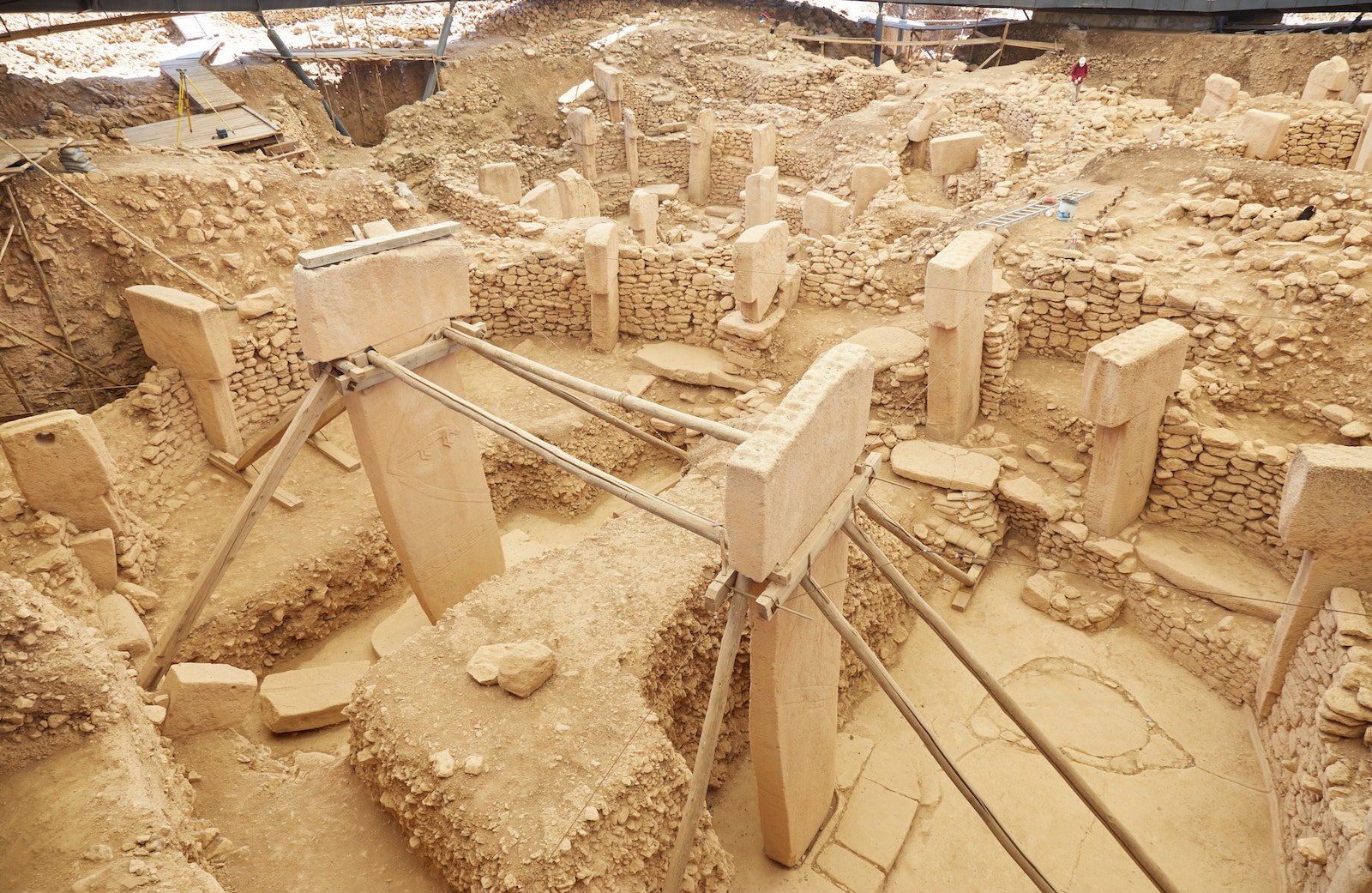
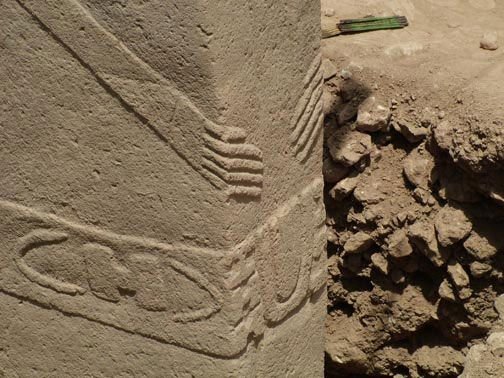
Stand in front of one of the two great central pillars of Enclosure D at Göbekli Tepe and the abstraction resolves into a figure. A shallow arm runs down the long side of the shaft; at the bottom it turns, and a hand with long fingers reaches around to the front, meeting its opposite over the belly. Below the hands sits a belt, and hanging from the belt an animal-skin loincloth — read as a fox pelt. The wide slab on top is not a capital. It is a head, seen as if abstracted or turned, sitting on a long body.
This was the excavator Klaus Schmidt's central insight: the T-pillars are stylised anthropomorphic beings. Once you see the arms and hands, the whole form reads as a person — tall, faceless, standing. The animals carved on many pillars are then not decoration on a column but creatures moving across, or clinging to, a body.
The same idea, three ways
What makes this a network signature rather than a Göbekli quirk is that the anthropomorphic pillar reappears across the Taş Tepeler sites, in different registers. At Karahan Tepe, pillars in Structure AD carry human figures carved in relief, and the site also produced fully sculpted human heads and seated statues — the same population of beings, rendered both as pillars and as free sculpture.
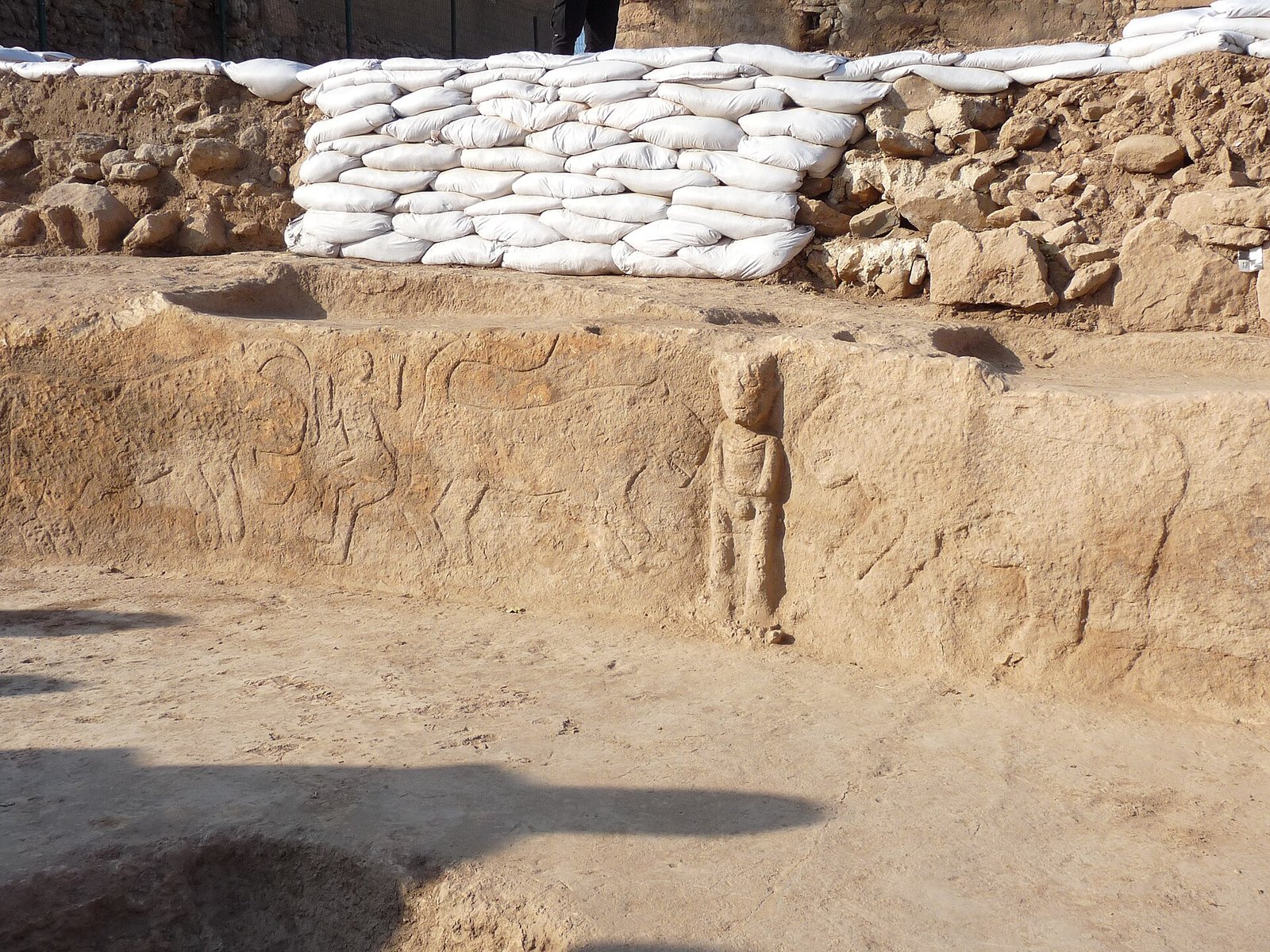
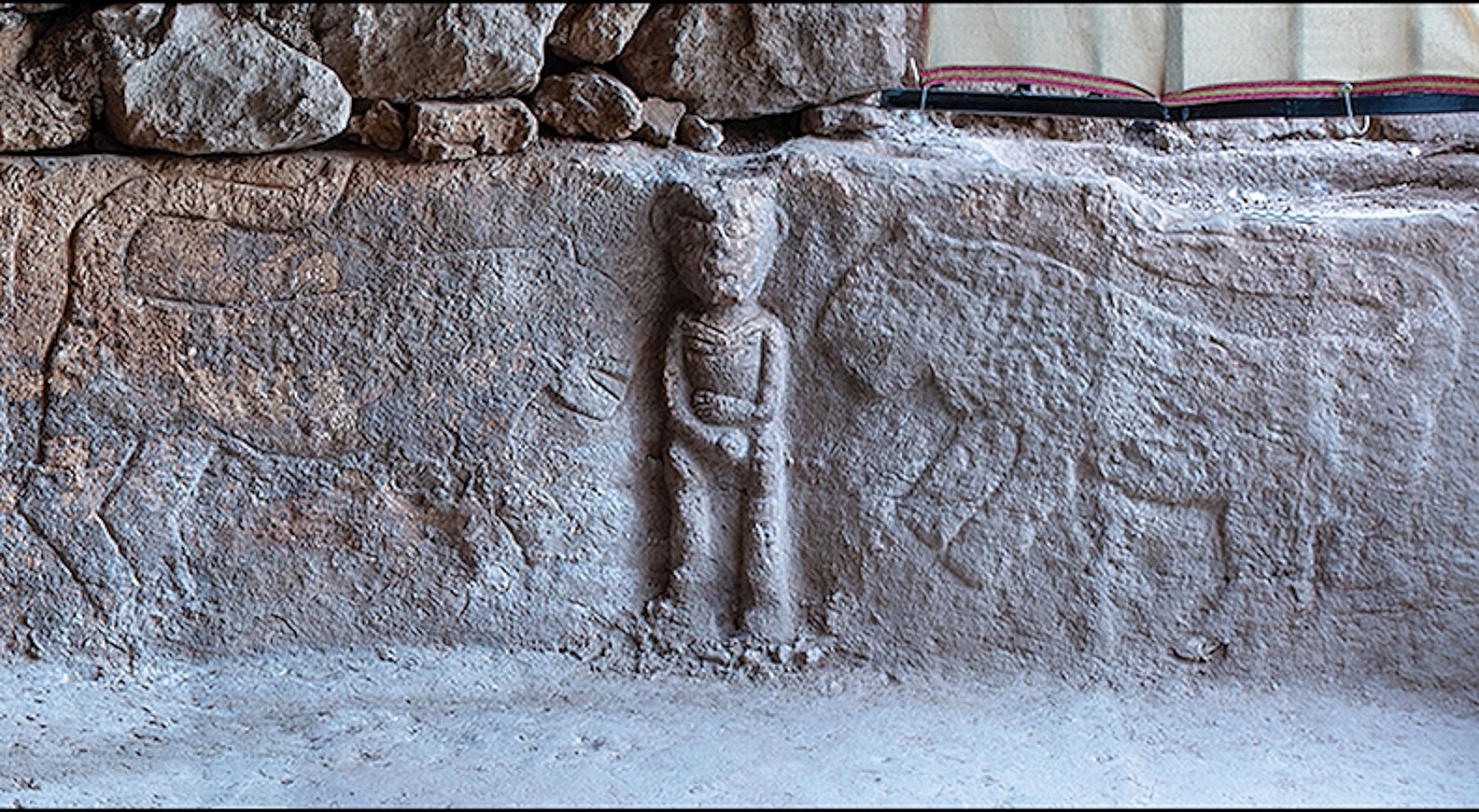
At Sayburç, the excavator Eylem Özdoğan describes a fully three-dimensional human at the centre of the bench relief: a man who grips a leopard on either side. Here the figure is naturalistic, with a modelled head and limbs. Set the three side by side and you see a spectrum — from Göbekli's tall, abstracted pillar-people, through Karahan's relief figures, to Sayburç's rounded human — all versions of the same conviction that the important presences in these rooms were human-shaped.
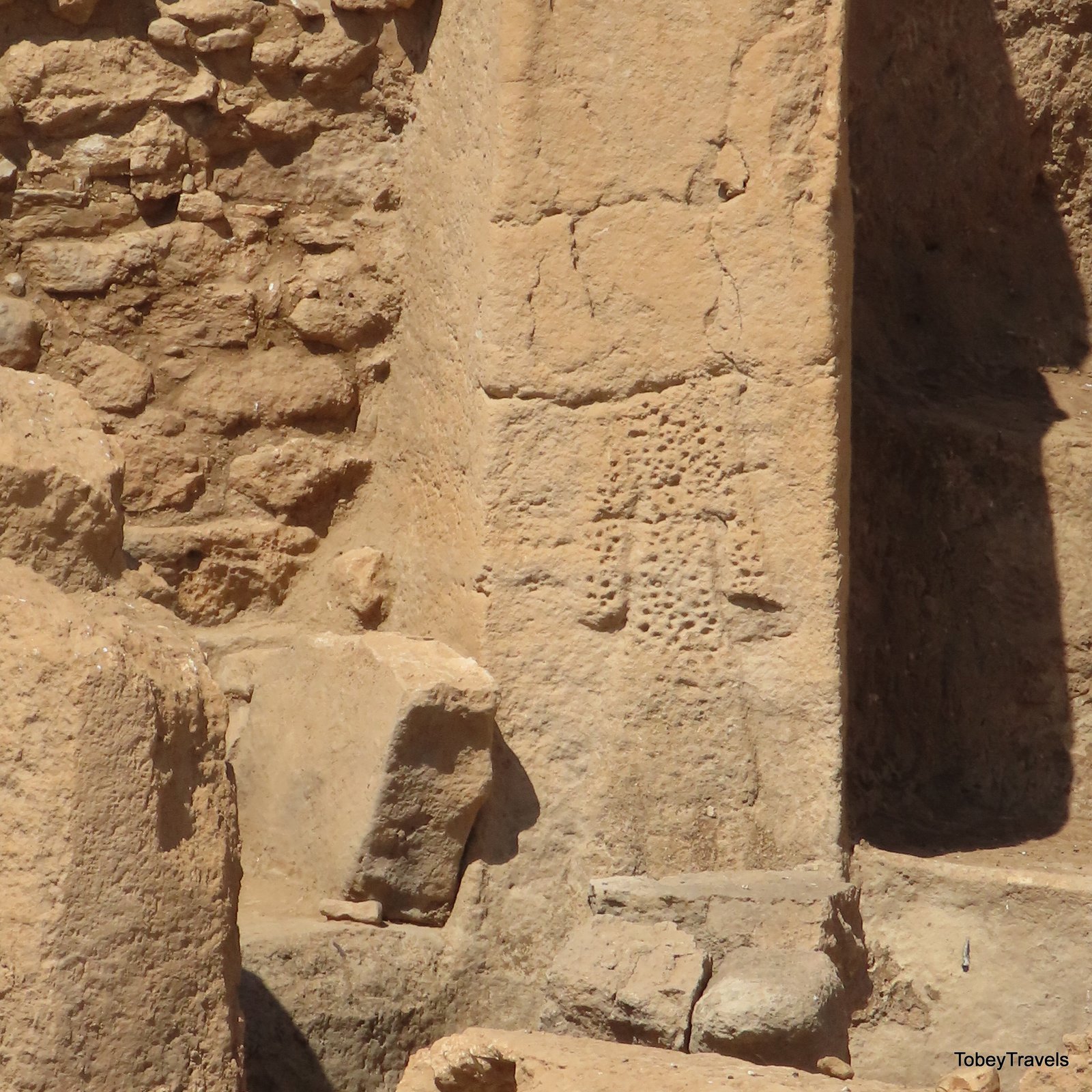
tobeytravels, Structure AD, Pillar Carvings, Human Figure, Karahantepe (Karahan Tepe), Turkey (1), CC BY-SA 4.0, via Wikimedia Commons.
Rooms full of standing figures
This changes how you picture the buildings. If the pillars are bodies, then an enclosure at Göbekli Tepe is not an empty ring of stones but a room crowded with standing beings — two tall figures at the centre, a circle of smaller ones set into the wall, all facing inward. The living people who gathered there did so among a company of stone figures many times their height.
It also ties the imagery together. The belt and loincloth, the arms folded to the front, the animals worn against the body: these are the marks of a person, or a personage. Whatever these beings were — ancestors, spirits, mythic actors — the builders went to great trouble to make monoliths that were unmistakably someone.
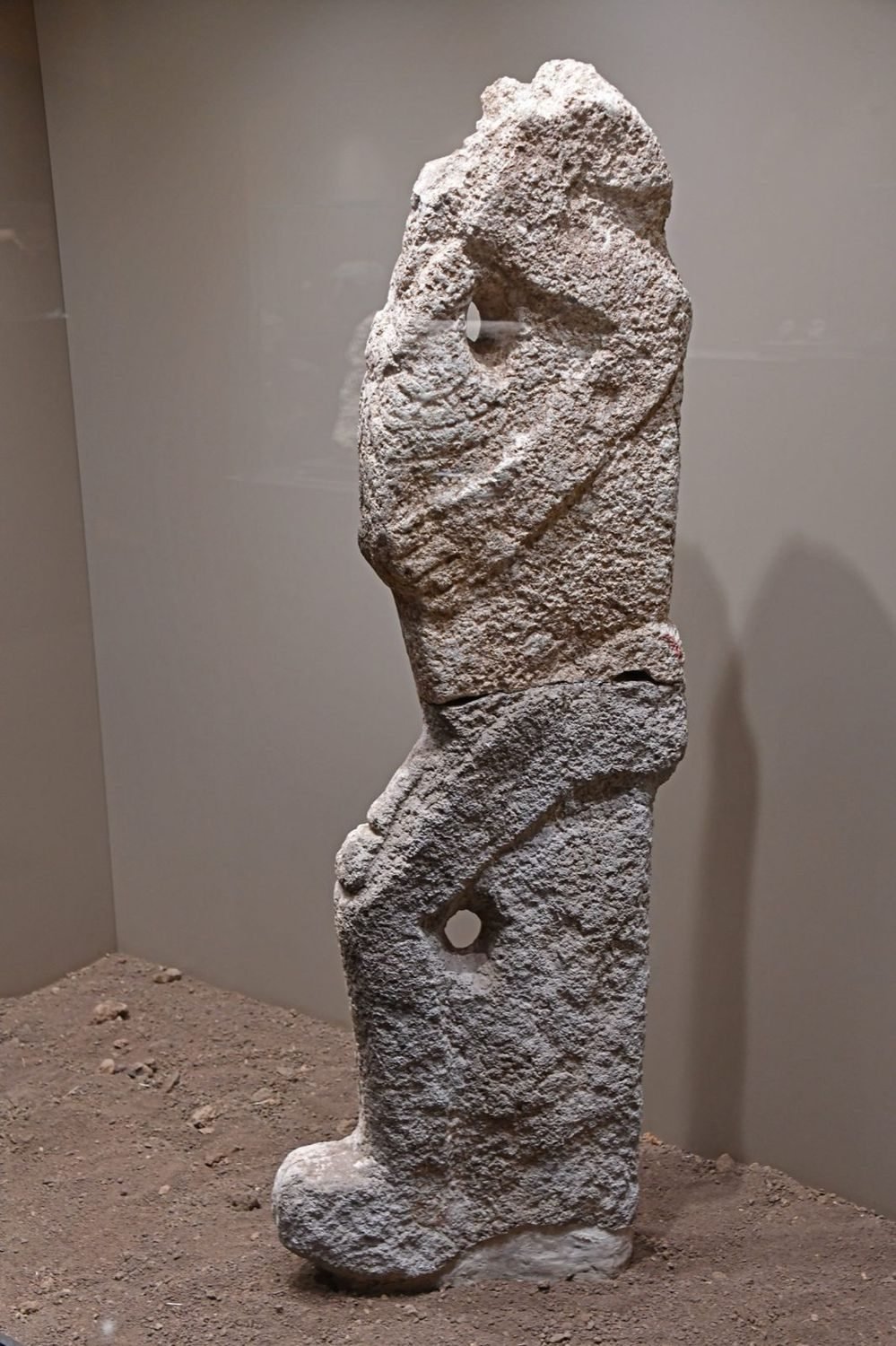
Dosseman, Urfa museum Karahantepe Sitting human statue Neolithic Age in 2024 7363, CC BY-SA 4.0, via Wikimedia Commons.
Why it matters
The anthropomorphic reading is one of the strongest bridges between the sites, because it is carried by physical detail — the hands, the belt — rather than by interpretation alone. It is also the quiet reason the older label of 'temple' sits awkwardly: a hall lined with giant human figures is as easily read as a gathering of ancestors or a mythic assembly as a house of gods.
It is the single most useful thing to know before looking at any Taş Tepeler pillar. The T is not a shape. It is a person, seen edge-on, waiting in the room.
Common questions
What do the T-pillars of Göbekli Tepe represent? The excavators read them as stylised human — or human-like — beings: the wide T-top is a head, the shaft a long body, with an arm carved down each side and hands meeting at the front, above a belt. Exactly who they represent — ancestors, spirits, mythic figures — is still debated.
Are the Göbekli Tepe pillars people? In form, yes: they are built as bodies, not columns. The clearest examples carry an arm, a hand and a belt, and the same body-shaped idea recurs at Karahan Tepe and Sayburç, both as relief figures and as free-standing statues.
What is uncertain
Who the pillar-beings are is unknown, and honest accounts leave it open: ancestors, deities, spirits and mythological figures have all been proposed, and none is proven. The clearest anthropomorphic details — arm, hand, belt, loincloth — are best preserved on Göbekli Tepe's central pillars; not every pillar carries them, and many are plain or eroded.
What is firm is the pattern itself. Across Göbekli Tepe, Karahan Tepe and Sayburç, the human body is the organising form — carved as a pillar, as a relief, and as a statue. Schmidt's anthropomorphic reading is now widely shared among the excavators, even where its meaning is not.
Key takeaways
- Göbekli Tepe's T-pillars are built as bodies seen edge-on: the wide top is a head, the shaft a torso, with arms and hands carved in low relief.
- The giveaway detail is physical — an arm running down the side, hands meeting at the front above a belt, sometimes with a fox-pelt loincloth.
- The same body-idea recurs across the region as pillars, reliefs and free-standing statues — a shared conviction, not one site's quirk.
- If the pillars are people, an enclosure is a room full of standing beings — which is why 'temple' sits awkwardly.
Sources
- Schmidt, K. (2010). Göbekli Tepe – the Stone Age Sanctuaries. New results of ongoing excavations with a special focus on sculptures and high reliefs. Documenta Praehistorica 37.
- Özdoğan, E. (2022). The Sayburç reliefs: a narrative scene from the Neolithic. Antiquity 96(390).
- DAI Tepe Telegrams — A sanctuary, or so fair a house? (architecture and the central pillars)
This article is written from the primary literature and excavators' reports cited above. Interpretations are attributed; uncertainties are stated in the text.