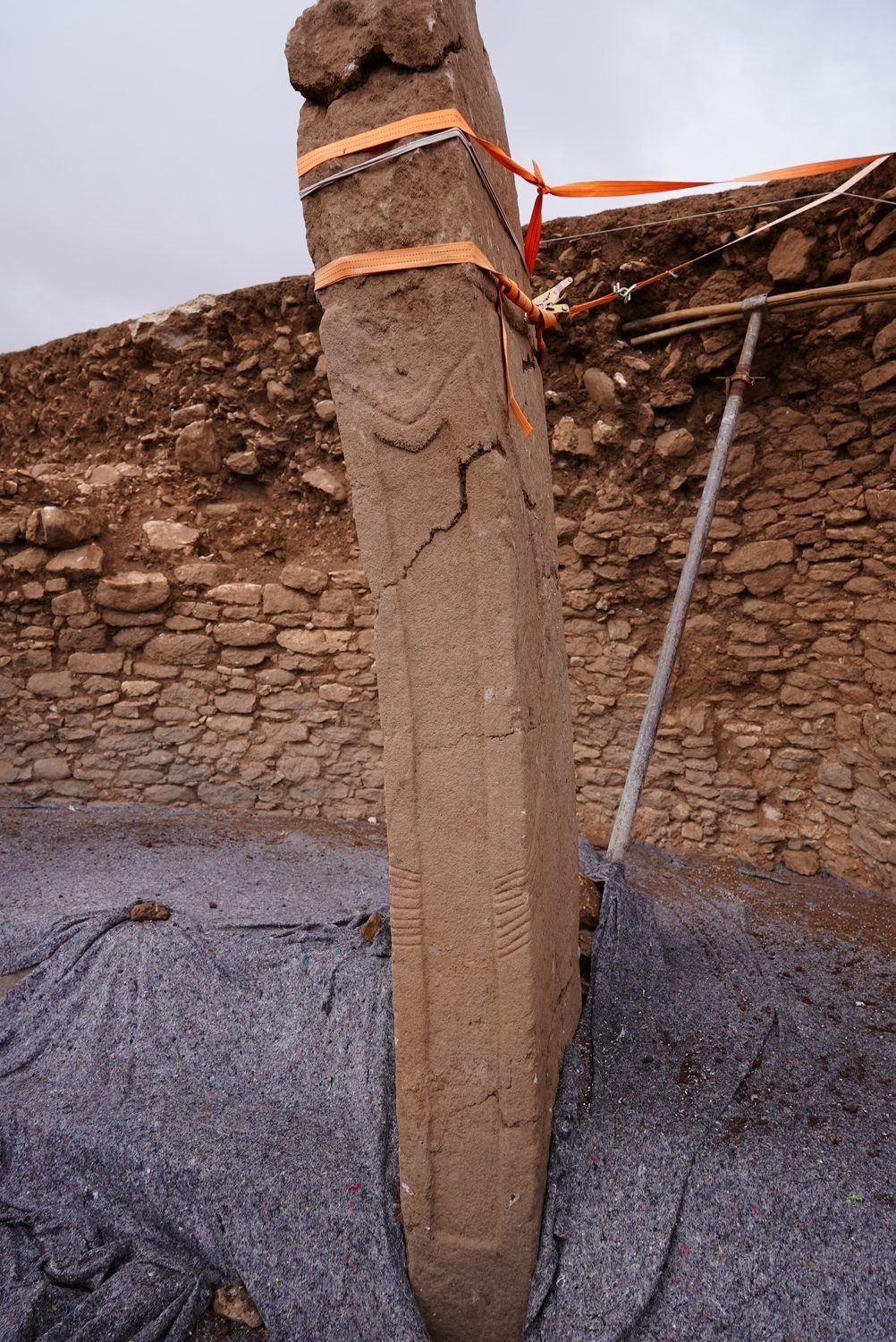
An unusual pair of 'hands'
It is easy to walk past a T-shaped pillar as a piece of architecture — a post, a slab stood on end. This one, photographed at Karahan Tepe as it was lifted and strapped during fieldwork, carries a detail that stops you: low on the shaft, on each of the two front edges, is a fan of slender grooves. Count them and the number is unmistakable — eight to a side, sixteen in all.
That count matters, because it is wrong for a hand. The standard reading of these pillars treats such marks as fingers, and a human hand has five. Here there are far more, and they do not sit like fingers brought together at a belt: they splay outward and downward, fanning from a single root. Look up the shaft and the 'arm' runs down the side as expected — but where it meets the shoulder, the junction is unlike the clean arm-to-shoulder turn on a typical T-pillar. Two anomalies, on the same stone, in the same place a body's hands should be.
These observations come from close, first-hand examination of the pillar in the field by researcher Dakota Wint, who photographed it during the lift. They are the kind of detail that is easy to miss in a passing glance and easy to over-smooth in a line drawing — which is exactly why the high-resolution field photographs matter.
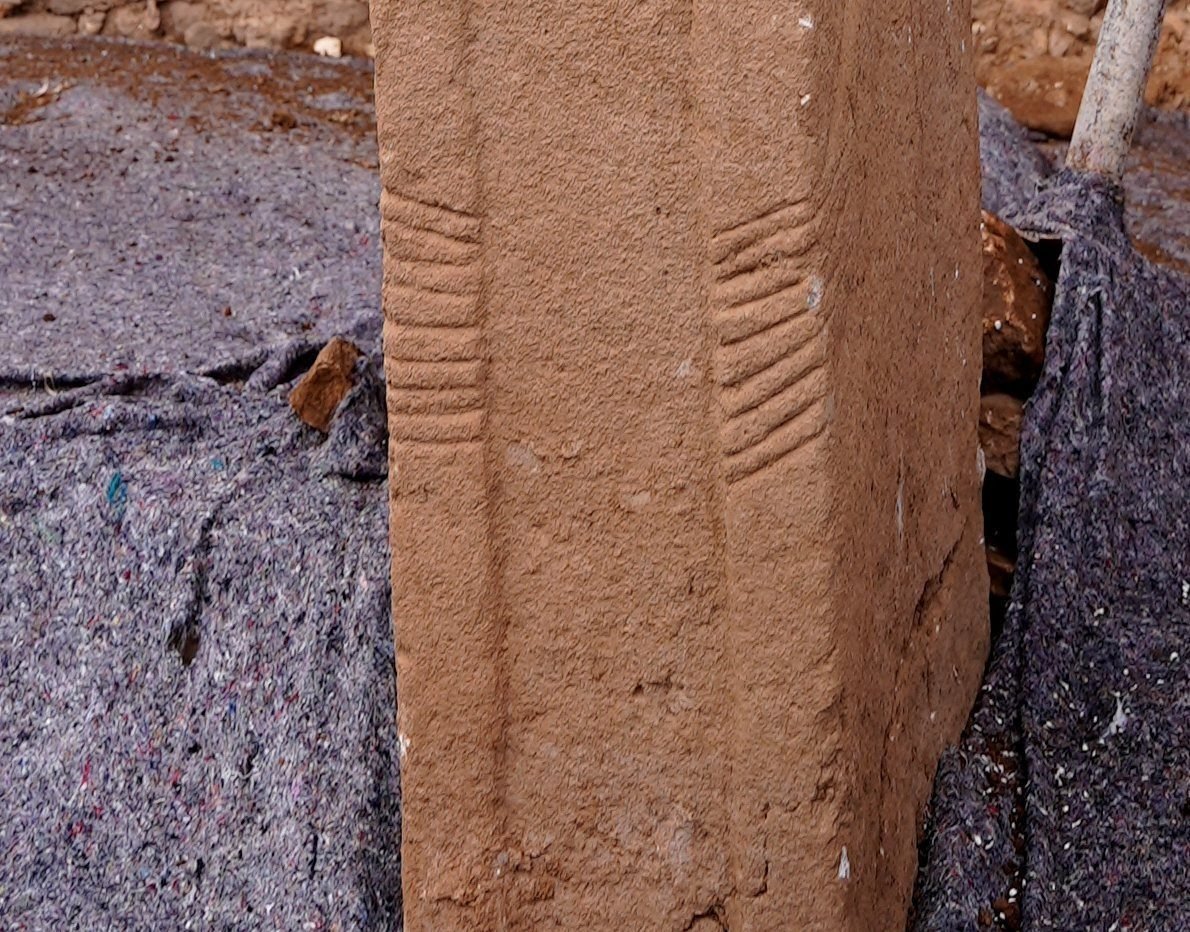
The usual T-pillar hand — and how this one departs
To see why this is strange, you have to know the norm. The idea that the great T-pillars are stylised human beings was Klaus Schmidt's central reading at Göbekli Tepe, and it is carried by anatomy: an arm down each side, hands — usually with the expected number of fingers — meeting at the front of the shaft above a belt, sometimes with a fox-pelt loincloth below. That convention repeats across the region; even small sites like Harbetsuvan Tepesi have produced pillars with finger-and-arm reliefs.
This Karahan pillar quotes that vocabulary — arm, shoulder, a 'hand' where a hand belongs — and then breaks it. Too many digits; a fan rather than a grip; a shoulder that reads differently. On a weathered relief, any one of these could be dismissed. Together, on a well-preserved stone, they invite a second look: what if the carver was not depicting a human hand at all?
Where a T-pillar usually resolves its arm into a human hand, this figure resolves it into a wing — a being that is part human, part crane.
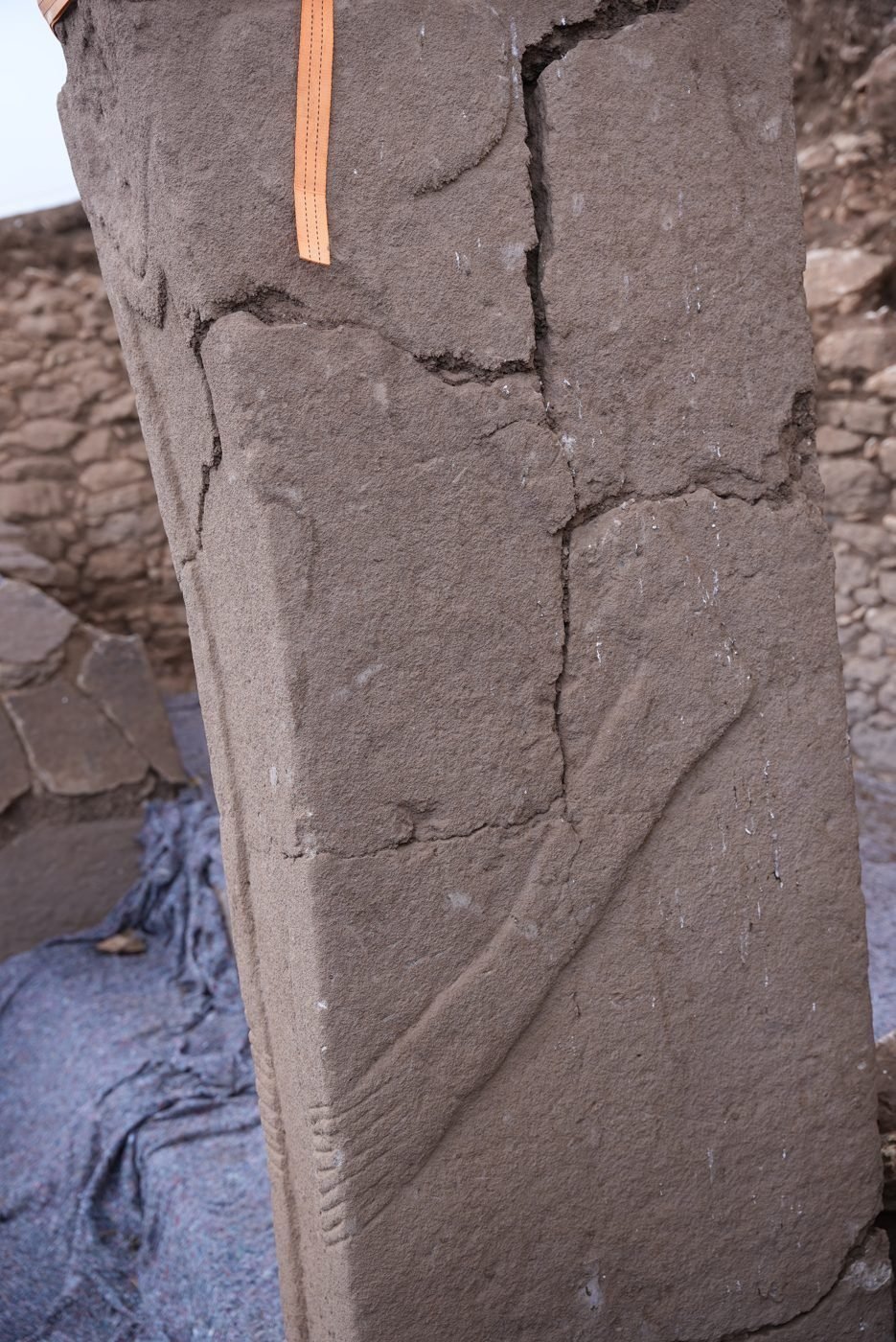
A hand — or a wing?
The alternative Dakota Wint proposes is simple and, once seen, hard to un-see: the fan of long, splayed grooves reads like the primary flight feathers of a bird's wing, and specifically a crane's. On this view the shaft still shows a body, but where a T-pillar usually resolves its arm into a human hand, this figure resolves it into a wing — a being that is part human, part crane, or a human wearing a crane's wing.
It is a hypothesis, offered as such — the excavation team's own study of the pillar is still to come, and a worn relief can be read more than one way. But it is not a wild one, because the crane is one of the best-attested and strangest presences in this exact symbolic world.
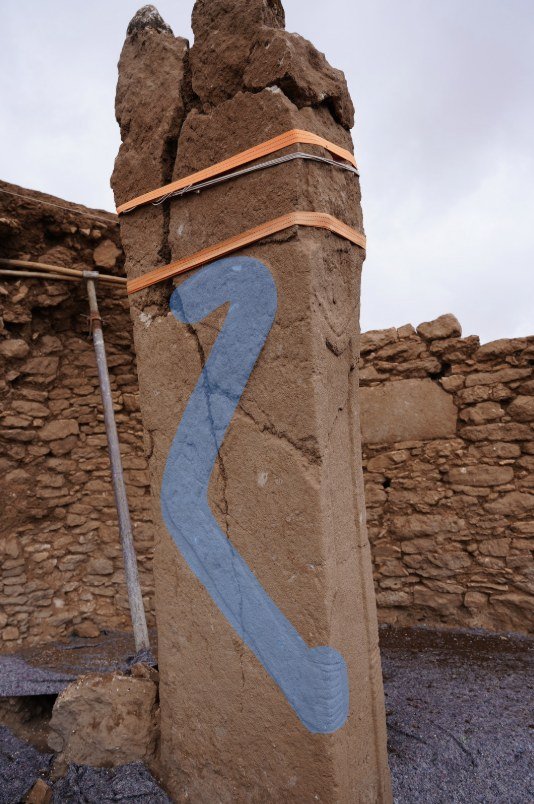
Why cranes — the masquerade evidence
Cranes are everywhere in the Pre-Pottery Neolithic of this region. At Göbekli Tepe, of all the birds these people left behind, cranes turn up second most often in the bones — they clearly knew cranes intimately. And the carvings do something peculiar with them. On Pillar 2 at Göbekli Tepe, beneath an aurochs and a fox, a crane is carved with human-looking legs — bending the wrong way for a bird. Since the site's artists render bird anatomy correctly elsewhere, the DAI team reads this not as a mistake but as a deliberate signal: a person in a crane costume, mid-masquerade.
The clinching find comes from Çatalhöyük, a related site, where a single Common Crane wing was recovered with the tell-tale marks of a costume: cut-marks showing the wing was detached at the joints, and holes pierced through the skin between the bones — as Nerissa Russell and Kevin McGowan argued, so that fibres could tie the wing to a person's shoulder (Russell & McGowan 2003). A detached crane wing, made to be worn at the shoulder. If a Karahan carver wanted to show exactly that — a wing where the shoulder meets the arm — a fan of long feathers is precisely how it would look.
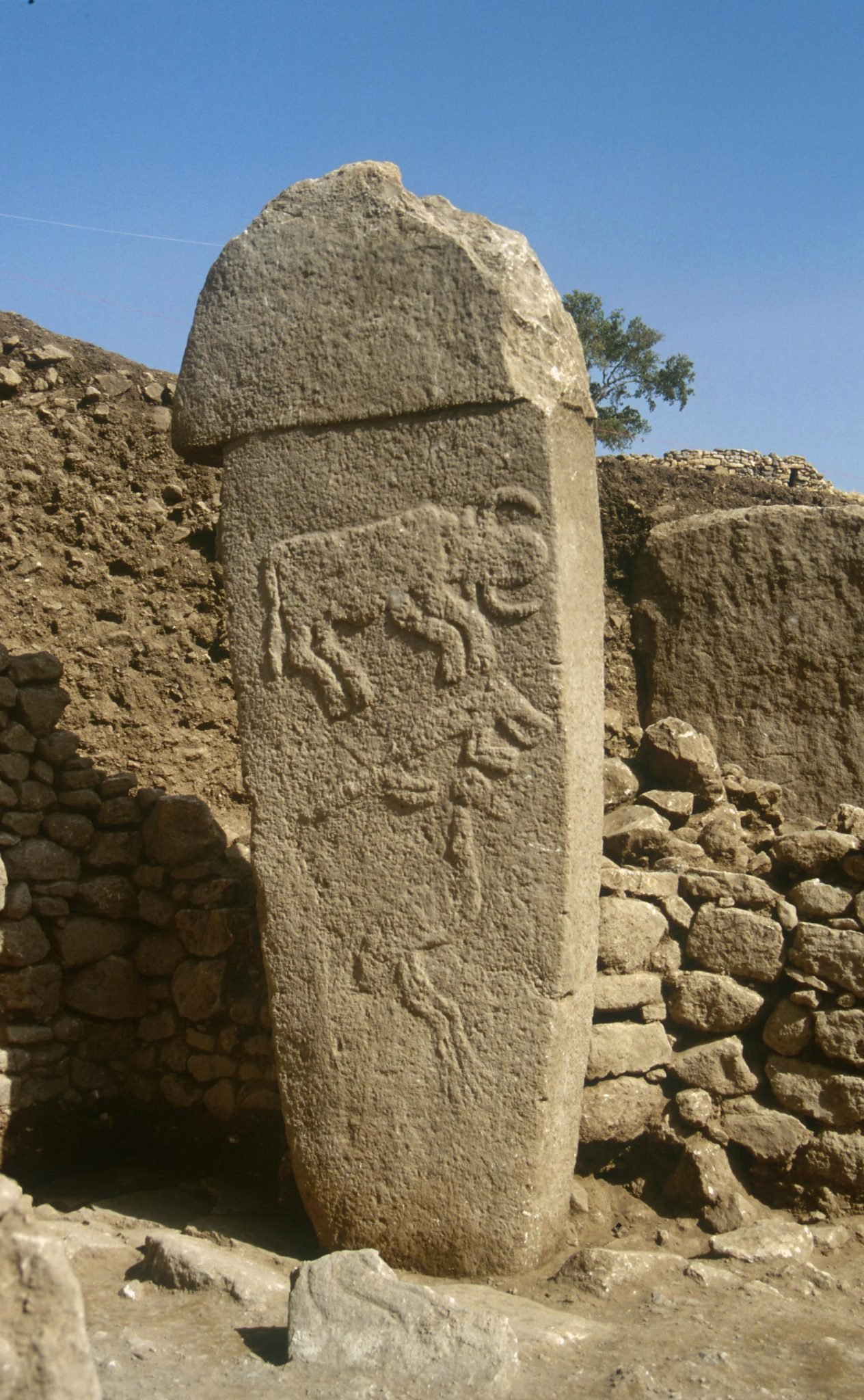
German Archaeological Institute, Göbekli Tepe Project, Pillar 2, Enclosure A, Göbekli Tepe, Copyright: DAI — used with permission, via .
Cranes, dance, and fertility
Why would people dress as cranes? Because cranes dance. Breeding pairs and whole flocks perform elaborate leaping, wing-spreading displays — and, famously, cranes will join a dance if a human starts one. In the Neolithic, dance is read as a powerful tool of communal bonding and myth re-enactment (Garfinkel 1998), and a bird that is roughly human-sized, long-lived, socially bonded and given to dancing is an obvious partner for people imagining their own origins. Russell and McGowan suggest crane dances were imitated to re-enact myths of origin — of the clan, or of humanity itself.
And crane dance is, at root, courtship: pair-bonding, mating, renewal. Cranes also return with the seasons, vanishing and coming back each year — an easy natural emblem of fertility and rebirth. That resonates hard at Karahan Tepe, a site saturated with fertility symbolism: rooms full of deliberately phallic pillars, the phallus-shaped uprights standing before a carved human head in Structure AB, and male imagery running through the wider Taş Tepeler network. A crane-winged figure — courtship-dancer, seasonal returner — would sit naturally inside that world of renewal and increase. On Wint's reading, this pillar is not just a person in stone; it may be a person caught in the act of becoming a crane, at a site obsessed with fertility.
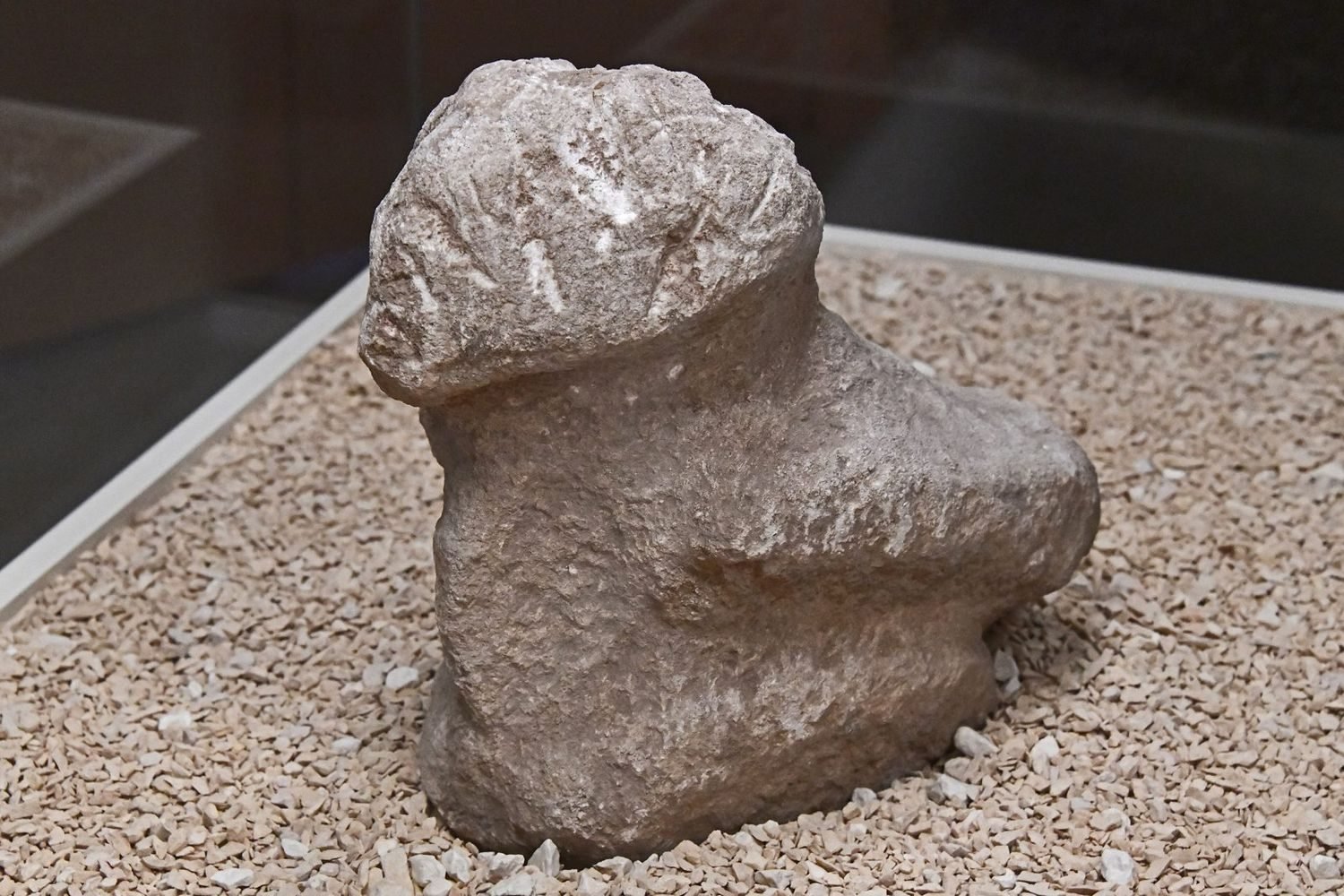
Dosseman, Urfa museum Karahantepe Statue of Bird Neolithic age in 2024 7312, CC BY-SA 4.0, via Wikimedia Commons.
Not the only half-animal being
If a crane-winged figure sounds far-fetched, remember that the Taş Tepeler world is full of beings that are not quite human. This pillar joins a small, striking family of composite figures — part person, part animal — and seeing them together makes the reading far less of a stretch.
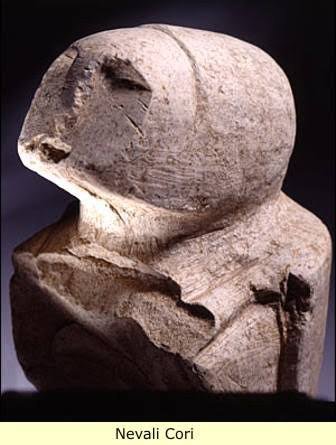
The most famous is the so-called 'bird-man' of Nevalı Çori, the Pre-Pottery Neolithic village (now drowned beneath the Atatürk Dam) that produced the earliest T-pillars of all. Among its sculptures is a life-size limestone head topped by a bird — most often read as a bird of prey perched on a human head, fusing person and bird into a single stone. Nevalı Çori also gave us a strange 'totem-pole' sculpture that stacks human figures and a bird of prey on top of one another. Human and bird, deliberately merged, more than a thousand years before Göbekli Tepe's great enclosures were buried.
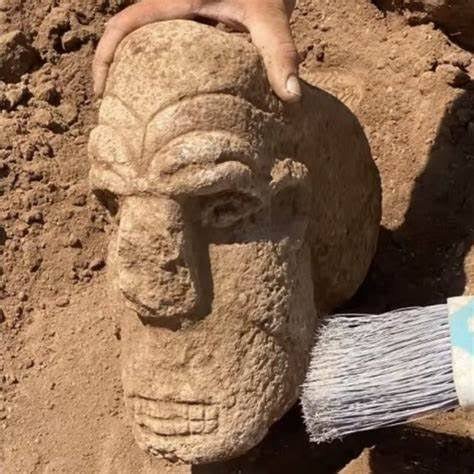
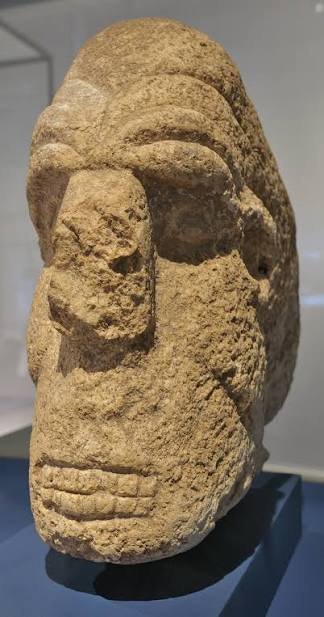
Closer to home, an obscure carved head from Karahan Tepe — heavy-browed and broad-muzzled, its face not quite a person's — is read by researcher Dakota Wint as a possible 'leopard-man': a human-feline composite. That would fit Karahan perfectly, because the leopard is one of the site's signature animals. Leopards prowl across its reliefs; one celebrated Karahan sculpture shows a human figure seated astride a leopard, its body gripped by the big cat. A leopard-headed being would simply be the sculptural cousin of a crane-winged one — the same impulse to blur the line between a person and a powerful animal.
Seen as a group, these figures reframe our pillar. A T-pillar that ends in a crane's wing is not a one-off oddity to be explained away; it is one more entry in a regional catalogue of human-animal beings — bird-men, leopard-men, crane-dancers — through which these communities seem to have thought about who, and what, they were. (Both the Nevalı Çori bird-man and the Karahan leopard-man are illustrated below.)
How the pillar was made — and why it survived
Whatever it depicts, the stone's history is the same. Karahan Tepe sits about 35 km east of Göbekli Tepe, and its builders carved the T-pillars from the local limestone, some shaped standing from the living bedrock. In his 2021 report, director Necmi Karul describes how the special buildings were then deliberately buried — filled with earth and stone in a careful, staged process and sealed under flat slabs. That burial is why a detail as fine as a fan of feathers survives at all: the stone that hid the figure for eleven millennia is also what preserved it.
Common questions
How many fingers does the Karahan Tepe pillar have? Each 'hand' carries eight slender grooves — sixteen in total — far more than the five of a human hand, and they splay outward like feathers rather than meeting at a belt.
Is it a hand or a crane's wing? Both readings are on the table. The standard interpretation treats such marks as fingers on a stylised human; researcher Dakota Wint proposes that the unusual count, the fanned shape and the atypical shoulder point instead to a crane's wing. It is a hypothesis pending the excavation team's own study.
Why are cranes important at these sites? Cranes are the second most common bird found in the animal bones at Göbekli Tepe; a Göbekli pillar shows a crane with human legs (a costumed dancer), and a Çatalhöyük crane wing was cut and pierced to be tied to a shoulder. Cranes' courtship dances and seasonal return link them to communal ritual and fertility.
What is uncertain
This is the honest heart of the piece. The crane-wing reading is a first-hand field hypothesis by researcher Dakota Wint, not the published conclusion of the Karahan Tepe excavation team — whose own study of this pillar's structure, phase and imagery is still to come, and should be treated as the authority when it appears. A weathered low relief can be read more than one way, and the 'many fingers' could yet be argued as a stylised or damaged human hand.
What is not speculative is the surrounding evidence: cranes really are dominant in the region's bird bones, Pillar 2's crane really does have human legs, the Çatalhöyük crane wing really was rigged to be worn, and Karahan Tepe really is steeped in fertility imagery. The hypothesis is an attempt to read one unusual pillar in the light of that firmly-attested world — offered as a question worth asking, not a fact to be repeated.
Key takeaways
- Each 'hand' on this Karahan Tepe pillar has eight fingers (sixteen in all) and an unusual shoulder — wrong for a human hand.
- Researcher Dakota Wint proposes the fanned grooves are the flight feathers of a crane's wing, not fingers.
- It's grounded: cranes are the second most common bird in the bones at Göbekli Tepe, a Göbekli crane has human legs (a costumed dancer), and a Çatalhöyük crane wing was rigged to be worn.
- Crane courtship-dance and seasonal return tie the bird to fertility — a theme that saturates Karahan Tepe's phallic imagery.
- It remains a hypothesis — the excavation team's own reading of the pillar is still to come.
Sources
- Peters, J. & Schmidt, K.; and DAI Tepe Telegrams — 'Dances with Cranes': animal masquerade in Pre-Pottery Neolithic ritual
- Russell, N. & McGowan, K. J. (2003). Dance of the Cranes: crane symbolism at Çatalhöyük and beyond. Antiquity 77(297), 445–455.
- Karul, N. (2021). Buried Buildings at Pre-Pottery Neolithic Karahantepe. Türk Arkeoloji ve Etnografya Dergisi 82, 21–31.
- Schmidt, K. (2010). Göbekli Tepe – the Stone Age Sanctuaries. Documenta Praehistorica 37 (the anthropomorphic T-pillar reading).
- Field observation & hypothesis: Dakota Wint (Taş Tepeler archive) — first-hand examination and photographs of the pillar.
- Hauptmann, H. — the Nevalı Çori sculptures, including the composite 'bird-man' head and the human-and-raptor 'totem-pole' figure.
This article is written from the primary literature and excavators' reports cited above. Interpretations are attributed; uncertainties are stated in the text.
Go deeper
Dances with cranes: a Neolithic animal masquerade →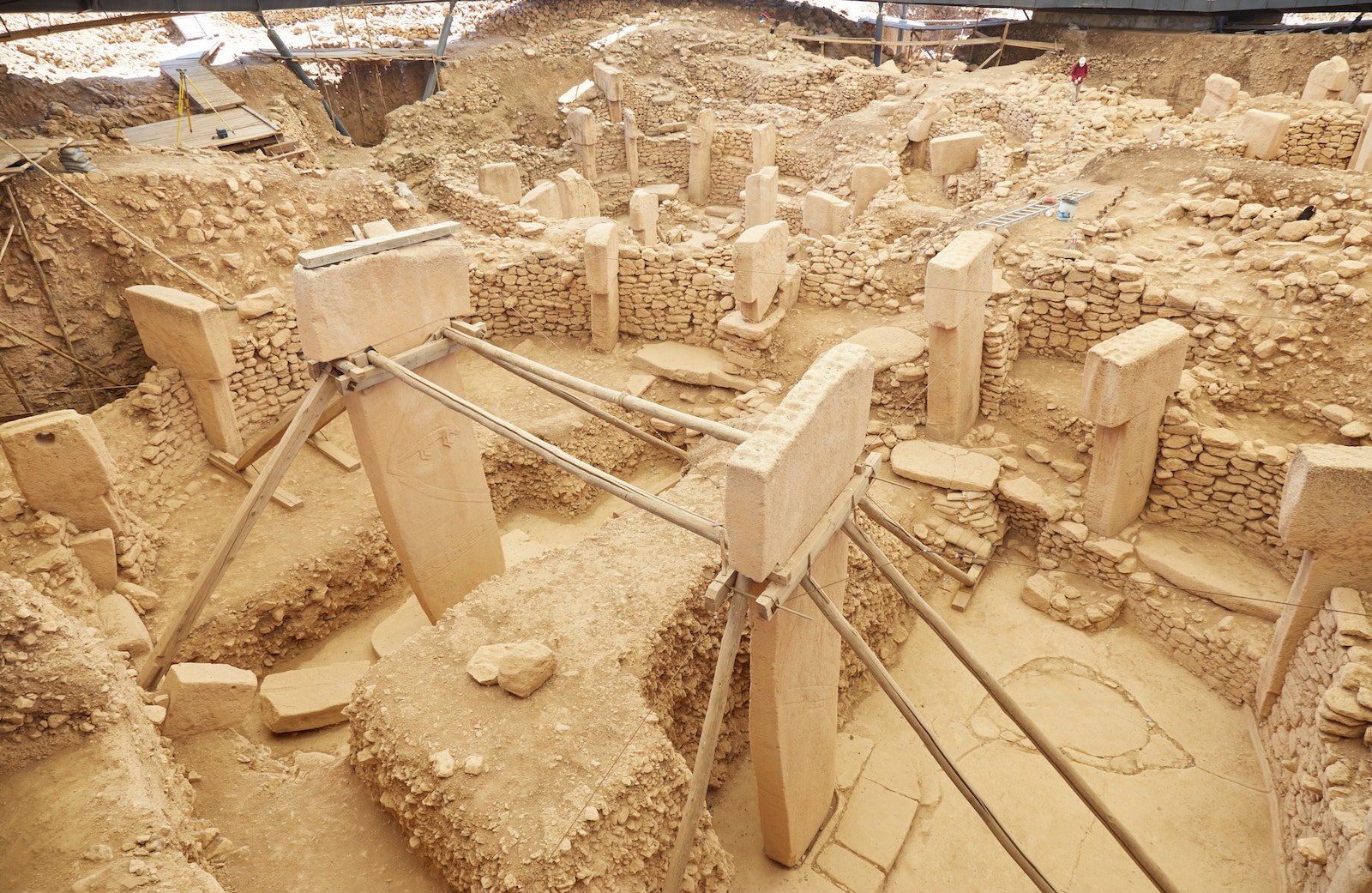 The T-pillar is a body: why the great stones are people, not columns →Nevalı Çori: the drowned village that carved the first T-pillars →What do Göbekli Tepe's animals mean? →What are Karahan Tepe's phallus pillars? →What is Karahan Tepe's Structure AB? →