Short answer
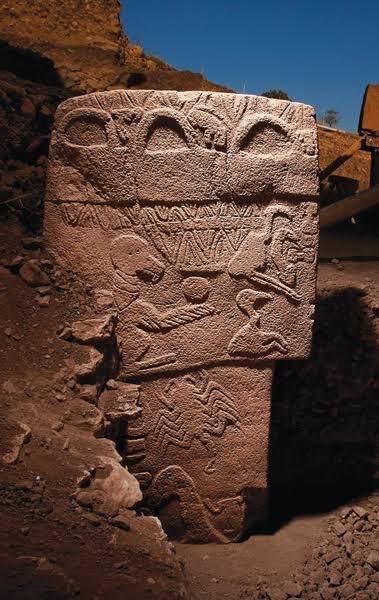
The carvings are a shared symbolic language centred on dangerous wild animals, the human body, and death — foxes, snakes, vultures and scorpions rather than the gazelle people actually ate; humans shown headless, abstracted into pillars, or reduced to a single carved head.
It recurs across many sites over centuries, so it was clearly meaningful and shared. But there is no evidence it encodes a single decodable system such as a calendar or star map. We can see the vocabulary; we have lost the grammar.
A bestiary of the dangerous
The most striking fact about the animals carved across these sites is which ones were chosen. Peters and Schmidt's study of the Göbekli Tepe fauna showed that the creatures on the pillars are overwhelmingly wild and dangerous — foxes, snakes, wild boar, aurochs, scorpions, spiders, and vultures — not the gazelle and wild sheep the people actually hunted and ate. This was not a record of the menu. It was a world of powerful, threatening beings.
Some animals appear in dramatic three dimensions, like the snarling predator of Pillar 27; others swarm across the stone in dense low relief. Each pillar is different, and the combinations look deliberate.
The human, abstracted and broken
Alongside the animals runs a preoccupation with the human body — but rarely a whole, ordinary person. The great central pillars are humans abstracted into faceless giants with arms, hands, and belts. Elsewhere the human appears headless (the Vulture Stone) or reduced to a carved head (Karahan). At Karahan and beyond, phallic imagery is prominent. The body is present, but always transformed — a sign, not a portrait.
Then, rarely, it becomes a scene. The Sayburç relief (Özdoğan 2022) shows figures and animals arranged as what may be the earliest narrative 'story' ever carved — a glimpse of myth, not just symbol.
One language, many hands
What makes this a shared symbolism rather than a set of local habits is how the same elements recur across the landscape. The T-pillar-as-human, the fox, the snake, the concern with the head — these turn up at Göbekli Tepe, at Karahan Tepe, at Sayburç, at Sefertepe, over many centuries. Different communities were plainly drawing on the same pool of images.
But they were not copying. Sayburç produced a narrative scene nobody else has; Karahan reduced the human to a head watching a room; Göbekli filled its pillars with swarming predators. The same words, in different hands — which is exactly what you would expect of neighbours in conversation, not outposts of one cult.
Sex, and the near-absence of women
The symbolism is emphatically male. Where the sex of a carved animal can be read, it is male; the human imagery is dominated by phalli, most insistently at Karahan Tepe, where pillars themselves take phallic form. Set against this, images of women are almost entirely missing. At Göbekli Tepe there is a single clearly female figure — a graffito of a woman, apparently giving birth, scratched into a slab in a later building, long after the great enclosures were raised.
It is worth being careful about what this means. What survives is what was carved in durable stone by whoever did the carving; it is not a census of who mattered or what everyone believed. But the pattern itself — overwhelmingly male, focused on the phallus, the head and dangerous animals — is real and consistent, and any honest reading of the symbolism has to start from it rather than around it.
Symbols that step off the wall
Not all of this is relief carving. Some of the most charged imagery is fully three-dimensional. Predators crawl head-downward off the tops of pillars; a snarling big cat projects in high relief from Pillar 27 at Göbekli Tepe; at Karahan Tepe a human head is carved out of the bedrock so that it leans into the room and watches the entrance, and free-standing statues — a gaunt seated man, animals — were set up to be seen from every side.
This matters for reading the symbolism, because a sculpture in the round is made to share space with living people, not just to be looked at on a surface. The line between 'decoration' and 'presence' dissolves: some of these images were built to inhabit the room alongside whoever entered it.
Reading it honestly
Abstract signs appear too — most famously the 'H' symbol, along with crescents and other marks whose meaning is unknown. The temptation is to decode all of this into a single system: a calendar, a star map, a religion. The evidence doesn't support that, and the site's own excavators resist it.
What we can say is disciplined and still astonishing: these communities shared a rich symbolic language, repeated across many sites over centuries, centred on dangerous animals, the human body, and death. We can see the vocabulary. We have lost the grammar.
Common questions
What do the animals at Göbekli Tepe mean?
They're overwhelmingly wild, dangerous animals rather than everyday prey, suggesting a symbolic 'language' about power, danger, and belief rather than a record of hunting. The precise meaning is unknown.
What is the H symbol at Göbekli Tepe?
A recurring abstract sign shaped like an 'H,' found alongside crescents and other marks. Its meaning is not known, though it appears deliberately and repeatedly.
Is there a hidden code in the carvings?
There's no evidence for a single decodable system (like a calendar or star map). The imagery is a shared symbolic language whose specific meanings are lost.
Sources & further reading3 references
- Peters, J. & Schmidt, K. (2004). Animals in the symbolic world of Pre-Pottery Neolithic Göbekli Tepe, south-eastern Turkey: a preliminary assessment. Anthropozoologica 39(1): 179–218.
- Schmidt, K. (2012). Göbekli Tepe: A Stone Age Sanctuary in South-Eastern Anatolia. Berlin: ex oriente. The foundational monograph by the site's first excavator.
- Özdoğan, E. (2022). The Sayburç reliefs: a narrative scene from the Neolithic. Antiquity 96(390): 1599–1605. doi:10.15184/aqy.2022.125
Full bibliography: the Taş Tepeler reference library →