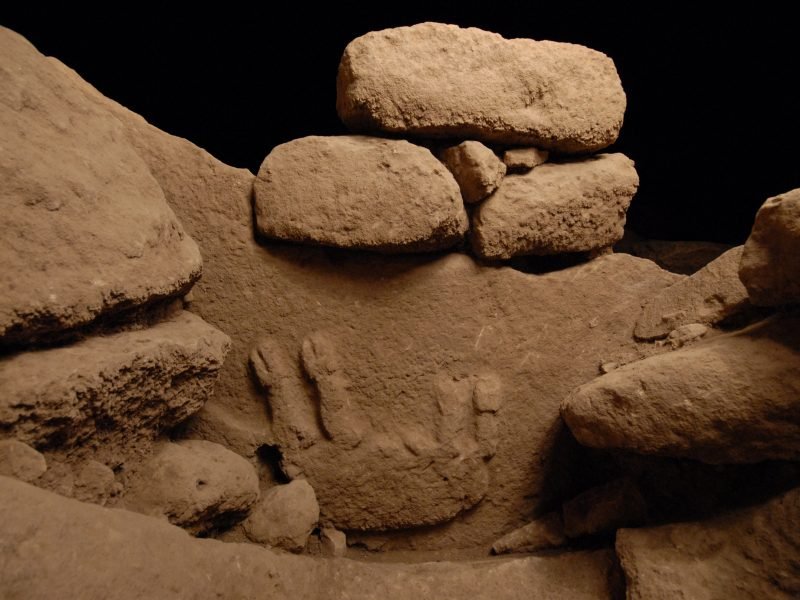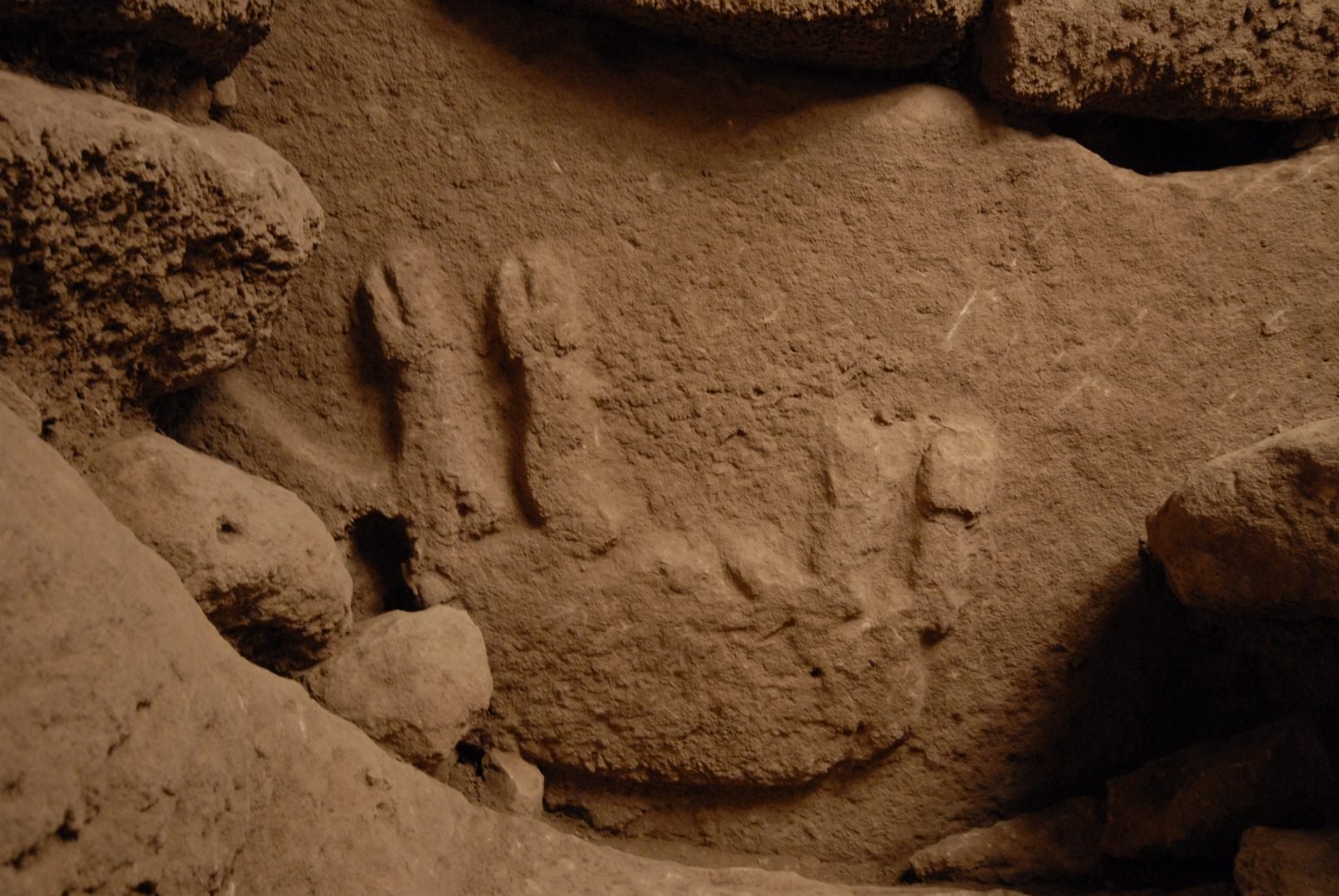
The same strange object, again and again
Among the most quietly puzzling things the Taş Tepeler excavators keep finding is the porthole stone: a roughly quadrangular slab of limestone pierced by one or two round openings. It is not a decorative detail unique to one building. It recurs — at Göbekli Tepe, at Karahan Tepe, and at other T-pillar sites in the region — which makes it one of the small shared signatures that tie these places together.
The name is a modern convenience, borrowed from a ship's round window. What the openings actually did is the interesting part, because the porthole stones do not all behave the same way.
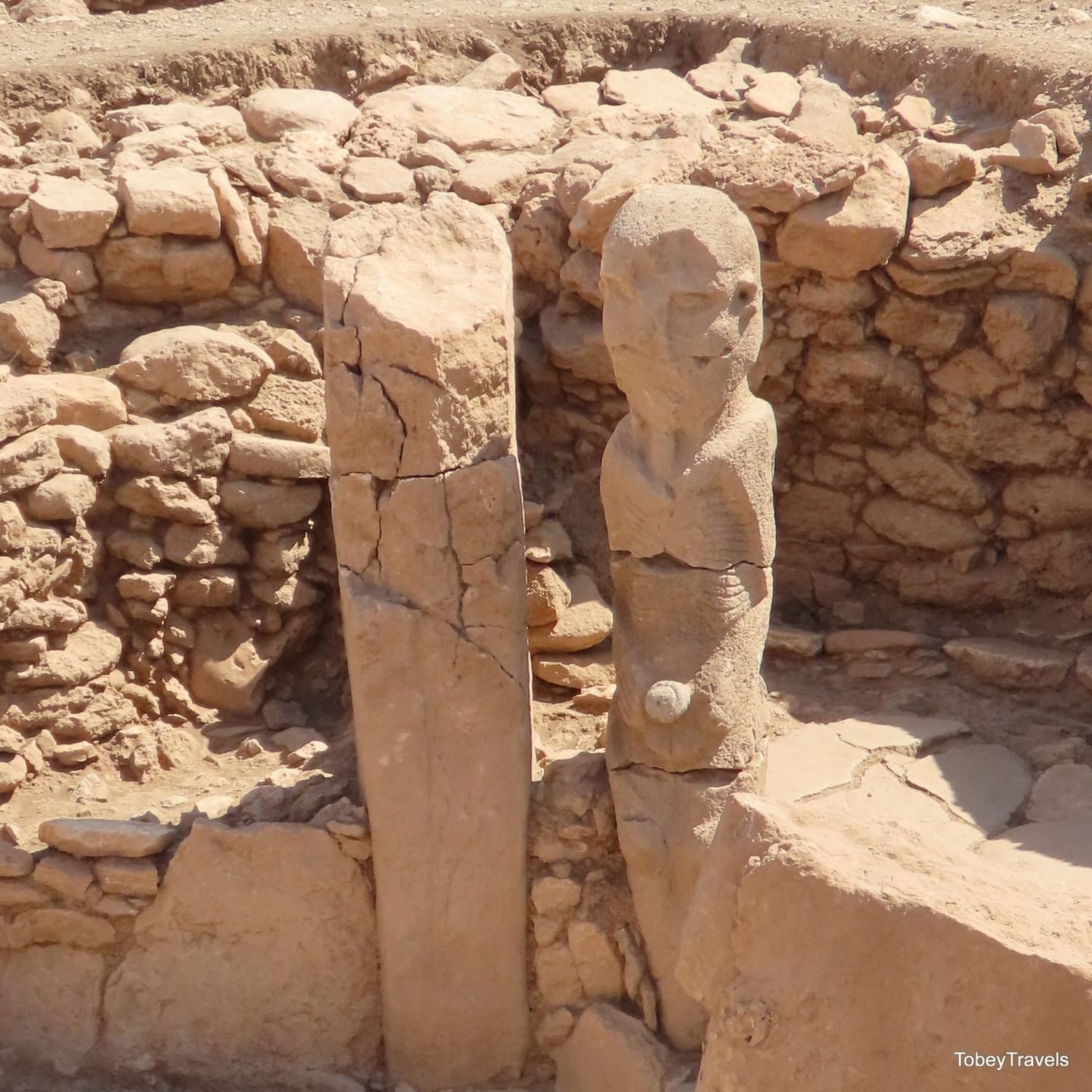
tobeytravels, Porthole Stone and Phallic Statue Enclosure, Area 08, Karahantepe (Karahan Tepe), Turkey, CC BY-SA 4.0, via Wikimedia Commons.
Set in a wall, lying loose, or a window between rooms
At Göbekli Tepe, one porthole stone was found lying on the terrazzo floor of Enclosure B, off to one side; its original placement is unresolved. But a richly decorated example was found in situ in a wall north of the same enclosure, which supports the idea that some of these slabs worked as entrances or threshold elements. South of Enclosure C, a porthole slab stood at the mouth of a corridor-like passage, with a wild boar carved in relief below the opening — the piece the excavation team once described, memorably, as being 'guarded by beasts'.
At Karahan Tepe the idea reappears in a different guise. In the bedrock-cut chamber Structure AB, a porthole-like opening pierces the rock as a 'window' through to the neighbouring Structure AD — an opening between two rooms rather than a door to the outside. Elsewhere on the mound a porthole stone stands beside a phallus-shaped statue. Same concept, adapted to a site that carved its rooms downward into the rock instead of building them up.
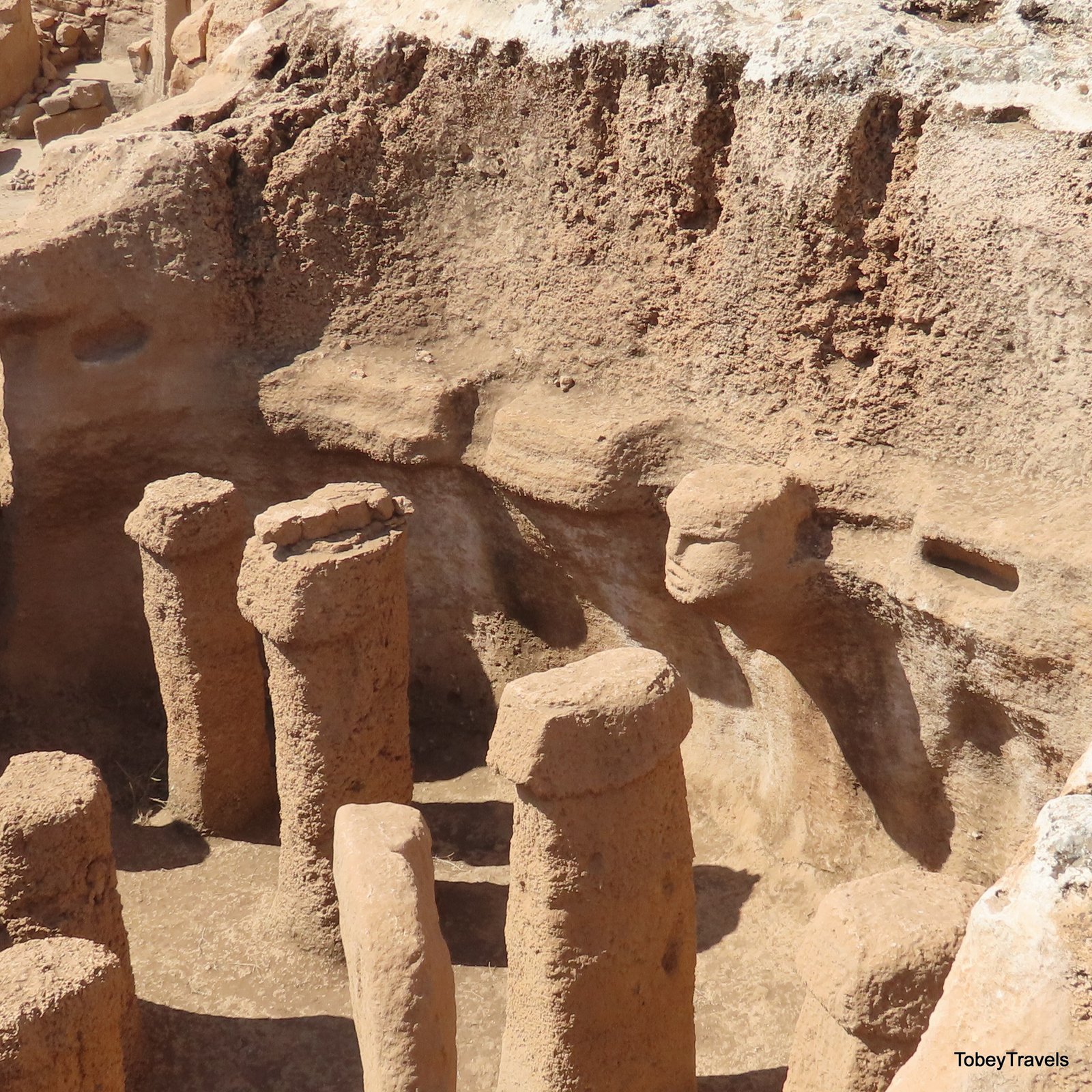
tobeytravels, Structure AB, Pillars Shrine with Porthole Window to AD and Carved Head, Karahantepe (Karahan Tepe), Turkey, CC BY-SA 4.0, via Wikimedia Commons.
Why 'doorways to nowhere'
Here is the catch that makes the porthole stones so intriguing: several of the openings are too small for an adult to pass through. Whatever they framed, it was often not a body. That has led excavators to read at least some of them as symbolic thresholds — a passage between spaces, or between states, marked in stone rather than physically walked.
The boar carved beneath the Enclosure C opening points the same way. If an animal 'guards' the hole, the hole is not merely structural; it is charged, a place where something crosses over. Whether that crossing was for spirits, for the dead, for light on a particular day, or for an idea we can no longer recover, the stones do not say.
A door for something that isn't a body
The detail that makes these stones so intriguing is their size. If several of the openings are too small for an adult to squeeze through, then whatever they framed was often not a person. That has pushed excavators toward reading at least some of them as thresholds of meaning rather than of movement — a crossing between spaces, or between states, marked out in stone even though no one physically walked through it.
The carved boar beneath the Enclosure C opening points the same way. If an animal is set to 'guard' a hole, the hole is not merely structural — it is charged, a place where something is imagined to cross over. Whether that crossing was meant for spirits, for the dead, for light on a particular day, or for an idea we can no longer recover, the stones themselves stay silent.
The same idea, built up or cut down
Part of what makes the porthole stone such a good network signature is how it adapts from site to site. At Göbekli Tepe, where rooms were built up from the ground, portholes appear in walls and at the mouths of passages. At Karahan Tepe, where the builders cut their chambers downward into the living rock, the same idea returns as a window pierced between Structure AB and Structure AD. Same concept, opposite construction — a shared element flexing to fit two very different ways of making a room, across the Şanlıurfa region some twelve thousand years ago.
What is uncertain
The function of porthole stones is unsettled, and honest excavation reports keep it that way. Some clearly framed entrances; others were found displaced, their original setting lost; the 'window' between Karahan's AB and AD is described from field observation that awaits full publication. Popular claims that specific portholes were astronomical sightlines are not established.
What is solid is the pattern itself: the perforated slab is a recurring architectural element across the Taş Tepeler sites, not a one-off. Reading any single example in isolation is exactly the trap the excavators warn against.
Common questions
What is a porthole stone at Göbekli Tepe? A roughly quadrangular limestone slab pierced by one or two round openings. The name is a modern convenience borrowed from a ship's round window; some framed entrances, while others may have been symbolic thresholds.
What were the porthole stones used for? It's unsettled. Some clearly framed entrances or served as windows between rooms, but several are too small to climb through, so excavators read at least some as symbolic thresholds — a passage between spaces or states, marked in stone.
Key takeaways
- A porthole stone — a slab pierced by a round hole — recurs at Göbekli Tepe, Karahan Tepe and other T-pillar sites, a small shared signature.
- They don't all behave alike: some sat in walls as thresholds, one was found loose, and at Karahan one is a "window" between two rooms.
- Several openings are too small for an adult to pass through, so many may be symbolic thresholds rather than real doorways.
- At Enclosure C a wild boar is carved below the opening — an animal that seems to 'guard' a charged crossing-point.
Sources
- DAI Tepe Telegrams — Guarded by beasts: a porthole stone from Göbekli Tepe
- DAI Tepe Telegrams — Boars in Göbekli Tepe's Enclosure C
- Karul, N. (2021). Buried Buildings at Pre-Pottery Neolithic Karahantepe. Türk Arkeoloji ve Etnografya Dergisi 82.
This article is written from the primary literature and excavators' reports cited above. Interpretations are attributed; uncertainties are stated in the text.