Göbekli Tepe · Şanlıurfa, Türkiye · One of the great ring buildings
Enclosure D
PPNA · Layer III · 10th millennium BCE · oval ring · Ø ~14 m · ~11–12 wall pillars · two central (18 & 31)
The best-preserved and most completely exposed of Göbekli Tepe's great Pre-Pottery Neolithic ring buildings — an oval of T-shaped pillars around two colossal human-like central pillars, and home to the site's most famous carving, the Vulture Stone.
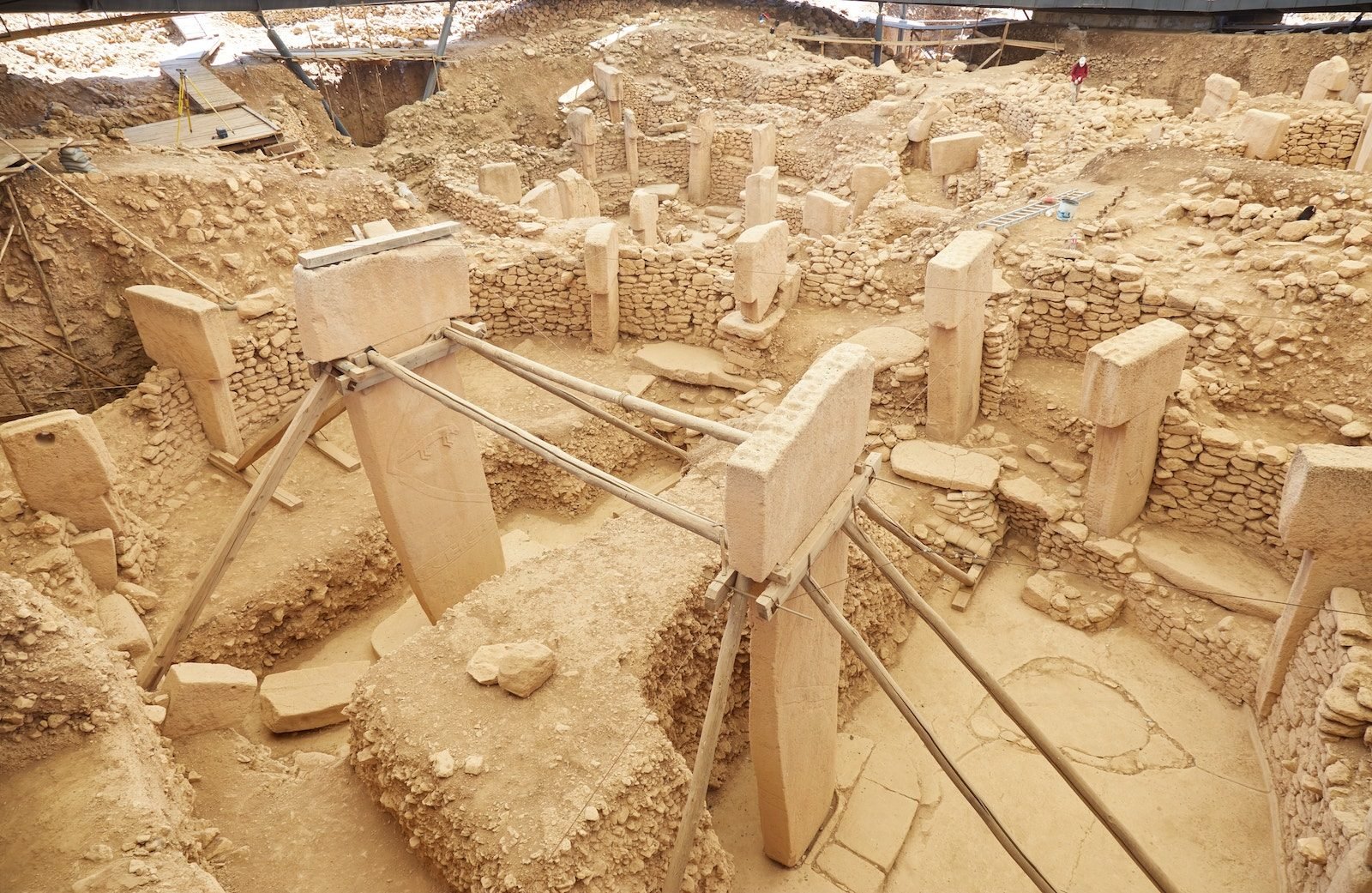
Enclosure D exposed: the oval ring of inward-facing T-pillars around the two central monoliths (18 & 31), read from the inside beneath the protective shelter. Photo: DAI, Göbekli Tepe Project.
German Archaeological Institute, Göbekli Tepe Project, Enclosure D, Göbekli Tepe, Copyright: DAI — used with permission, via .
01
Quick facts
The reference building against which the site's more fragmentary enclosures are read. Published diameters vary (~12–20 m); the weight is an estimate, not a measurement.
Period
PPNA — 10th millennium BCE (Layer III)
Inner diameter
oval ring, ~14 m across
Central pillars
two — Pillars 18 & 31, standing parallel
Central pillar height
~5.5 m tall
Central pillar weight
roughly 8–10 tonnes eachestimate
Wall / ring pillars
~11–12 T-shaped pillars, facing inward
Floor
smoothed natural bedrock; pillars on cut pedestals
Famous carving
Pillar 43 — the Vulture Stone
Height (~5.4 m / ~5.3 m raised, spring 2010) is DAI-measured; the ~8–10 t weight is a published estimate, not a weighed figure. Inner diameter of ~14 m is defensible, but published figures vary — the authoritative plan is Schmidt 2012.
02
The architecture
Enclosure D is an oval room built to be read from the inside. A stone ring wall with a low bench along its inner face encloses the space; into that wall are set roughly eleven smaller T-shaped pillars, each turned to face the centre. At the heart stand two far larger T-pillars — 18 and 31 — parallel to one another, so that everything in the building points inward toward them. The floor is smoothed natural bedrock, and the two central pillars rise from pedestals carved out of that bedrock. Because it survived so completely, Enclosure D is the yardstick against which the site's more fragmentary buildings are read.
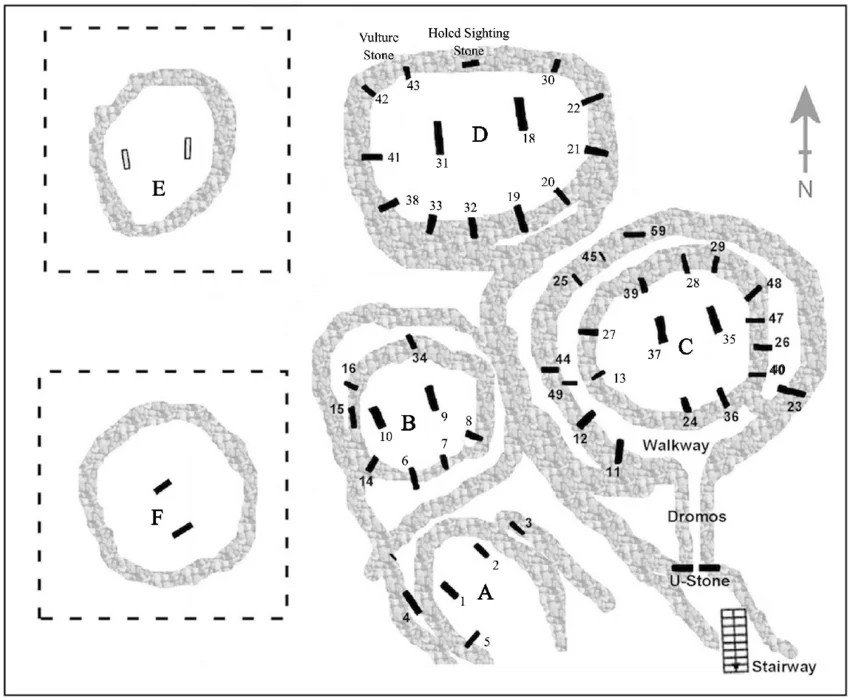
Excavation plan of the main enclosures (A–F). Enclosure D reads as the oval at the centre — the two central pillars (18 & 31) inside a ring of numbered T-pillars, with Pillar 43 (the Vulture Stone) and Pillar 30 (the Holed Sighting Stone) on the wall. Aerial photography isn't possible under the site's protective roof. Plan: after the Göbekli Tepe Project (DAI).
Key to the building — Central pillars 18 & 31 the two colossal, parallel human-like monoliths at the focus of the room (the central-pillars page). Ring / wall pillars the surrounding T-pillars set into the ring wall, each turned inward toward the centre — on the plan, Pillars 19, 20, 21, 22, 30, 32, 33, 38, 41, 42 and 43. Pillar 43 the Vulture Stone, the most famous carved wall pillar. Pillar 33 a richly carved wall pillar — cranes, snakes and a fox. Pillar 30 the Holed Sighting Stone on the ring wall (no page yet). Floor smoothed natural bedrock; the central pillars rise from pedestals cut from that bedrock.
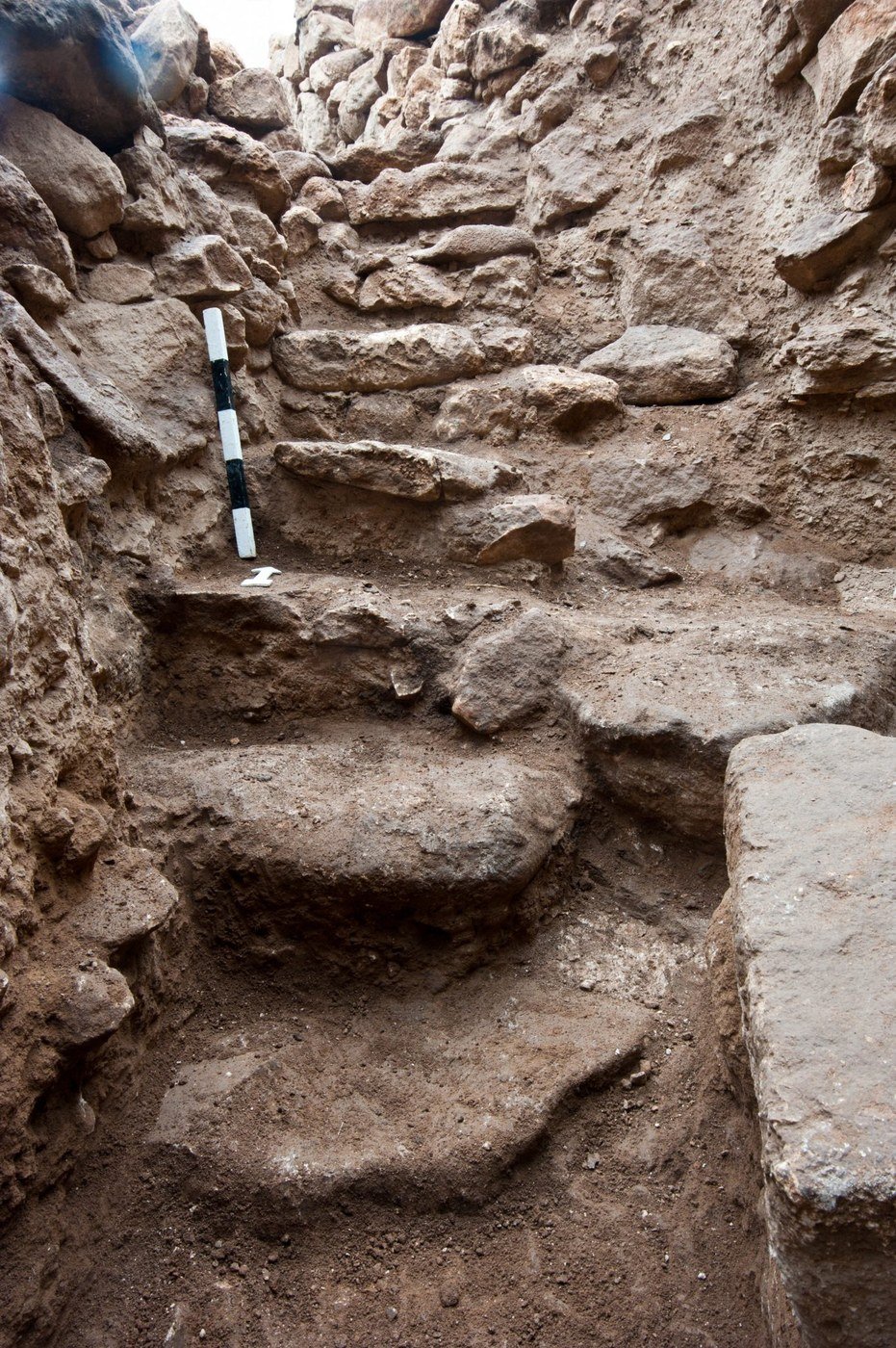
Enclosure D's way in looks more elaborate than a simple gap in the wall. Excavation of the entrance area has exposed a built stairway — so far eight steps — suggesting a more complex, staged approach into the building rather than a single threshold.
Eight steps of a stairway uncovered in the apparently more complex entrance situation of Enclosure D. Photo: N. Becker, DAI, Göbekli Tepe Project.
How it was built — quarrying from the living rock
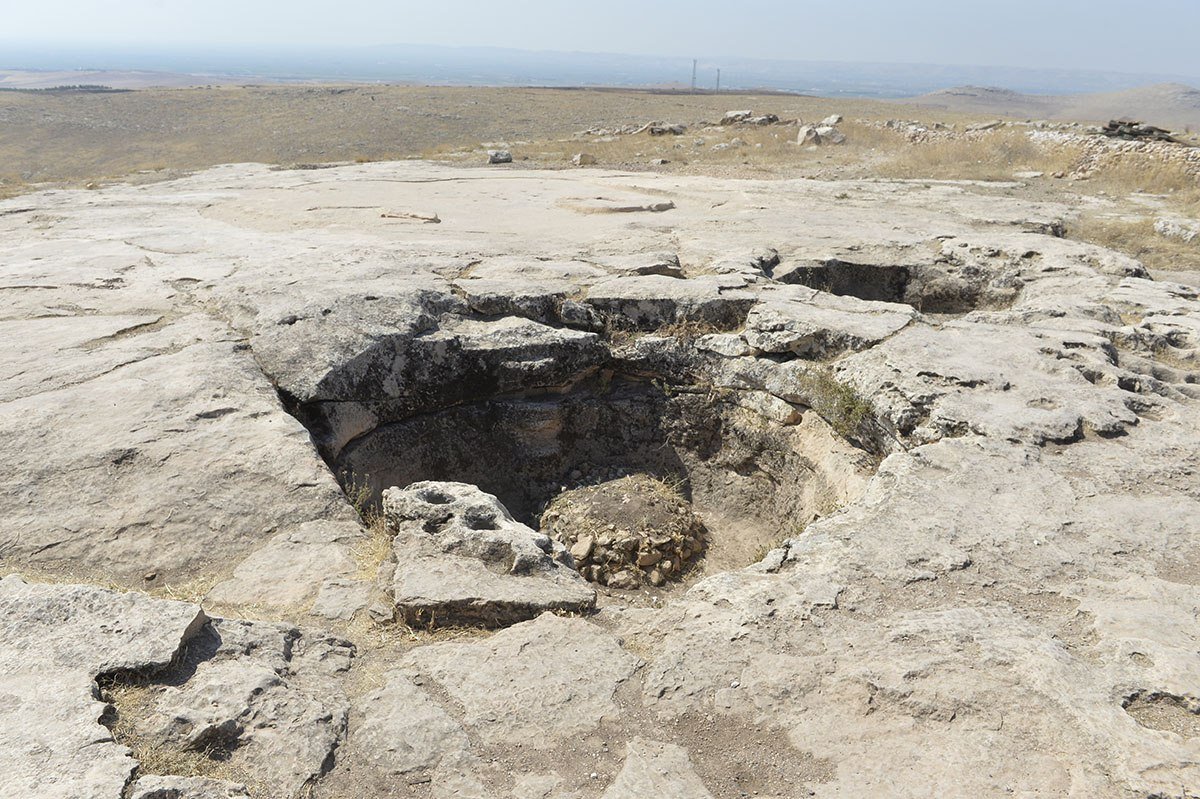
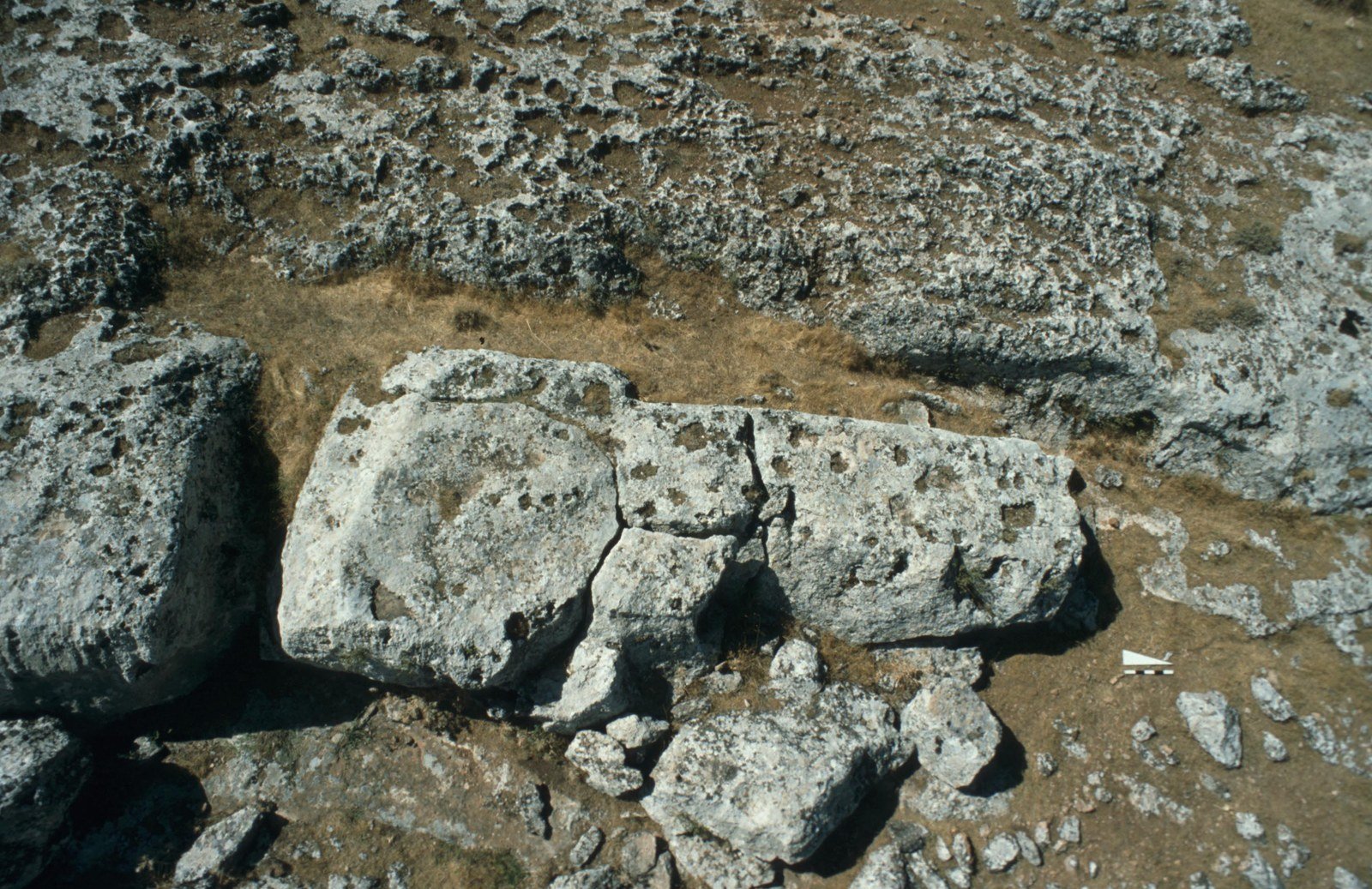
The builders did not haul stone from far away — they worked the limestone bedrock of the ridge itself. The great T-pillars were quarried whole, as single monoliths; the walls between them are dry-stone masonry, not cut blocks; and the enclosure floors and the pedestals beneath the central pillars were cut straight from the living rock. On flat exposures nearby, half-worked bedrock still records the process — pillar outlines with a channel cut around them, and rows of small pecked cup-like hollows.
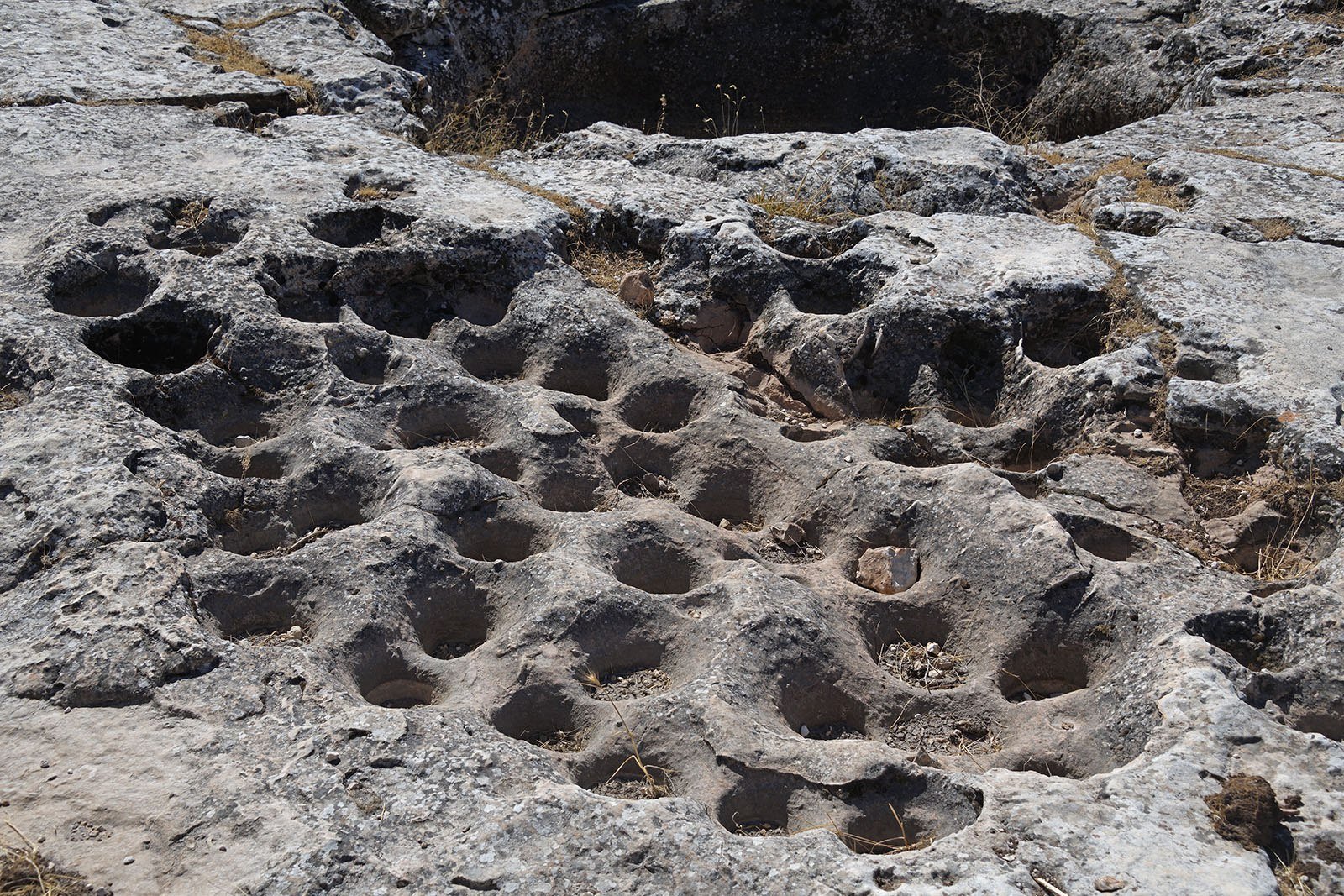
What those rows of cup-hollows were for is not settled. Because Göbekli's builders did not work in dressed blocks, a likelier reading than block-quarrying is that they mark an early stage of cutting a structure down into the bedrock — the first bite of hollowing out a space in the living rock, as the enclosures and later Taş Tepeler buildings were carved — a beginning left unfinished. This is an interpretation, not an established fact.
Rows of cup-like hollows pecked into the bedrock. Their purpose is debated: rather than freeing cut blocks, they may be the first stage of carving a structure down into the living rock — a beginning left unfinished. (Interpretation.) Bedrock working on the ridge; location "near Enclosure E" per the owner, not independently confirmed.A basin cut straight into the living bedrock of the hilltop — the same worked rock from which pillars, floors and pedestals were shaped. Bedrock working on the ridge; location "near Enclosure E" per the owner, not independently confirmed.
The quarries lie on the same limestone plateau as the tell. The rock is banked in strata about 0.6–1.5 m thick, split by natural fault lines — so masons only had to cut around a workpiece, not beneath it. Using flint picks (and probably wooden tools), they dug a channel in the shape of the wanted pillar down to the fault line, then levered the block free with wooden beams and wedges. When a flaw or crack appeared, the piece was abandoned in place — which is why several near-finished pillars still lie in the quarries, recording the technique first-hand.
The largest of these is a T-shaped pillar about 7 m long and 1.5 m thick, left on the edge of the western plateau — an estimated ~50 tonnes. Cutting it at the plateau edge meant less rock to remove on one side. Why it was left is unclear: perhaps a hairline crack, perhaps simply too big to move the few hundred metres to the tell. No direct traces of the transport survive; ethnographic parallels from Indonesia (wooden sledges and planks, large teams) suggest how monoliths of this size could be hauled — no aliens required.
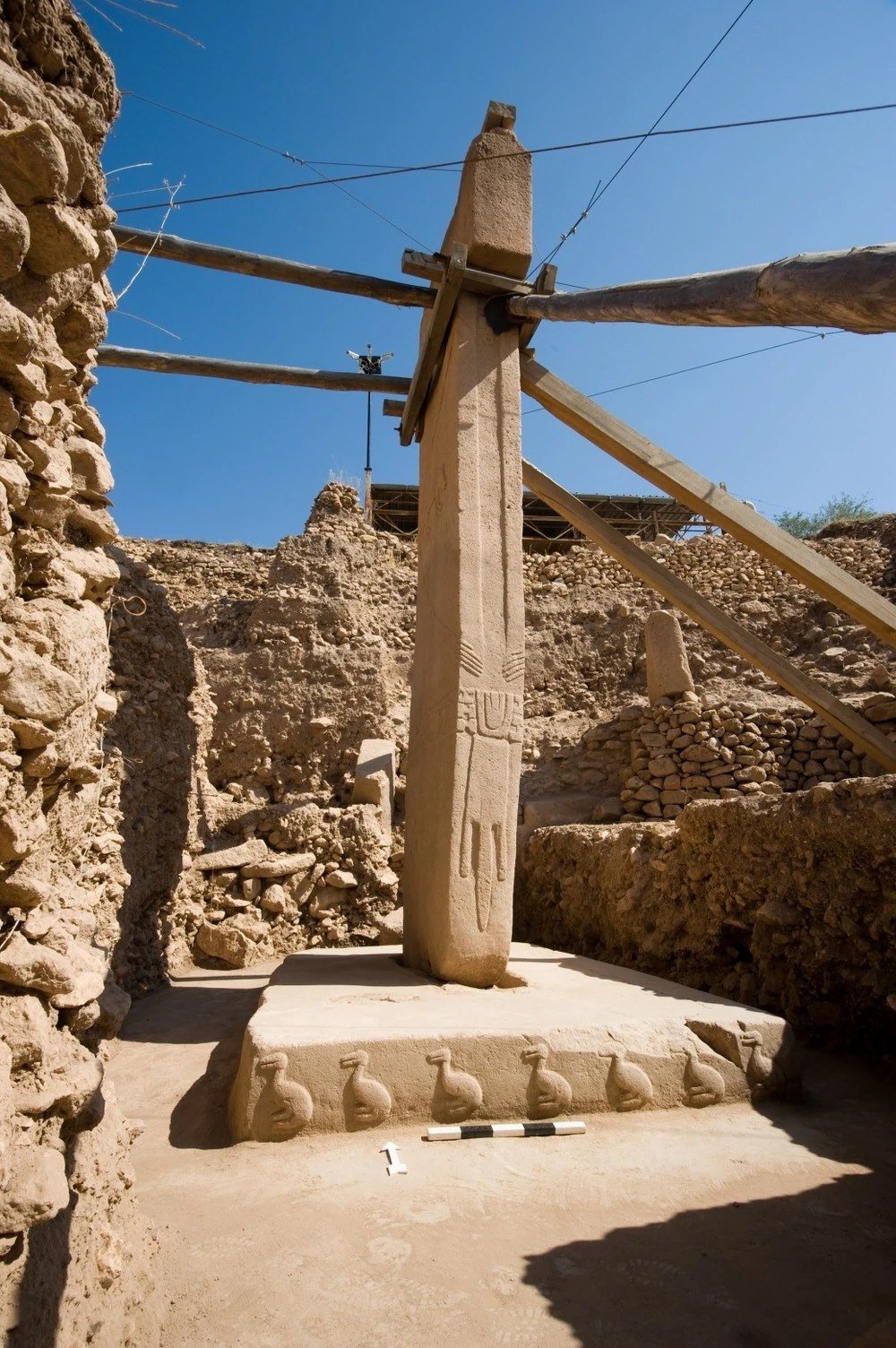
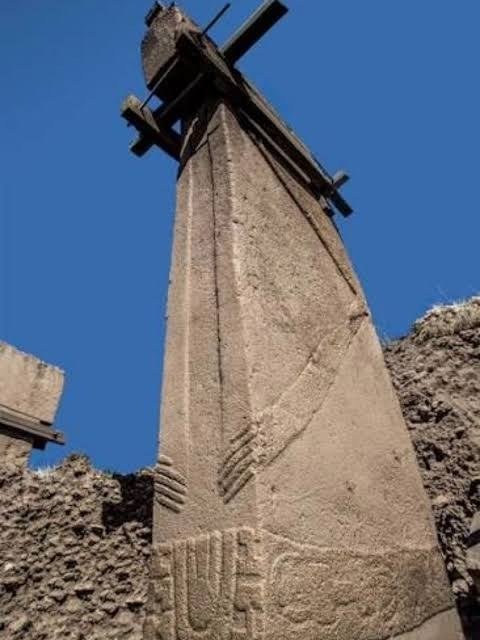
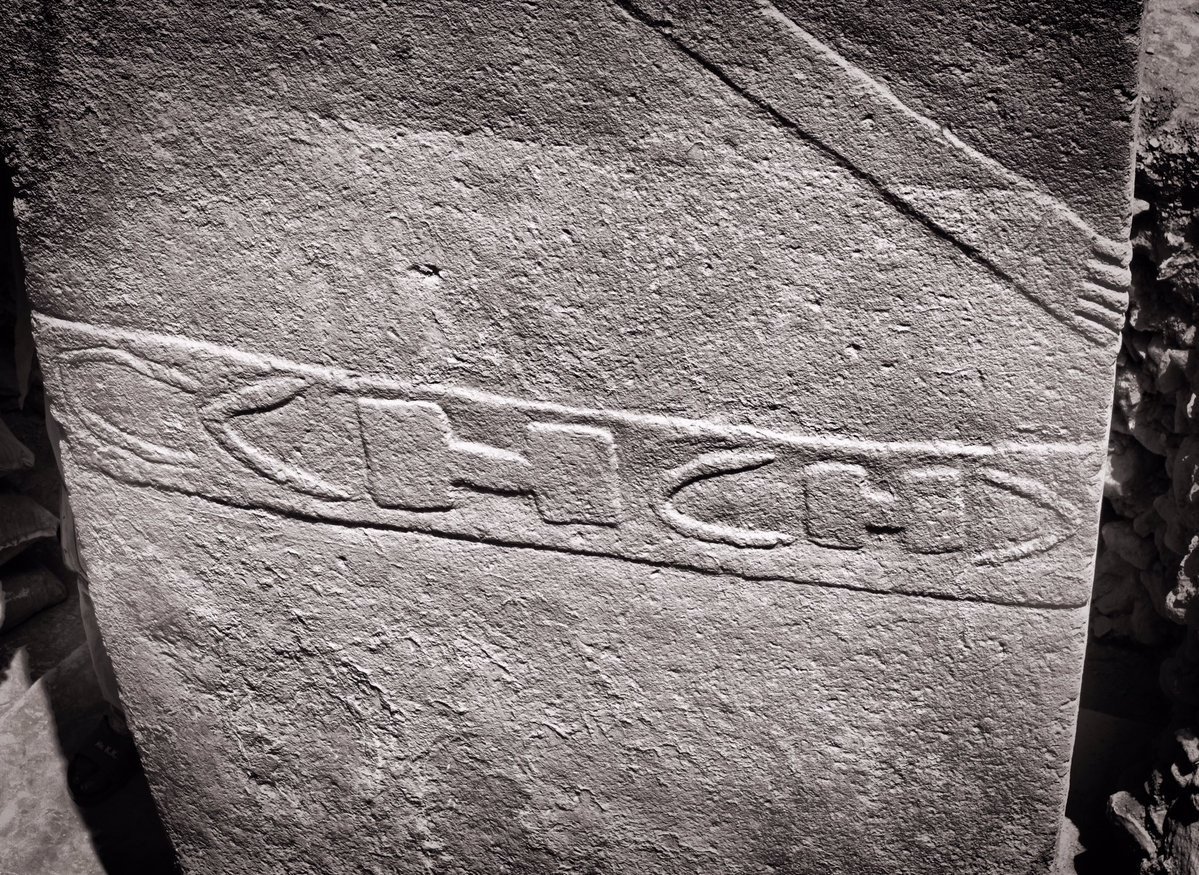
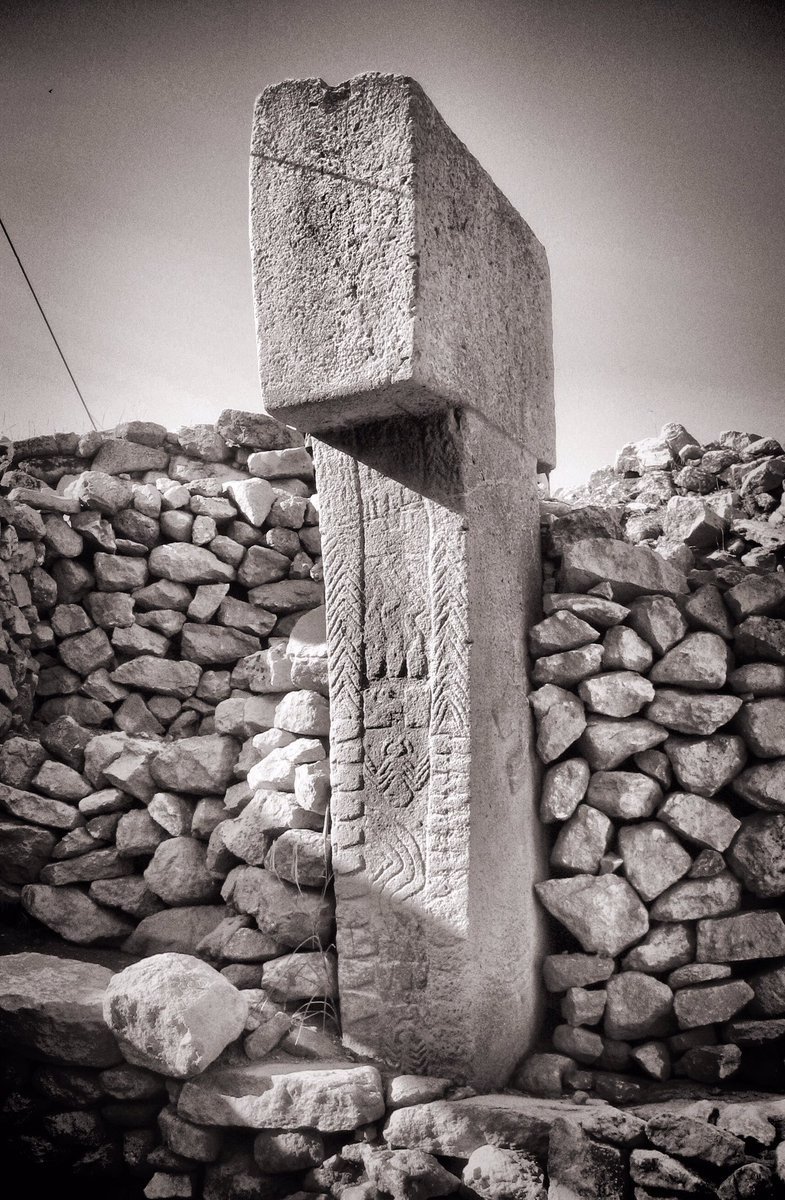
From a distance the two central pillars look like plain T-shaped posts. Up close the human reading is unmistakable: the long shaft is a body, the wide top is a head seen from the side, and arms run down the flanks to long-fingered hands that meet over the belly. A belt circles the waist — worked with repeating H-shaped and C-/crescent-shaped signs — and below it hangs an animal-skin loincloth, rendered as a fox pelt. There are no faces: no eyes, no mouth. The pair stand parallel, dressed alike, at the focus of the room, while the smaller wall pillars face inward toward them. The intent to show a clothed human-like body is not in doubt; who or what they represent — ancestors, spirits, deities, idealized humans — is not known.
Both are single quarried limestone blocks carved in low relief: Pillar 18 stands about 5.4 m, Pillar 31 about 5.3 m. The arms bend at the elbow and five long fingers of each hand meet over the belt; the same abstract H- and C/crescent "small signs" on the belt recur on other pillars and on portable objects; a fox also appears on the shaft of Pillar 18. The facelessness appears deliberate, and the pair is set parallel, aligned roughly NW–SE at the centre.
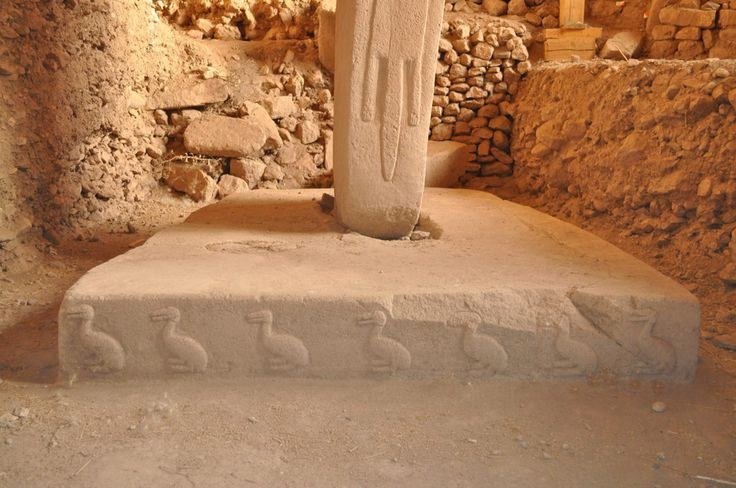
Central Pillar 18 on its plastered pedestal: low-relief arms, hands and belt run down the shaft, and a row of carved ducks/waterfowl follows the base of the pedestal. Photo courtesy of the site owner; classic Enclosure D central pillar.
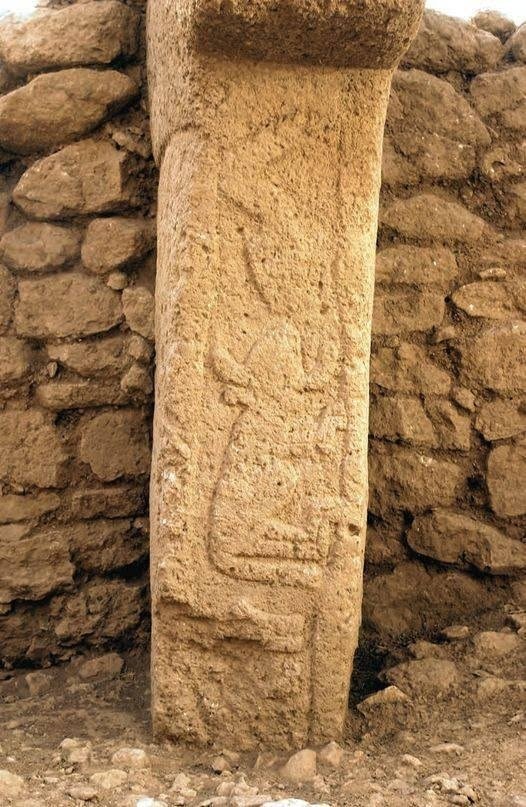
Pillar 18 from below: the arm and hand curve to the waist above the woven belt and the fox-pelt loincloth — the clothed human body rendered in stone. Photo courtesy of the site owner; Enclosure D central pillar.The pedestal of Pillar 18: a row of carved ducks/waterfowl runs along the front of the platform from which the monolith rises. Photo courtesy of the site owner; Enclosure D central pillar.
The eastern monolith — ~5.5 m: a stylised human, with carved hands clasped around the waist above a woven belt and fox-pelt loincloth. It stands on the pedestal carved with a row of ducks.
Central Pillar 18 from below: the arm and long-fingered hand curve to the waist above the belt and fox-pelt loincloth. Photo courtesy of the site owner; Enclosure D central pillar.Full page →
The western monolith — twin of 18: the same anthropomorphic lines, with hands, long arms and a carved belt running down the narrow side profile.
The belt band shared by both central pillars: H-shaped signs alternating with C-/crescent signs. Photo: DAI, Göbekli Tepe Project.Full page →
Ring wall · P19
Pillar 19 — no page yet
A ring-wall T-pillar with little decoration recorded — listed here for completeness of the wall sequence.
Ring wall · P20
Pillar 20 — no page yet
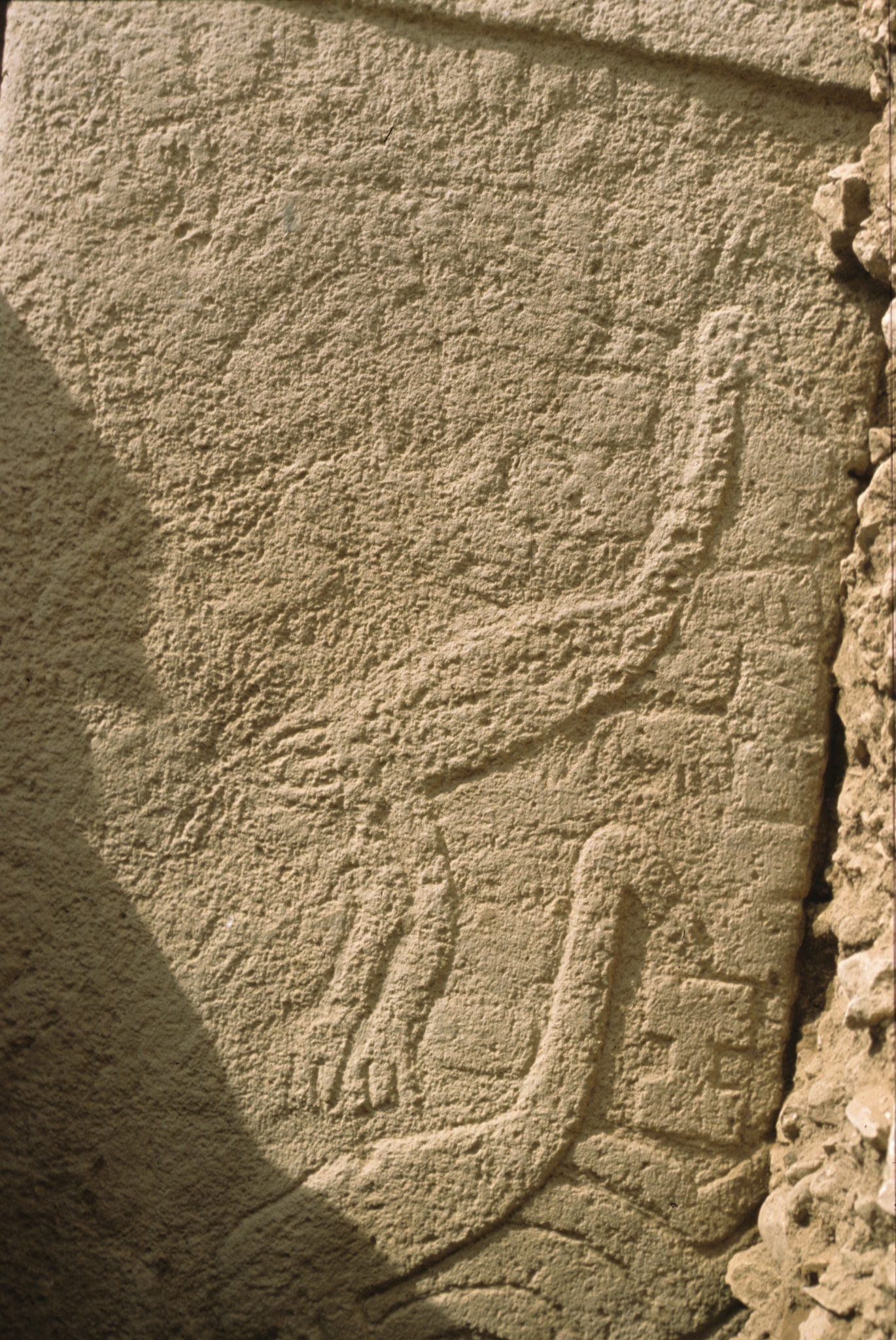
Richly decorated: a relief sequence of a snake, an aurochs, a boar and a fox running down the shaft.
Pillar 20 set in the ring wall, its shaft carrying a sequence of animal reliefs — a snake, an aurochs, a boar and a fox. Photo courtesy of the site owner; Enclosure D.
Ring wall · P21
Pillar 21 — no page yet
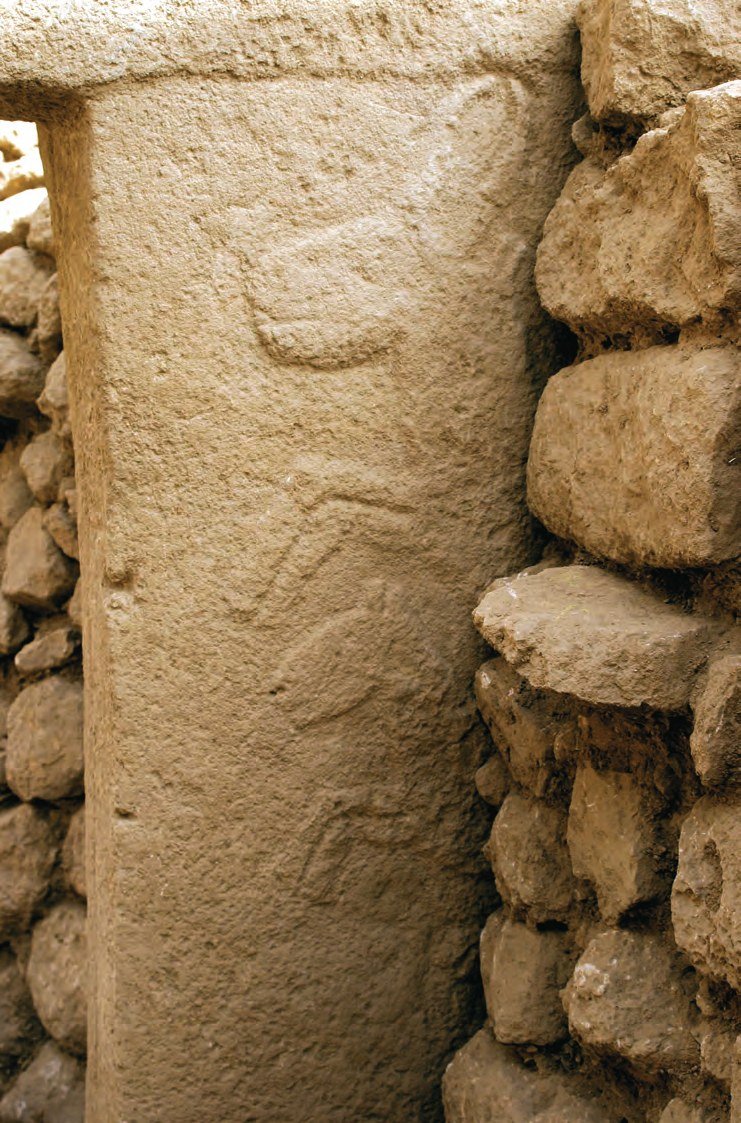
Faint animal reliefs, tentatively read as a goitred gazelle and an Asiatic wild ass — worn and hard to make out.
Pillar 21 in the ring wall: the reliefs are faint and worn, tentatively read as a goitred gazelle and an Asiatic wild ass. Photo courtesy of the site owner; Enclosure D.
Ring wall · P30
Pillar 30 — no page yet
The "Holed Sighting Stone" — a perforated slab set on the ring wall, its bored opening giving it its name.
Ring wall · P32
Pillar 32 — no page yet
A ring-wall T-pillar; little decoration recorded — listed here for completeness of the wall sequence.
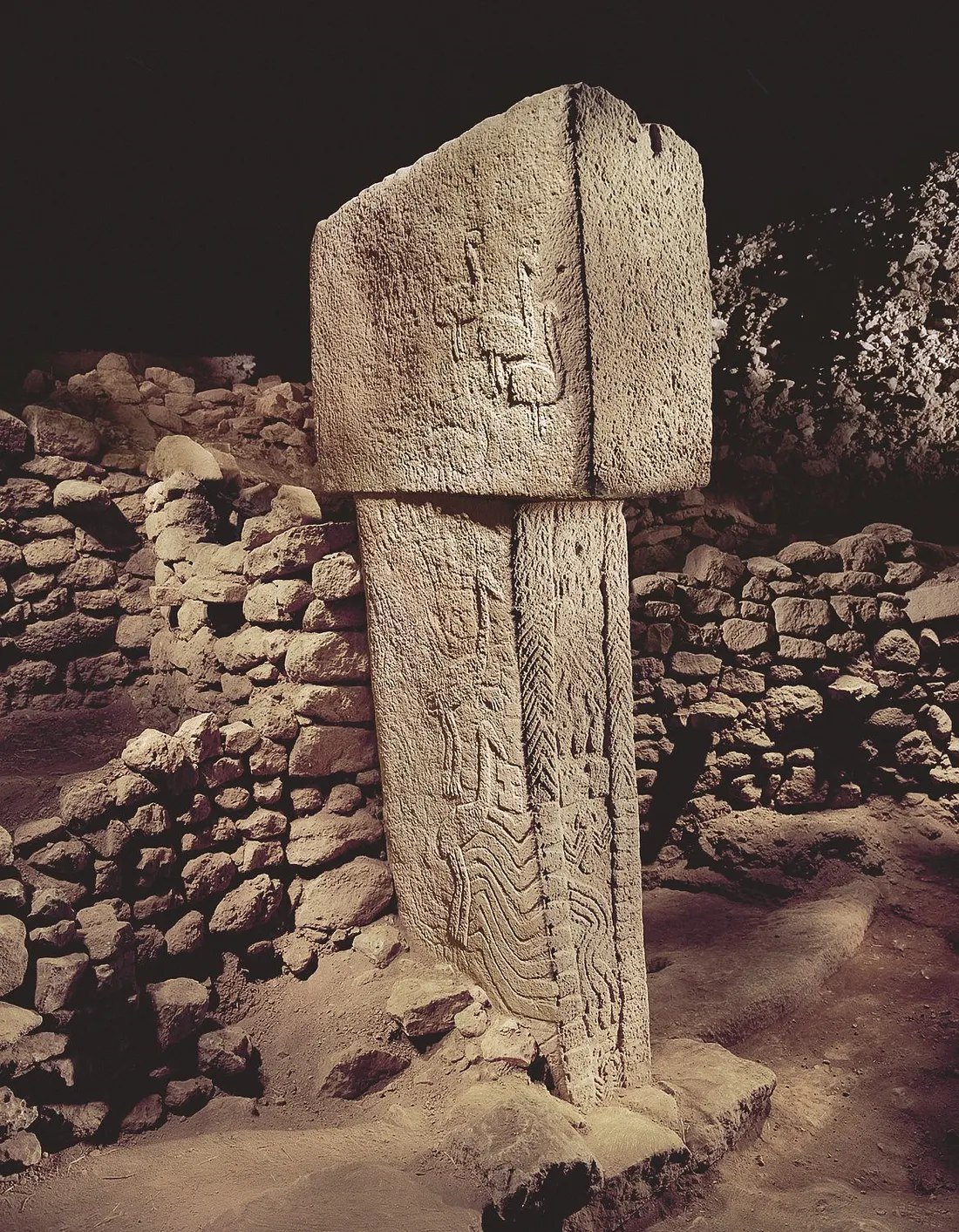
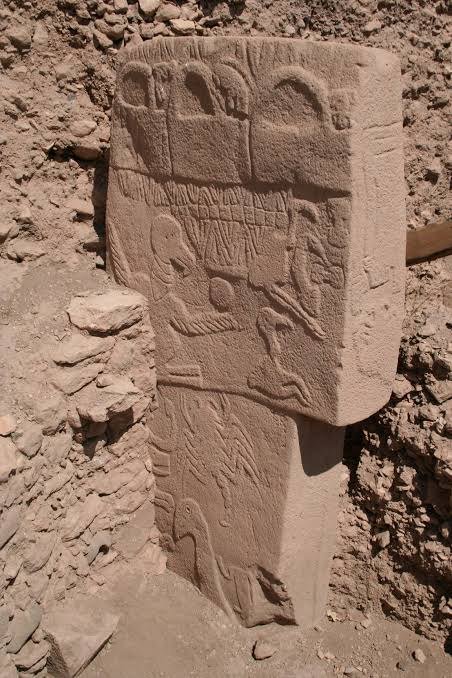
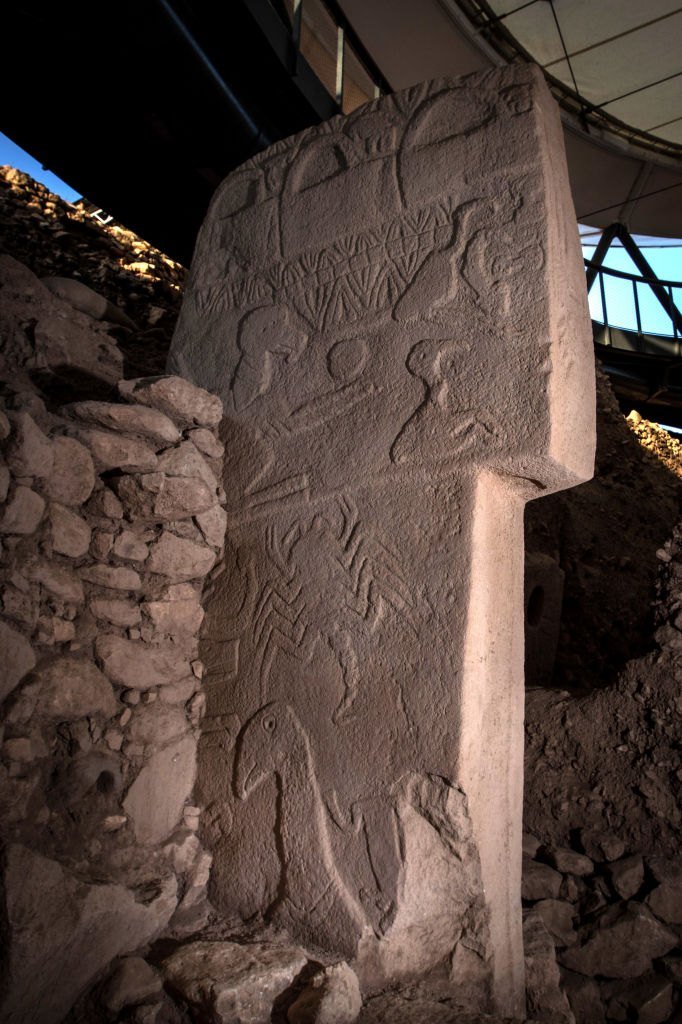
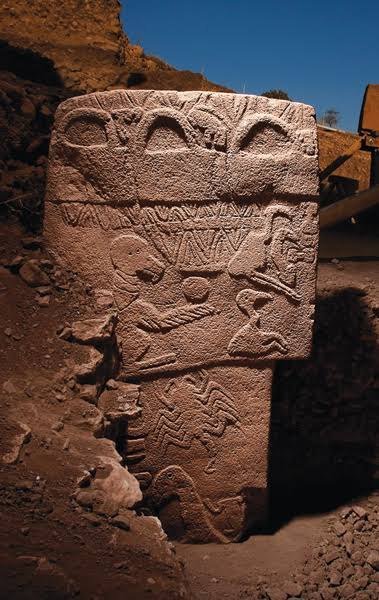
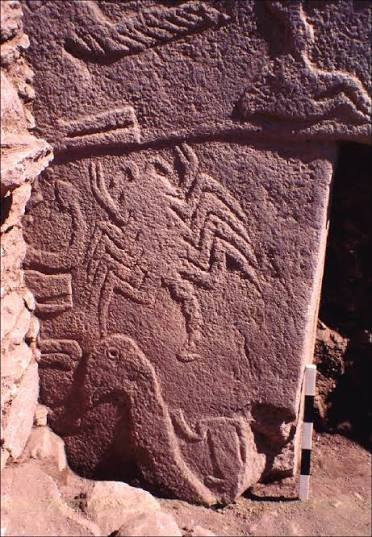
The "Vulture Stone": dense iconography including a large vulture, a scorpion, snakes, a headless human figure, and three debated "handbag" shapes near the top.
Pillar 43, the Vulture Stone — the most famous carved wall pillar of Enclosure D. Photo: DAI, Göbekli Tepe Project.Full page →
The site's most reproduced image: a dense scene of a vulture, a scorpion, birds, a row of "bags," a headless human figure and a disc. It has attracted elaborate "star map" and comet readings that go well beyond what the relief can support — the excavators reject them.
Frontal view in raking light: the vulture, birds, the scorpion and the headless figure. Photo: DAI, Göbekli Tepe Project.Pillar 43 as visitors see it today, still against the wall of Enclosure D beneath the shelter. Photo: DAI, Göbekli Tepe Project.The whole pillar in situ, angled: vulture and birds across the top, the row of "bags," scorpion and headless figure below. Photo: DAI, Göbekli Tepe Project.Detail: the disc above the vulture's wing, at the centre of the "star map" readings. Photo: DAI, Göbekli Tepe Project.
05
What was found inside D
The material that filled Enclosure D — the same fill that kept the pillars standing — contained a dense record of the building's later life: fragmented sculptures and stone heads deposited beside the pillars, huge quantities of animal bone and worked flint, human remains including worked skull fragments, and a handful of small, striking objects.
The 2009 backfill — a structured process
In 2009 the excavation removed the last metre of fill from Enclosure D, the best-preserved building of the older Layer III. That backfill is a real limiting factor: very few in-situ deposits from the building's actual use-time survive within it.
Yet the way the fill was laid down looks less like simple rubbish or collapse alone and more like a structured process involving deliberate acts. The most striking of these is the deposition of artefacts and sculptures within the fill itself — often placed right next to the pillars: the heads of anthropomorphic sculptures, miniature masks, a new type of figurine, a statue set into the ground face-down, and boar sculptures.
DAI Göbekli Tepe Project / Tepe Telegrams: "Losing your head at Göbekli Tepe" (2016); "Behind the Mask… miniature masks" (2018); "A short note on a new figurine type" (2017); "Buried face-down: a statue from Göbekli Tepe's southwestern hilltop" (2017); "Boars in Göbekli Tepe's Enclosure C" (2016).
A predator and a headless figure on a slab
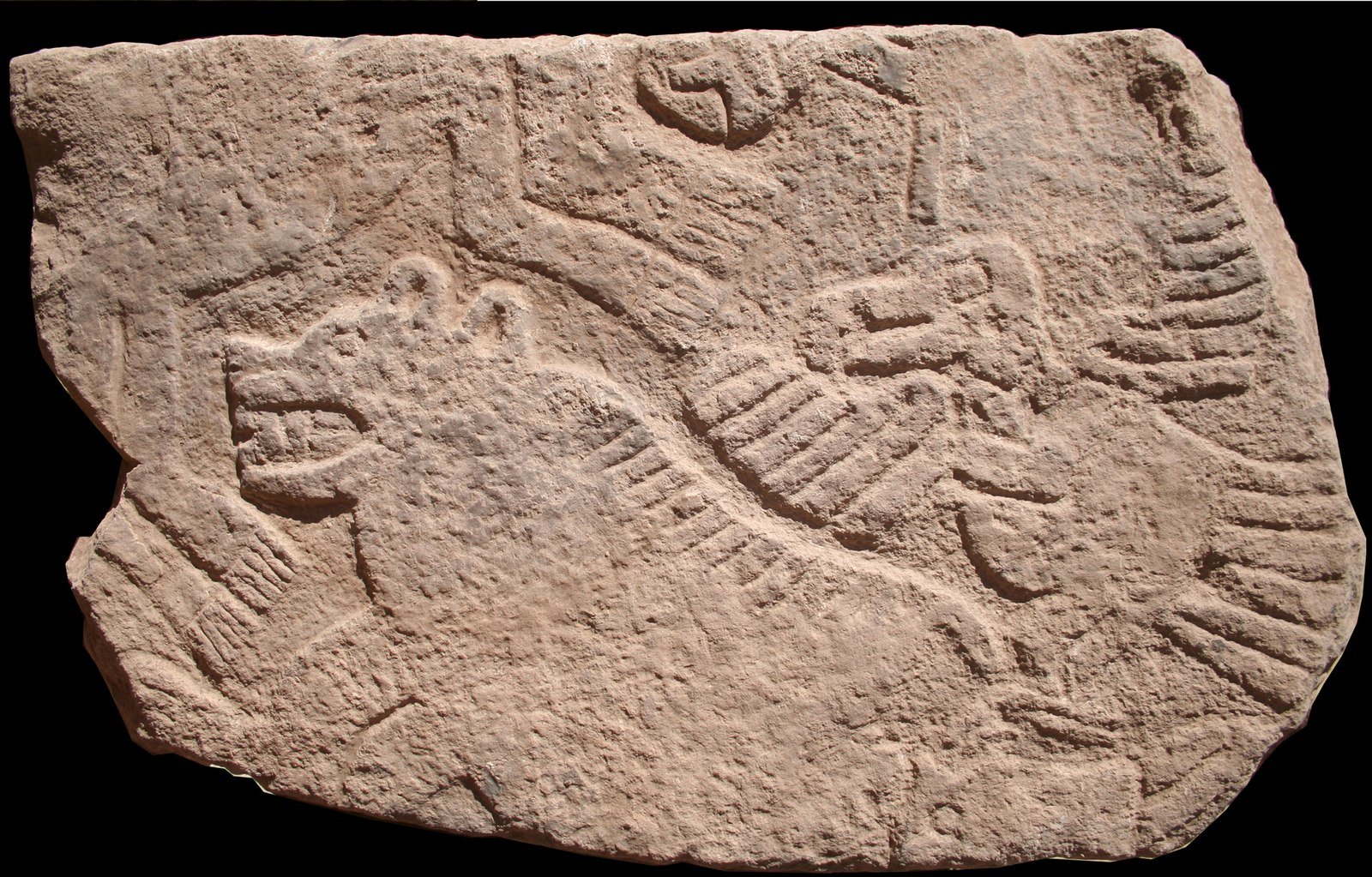
Among the carved stone from the enclosure is a limestone slab, worked flat, that pairs a large open-jawed predator — read as a hyena or big cat — with a headless human figure shown with a ribbed torso, limbs and phallus. The pairing of a beast of prey with a decapitated human belongs to the same repertoire of aggression, death and the severed head that runs through the site's imagery.
A predator and a headless human figure carved on a limestone slab. Subject verified from the photograph; the Enclosure D provenance is per the site owner and not independently confirmed.
Masks near Pillar 18 — a limestone and a clay mask
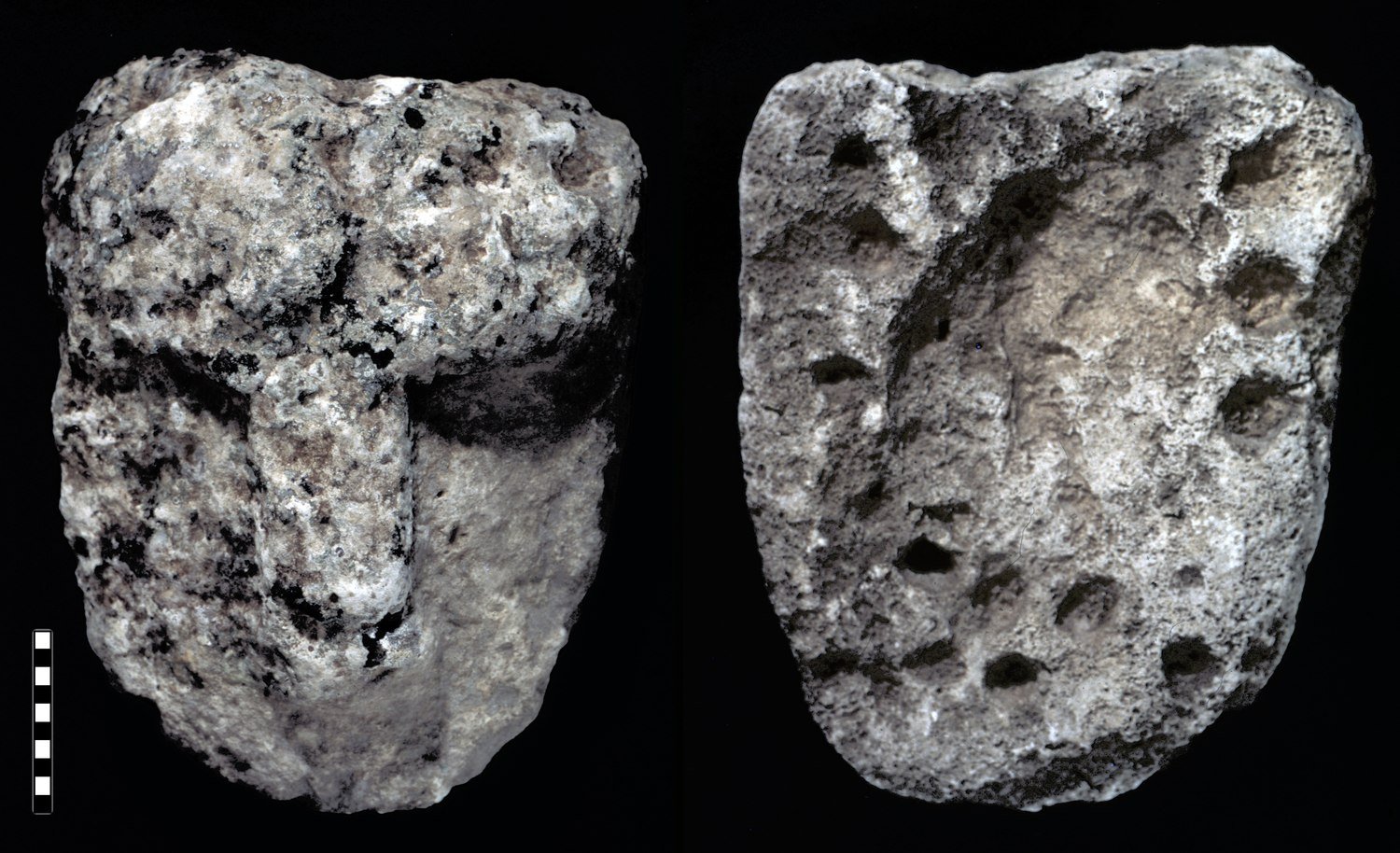
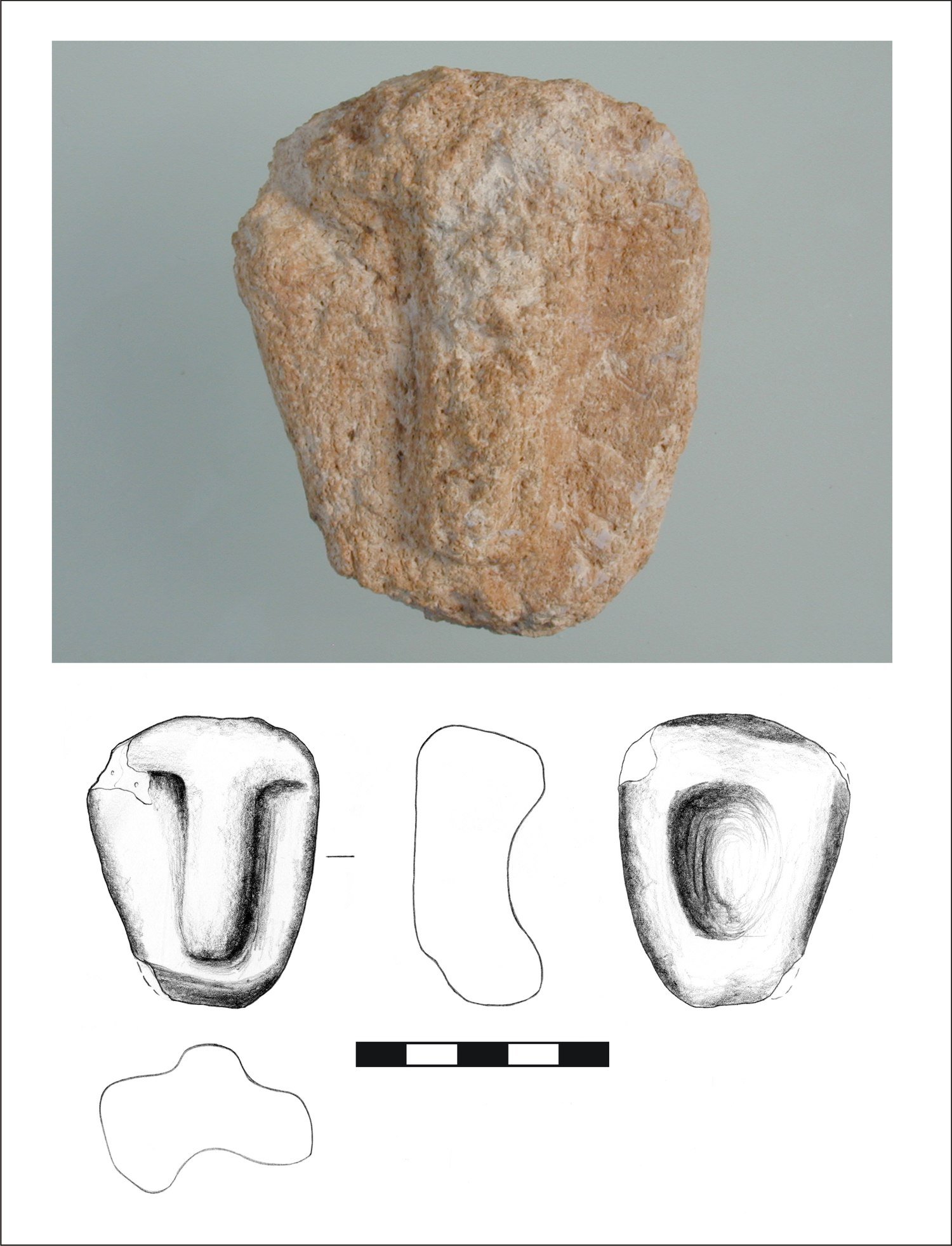
During the 2001 season, excavation of Enclosure D (area L9-78) reached Pillar 18. At the level of the fox relief on P18, about 2.20 m deep in the fill, a miniature limestone mask was retrieved in the pillar's immediate vicinity. The next ~10 cm of sediment yielded a second mask, this one of clay — fragmentary, originally ovaloid, with a concave back, a prominent nose and large near-open-worked eyes, its surface darkened and possibly burned. The excavators tie the masks to the final stages of use and backfilling rather than to the building's original life (Dietrich, Dietrich & Notroff 2018).
A limestone mask from Göbekli Tepe. Photo: DAI, Göbekli Tepe Project.The miniature mask recovered near Pillar 18 in Enclosure D. Photo: DAI, Göbekli Tepe Project.
Fragmented sculptures & stone heads
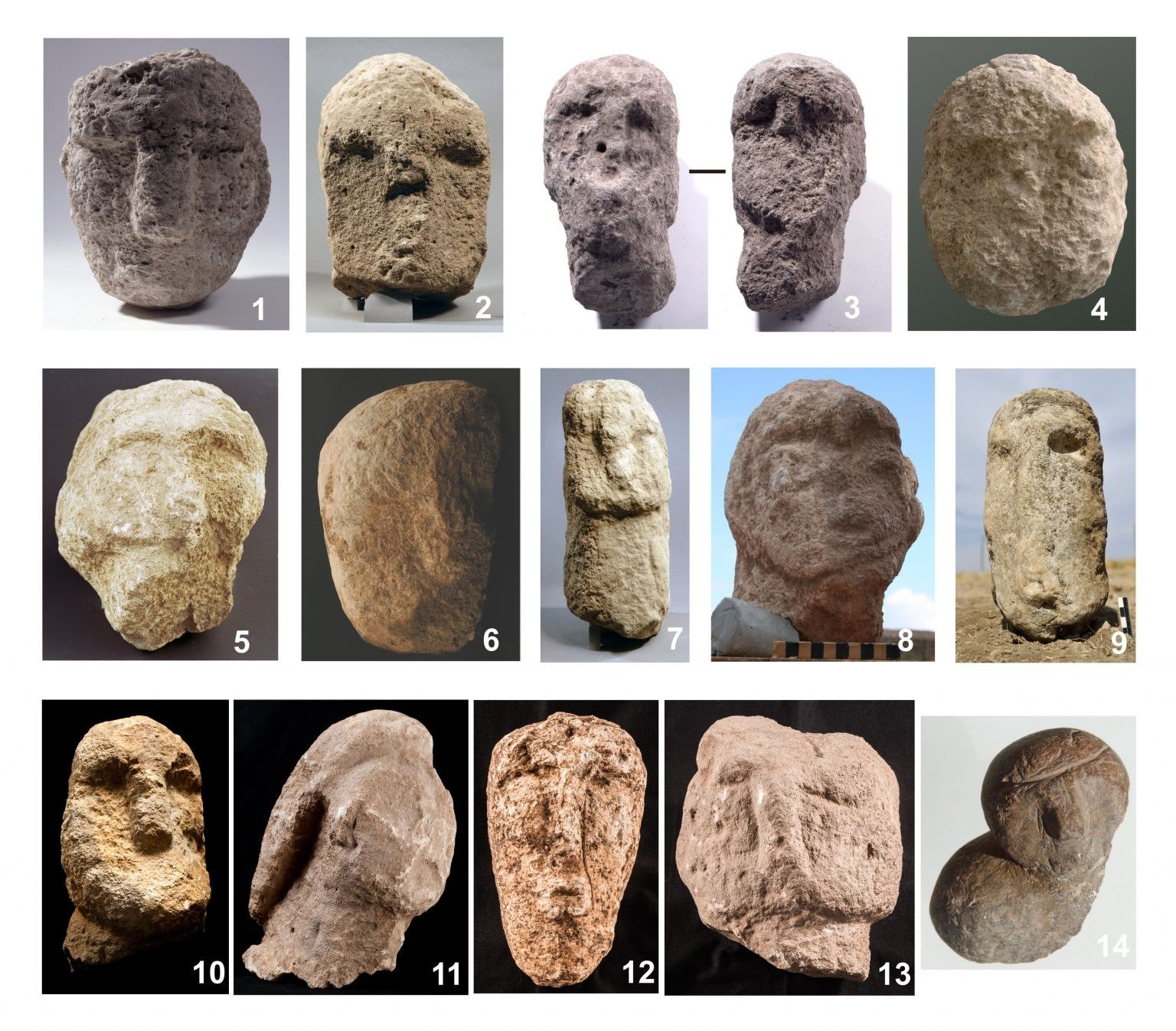
Anthropomorphic stone heads, broken from statues, were regularly deposited deep in the fill next to the pillars — a recurring pattern, distinct from the masks.
Part of the corpus of limestone heads deliberately broken from anthropomorphic statues — many recovered from the fill, deposited beside the pillars. Figure: DAI, Göbekli Tepe Project.
The aurochs humerus with an embedded flint point
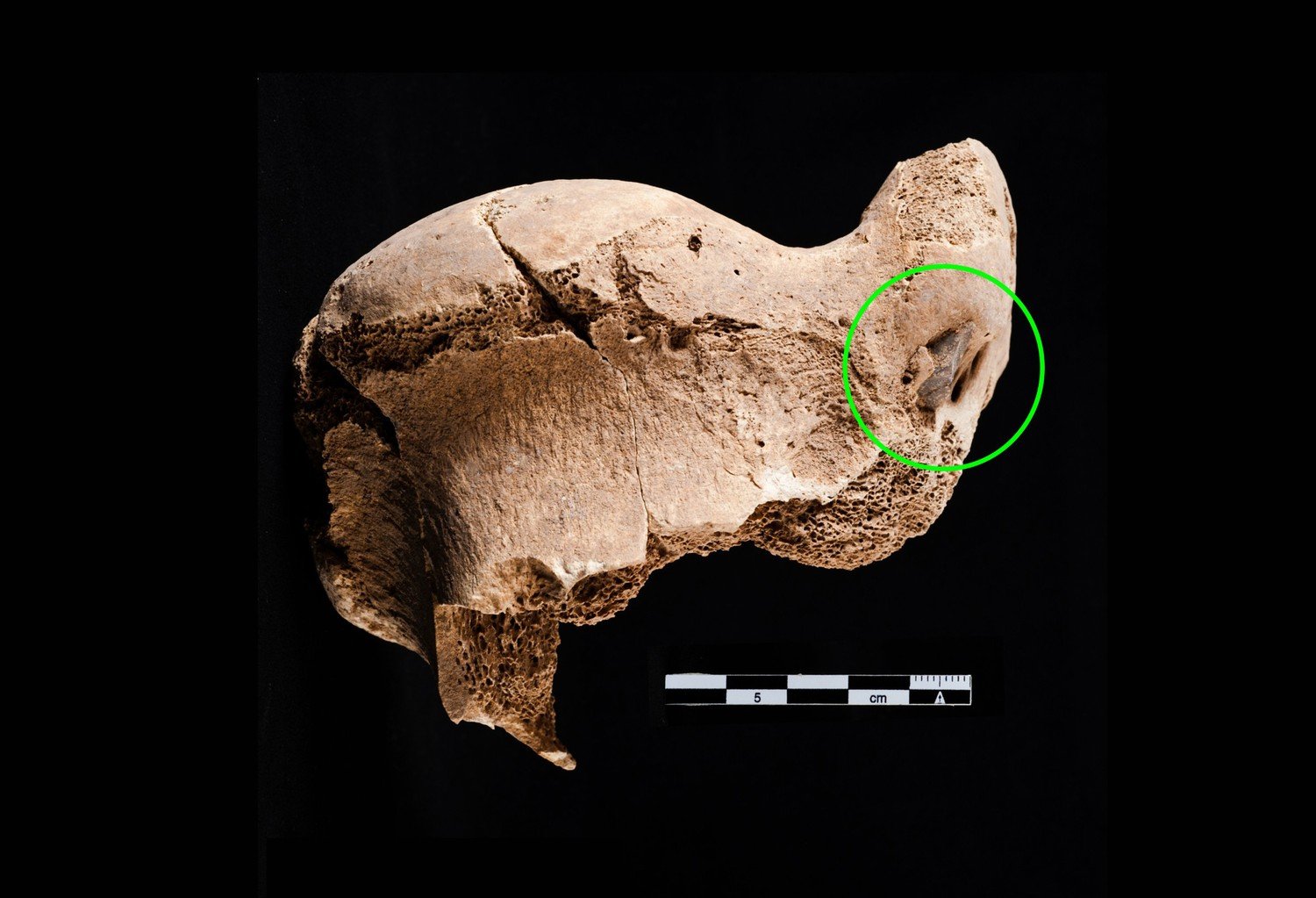
An aurochs upper-arm bone with the tip of a flint projectile point still lodged in it, found in 2009 in the south-western part of Enclosure D, in the last ~10 cm of soil above the bedrock floor, directly in front of the bench linking Pillars 32, 33 and 38. It is read as a missed shot — aimed at the chest from about 10 m, to the animal's right; with no healing on the bone, the animal died soon after, roughly 12,000 years ago (Pöllath et al. 2018).
Aurochs humerus, embedded flint point circled, with scale. Photo: N. Becker, DAI, Göbekli Tepe Project.
Animal bone & lithics
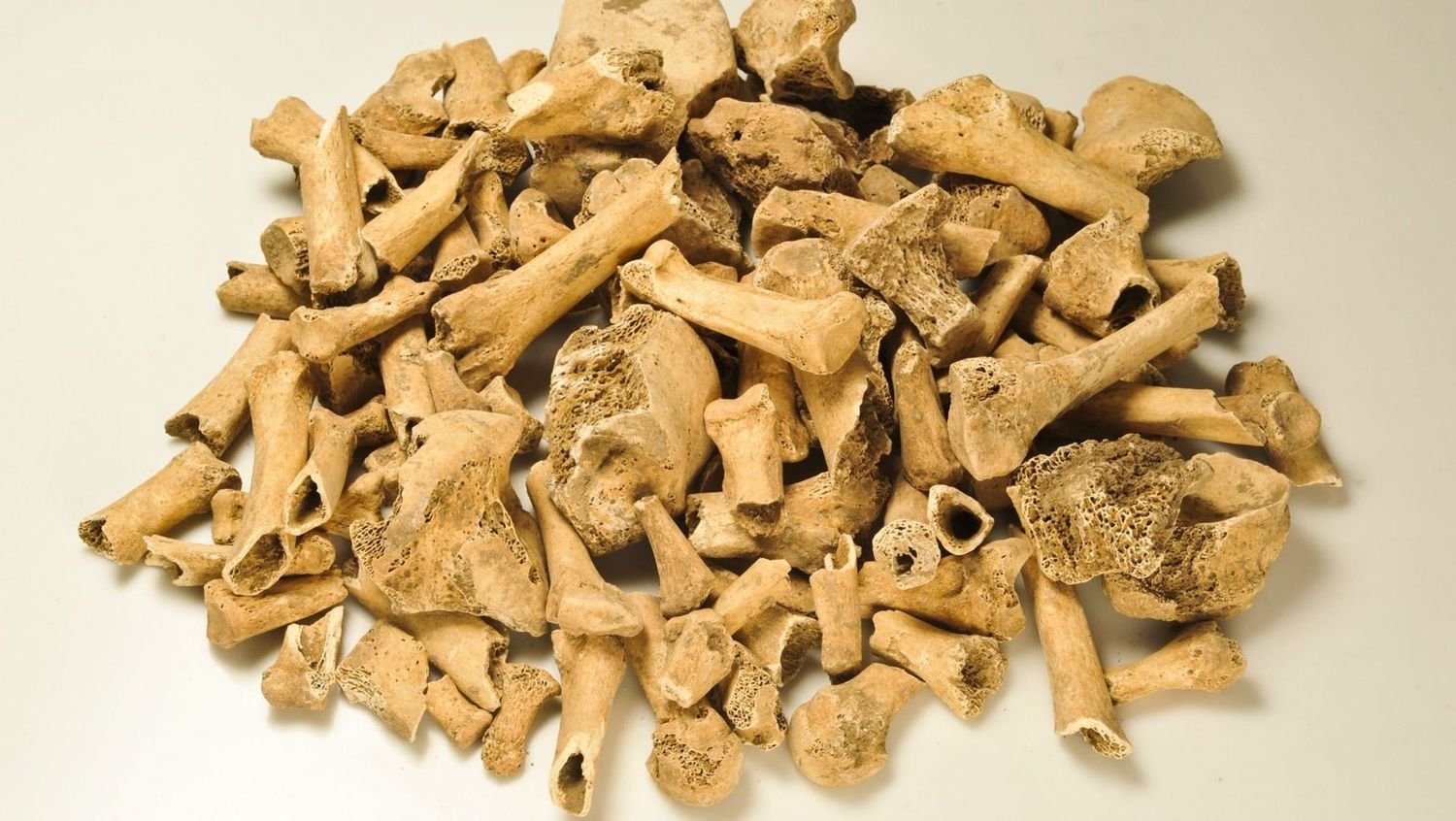
The fill is rich in butchered animal bone — wild game such as gazelle, aurochs, wild boar and birds — and in enormous quantities of chipped stone (points, blades and debitage), consistent with large-scale gatherings and feasting and with on-site tool production (Schmidt 2012; Dietrich et al. 2012).
Animal bone from the site's deposits — the debris of large-scale consumption. Photo: DAI, Göbekli Tepe Project.
Human remains — skull fragments
Worked and incised human skull fragments were recovered from Göbekli Tepe's fills — the basis for the site's "skull cult" interpretation (Gresky, Haelm & Clare 2017). Care: the carved-skull study reports material from the site's deposits generally; whether specific fragments belong specifically to Enclosure D should be verified against Gresky et al. before it is stated. (No verified photograph of the worked crania is printed here for that reason.)
06
How long did it exist?
Enclosure D was not raised once and left. Building-archaeology work by the current DAI team shows the great buildings had long, complex biographies: they were repaired, partly rebuilt, re-cut and refaced, and wrapped in more than one "skin" wall over their lives. What looks like a single monument is really the last visible state of a structure worked and re-worked across generations — plausibly over centuries. Göbekli Tepe's monumental phase (Layer III / PPNA) belongs to the 10th millennium BCE, and radiocarbon dates suggest the round buildings were in use for a long span, with at least a partial overlap between the tail end of their use and the younger, rectangular buildings of Layer II.
On record — spans the team proposes
Monumental (round) buildings: PPNA, built in the centuries around 9500 BCE; the site as a whole was occupied for roughly 1,500 years before abandonment (into the PPNB).
The buildings show multiple construction and modification phases, secondary re-use of pillars (documented in B, C and H — the same logic applies to D), and successive enclosing walls.
Radiocarbon evidence points to a partial chronological overlap between the late use of the round buildings and the rectangular Layer II buildings — the "special" and "domestic" architecture were not cleanly sequential.
Kinzel & Clare 2020 (building biographies); Clare 2020 (research summary); Dietrich et al. radiocarbon programme; Schmidt 2012.
07
Was it roofed?
Debated
The current excavation team increasingly reads the great buildings as having been roofed, and Lee Clare (DAI) has set out concrete physical evidence for it. The pillar tops around the walls of a building sit at roughly the same elevation — within about ±20 cm of one another — which is what you would expect if they once carried a shared horizontal structure rather than standing free. In the fill, excavators found the negatives (impressions) of beams about 20 cm in diameter, and two such crossed beams, each roughly 20 cm across, appear to have carried a plastered roof surface spanning the building. An earlier architectural study (Kurapkat) had already argued the special buildings were most likely roofed. The question is still labelled open — no roof survives intact and the spans are large — but the balance of the physical evidence now leans toward roofing rather than open-air enclosures.
For roofing (Clare / DAI): pillar tops across a building's walls level to within ~±20 cm; negatives of ~20 cm-diameter beams in the fill; two crossed ~20 cm beams that seem to have supported a plastered roof surface; Kurapkat's earlier architectural case for load-bearing pillars.
Still uncertain: no roofing survives in place; the unsupported spans are large; preservation and slope make it hard to test fully — so the team keeps it as a genuinely open, if now roofing-leaning, question.
Lee Clare (DAI) on roofing evidence — pillar-top elevations, beam negatives and the crossed beams carrying a plastered roof; Kurapkat (architecture / probable roofing); Kinzel & Clare 2020; DAI Tepe Telegrams.
08
Was Enclosure D intentionally buried?
Old interpretation — Schmidt
The enclosures were deliberately backfilled — intentionally, even ceremonially, buried in a single closing act that entombed the pillars. On this reading the fill was carried in on purpose to "retire" the building, which is why the pillars survived upright.
Current — Clare, Kinzel, Sönmez & colleagues
Deliberate, wholesale ritual burial has become increasingly unlikely. Soundings dug in 2017 and renewed building-archaeology show the fill is uneven — heaviest and most disturbed toward the downhill/slope side — which fits collapse, erosion and slope-wash far better than one deliberate backfilling event. Clare describes the mechanism directly: the slope above the buildings slipped and pulled them down, filling them — so much of the "fill" is collapse and eroded sediment, with only some intentional deposition mixed in over the building's long life. In step with this, the surrounding architecture is now interpreted as predominantly residential rather than purely special-purpose. The fill's formation is treated as an open research question, not a settled "burial."
The two readings are not a contradiction. When the last metre of fill was cleared in 2009, it did contain deliberate acts — sculpture heads, miniature masks, a new figurine type, a face-down statue and boar sculptures, repeatedly set down next to the pillars (see What was found inside D). What has changed is the reading of the bulk of the fill: rather than one wholesale ceremonial burial, most of the mass is now understood as collapse and slope-wash accumulated over the building's long life, with these intentional depositions occurring within that largely natural fill rather than constituting it. Deliberate structured acts and a mostly natural fill history can, and did, coexist.
Clare, Kinzel, Sönmez & Uludağ 2022, "There and Back Again" (opposes the "ritual backfilling" reading; slope-collapse mechanism); supported by Kinzel & Clare 2020 and Pöllath et al. 2018 ("a multifaceted history of backfilling through erosion and intentional events"); DAI Tepe Telegrams on the deliberately deposited heads, masks, figurine, face-down statue and boars.
09
What might it have meant?
What we know
Secure — attested by the architecture and the finds.
Two colossal, faceless, human-like central pillars (arms, hands, belt, fox-pelt loincloth), standing parallel at the centre.
Smaller wall pillars ringed around them, facing inward, with a bench — an architecture engineered to focus attention inward.
A dense animal-relief repertoire (snakes, foxes, cranes, aurochs, boar, vulture, scorpion) plus abstract "small signs" (H, C/crescent).
Human remains, including worked skull fragments, from the site's deposits.
Enormous investment in quarrying, carving and raising multi-tonne monoliths without metal, wheel or draft animals — implying coordinated labour beyond a single household.
Possible interpretations
Readings, not facts — competing interpretations advanced in the DAI's 2026 pillar-imagery volume (Dietrich & Schmidt 2026).
Ancestors / the dead — the central figures as revered ancestors; supported by the skull evidence and the human form, but not proven.
Supernatural beings / deities / spirits — the faceless, larger-than-human figures as other-than-human persons.
Group / clan identities — different animal "emblems" dominating different enclosures (fox in B, boar in C, mixed in D) read as markers of social groups or territories.
Animistic / shamanistic ontologies — a world in which humans, animals and objects share personhood; transient human–animal identities; themes of tension, aggression, death and transformation.
A place of periodic ritual gathering / feasting — scattered forager groups convening to build, feast, exchange and renew alliances, with ritual woven through the social event.
The 2026 DAI synthesis treats these explicitly as competing interpretations, not established facts — its interpretive chapters are structured as alternatives ("Interpretation 1: Animistic/shamanistic ontologies…"; "Interpretation 2: Territoriality – Ancestor worship") and stress that they advance possible readings of a fragmented record.
Not an island. Enclosure D — and Göbekli Tepe as a whole — was never sealed off from its neighbours. Its central symbols, the snake, the vulture and the human head, recur across the Taş Tepeler, the cluster of Pre-Pottery Neolithic sites in the Şanlıurfa region that includes Karahan Tepe, Sayburç, Sefertepe, Çakmaktepe and others. Göbekli Tepe was the most spectacular node in that regional web of contact and shared ideas, not a one-off standing alone — the same visual language, worked in stone, turns up from building to building and site to site across the wider Şanlıurfa Neolithic world.
Still debated — not a star map. The astronomical and calendrical readings attached to Pillar 43 (e.g. Sweatman) are not supported by the DAI team and go well beyond what the relief can carry.
10
The finds & carved stones
The central pillars, the carved wall pillars and the objects lifted from Enclosure D's fill, gathered as one catalogue. Where a full object page exists, it is linked from the card.
Centre · P18 & P31
The two central pillars
The twin monoliths at the focus of the room — about 5.5 m tall, an estimated 8–10 tonnes each — carved as stylised human bodies with arms, long-fingered hands over a belt of H- and C-signs, and a fox-pelt loincloth. They have no faces; who they represent is unknown.
A wall pillar whose two broad faces answer each other: tall cranes and a great bundle of snakes on one side, a leaping fox and an equal bundle on the other, the serpents pouring over the front where their heads meet — one of the richest single relief fields in the enclosure.
The site's most reproduced carving: a dense scene of a vulture, a scorpion, birds, a row of "bags," a headless human figure and a disc. It has drawn elaborate "star map" and comet readings that go well beyond what the relief can support — the excavators reject them.
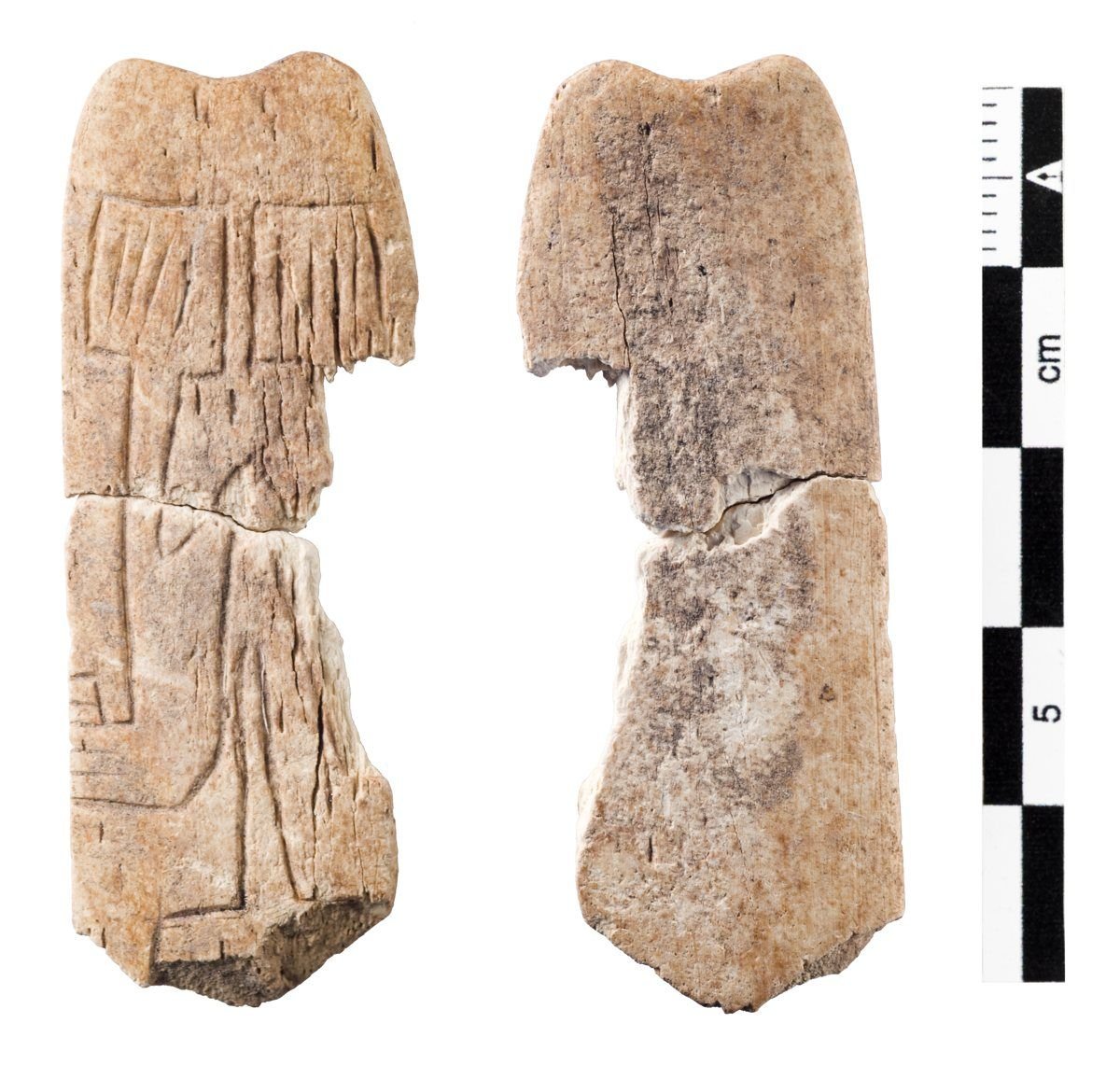
A small worked bone (~1.9 × 0.3 cm section) carrying a worn, partly preserved carving. The excavators read it as a possible abbreviated depiction of the enclosures themselves — what may be one or two T-shaped pillars with an arm, a belt and a fringed skin, rendered in miniature. The image is faint and its reading is not certain. Now in the Şanlıurfa Museum.
Photo: DAI, Göbekli Tepe Project. See O. Dietrich & J. Notroff, "A Decorated Bone 'Spatula'," Neo-Lithics 1/16.
Fill find · near P18
The masks near Pillar 18
At the level of the fox relief on Pillar 18, a miniature limestone mask was retrieved in the fill; the next ~10 cm yielded a second, clay mask — ovaloid, with a prominent nose and large eyes. The excavators tie them to the final stages of use and backfilling.
Photo: DAI, Göbekli Tepe Project.
Fill find · 2009
The aurochs humerus with a flint point
An aurochs upper-arm bone with the tip of a flint projectile point still lodged in it, found in the last ~10 cm of soil above the bedrock floor, in front of the bench linking Pillars 32, 33 and 38. Read as a missed shot; with no healing, the animal died soon after, roughly 12,000 years ago.
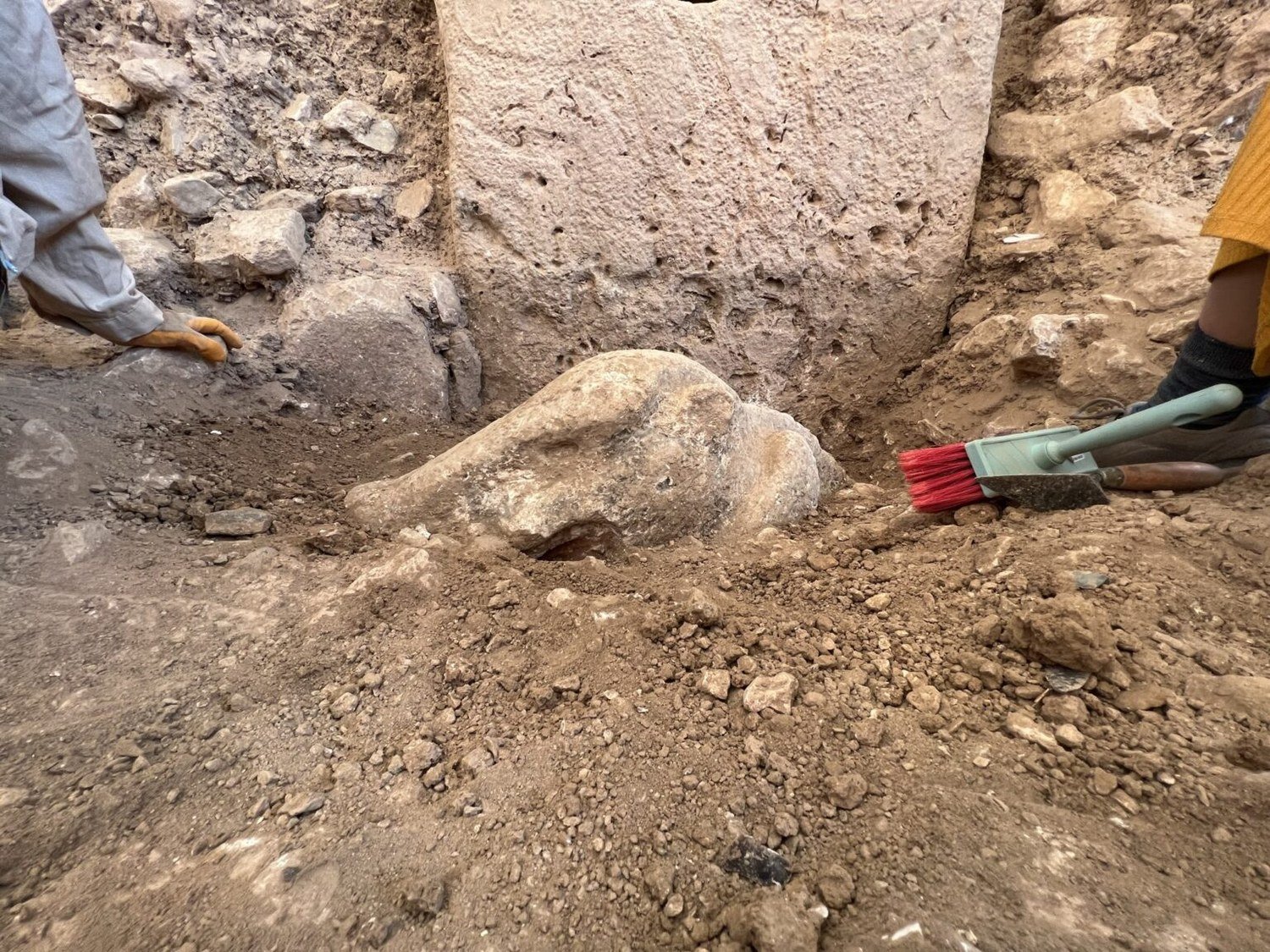
A life-size limestone boar — 1.35 m long — found in 2023 on the stone bench in the northern part of Enclosure D, facing Pillar 67. It still carried traces of red, black and white pigment — the first hard proof that the site's sculptures were once coloured. Now in the Şanlıurfa Archaeology Museum.
Anthropomorphic stone heads, deliberately broken from statues, were regularly deposited deep in the fill next to the pillars — a recurring pattern, distinct from the masks, and part of the structured acts recorded within Enclosure D's fill.
Figure: DAI, Göbekli Tepe Project.
All seven cards use real archive photographs. Full object pages exist for the central pillars, Pillar 33, Pillar 43, the aurochs bone and the painted boar; the masks and the limestone-head corpus are shown as photographed finds without a separate page.
11
Sources
Schmidt, K. 2012. Göbekli Tepe: A Stone Age Sanctuary in South-Eastern Anatolia. Berlin: ex oriente. (English ed.; German original Sie bauten die ersten Tempel, 2006.)
Dietrich, O. et al. 2012. "The role of cult and feasting in the emergence of Neolithic communities. New evidence from Göbekli Tepe." Antiquity 86(333): 674–695.
Notroff, J., O. Dietrich & K. Schmidt 2014. "Building Monuments, Creating Communities…," in J. Osborne (ed.) Approaching Monumentality in Archaeology. SUNY Press, 83–105.
Notroff, J., O. Dietrich, L. Dietrich, C. Lelek Tvetmarken, M. Kinzel, J. Schlindwein, D. Sönmez & L. Clare 2017. "More than a Vulture: A Response to Sweatman and Tsikritsis." Mediterranean Archaeology & Archaeometry 17(2): 57–63. (The excavators' point-by-point rebuttal of the "star map" / comet reading of Pillar 43.)
Dietrich, O., L. Dietrich & J. Notroff 2018. "A Clay Mask Depiction from Göbekli Tepe." Neo-Lithics 2018/1: 8–12. (Limestone and clay masks near Pillar 18, area L9-78, 2001.)
Pöllath, N., O. Dietrich, J. Notroff, L. Clare, L. Dietrich, Ç. Köksal-Schmidt, K. Schmidt & J. Peters 2018. "Almost a chest hit: An aurochs humerus with hunting lesion from Göbekli Tepe…" Quaternary International 495: 30–48.
Gresky, J., J. Haelm & L. Clare 2017. "Modified human crania from Göbekli Tepe provide evidence for a new form of Neolithic skull cult." Science Advances 3(6): e1700564.
Kinzel, M. & L. Clare 2020. "Monumental — compared to what? A perspective from Göbekli Tepe," in Monumentalising Life in the Neolithic. Oxford: Oxbow Books, 29–48.
Clare, L. 2022 (with M. Kinzel, D. Sönmez & C. Uludağ). "There and Back Again — Towards a New Understanding of Abandonment Practices at… Göbekli Tepe," in Bridging the Gap, Vol. 1. Oxford: Archaeopress Access Archaeology.
Clare, L. 2020. "Göbekli Tepe, Turkey. A brief summary of research at a new World Heritage Site (2015–2019)." e-Forschungsberichte des DAI 2020/2.
Kurapkat, D. 2012/2015. On the architecture and probable roofing of the Göbekli Tepe special buildings.
Haklay, G. & A. Gopher 2020. "Geometry and Architectural Planning at Göbekli Tepe, Turkey." Cambridge Archaeological Journal 30(2): 343–357. (A proposal, not a fact.)
Dietrich, O. & K. Schmidt † 2026. Göbekli Tepe: The Imagery of the Pillars in the Monumental Buildings A–D, F and H. (Vol. eds. R. Eichmann & J. Peters.) Archaeologica Euphratica. Reichert / DAI. ISBN 978-3-7520-0839-5. (Treats animistic/shamanistic ontologies and ancestor worship as interpretations.)
DAI Göbekli Tepe Project, Tepe Telegrams (research blog). "Losing your head at Göbekli Tepe" (2016) — deliberately deposited anthropomorphic sculpture heads.
DAI Göbekli Tepe Project, Tepe Telegrams. "Behind the Mask… A Study of Miniature Masks from Göbekli Tepe" (2018).
DAI Göbekli Tepe Project, Tepe Telegrams. "A short note on a new figurine type from Göbekli Tepe" (2017).
DAI Göbekli Tepe Project, Tepe Telegrams. "Buried face-down: a statue from Göbekli Tepe's southwestern hilltop" (2017).
DAI Göbekli Tepe Project, Tepe Telegrams. "Boars in Göbekli Tepe's Enclosure C" (2016).
DAI Göbekli Tepe Project, Tepe Telegrams. Post on the dating of Layer III / the monumental round buildings (2016).
12
Related structures
The pillars and finds of Enclosure D are catalogued above under The finds & carved stones. Below are the neighbouring buildings, a related theme, and ways to visit.
To visit — Göbekli Tepe lies northeast of Şanlıurfa, Türkiye; Enclosure D stands beneath the main protective shelter. The painted boar and other finds are conserved at the Şanlıurfa Archaeology Museum.