The problem: stone has no birthday
Radiocarbon dating measures the decay of carbon-14 in things that were once alive — charcoal, bone, seeds, plant fibres. A limestone pillar was never alive, so it cannot be dated directly. To date a building, you have to find organic material that got trapped in it at the moment it was made, and date that.
This is harder than it sounds, and it is the root of most confusion about how old these sites 'really' are. Charcoal scattered in the fill of a building can be older than the building (an old branch, redeposited ash) or younger (material that trickled in later). Date the fill and you may be dating the wrong event entirely.
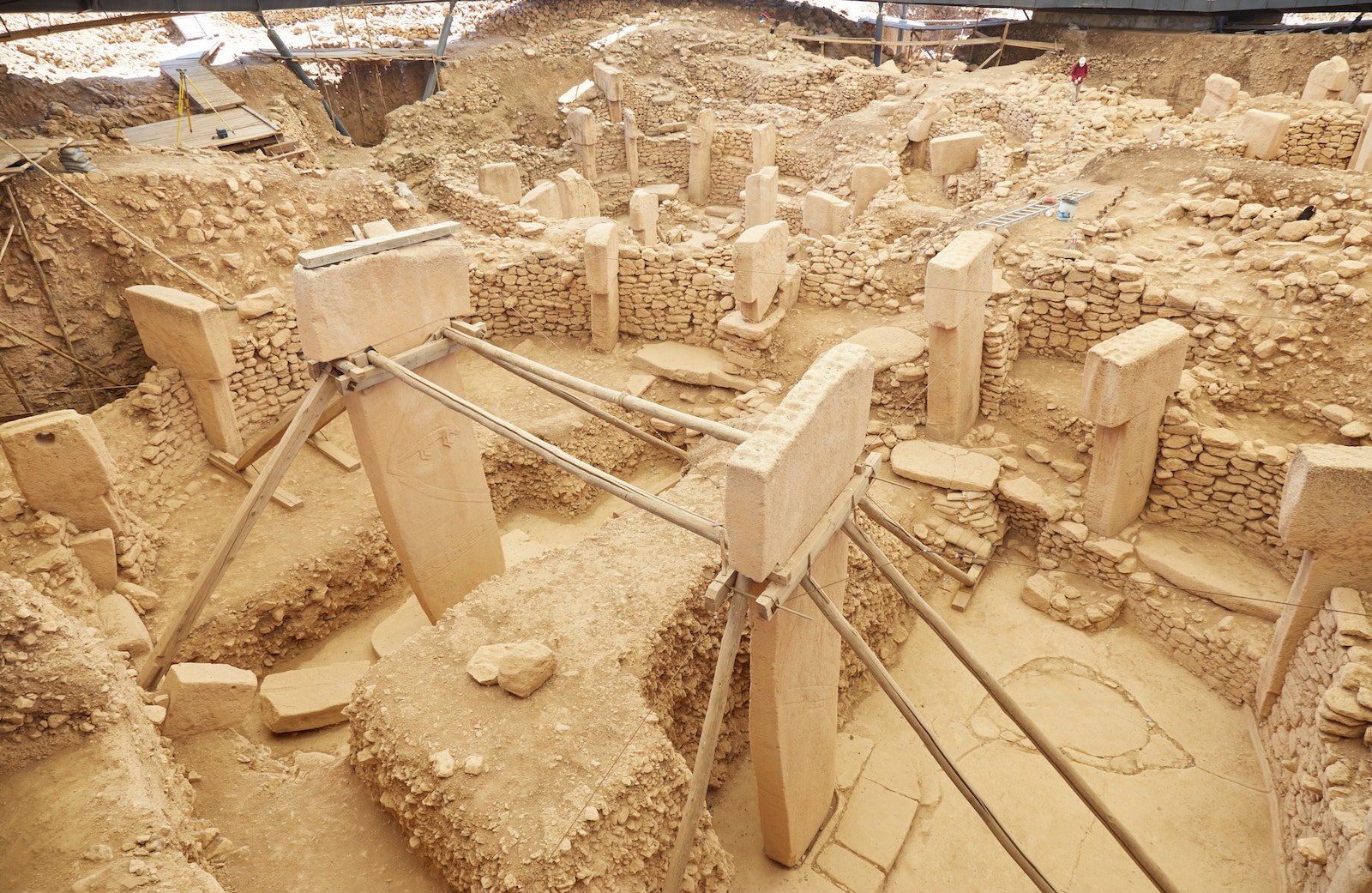
German Archaeological Institute, Göbekli Tepe Project, Enclosure D, Göbekli Tepe, Copyright: DAI — used with permission, via .
The trick: date the wall, not the rubble
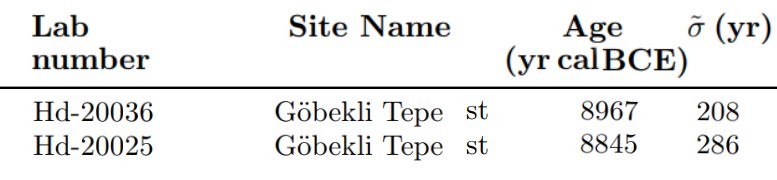
The way around this is to sample organic material built into the structure itself. At Göbekli Tepe, the team radiocarbon-dated organics bound into wall plaster and mortar, not just loose charcoal — material that was mixed in when the wall was raised, and therefore dates the construction phase rather than whatever accumulated afterwards. Combined with dates on the fill and the layers above and below, this pins the enclosures to the Pre-Pottery Neolithic, broadly the tenth and ninth millennia BCE.
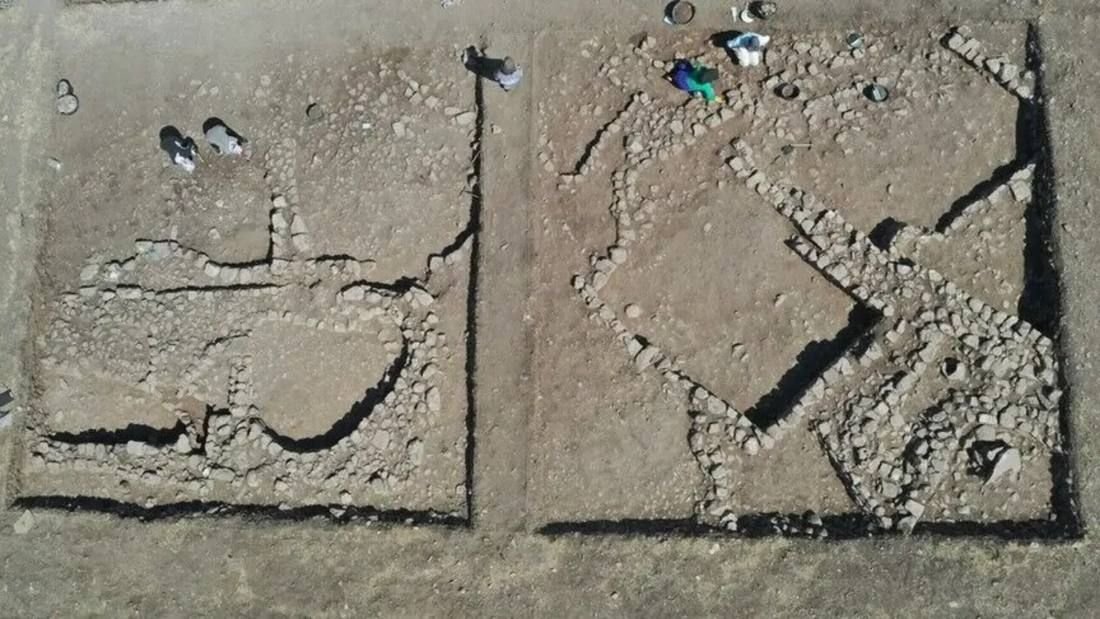
The same logic runs across the network. At Sayburç, the excavator Eylem Özdoğan frames the occupation as a short, largely single-layer horizon with radiocarbon around 8650–8300 BCE — a tight window, because there is little later building to muddy the sequence.
What careful dating revealed: overlap, not a tidy sequence
Good dating does more than produce a headline number; it untangles the order of events. At Göbekli Tepe, Lee Clare describes Building D as having multiple nested phases, with radiocarbon from its wall mortar and charcoal indicating both late PPNA and early PPNB activity. The consequence is important: the later phases of the great special building were contemporaneous with the surrounding rectangular buildings.
In plain terms, the neat story — first the monuments, then, much later, ordinary houses — does not hold. The dating shows the two overlapped. That single methodological result is a large part of why the whole 'was Göbekli Tepe inhabited?' question has reopened.
Reading a radiocarbon date
A radiocarbon result is never a single year. The lab measures how much carbon-14 survives, converts that to a 'radiocarbon age', then calibrates it against a curve of known atmospheric variation to produce a calendar range, quoted with a probability — something like '9200–8900 BCE at 95% confidence'. Two honest samples from the same wall can legitimately differ by a century, which is why archaeologists reason with overlapping ranges and sequences, not single headline numbers.
This is also why you will see different 'ages' for Göbekli Tepe in different articles — c. 9600 BCE, 9500 BCE, '11,600 years ago'. These are the same site read at different points within one calibrated span, not a contradiction. The honest statement is a bracket: the monumental phase falls in the earlier Pre-Pottery Neolithic, broadly the tenth millennium BCE, with use continuing into the ninth. Anything more precise than that — a single, confident year — is a claim about one sample, not about the whole building or the site.
Common questions
How is Göbekli Tepe dated if you can't carbon-date stone? By radiocarbon-dating organic material — charcoal, bone, and crucially the organics trapped in wall plaster and mortar — that was built into the structures. That dates the construction event, not whatever later washed into the fill.
How old is Göbekli Tepe, exactly? There is no single exact year: radiocarbon gives calibrated ranges. The monumental enclosures date broadly to the tenth–ninth millennia BCE — roughly 11,600 to 10,000 years ago.
Why do different sources give different ages? Because a radiocarbon date is a probability range, not a point. Different writers quote different points within the same calibrated span, so the numbers look inconsistent even when they agree.
What is uncertain
Radiocarbon gives calibrated ranges, not exact years, and different samples from one building can legitimately span a century or more. Clare's account of Building D's nested phases comes from lecture material, and Özdoğan's Sayburç figures from interview framing; both may be refined in final publication. The precise construction date of any single enclosure remains a matter of probability, not certainty.
What is solid is the method and the age bracket: these are radiocarbon-dated sites, anchored by organic material including the builders' own wall mortar, and they sit firmly in the Pre-Pottery Neolithic.
Key takeaways
- Limestone can't be carbon-dated, so the sites are dated from organic material built into the walls — plaster, mortar, charcoal.
- That anchors the enclosures in the Pre-Pottery Neolithic, roughly the 10th–9th millennia BCE.
- Careful dating showed the great buildings and the rectangular houses overlapped — not monuments first, homes much later.
- Every radiocarbon date is a calibrated range, which is why different sources quote slightly different 'ages'.
Sources
- Dietrich, O. et al. (2012). The role of cult and feasting in the emergence of Neolithic communities. New evidence from Göbekli Tepe. Antiquity 86(333).
- Clare, L. (2020). Göbekli Tepe, Turkey. A brief summary of research at a new World Heritage Site (2015–2019). e-Forschungsberichte des DAI.
- Özdoğan, E. (2022). The Sayburç reliefs: a narrative scene from the Neolithic. Antiquity 96(390).
This article is written from the primary literature and excavators' reports cited above. Interpretations are attributed; uncertainties are stated in the text.