Short answer
About 11,500 years old. The earliest great enclosures were built around 9500 BC, in the Pre-Pottery Neolithic A.
That is roughly 7,000 years before the Great Pyramid, 6,000 before Stonehenge, and 6,000 before the first writing. The site then stayed in use until around 8000 BC — so "how old is Göbekli Tepe" is really a question about which part of it you mean.
Two sites stacked on one hill
Göbekli Tepe is not one building phase. Excavators distinguish two layers, and they look nothing alike.
Layer III is the lower and older one. It holds the famous circular enclosures with the great T-shaped pillars — the images that made the site world-famous. Layer II sits above it: smaller buildings with rectangular ground plans, which sometimes have pillars too, but much smaller ones.
That division is not a local invention. It follows the framework Kathleen Kenyon built from the stratigraphy of Jericho, where she noticed that early Pre-Pottery Neolithic buildings are round and later ones are rectangular. Göbekli Tepe fits the pattern: round monumental architecture below, rectangular domestic-scale architecture above.
So the honest answer to "how old is it" depends on which layer you are standing on.
What the stone tools say
Before any laboratory gets involved, the flint says something. Projectile points are the Neolithic's most reliable index fossil — their shapes changed on a known schedule across the Near East.
Göbekli Tepe produces el-Khiam, Helwan and Aswad points, all characteristic of the PPNA. It also produces Byblos and Nemrik points in quantity, which are PPNB, plus a few rare Nevalı Çori points.
The revealing detail is what is missing. The characteristic forms of the latest PPNB do not appear at all. That absence is the evidence for abandonment: people stopped coming to the hill after the middle PPNB, around 8000 BC.
There is a second absence worth noticing. Göbekli Tepe has produced no domesticated plants and no domesticated animals. Whoever raised these pillars had not yet begun to farm — and the site was abandoned at roughly the moment agriculture became fully established elsewhere. A hunter-gatherer place, ending as the hunter-gatherer world did.
Why dating this site is unusually hard
Here is the problem that most popular accounts skip.
The Layer III enclosures were not simply abandoned. At the end of their use-lives they were cleaned out, partly dismantled, and deliberately refilled — and the refilling appears to have happened fast, because there are no sterile layers of wind-blown or water-laid sediment in between.
That is fascinating for understanding what the buildings were for. It is a disaster for dating them. Organic material sitting in that fill could be older or younger than the enclosure it sits in. Backfilling can even produce inverse stratigraphy, where younger material ends up deeper down. Date the fill and you may be dating the burial, the party that preceded it, or something scraped up from elsewhere on the hill.
An early attempt to sidestep this used pedogenic carbonates — the crust that forms on limestone once it is buried. The relative sequence came out right, but the absolute ages came out clearly too young: Layer III pushed into the 9th millennium, Layer II into the 8th or even 7th. Those dates work only as a terminus ante quem — a latest-possible bound — not as the age of the architecture.
The date that actually anchors it
The breakthrough was dating the buildings directly rather than what was dumped inside them.
The enclosure walls were finished with loam wall plaster, and that plaster contains small amounts of organic material. A sample from the ring wall of Enclosure D, taken between Pillars 41 and 42, returned 9984 ± 42 ¹⁴C-BP — 9745–9314 cal BC at 95.4% confidence.
That is the number the whole popular figure rests on. It places the construction of the most famous enclosure squarely in the PPNA, and unlike a fill sample it dates the wall itself.
It does not stand alone. Three charcoal samples recovered close to bedrock beside Enclosure D cluster at 9664–9311 cal BC — independent material, same window.
The enclosures are not the same age
This is the part that gets flattened in almost every retelling, and it is the most interesting thing in the chronology.
The radiocarbon evidence suggests the Layer III enclosures were not contemporaneous. Enclosure D is the earliest for which we have a documented sequence: built around the mid-10th millennium cal BC, used, then buried in the late 10th. The outer ring wall of Enclosure C may be younger — possibly built while D was being backfilled. Enclosure A appears younger still.
If that holds, Göbekli Tepe was never a single monument raised in one heroic effort. It was a place people came back to for centuries, building a new enclosure while the previous one was being closed down. The hill was a project across generations, not an event.
The caution belongs here too: this rests on a small number of dates, and the excavators say plainly that more data are needed before the sequence can be treated as settled.
Why you see 11,000, 11,500 and 12,000
All three numbers circulate, and they are not really contradictory — they are answers to slightly different questions, plus some rounding.
12,000 usually comes from rounding the outer edge of the calibrated range, or from headline writers preferring a rounder number. 11,500 is the best-supported figure for the earliest monumental enclosures. 11,000 often reflects the site as a whole, including its later phases.
Two technical facts widen the spread. Raw radiocarbon results are reported as BP — before 1950 — and must be calibrated into calendar years, which shifts them substantially. And this particular stretch of the calibration curve has a plateau, which means the probability ranges come out wider than usual no matter how good the sample is.
So a careful answer is a range, not a point: the great enclosures went up in the middle centuries of the 10th millennium BC, and the site was finished with by around 8000 BC.
What is still open
How long any single enclosure stood before it was buried is genuinely unresolved. One animal tooth from Enclosure D's fill dates to 9746–8818 cal BC, while charcoal from the same fill gives 9127–8763 cal BC. If the tooth belongs to the enclosure's use-life — plausible, given the evidence for large feasts at the site — the building may have stood for several centuries before closure. A short life is still possible too.
A much larger series of 80 wall-plaster samples has been dated and awaits publication. When it appears, the picture below will get sharper, and some of it may change. We will update this page when it does.
The dates themselves
Popular accounts give you a number. Here are the measurements it comes from — the same ones published by the excavation team, with lab codes so you can look them up. All calibrated ranges are at 95.4% confidence unless noted.
Compiled from the Göbekli Tepe Research Project's own published radiocarbon sequence (Dietrich, Köksal-Schmidt, Notroff and Schmidt, Neo-Lithics 1/2013; Dietrich and Schmidt, Neo-Lithics 2/2010). At the time of that summary only eleven radiocarbon dates existed for the whole site — a reminder of how thin the ground is beneath a very confident-sounding number.
Standing in the tenth millennium
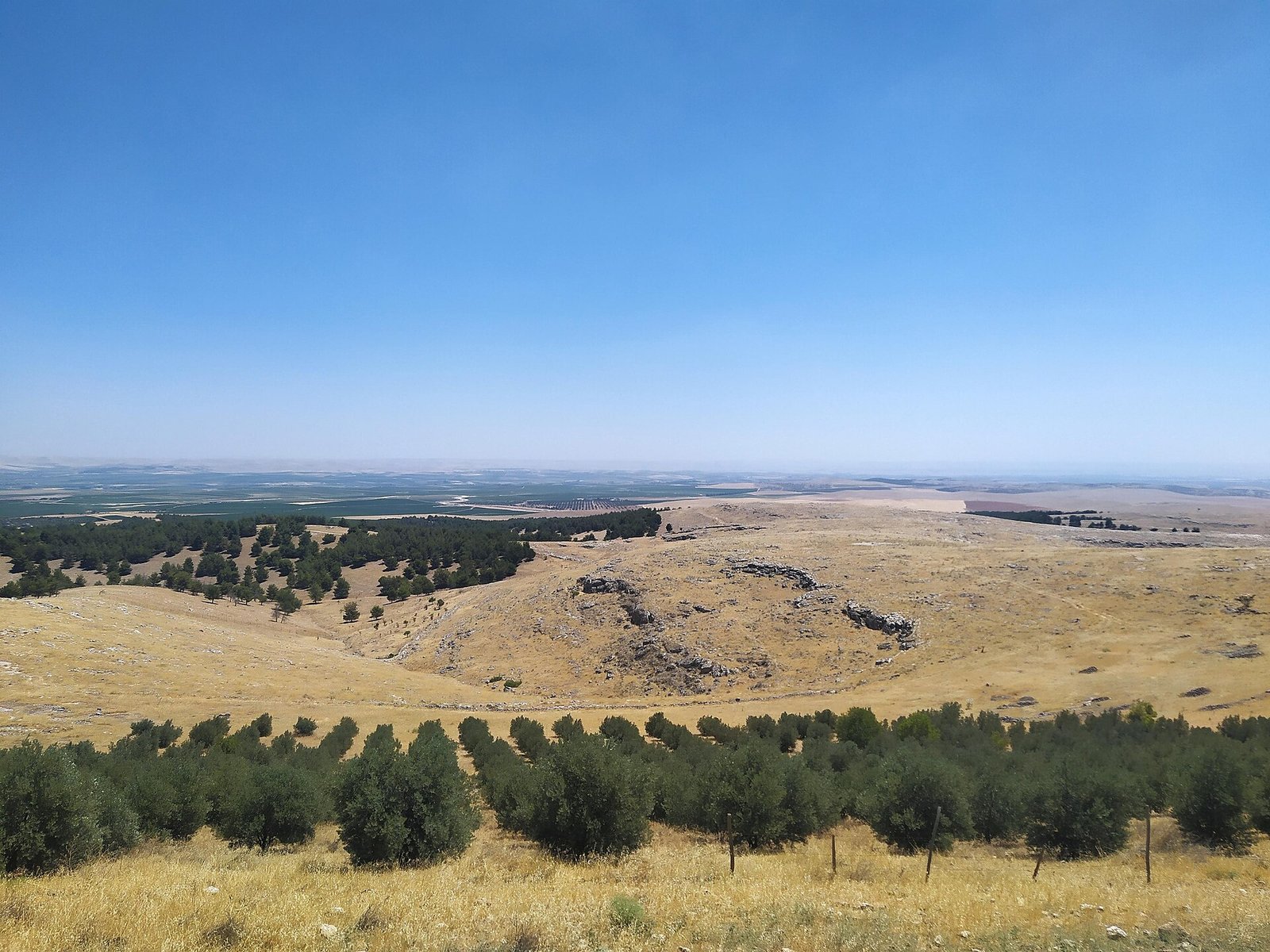
Numbers this large stop meaning anything on a screen. They start meaning something when you are on the walkway above Enclosure D, looking at the ring wall that gave up the 9745–9314 cal BC sample, with the Harran plain running away south. That wall is the reason the number exists.
See how a visit works →Common questions
Is Göbekli Tepe older than the pyramids?
Yes, by roughly 7,000 years. The Great Pyramid dates to around 2560 BC; Göbekli Tepe's earliest enclosures to around 9500 BC. The gap between Göbekli Tepe and the pyramids is larger than the gap between the pyramids and today.
Is Göbekli Tepe the oldest temple in the world?
It is the oldest known monumental architecture of its kind, and it is routinely called the world's first temple. Archaeologists are less comfortable with the word: 'temple' imports assumptions about religion and priesthoods that the evidence does not supply. 'Monumental gathering place' is closer to what can actually be demonstrated.
How do we know the dates are right?
Two independent lines agree. Radiocarbon on wall plaster and on charcoal near bedrock both place Enclosure D in the late 10th millennium cal BC. Separately, the stone tool types present — and the later types conspicuously absent — put the site's use between the PPNA and the middle PPNB. Neither method depends on the other.
Were all four enclosures built at the same time?
Apparently not. Enclosure D is the earliest of those dated; Enclosure C's outer ring wall may be younger, and Enclosure A younger still. This rests on a small number of dates and the excavators treat it as provisional.
Why was it abandoned around 8000 BC?
Nobody knows for certain, but the timing is suggestive. Göbekli Tepe has no domesticated plants or animals, and it goes out of use at roughly the point when farming becomes fully established in the region. A place built by and for hunter-gatherers ends as that way of life does.
Sources & further reading3 references
- Clare, L. (2020). Göbekli Tepe, Turkey. A brief summary of research at a new World Heritage Site (2015–2019). e-Forschungsberichte des Deutschen Archäologischen Instituts 2020(2): 81–88.
- Dietrich, O., Heun, M., Notroff, J., Schmidt, K. & Zarnkow, M. (2012). The role of cult and feasting in the emergence of Neolithic communities. New evidence from Göbekli Tepe, south-eastern Turkey. Antiquity 86(333): 674–695.
- Schmidt, K. (2012). Göbekli Tepe: A Stone Age Sanctuary in South-Eastern Anatolia. Berlin: ex oriente. The foundational monograph by the site's first excavator.
Full bibliography: the Taş Tepeler reference library →