A drawing too important to rush
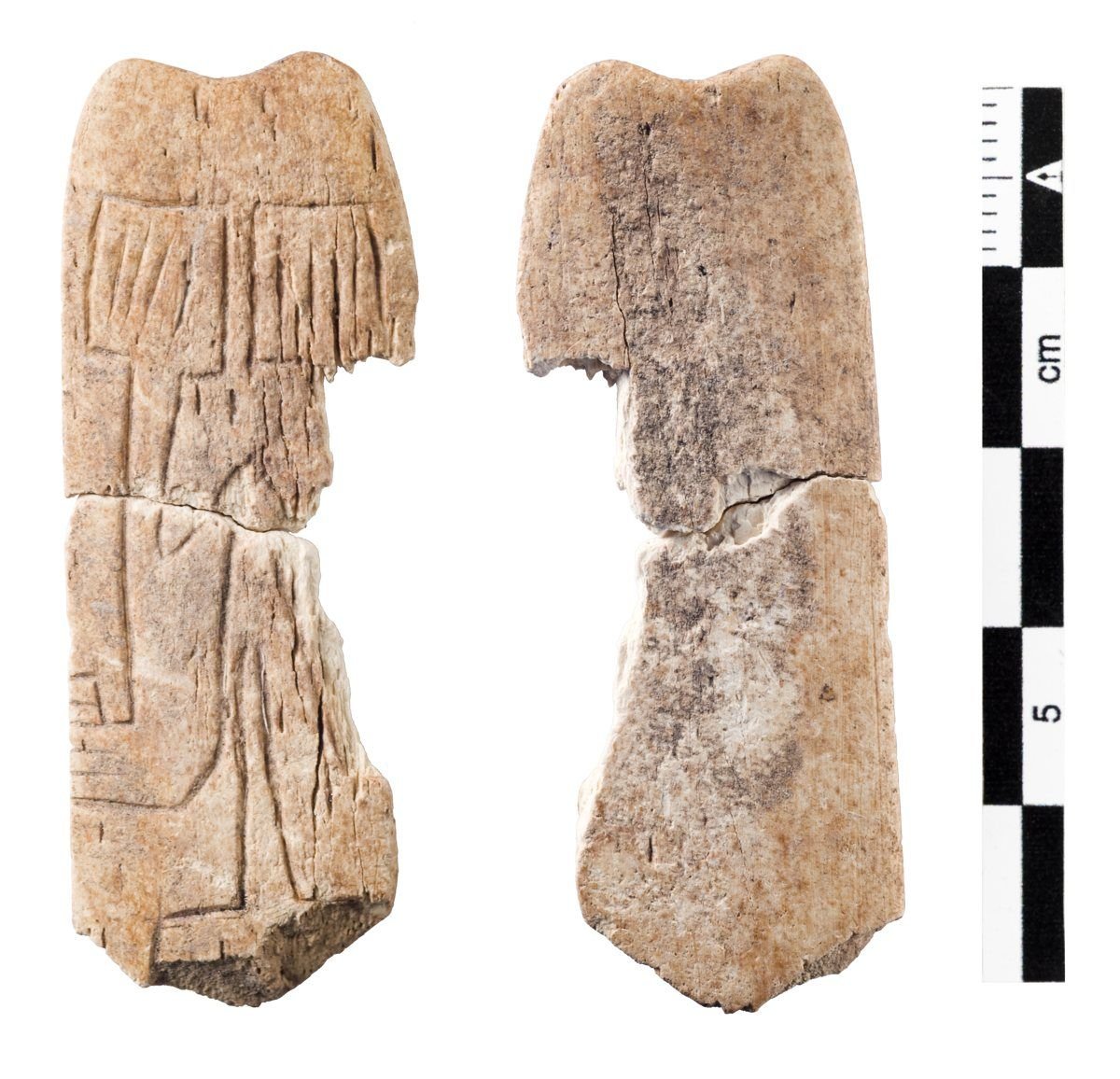
In 2011, in a trench in Göbekli Tepe's northwestern depression, excavators found a fragment of a bone object — a small implement usually described as a 'spatula', cut from a rib, measuring just 5.3 × 1.9 × 0.3 cm. Small enough to hold between two fingers. What made it stop the dig was not its shape but its surface: it carries a carved drawing, only partly preserved and, at first glance, rather unclear. In the upper part, though, two hatched T-shaped forms stand out — one complete, one broken off at the edge.
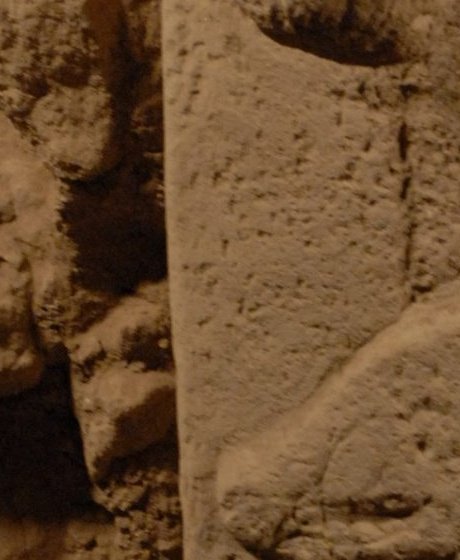
Two Ts, side by side, hatched with fine lines, on an 11,000-year-old bone from Göbekli Tepe. It is almost impossible not to think of the site's most famous feature — the T-shaped pillars standing all around. That resemblance set off a careful, sceptical debate inside the research team, and the find was deliberately not rushed into print. It went instead on display in the Şanlıurfa Museum, where visitors now puzzle over it exactly as the excavators first did.
Reading a picture, 11,000 years on
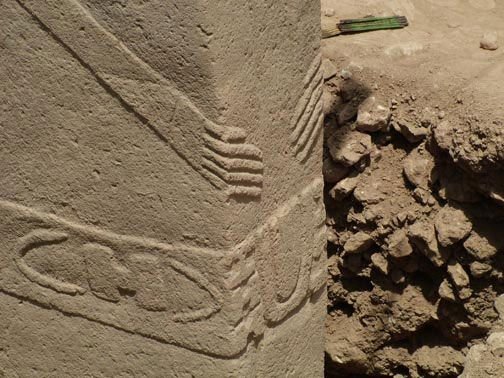
The little bone is a perfect case study in how hard it is to 'read' Neolithic art — a problem archaeologists take seriously enough to borrow a framework from art history, the art historian Erwin Panofsky's levels of meaning. At the first level you simply describe the marks: lines, hatching, two T-shaped outlines. At the second, you try to say what those forms represent — and this is where a shared code with the maker would be needed, and where, for a culture with no writing and no living tradition, we largely run out.
The T-pillar reading is attractive precisely because we can see what the shapes might point to — the pillars are everywhere on the hill. But that is an inference we supply, not a caption the artist left. If the reading is right, the implication is extraordinary: art about art, the builders of the great stones making a small, portable image of them. A picture you could carry in a pouch — to teach, to remember, to claim membership, or to mean something we will never recover.
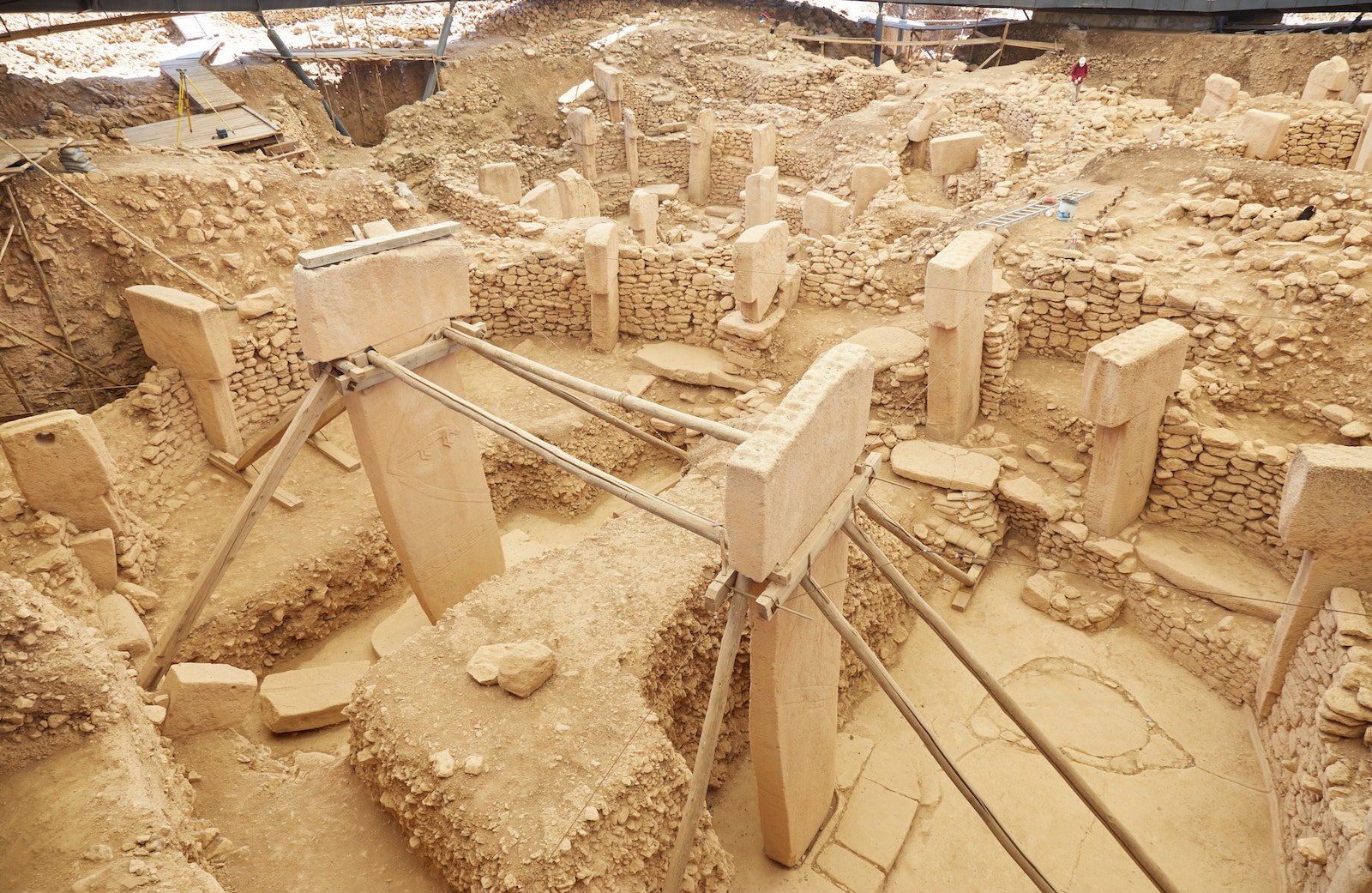
German Archaeological Institute, Göbekli Tepe Project, Enclosure D, Göbekli Tepe, Copyright: DAI — used with permission, via .
Why it matters either way
Even setting the T-pillar interpretation aside, the object is important. Portable, engraved art is rare at Göbekli Tepe, a site dominated by monumental stone; a hand-sized carved bone gives us a glimpse of image-making at the scale of the individual rather than the community. It reminds us that alongside the ten-tonne pillars, these people also made — and presumably exchanged and handled — small, personal things we only rarely recover.
And if the two Ts really are pillars, the bone becomes one of the earliest known cases of a society depicting its own monuments — a Neolithic equivalent of drawing your cathedral. That single possibility is why the excavators treated a 5-centimetre scrap of rib with such caution and such care.
Common questions
What is the Göbekli Tepe bone spatula? A small rib-bone implement (5.3 × 1.9 cm) found in 2011, engraved with a partly-preserved design that includes two hatched T-shaped forms. It is now displayed in the Şanlıurfa Archaeology Museum.
Does it really show the T-pillars? Possibly. The two T-shapes strongly recall the site's T-pillars, which would make it a rare depiction of the monuments by their own builders — but the excavators treat this as a careful hypothesis, not a proven fact.
Why didn't the excavators just announce it as a picture of the pillars? Because Neolithic images have no captions. Reading a shape as a specific object requires cultural knowledge we don't fully have, so the team deliberately avoided overclaiming.
What is uncertain
Everything hinges on the reading. The drawing is fragmentary and faint, and the identification of the two shapes as T-pillars — rather than an abstract motif, a plant, or something else — is a hypothesis the team itself has been careful about. Far more speculative interpretations circulate online; the excavators have pointedly refused to join them.
What is certain is the object: a small carved bone, from a secure Neolithic context, bearing a deliberate design with two T-like forms. Whether it is the earliest depiction of the T-pillars or something else entirely, it is a rare and precious glimpse of Göbekli Tepe's people drawing on a scale that fits in the hand.
Key takeaways
- A 5-centimetre carved rib bone from Göbekli Tepe bears an engraving with two hatched T-shapes.
- The shapes strongly recall the site's T-pillars, raising the possibility of art depicting its own monuments.
- Reading Neolithic images is hard — the T-pillar interpretation is an inference we supply, not a caption the maker left.
- Either way, portable engraved art is rare here; the bone is a glimpse of image-making at hand-held scale.
Sources
- DAI Tepe Telegrams — A decorated bone spatula, what's in that picture? Iconology and Archaeology
- Dietrich, O. et al. — discussion of the incised bone object, Göbekli Tepe (DAI).
- Panofsky, E. (1939/1982). Studies in Iconology — the levels-of-meaning framework, applied in the DAI Tepe Telegrams post linked here.
This article is written from the primary literature and excavators' reports cited above. Interpretations are attributed; uncertainties are stated in the text.