Short answer
Possibly — some cranes carved at Göbekli Tepe appear to stand on human legs, raising a serious question in the literature: are these birds, or people wearing bird masks and costume?
The carvers knew exactly what a crane looks like, so the human-style legs read as a deliberate choice, and the site has produced mask depictions and miniature mask objects. If they are masked dancers, the pillars record ceremony rather than wildlife — but this remains a leading interpretation, not an established fact.
The detail that started it
Cranes appear in the Göbekli Tepe relief corpus — Pillar 33 in Enclosure D carries birds among its snakes and foxes, and cranes have been identified on other pillars including Pillar 2.
The awkward detail is anatomical. Cranes have thin, backward-jointed bird legs. A number of the Göbekli cranes do not. They stand on legs that read as human — straight, forward-jointed, with the weight distributed the way a person's is.
A crane with human legs is not a mistake. Whoever carved these knew exactly what a crane looks like; the birds are otherwise observed with real precision. The legs are a choice.
So what are we looking at?
The cautious reading is that these are stylised birds, and that the leg treatment is a carving convention rather than a statement.
The stronger reading — and the one that has drawn attention — is that some of these images show people in bird masks and costume, or a figure caught mid-transformation between human and crane.
There is supporting material. Göbekli Tepe has produced stone-sculptured depictions of masks and miniature mask objects, and masks turn up more widely across the Pre-Pottery Neolithic horizon alongside plastered skulls and other treatments of the face. The idea that faces could be concealed, swapped or transformed was demonstrably present in this world.
The masks that have actually been found
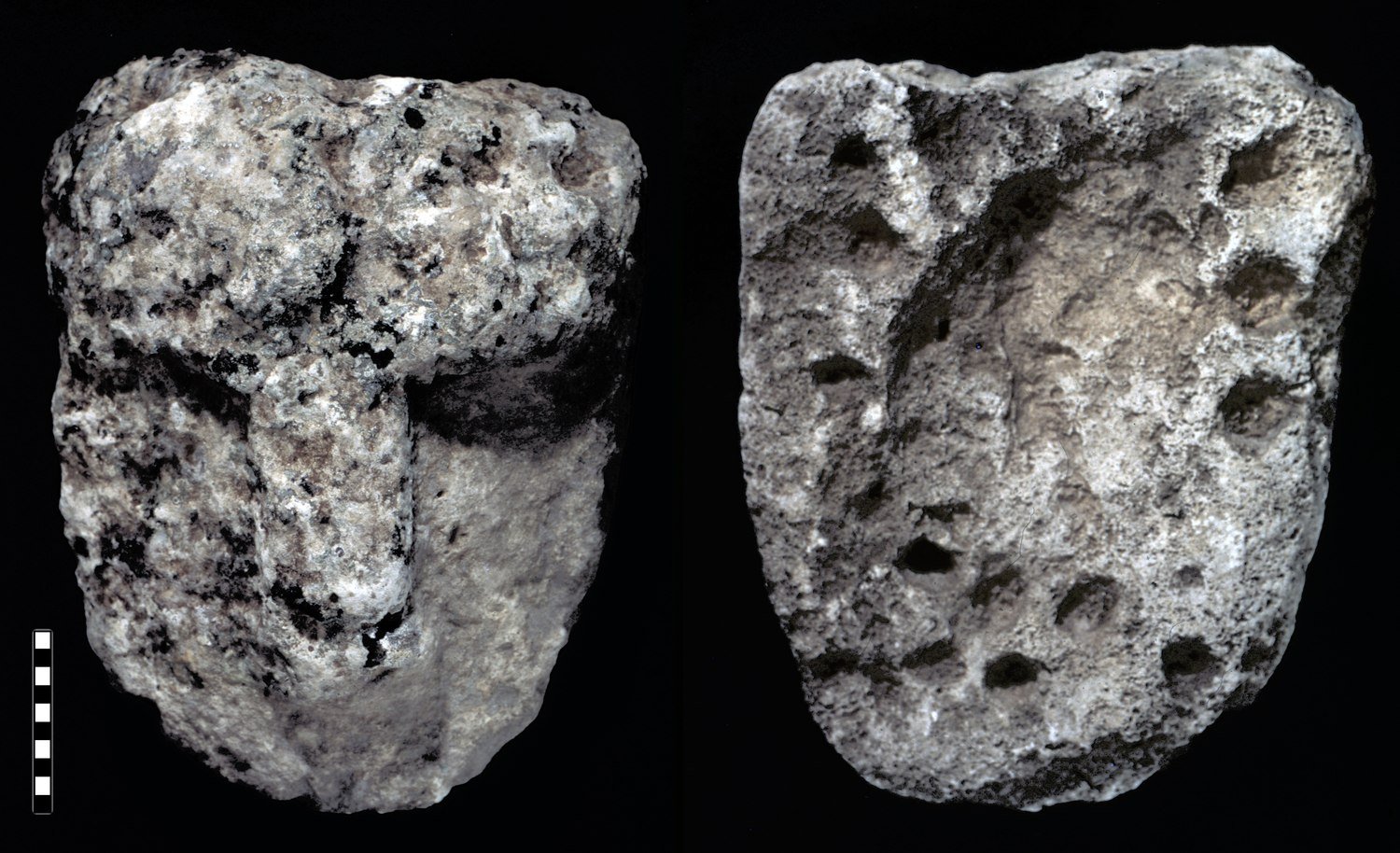
The masking argument does not rest on the carvings alone. Göbekli Tepe and its neighbours have produced a small but real set of stone masks, described by the excavation team (O. Dietrich, J. Notroff and L. Dietrich, 2018).
The most arresting is a larger-than-life limestone mask about 42 cm high, recovered during surface clearance in 1995. The face is minimal — the eyes barely marked, the mouth absent, the brow and nose cut as a single 'T'. That same 'T'-face is how anthropomorphic figures are shown across the site, which is why it reads as a human face and not something else. At that size it is too heavy to wear; it was more likely fixed to a wall or a support.
Alongside it are miniatures, each only a few centimetres tall, carved from limestone or from a flint cortex. One (5.7 cm) came from the filling of Enclosure D; one (4.5 cm), with more pronounced eyes, from beside a central pillar of Enclosure C; and one (4.7 cm), engraved with curved chevrons over the brow — possibly a headdress, possibly tattooing or scarification — from beside a central pillar of Enclosure H.
What separates these from the site's many carved stone heads is the back. The masks have a hollowed, concave rear, the way a face-covering would. A comparable miniature — this one with eyes, a nose and an open, almost screaming mouth — comes from nearby Nevalı Çori, the site that first produced the region's T-shaped pillars.
The excavators' cautious reading is that these stone masks, miniature and over-sized alike, are copies of real masks that were once worn — most likely made of organic materials such as wood, which have not survived. If so, they are the durable trace of a masking tradition. And they were handled deliberately: complete masks and selected fragments were placed in the backfill of the enclosures, most often near the central pillars.
Why a mask changes everything
If these are masked people, the carvings stop being a bestiary and become a record of performance.
A mask does something specific: it makes the wearer temporarily somebody — or something — else. An ancestor. An animal. A figure with authority the ordinary person does not hold. Masking is how many societies stage the moment when a person crosses a boundary.
Read that way, the pillars are not decorated with animals. They preserve ceremonies. This sits closely with Lee Clare's argument that the imagery should be understood as narrative and worldview material rather than depictions of animals in the landscape — figures in stories a Neolithic viewer would recognise, not wildlife observation.
Why cranes in particular
Cranes are a reasonable candidate for this kind of symbolism. They are tall, long-legged and roughly human in silhouette when standing. They migrate — appearing and vanishing on a seasonal cycle. And crane courtship involves elaborate leaping dances, which is exactly the kind of behaviour a human dancer can imitate.
A bird that stands like a person, disappears and returns each year, and dances is unusually well suited to carrying ideas about travel between states — between here and elsewhere, living and dead.
What is honestly not settled
A good deal. Nobody has published an agreed count of crane images at Göbekli Tepe. The structural context of some cited examples, including Pillar 2, needs pinning down. It is not established how widely the human-leg observation is accepted rather than debated.
And even granting the detail, the interpretation stays open: masked dancers, a myth of transformation, a costumed ritual specialist, or a stylistic convention with no such meaning at all are all live options.
What can be said is narrower and still interesting: some of the birds carved at Göbekli Tepe were given legs that are not bird legs, and no one has explained that convincingly as an accident.
The masks that survive
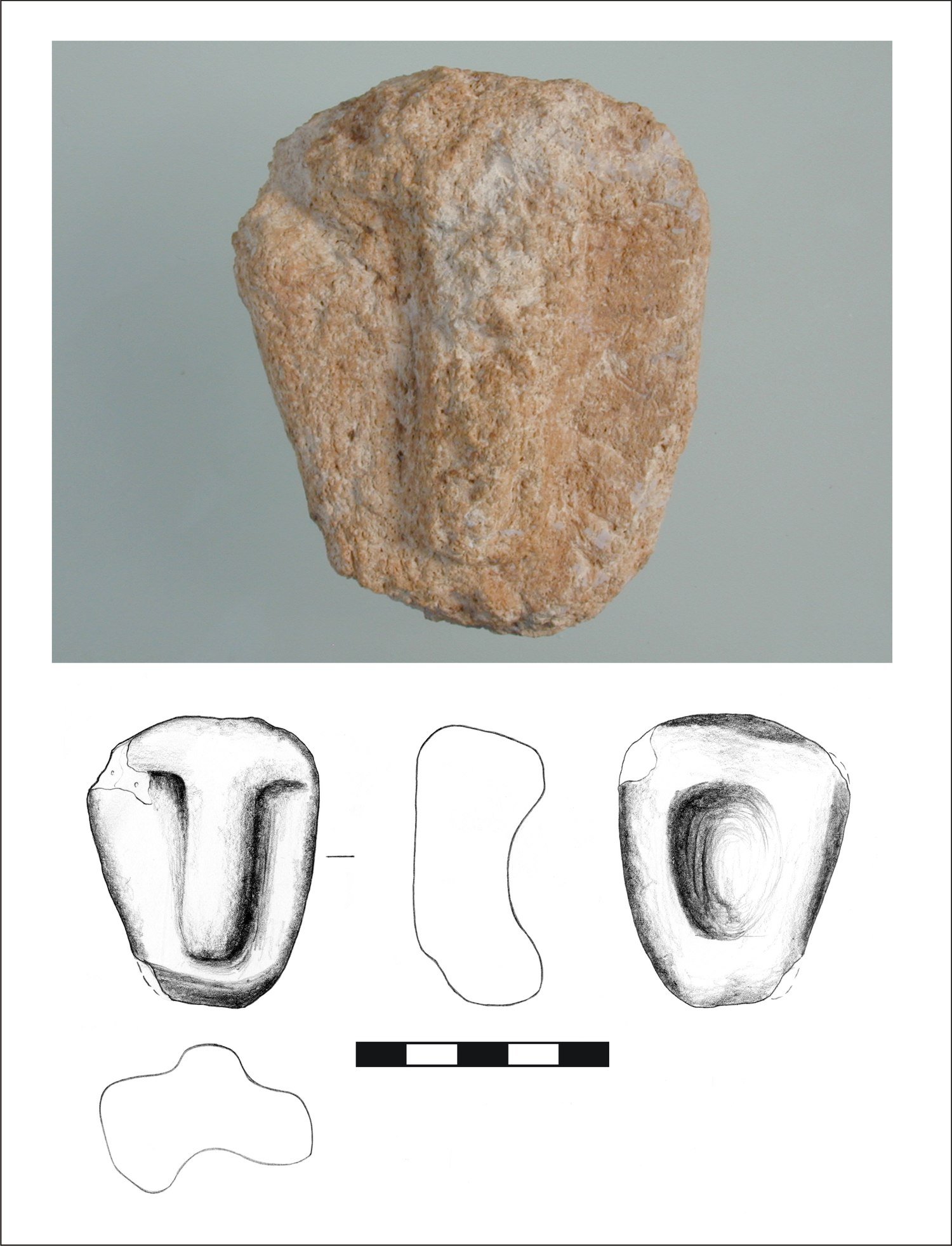 Miniature mask, Enclosure DA limestone miniature 5.7 cm tall, from the filling of Enclosure D — the same reduced 'T'-face as the large mask, with a concave back.
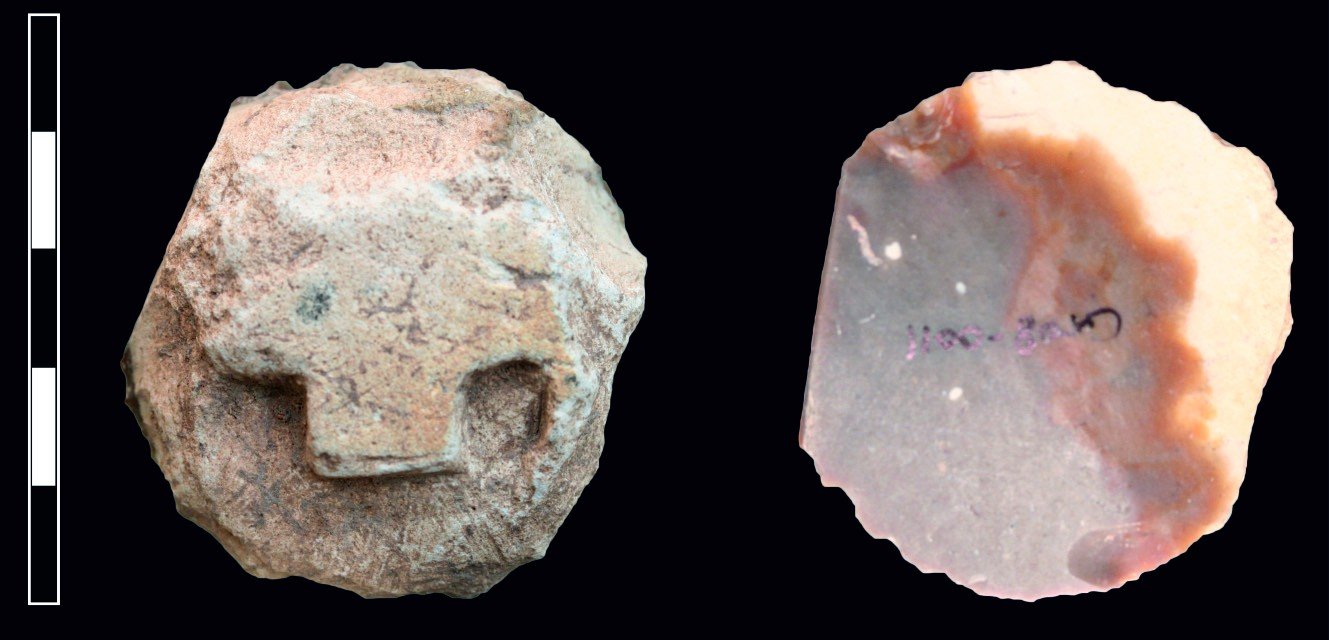 Miniature mask, Enclosure CA 4.5 cm mask engraved in a flint cortex, found beside a central pillar of Enclosure C; here the eyes are more clearly marked.
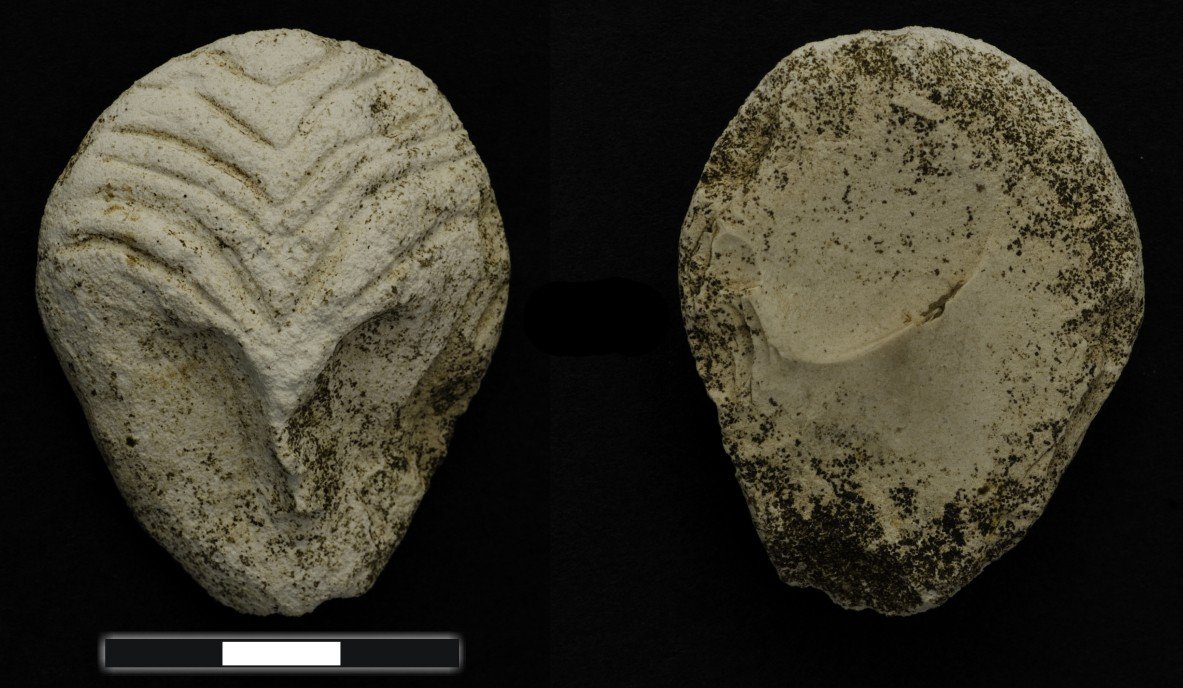 The chevron mask, Enclosure HA 4.7 cm mask on flint cortex with curved chevrons over the brow — a headdress, or perhaps tattooing or scarification. Found next to a central pillar of Enclosure H.
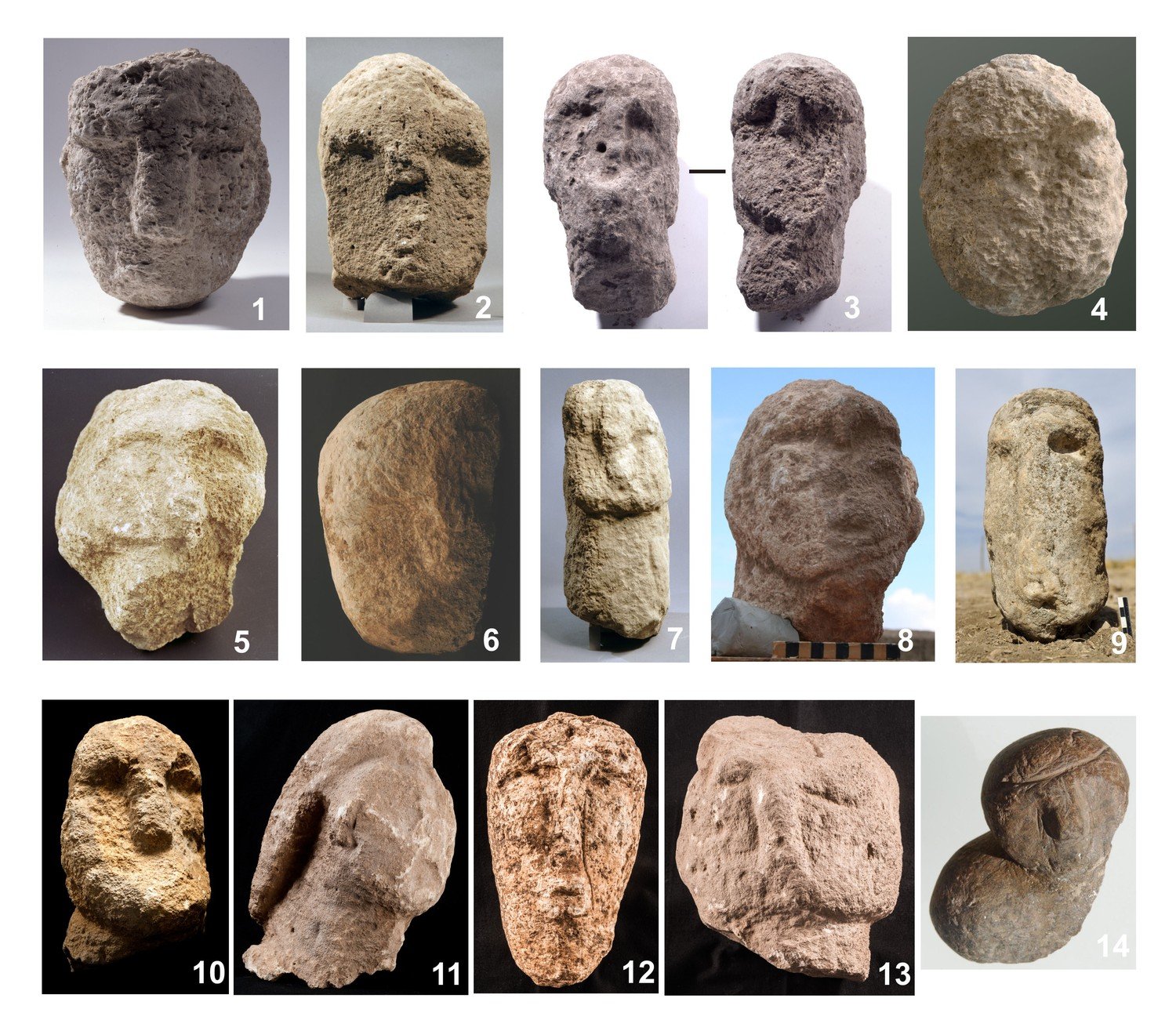 The limestone headsA selection of carved stone heads from Göbekli Tepe (not to scale). Some may show masked faces; the masks proper are set apart by their hollow backs.
Common questions
Were masks actually found at Göbekli Tepe?
Yes. The team has published one larger-than-life limestone mask (about 42 cm, found in surface clearance in 1995) and several miniatures a few centimetres tall from the fillings of Enclosures D, C and H — plus a comparable miniature mask from nearby Nevalı Çori.
How do we know they are masks and not just carved heads?
The masks have a hollow, concave back, like a face-covering, which sets them apart from the site's many solid carved stone heads. The 42 cm example is too heavy to have been worn, so it is read as a durable copy of a lighter organic mask.
What were the masks for?
The excavators cautiously read them as objects tied to masking and transformation — worn (in organic versions) or displayed in ritual — and note that several were deliberately placed in the backfill near the central pillars. What exactly they meant is not recoverable.
Do the carvings show people wearing masks?
It is a leading interpretation, not an established fact. Some cranes at the site appear to stand on human legs rather than bird legs, which — together with the real mask objects — raises the possibility of costumed, masked performers. Whether a given carving shows a masked person remains interpretation.
Was masking unique to Göbekli Tepe?
No. Mask objects and mask imagery recur across the Pre-Pottery Neolithic of the region — Nevalı Çori, and later the plastered and modelled faces of the southern Levant — so masking was demonstrably part of this wider world.
Sources & further reading5 references
- Peters, J. & Schmidt, K. (2004). Animals in the symbolic world of Pre-Pottery Neolithic Göbekli Tepe, south-eastern Turkey: a preliminary assessment. Anthropozoologica 39(1): 179–218.
- Schmidt, K. (2012). Göbekli Tepe: A Stone Age Sanctuary in South-Eastern Anatolia. Berlin: ex oriente. The foundational monograph by the site's first excavator.
- Clare, L. (2025). Public lectures and interviews on Göbekli Tepe (Göbekli Tepe Project, DAI). Transcribed talks and interviews held in the Taş Tepeler research atlas. Spoken material rather than a peer-reviewed publication; positions may be refined in print.
- Notroff, J., Dietrich, O. & Schmidt, K. (2014). Building Monuments, Creating Communities. Early monumental architecture at Pre-Pottery Neolithic Göbekli Tepe. In J.F. Osborne (ed.), Approaching Monumentality in Archaeology: 83–105. Albany: SUNY Press.
- The Tepe Telegrams (official research blog of the Göbekli Tepe Project, DAI). The Tepe Telegrams. Deutsches Archäologisches Institut. link Accessible, authoritative running commentary from the excavation team.
Full bibliography: the Taş Tepeler reference library →