The oldest of us
In 1993, a construction crew digging in the Balıklıgöl district in the heart of Şanlıurfa turned up a statue. It came from a buried Neolithic settlement archaeologists now call Yeni Mahalle, under the modern city. What they had found turned out to be the oldest known life-sized statue of a human being — carved around 9,500–9,000 BCE, some 11,500 years ago, older than the first pottery, the first metal, the first writing, by thousands of years.
He is carved from a single block of limestone and stands about 1.8 metres tall — the height of a living man. Below the hands the body ends not in legs but in a plain peg, so the figure was probably meant to be set upright into the ground or a floor, standing among the living rather than lying down. He is now the centrepiece of the Şanlıurfa Archaeology Museum.
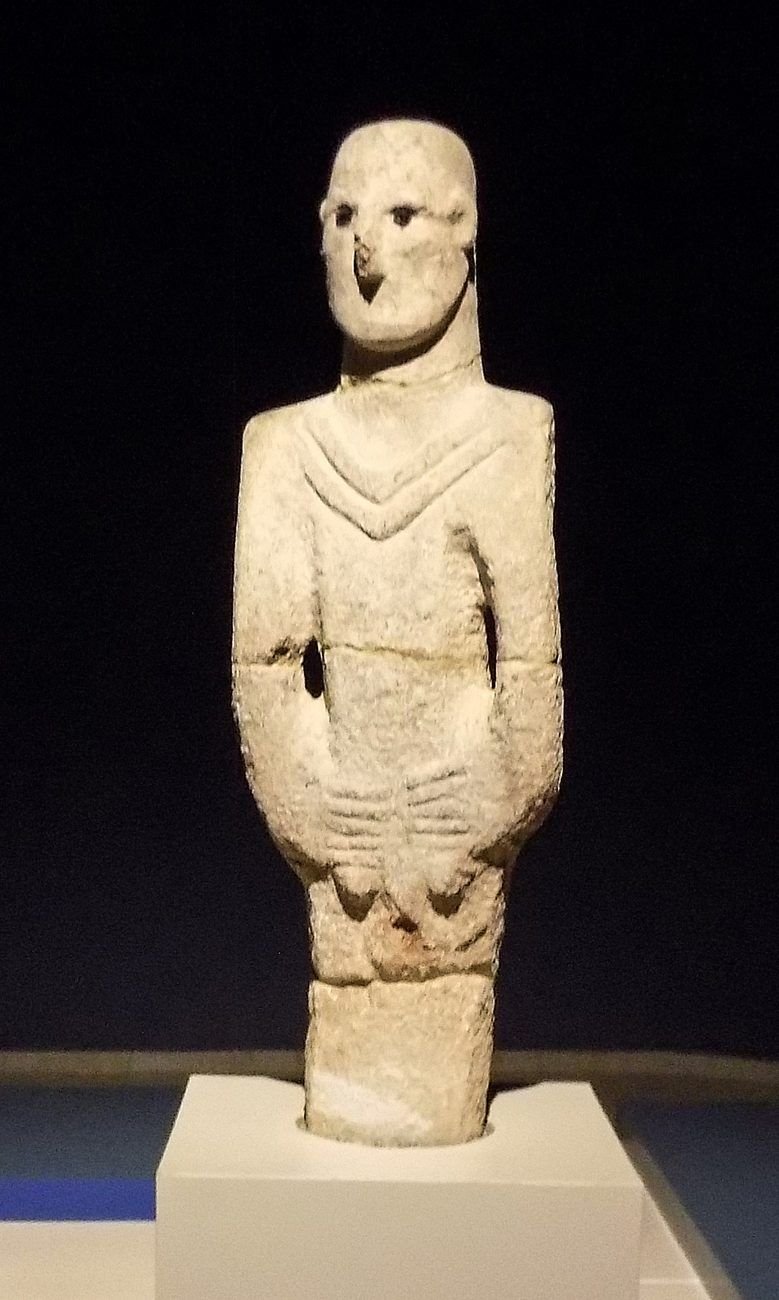
Cobija, Urfa man (web), CC BY-SA 4.0, via Wikimedia Commons.
A face with no mouth
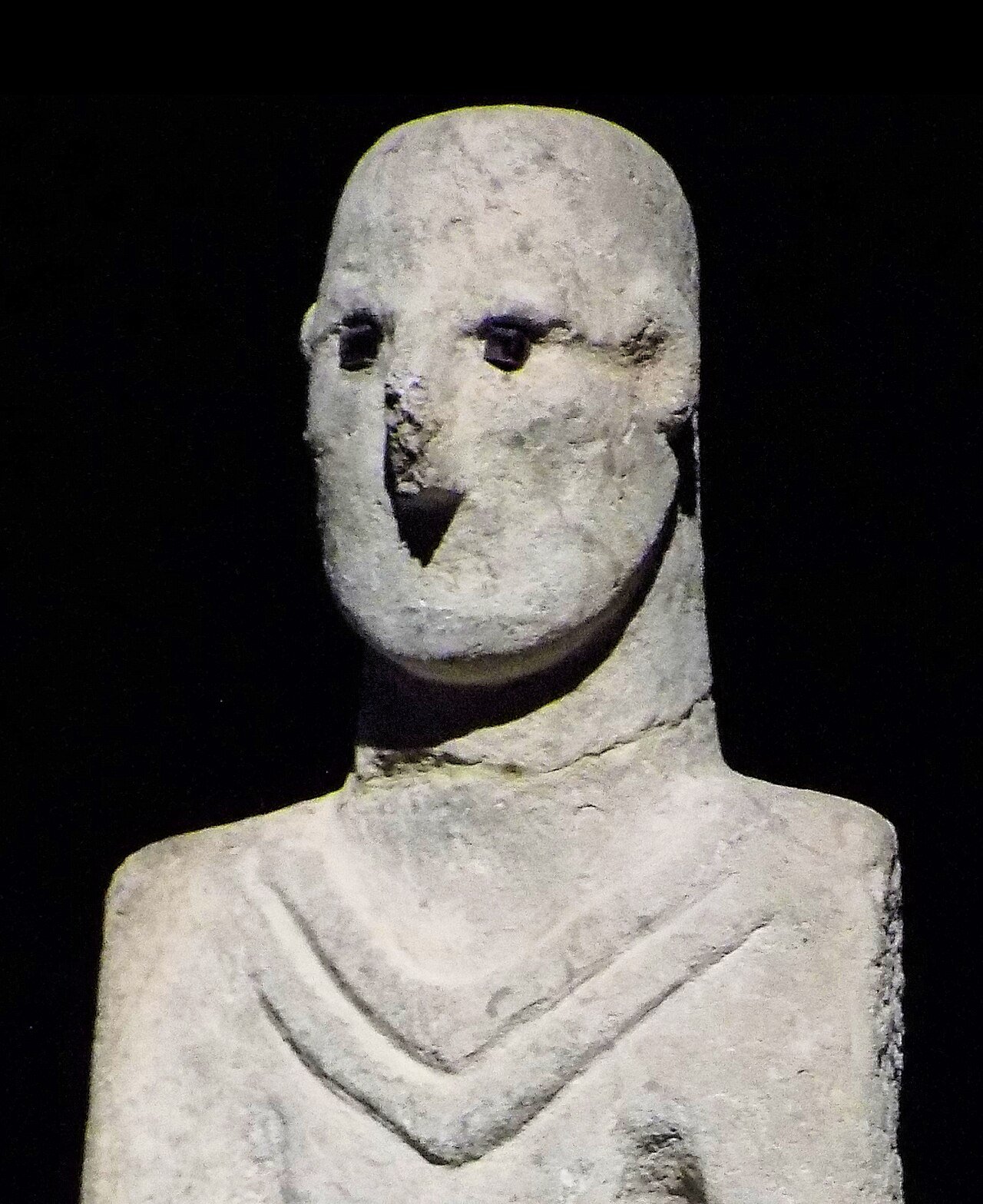
What stops you is the face. The eyes are deep-set sockets inlaid with black obsidian — volcanic glass — so that even now the figure seems to look. The nose is carved but broken. And there is no mouth: the lower face is left blank. A being that sees but does not speak.
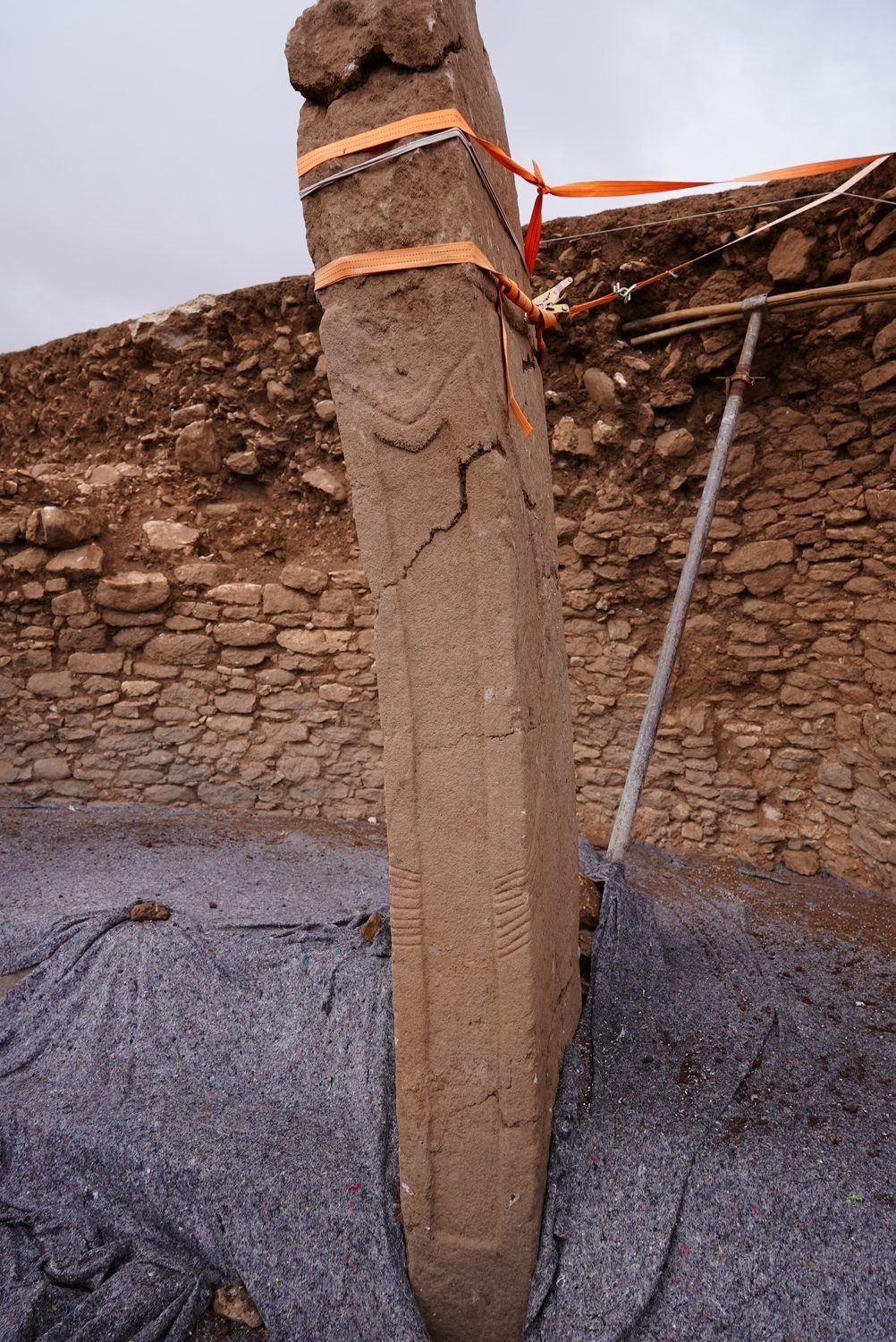
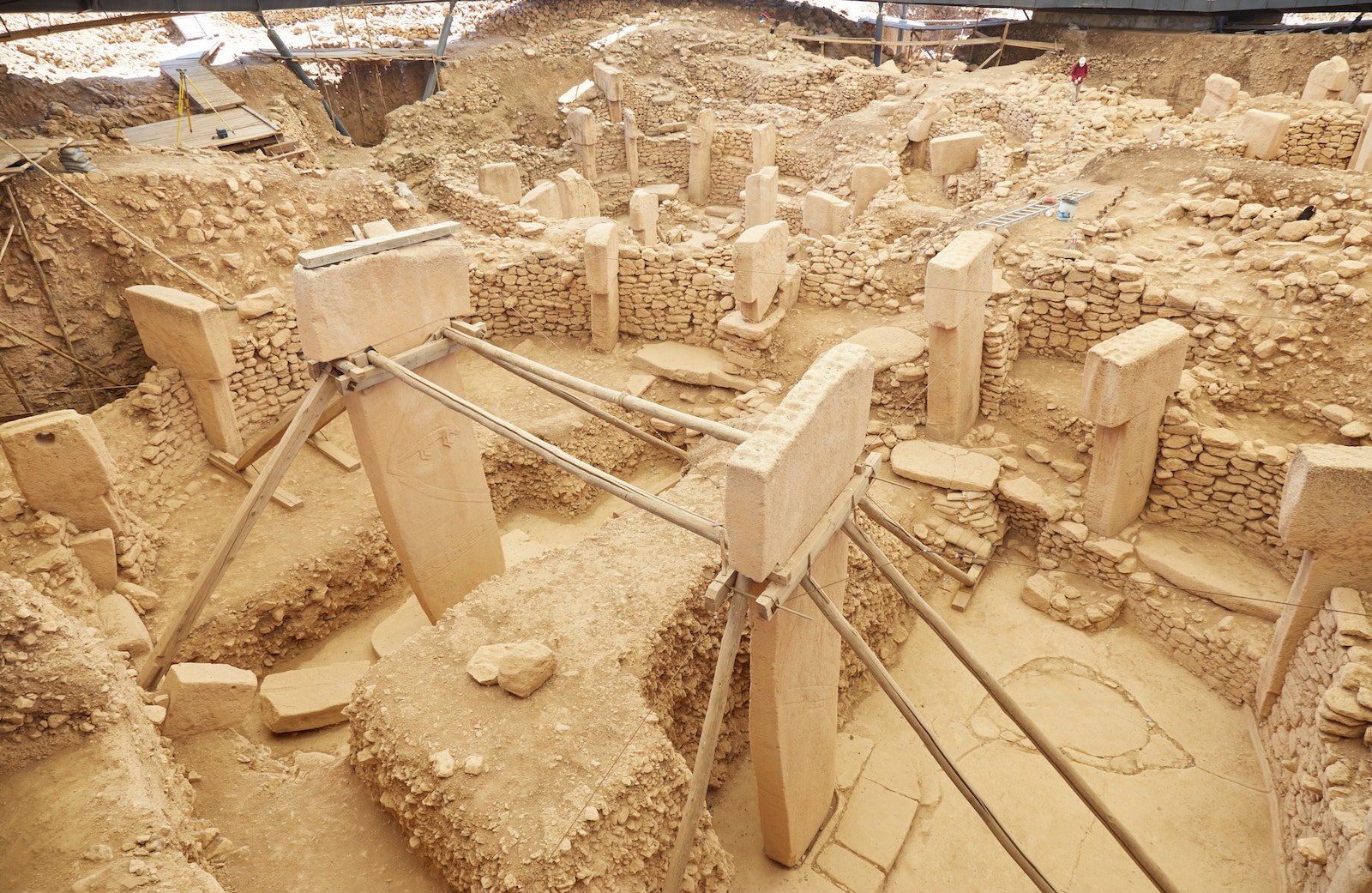
Around the neck runs a V-shaped double line, read as a collar or necklace. It is the one piece of ornament on an otherwise naked body, and it matters, because the same V-collar and the same watchful, mouthless presence turn up again on the great T-pillars a day's walk away at Göbekli Tepe and Karahan Tepe. Urfa Man is not an isolated curiosity; he is the naturalistic version of the beings those sites render as abstract stone.
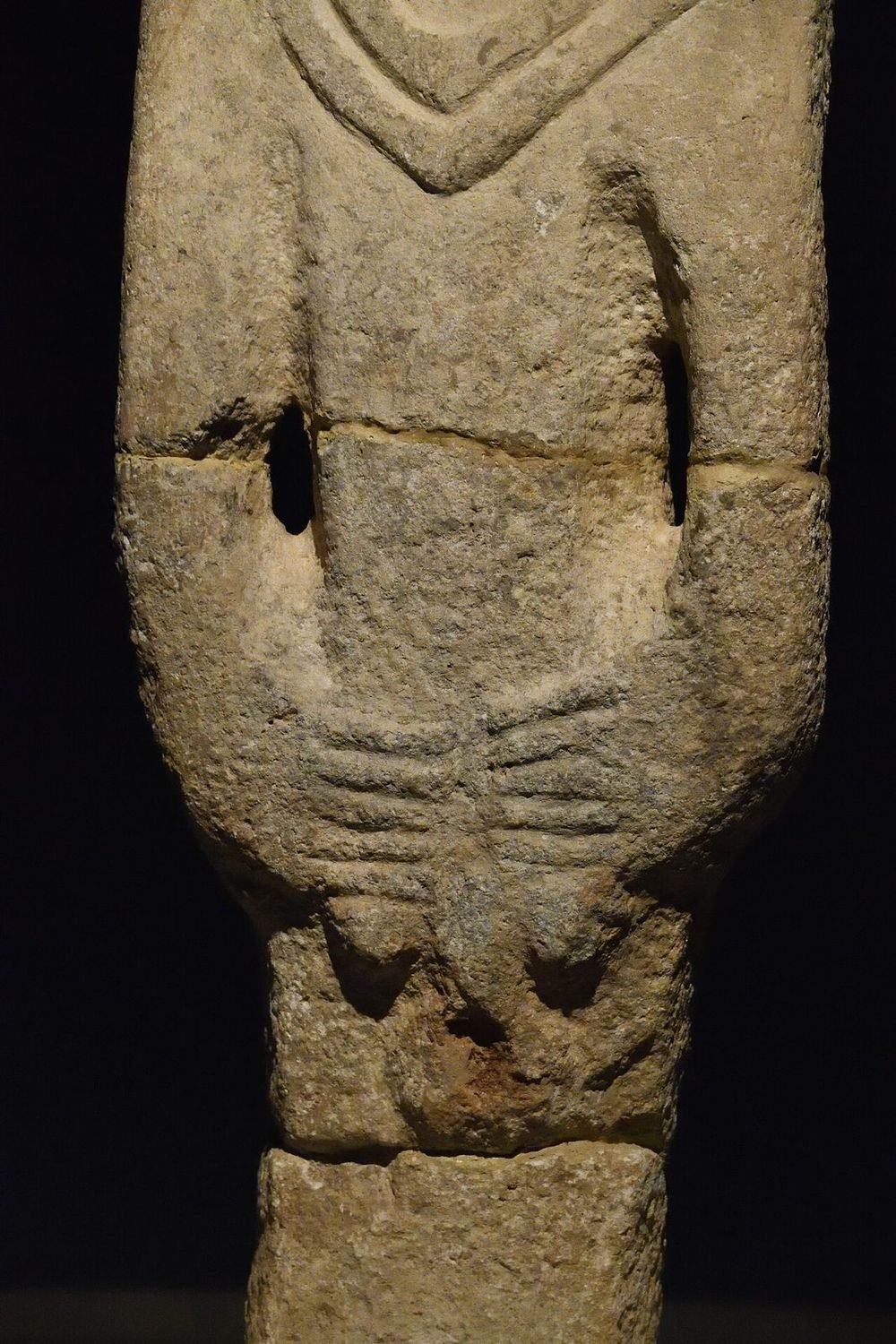
Dosseman, Urfa museum Urfa man sept 2019 4716, CC BY-SA 4.0, via Wikimedia Commons.
The same gesture as the pillars
Look at the body and the connection sharpens. The arms are carved down the sides, and at the bottom the hands come together at the front, fingers rendered, cupped over the genitals. That is exactly the move the T-pillars make: an arm down each side of the shaft, hands meeting at the front over a belt. Where a pillar abstracts a body into a T, Urfa Man spells it out — face, eyes, collar, hands, sex — in the round.
Set the two side by side and the whole Taş Tepeler world lines up. The pillar is a body seen as architecture; Urfa Man is that same body carved as a person. Both are tall, standing, faceless-but-watching presences, made by the same communities within the same few centuries. He is the clearest answer to the question the pillars keep raising: who were these stone beings meant to be? Someone who looked, more or less, like the people who made them.
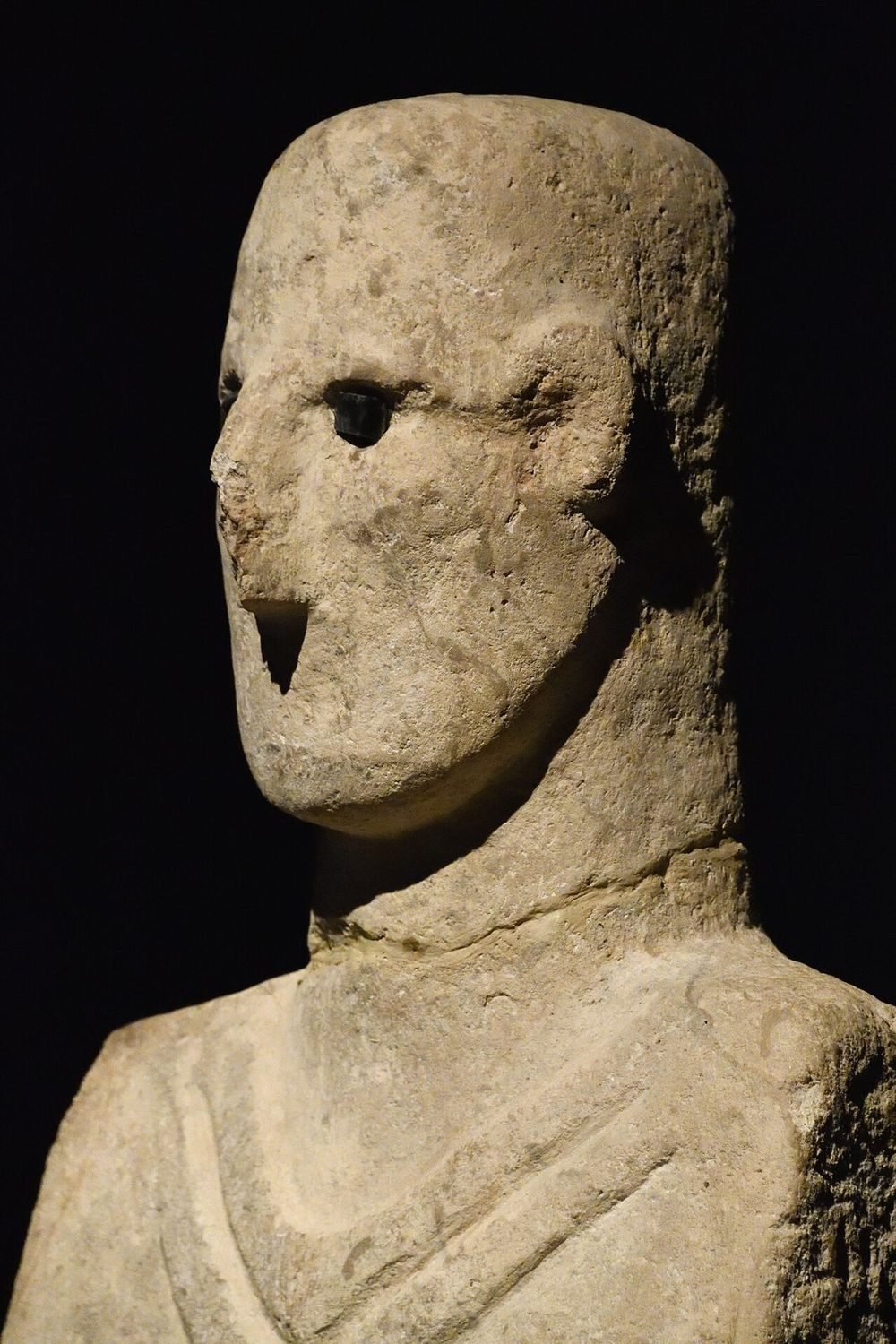
Dosseman, Urfa museum Urfa man sept 2019 4712, CC BY-SA 4.0, via Wikimedia Commons.
Found in the city, not on a hill
Unlike Göbekli Tepe or Karahan Tepe, Urfa Man did not come from a lonely mound in the hills. He came from under Şanlıurfa itself, beside the sacred pools of Balıklıgöl — which means a full Neolithic settlement, Yeni Mahalle, lies buried in the middle of a living city, mostly unreachable beneath modern streets. The statue is a fragment of a site we can barely dig, a reminder that the Taş Tepeler network reached right into what is now downtown Urfa.
Common questions
How old is Urfa Man? Roughly 11,500 years — carved in the Pre-Pottery Neolithic, about 9,500–9,000 BCE. That makes him older than Stonehenge or the pyramids by some seven thousand years, and the oldest life-size human statue known.
Why does he have no mouth? No one knows. The blank lower face is deliberate — the eyes were carefully inlaid with obsidian while the mouth was simply left out, an absence shared with other faces in the region. It gives the figure a fixed, watching, silent presence rather than an expression.
Where is Urfa Man now? In the Şanlıurfa Archaeology Museum, where he stands as its signature piece.
What is uncertain
The date is a range (about 9,500–9,000 BCE) based on the statue's style and its link to the Yeni Mahalle settlement, not on a direct radiocarbon date of the object itself. The precise phase, and much of the settlement he came from, remain poorly known because the site lies under the modern city.
What he was for is unknown. An ancestor, a mythic figure, a specific remembered person, a guardian at the pools — all have been suggested, none proven. Even the familiar description that he 'holds his penis' is a reading of a damaged lower body; what is certain is only that the hands are brought together at the front, in the same place the T-pillars put theirs.
Key takeaways
- Urfa Man is the oldest life-size human statue known — carved around 9,500 BCE, older than Stonehenge or the pyramids by some seven thousand years.
- He has obsidian eyes and no mouth, a watchful, silent presence closer to the T-pillars than to a portrait.
- His hands meet at the front over the genitals — the same gesture the T-pillars make in the abstract, tying the statue to the pillar-beings.
- He came from under modern Şanlıurfa, so a whole Neolithic settlement (Yeni Mahalle) lies buried beneath the living city.
Sources
- Live Science — Urfa Man: an 11,500-year-old life-size statue of a man
- Wikipedia — Urfa Man (Balıklıgöl statue)
- Şanlıurfa Archaeology Museum — Urfa Man / Balıklıgöl statue (collection)
This article is written from the primary literature and excavators' reports cited above. Interpretations are attributed; uncertainties are stated in the text.