Short answer
The Taş Tepeler sites span roughly 9600–7000 BCE — about two and a half thousand years, not a single moment. The great circular monuments belong to the earlier end; the settled villages come later.
Göbekli Tepe is far better dated than the rest, with three decades of radiocarbon work; Karahan Tepe is broadly contemporary; Gürcütepe is centuries younger. 'Twelve thousand years old' is a fair headline for the oldest end of the group, not a description of all of it.
The frame: PPNA and PPNB
Almost all dating in this region is expressed with two labels, so they are worth knowing.
PPNA — Pre-Pottery Neolithic A, roughly 9600–8800 BCE. The earlier phase. Round buildings, no farming, no pottery.
PPNB — Pre-Pottery Neolithic B, roughly 8800–7000 BCE, often split into early, middle and late. Rectangular buildings become common; domestication is under way by the later part.
A rough rule: PPNA is the monument horizon, PPNB is the village horizon. The great circular enclosures belong to the earlier end; partitioned houses to the later.
Site by site
Göbekli Tepe — the best-dated site by a wide margin, excavated since 1995 with an extensive radiocarbon programme. Monumental phase from around 9500 BCE (PPNA), with occupation continuing into the PPNB, and a commonly cited overall range of roughly 9600–8000 BCE.
Karahan Tepe — broadly contemporary with Göbekli Tepe, tenth into ninth millennium BCE. Excavation began only in 2019, so much of its public dating rests on comparison rather than a published radiocarbon sequence.
Sayburç — late PPNA into early PPNB, with figures in the region of 8650–8300 BCE discussed from the excavation. A short, essentially single-layer occupation.
Harbetsuvan Tepesi — early PPNB, so after Göbekli Tepe's earliest monumental phase.
Ayanlar Höyük — dated by Bahattin Çelik from surface material to between the early and middle PPNB. Excavation began only in September 2025, so this is survey-based and may be revised.
Sefertepe and Çakmaktepe — Pre-Pottery Neolithic, within the same broad horizon. Both are active excavations whose absolute chronologies are still being established; Çakmaktepe is discussed as early-horizon material.
Gürcütepe — the outlier at the young end. All four mounds are PPNB, with the easternmost later still in the PPNC. Later than Göbekli Tepe, not contemporary with it.
Why the precision varies so much
The gap between Göbekli Tepe and everything else is not a matter of importance. It is a matter of excavation years.
Göbekli Tepe has had three decades of work and a mature radiocarbon programme tied to defined stratigraphic contexts. Karahan Tepe has had since 2019. Ayanlar has had one season.
So when a site is described as 'the same age as Göbekli Tepe', that often means the material looks similar, which is a reasonable inference and not the same as a dated sequence. Both are legitimate; they carry different weight.
What complicates every one of these dates
Fill is not architecture. Several of these buildings were filled in. Material in the fill can be older or younger than the structure holding it, so a date from fill does not date the building.
Sites have phases. 'How old is Karahan Tepe' has at least four answers — first occupation, construction of the chamber, filling, abandonment.
Reuse and rebuilding. Göbekli Tepe's special buildings show multiple phases, with structures modified over long periods.
This is why careful sources give ranges rather than single years, and why a headline date should always prompt the question: dating what, exactly?
The honest summary
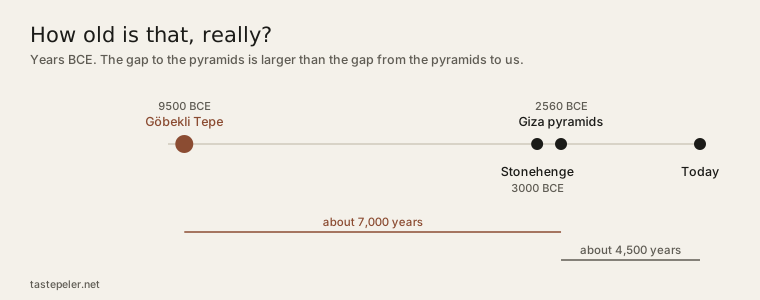
The Taş Tepeler sites span roughly 9600 BCE to 7000 BCE — around two and a half thousand years, which is longer than the gap between us and classical Athens.
Treating them as one moment flattens that. The people who raised Göbekli Tepe's enclosures and the people who lived in Gürcütepe's partitioned houses were separated by more time than separates us from the Roman Empire.
'Twelve thousand years old' is a serviceable headline for the oldest end of it. It is not a description of the group.
Common questions
How old are the Taş Tepeler sites?
They span roughly 9600 to 7000 BCE — about two and a half thousand years. Göbekli Tepe's monumental phase begins around 9500 BCE; Gürcütepe is much later, in the PPNB and PPNC.
What do PPNA and PPNB mean?
Pre-Pottery Neolithic A (roughly 9600–8800 BCE) and B (roughly 8800–7000 BCE). PPNA is broadly the monument horizon with round buildings; PPNB sees rectangular buildings and the onset of domestication.
Which site is best dated?
Göbekli Tepe, by a wide margin — excavated since 1995 with an extensive radiocarbon programme tied to stratigraphic contexts. Most other sites rely more on comparison.
How old is Sayburç?
Late PPNA into early PPNB, with figures in the region of 8650–8300 BCE discussed from the excavation.
How old is Gürcütepe?
It is the youngest of the group — all four mounds are PPNB, with the easternmost in the later PPNC. It is later than Göbekli Tepe, not contemporary with it.
Why do dates for these sites keep changing?
Most are recently excavated, several have multiple phases, and building fill can be older or younger than the structure containing it — so a date from fill does not date the architecture.
Sources & further reading7 references
- Clare, L. (2020). Göbekli Tepe, Turkey. A brief summary of research at a new World Heritage Site (2015–2019). e-Forschungsberichte des Deutschen Archäologischen Instituts 2020(2): 81–88.
- Dietrich, O., Heun, M., Notroff, J., Schmidt, K. & Zarnkow, M. (2012). The role of cult and feasting in the emergence of Neolithic communities. New evidence from Göbekli Tepe, south-eastern Turkey. Antiquity 86(333): 674–695.
- Schmidt, K. (2012). Göbekli Tepe: A Stone Age Sanctuary in South-Eastern Anatolia. Berlin: ex oriente. The foundational monograph by the site's first excavator.
- Karul, N. (2021). Buried Buildings at Pre-Pottery Neolithic Karahantepe. Türk Arkeoloji ve Etnografya Dergisi 82: 19–29. link
- Çelik, B. (2017). A new Pre-Pottery Neolithic site in Southeastern Turkey: Ayanlar Höyük (Gre Hut). Documenta Praehistorica 44: 360–367. doi:10.4312/dp.44.22 link
- Çelik, B. (2016). A small-scale cult centre in Southeast Turkey: Harbetsuvan Tepesi. Documenta Praehistorica 43: 421–428. doi:10.4312/dp.43.21 link
- Özdoğan, E. (2022). The Sayburç reliefs: a narrative scene from the Neolithic. Antiquity 96(390): 1599–1605. doi:10.15184/aqy.2022.125
Full bibliography: the Taş Tepeler reference library →