Short answer
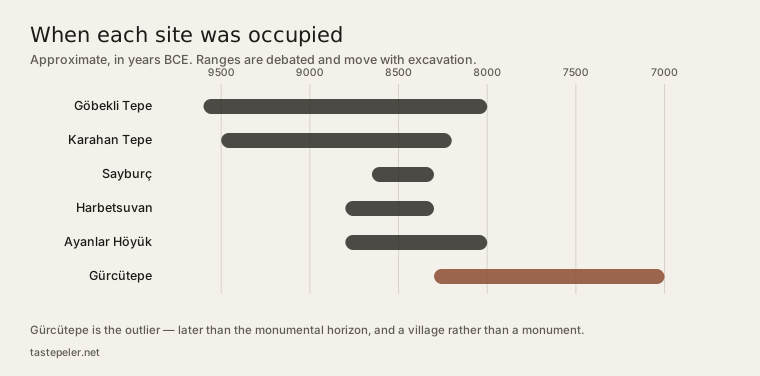
Taş Tepeler is not one date but a sequence spanning nearly two thousand years — from the round monument-builders of the Pre-Pottery Neolithic A (around 9600 BCE) to the settled villages of the Pre-Pottery Neolithic B and after, down to about 7000 BCE.
Göbekli Tepe spans the turn from PPNA to PPNB; Sayburç sits in the PPNB; Gürcütepe is later still. Reading the group as a timeline — monuments first, farming during, villages after — is the whole story. Flattening it into a single 'twelve thousand years old' misses the point, which is change.
The big periods, in plain terms
Archaeologists divide this stretch of the Neolithic in south-eastern Anatolia into a few named blocks. The Epipalaeolithic (before roughly 9600 BCE) is the tail of the Ice Age world of mobile hunter-gatherers. The Pre-Pottery Neolithic A, or PPNA (roughly 9600–8800 BCE), is when the great round monuments appear — still no farming, still no pottery. The Pre-Pottery Neolithic B, or PPNB (roughly 8800–7000 BCE), sees architecture turn rectangular, domestication take hold, and villages spread. Pottery only arrives afterwards.
All dates here are calibrated calendar years BCE, derived from radiocarbon. They are ranges, not pinpoints, and active excavation continues to refine them.
Where the sites sit
Göbekli Tepe spans the turn from PPNA into PPNB. Its oldest monumental buildings — the great round enclosures of what excavators call Layer III — belong to the PPNA, around 9500 BCE. Its later, smaller, more rectangular buildings (Layer II) belong to the early PPNB. The hill was built on and returned to across more than a thousand years.
Karahan Tepe belongs to the same broad Pre-Pottery Neolithic horizon; because large-scale excavation there only began in 2019, its detailed phasing is still being published. Sayburç dates to the mid-ninth millennium BCE — squarely PPNB — which is why its narrative relief is so important for that later moment. Çakmaktepe holds some of the earliest ground in the region; Gürcütepe sits later, as the world shifted toward settled villages.
How the dates are actually made
None of this is guesswork. The dates come from radiocarbon measurement of once-living material — charcoal, animal bone, and, crucially at Göbekli Tepe, the lime plaster the builders themselves made, which locks in carbon from the moment it was burnt. Raw radiocarbon ages are then calibrated against tree-ring and other records to convert them into real calendar years.
The result is always a range with a stated confidence, not a single year. That is why careful sources say 'around 9500 BCE' rather than a precise date — and why the honest question to ask of any headline figure is: dating what, from which context, exactly?
It gets finer than PPNA and PPNB
The two big blocks are a starting point, not the whole grid. Specialists routinely split the PPNB into Early, Middle and Late sub-phases (EPPNB, MPPNB, LPPNB), and add a terminal PPNC at the very end. These are not pedantry: each sub-phase carries its own signature in architecture, tool kits and subsistence, and it is at this resolution that the sites actually get placed against one another.
So when Harbetsuvan is described as 'Early PPNB' or Göbekli's Layer II as 'early PPNB', that is a claim about a slice perhaps two or three centuries wide — much sharper than 'the Neolithic', and the level at which real disagreement happens. It is also why a single site can straddle a boundary: Göbekli Tepe runs from the PPNA into the early PPNB, which is another way of saying it was in use across the join between the two great blocks.
This is a framework, not a fact sheet
The period scheme was built in the southern Levant — at Jericho and its neighbours — and then stretched north and east to cover Upper Mesopotamia. It does not fit the Şanlıurfa sites perfectly, and researchers argue about the edges: exactly where PPNA ends, how to label material that sits between the textbook phases, and whether the Levantine labels should be used here at all.
That is worth keeping in mind whenever you read a confident date. The period framework (which phase) and the absolute framework (which calendar years) are two different measuring sticks laid over the same ground, and they do not always agree cleanly. For where the individual sites fall and how the 'oldest' argument plays out, the sister pages below carry the detail; this page is the map of the periods themselves.
Why the sequence matters
Reading Taş Tepeler as a timeline, rather than a single 'oldest temple,' changes everything. It lets you watch ideas move: from the round PPNA enclosures with their towering central pillars, through the rectangular PPNB rooms cut into bedrock at Karahan, to the domestic villages that followed. The monuments come first, farming comes during, and the whole thing unfolds over a span longer than the distance between us and the Roman Empire.
Anyone who flattens that into one date is missing the actual story — which is one of change.
Common questions
What does PPNA and PPNB mean?
Pre-Pottery Neolithic A (roughly 9600–8800 BCE) and B (roughly 8800–7000 BCE) — the two main phases of the early Neolithic before pottery, defined by changes in architecture, tools, and subsistence.
How long was Taş Tepeler active?
The sites span nearly two thousand years across the Pre-Pottery Neolithic. Göbekli Tepe alone was in use for well over a thousand years.
Are the dates certain?
They're calibrated radiocarbon ranges, well constrained but not pinpoints, and still being refined as excavation and dating continue.
Sources & further reading5 references
- Dietrich, O., Heun, M., Notroff, J., Schmidt, K. & Zarnkow, M. (2012). The role of cult and feasting in the emergence of Neolithic communities. New evidence from Göbekli Tepe, south-eastern Turkey. Antiquity 86(333): 674–695.
- Clare, L. (2020). Göbekli Tepe, Turkey. A brief summary of research at a new World Heritage Site (2015–2019). e-Forschungsberichte des Deutschen Archäologischen Instituts 2020(2): 81–88.
- Schmidt, K. (2012). Göbekli Tepe: A Stone Age Sanctuary in South-Eastern Anatolia. Berlin: ex oriente. The foundational monograph by the site's first excavator.
- Karul, N. (2021). Buried Buildings at Pre-Pottery Neolithic Karahantepe. Türk Arkeoloji ve Etnografya Dergisi 82: 19–29. link
- Özdoğan, E. (2022). The Sayburç reliefs: a narrative scene from the Neolithic. Antiquity 96(390): 1599–1605. doi:10.15184/aqy.2022.125
Full bibliography: the Taş Tepeler reference library →