Short answer
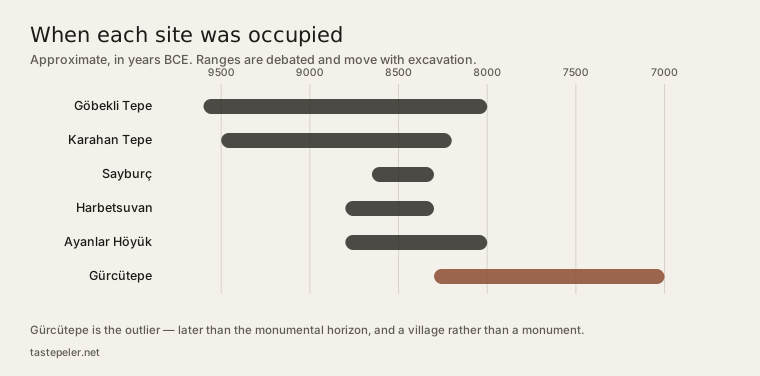
On the published evidence, Göbekli Tepe has the earliest securely dated monumental architecture — its oldest enclosures date to around 9600–8200 BCE, resting on by far the largest radiocarbon series in the group.
Çakmaktepe, Karahan Tepe and Harbetsuvan are each regularly called 'older than Göbekli Tepe,' but their reported ranges overlap it rather than precede it, and none is yet backed by a published radiocarbon series you can inspect. Which hill saw the earliest human activity is a genuinely open question; which has the earliest dated monuments is still Göbekli Tepe.
The short answer
Göbekli Tepe. Not because it is the most famous, but because it has by far the largest published series of radiocarbon determinations, and those dates place its earliest monumental enclosures around 9600–8200 BCE.
That is a claim about securely dated monumental architecture, which is a narrower claim than “the oldest site.” People were living in this landscape well before anyone raised a T-pillar. If you ask which hill has the earliest human activity, the answer is genuinely open. If you ask which site has the earliest well-dated monuments, it is still Göbekli Tepe.
Why you keep reading that something else is older
In the space of a few years, at least three different Taş Tepeler sites have been presented in English-language coverage as older than Göbekli Tepe: Çakmaktepe, Karahan Tepe and Harbetsuvan Tepesi.
They cannot all be right, and on current published evidence none of them is clearly established. The claim recurs for three ordinary reasons rather than any conspiracy of hype.
First, different things are being dated. A site's earliest scatter of flint is not the same as its earliest building, which is not the same as its earliest monument. A site can genuinely have older occupation and younger architecture than Göbekli Tepe, and a headline will flatten that into “older.”
Second, excavation news travels faster than excavation reports. Most of these sites began systematic work in 2021 or later. Season announcements circulate years before a stratigraphy and a radiocarbon series are published.
Third, “older than Göbekli Tepe” is the most efficient sentence in Neolithic archaeology for explaining why a site matters to a general reader. It is not dishonest. It is just doing publicity work rather than chronological work.
Çakmaktepe: the clearest case
Çakmaktepe is the site most often described as roughly a thousand years older than Göbekli Tepe. It is the best illustration of the problem, because the reported ranges do not agree with each other.
Reporting connected to the excavation places Çakmaktepe in the early Pre-Pottery Neolithic A, at roughly 9600–8800 BCE. Other accounts describe it as Late Epipalaeolithic to early PPNA, around 10500–9500 BCE.
Those are very different statements. The first puts Çakmaktepe squarely alongside Göbekli Tepe's early phase. The second puts part of its occupation before it. Both are in circulation; neither is supported in English by a published radiocarbon series you can inspect.
What is not in doubt is that Çakmaktepe is architecturally earlier in character — circular single-room houses cut into bedrock, not monumental enclosures. That is a real and interesting difference. It is not the same as being older.
Karahan Tepe and Harbetsuvan
Karahan Tepe's reported range, around 9400–8200 BCE, sits inside Göbekli Tepe's. The two are best understood as contemporaries with different building traditions — Göbekli raised and buried, Karahan carved down into rock — rather than as a sequence.
Harbetsuvan Tepesi is placed in the Early Pre-Pottery Neolithic B, broadly contemporary with Göbekli Tepe's Level II. Crucially, that dating rests on artefact parallels with Göbekli Tepe rather than on a published radiocarbon series from Harbetsuvan itself. A date derived from Göbekli Tepe cannot then be used to place a site before it.
What would actually settle it
A published radiocarbon series from each site, from secure stratified contexts, calibrated and presented with confidence intervals — and stated clearly as dating a specific building or layer rather than a whole hill.
Göbekli Tepe has this, accumulated over decades. Karahan Tepe is building it. Most of the others do not have it yet in accessible English publication. Until they do, any ranking of these sites by age is provisional, including this one.
That is an unsatisfying answer, and it is the honest one. We would rather tell you the evidence is not in than pick a winner for you.
How to read the chart
The timeline above shows reported ranges, not confidence intervals. Solid bars are published or project-stated ranges; lighter bars indicate that only a broad period is available; dashed outlines mark press-reported or unpublished figures — including the second, conflicting range for Çakmaktepe.
Read the overlap rather than the edges. Almost every site here occupies the same broad horizon. The Taş Tepeler landscape is better understood as a network of roughly contemporary communities than as a relay race with a winner.
Common questions
Which Taş Tepeler site is the oldest?
On published evidence, Göbekli Tepe has the earliest securely dated monumental architecture, around 9600–8200 BCE. Claims that other sites are older are not currently supported by published radiocarbon series.
Is Karahan Tepe older than Göbekli Tepe?
No, on current evidence. Karahan Tepe's reported range of roughly 9400–8200 BCE sits inside Göbekli Tepe's. They are best treated as contemporaries with different building traditions.
Is Çakmaktepe older than Göbekli Tepe?
It is often reported that way, but the ranges conflict. Excavation-linked reporting places it at roughly 9600–8800 BCE, overlapping Göbekli Tepe; other accounts give 10500–9500 BCE. No published radiocarbon series settles it in English.
Is Harbetsuvan older than Göbekli Tepe?
No. It is dated to the Early PPNB by artefact parallels with Göbekli Tepe itself, which cannot place it earlier.
Why do so many sites get called 'older than Göbekli Tepe'?
Because different things are being dated (occupation versus architecture), because season announcements travel faster than excavation reports, and because it is the quickest way to explain why a site matters.
Sources & further reading8 references
- Clare, L. (2020). Göbekli Tepe, Turkey. A brief summary of research at a new World Heritage Site (2015–2019). e-Forschungsberichte des Deutschen Archäologischen Instituts 2020(2): 81–88.
- Schmidt, K. (2012). Göbekli Tepe: A Stone Age Sanctuary in South-Eastern Anatolia. Berlin: ex oriente. The foundational monograph by the site's first excavator.
- Dietrich, O., Heun, M., Notroff, J., Schmidt, K. & Zarnkow, M. (2012). The role of cult and feasting in the emergence of Neolithic communities. New evidence from Göbekli Tepe, south-eastern Turkey. Antiquity 86(333): 674–695.
- Karul, N. (2021). Buried Buildings at Pre-Pottery Neolithic Karahantepe. Türk Arkeoloji ve Etnografya Dergisi 82: 19–29. link
- Çelik, B. (2016). A small-scale cult centre in Southeast Turkey: Harbetsuvan Tepesi. Documenta Praehistorica 43: 421–428. doi:10.4312/dp.43.21 link
- Şahin, F. & Massa, M. (2025). Mass-hunting in South-west Asia at the dawn of sedentism: new evidence from Şanlıurfa, south-east Türkiye. Antiquity.
- Çelik, B. (2006). Sefer Tepe: A New Pre-Pottery Neolithic Site in Southeastern Turkey. Neo-Lithics 1/06: 23–25.
- Şanlıurfa Neolithic Research Project — Taş Tepeler (2026). Official project site (Istanbul University / Şanlıurfa Museum). tastepeler.org link
Full bibliography: the Taş Tepeler reference library →