The claim that won't go away
Of all the ideas attached to Göbekli Tepe, none has travelled further than this one: that a single carved pillar is a star map, a coded record of a comet that struck the Earth nearly thirteen thousand years ago. It has been on television, in bestselling books, and in a thousand YouTube videos. People arrive on our tours already knowing 'the comet stone'.
So it is worth doing two things properly: setting out exactly what the theory says, fairly, and then setting out — just as clearly — why the archaeologists who have spent decades excavating Göbekli Tepe reject it. Both halves matter. The claim is not stupid; it is peer-reviewed and dressed in statistics. But the verdict of the people who actually dug the site is unambiguous, and it is no.
First, what is actually carved on the 'Vulture Stone'?
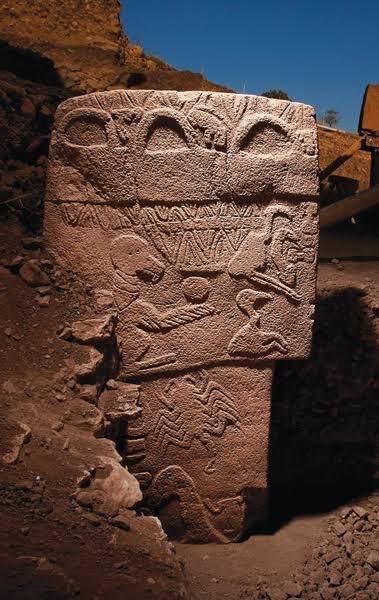
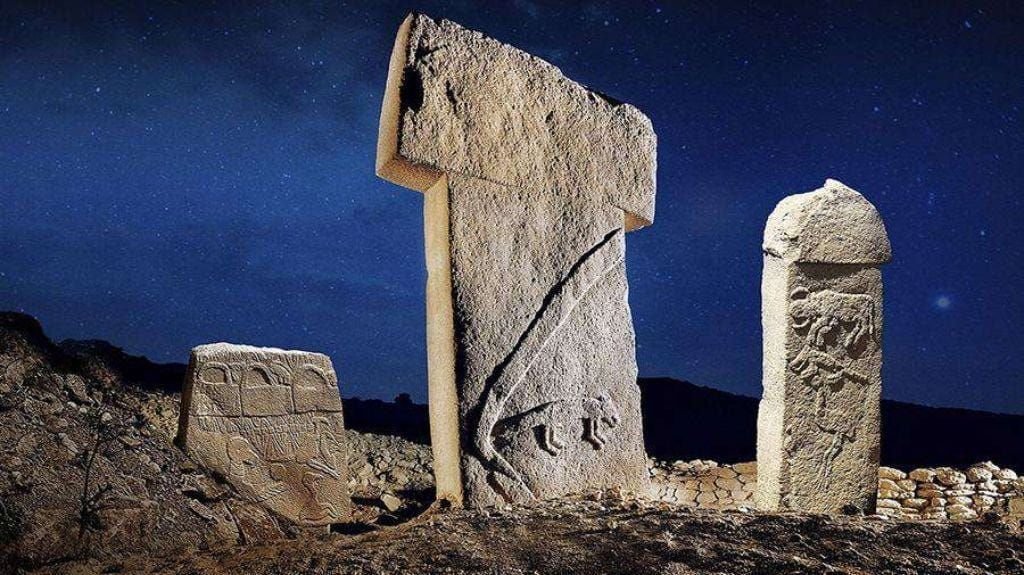
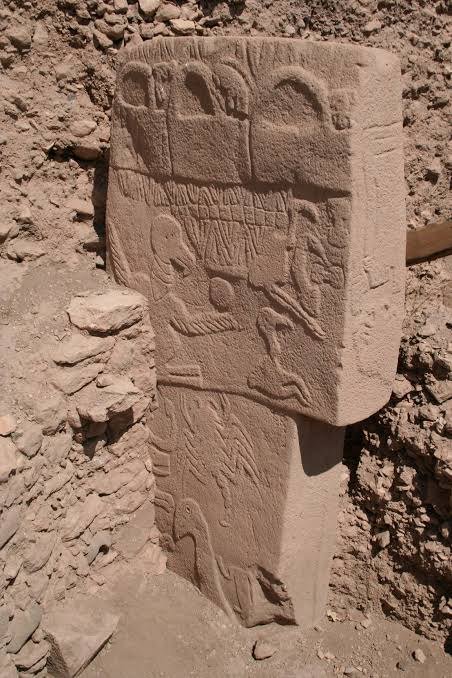
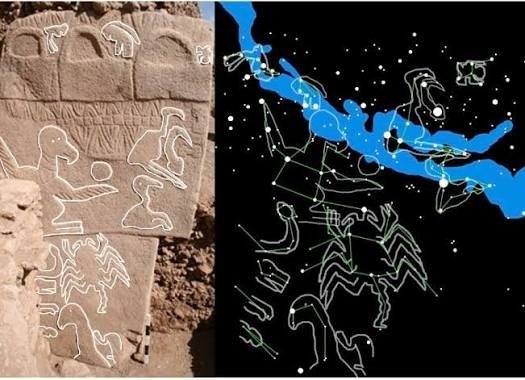
Pillar 43 stands on the western side of Enclosure D. It is one of the most crowded carvings at the site, and everything on it is real and undisputed. A large vulture spreads one wing upward, its wing-tip near a disc or sphere. A smaller bird stands to the right. There is a snake, two H-shaped symbols, wild fowl, and lower down a big scorpion and another bird's head. Near the bottom is a small headless human figure, male, with an erect phallus. Along the very top runs a row of three rectangular 'bag' shapes, each topped by a little animal.
That inventory is not in question. What is in question is what it means — and that is where a real carving and a modern theory part company.
The theory reads a single stone out of sixty, back-dates it a thousand years before the room it sits in was built, and calls the result a calendar. The people who dug the site call it something else: over-reading.
What Sweatman and Tsikritsis argue
In 2017 Martin Sweatman, a chemical engineer at the University of Edinburgh, and Dimitrios Tsikritsis published a paper with the memorable title 'Decoding Göbekli Tepe with archaeoastronomy: what does the fox say?' Their argument runs like this: the animals are not just animals but constellations — matched, using planetarium software, to the modern Western sky. The vulture becomes Sagittarius; the scorpion becomes Scorpius; the disc becomes the Sun.
Read that way, they say, Pillar 43 is a date stamp: the position of the Sun among those constellations, wound backwards through the slow wobble of the Earth's axis (the 'precession of the equinoxes'), points to a specific moment — 10,950 BC, give or take 250 years. That date, they argue, matches the onset of the Younger Dryas, a sudden cold snap, which they link to a contested idea that a comet or meteor swarm struck the Earth. On this reading, the Vulture Stone is a memorial to a catastrophe, and Göbekli Tepe was partly an observatory for watching the skies.
A crucial detail for judging the theory: the authors lean on a claimed statistical significance for their constellation matches, and Sweatman went so far as to write that any interpretation inconsistent with theirs 'is very likely to be incorrect'. In 2024 he extended the idea in the journal Time and Mind, reading tally-like V-marks on the same pillar as the 'world's oldest calendar' — 365 days, still commemorating the comet, now dated slightly differently to around 10,850 BCE.
The 'world's oldest calendar' sequel
The claim mutated in 2024. In the journal Time and Mind, Sweatman argued that a row of V-shaped marks on the same Pillar 43 is a lunisolar calendar — twelve months plus a handful of extra days, adding to 365 — and, again, that it commemorates the comet, now dated slightly differently to around 10,850 BCE. Headlines around the world announced the 'world's oldest calendar', and the story spread from a university press release into NPR, national newspapers and the rest.
That very slippage — the 'date stamp' quietly moving from 10,950 BC in 2017 to 10,850 BCE in 2024 — is itself a warning sign about how firm the underlying method really is. And the reception among specialists was cold. Göbekli's long-time archaeologist Jens Notroff called building a calendar 'merely on the basis of selected elements of this iconography' problematic, and described the approach as reverse-engineered: assume the images are a calendar, then match them to a pre-decided set of months and days. The project's director Necmi Karul has pointed to wooden traces indicating the buildings were roofed, and noted there is no astronomical evidence for an observatory at all.
The archaeologist André Costopoulos, reviewing the calendar paper, was blunter still — 'scaffolded speculation', an argument that leans on the phrase 'if this interpretation is correct' at moment after load-bearing moment, and a media failure as much as a scientific one.
Why the archaeologists reject it — the specifics
The Göbekli Tepe excavation team did not ignore the original claim either. They answered it in the same journal, in a 2017 paper bluntly titled 'More than a vulture' (Notroff, Dietrich, Clare and colleagues), and in plain language on their own blog. Their objections are specific, and they compound.
It reads a single, cherry-picked pillar. There are more than sixty monumental T-pillars at Göbekli Tepe, many carved just as elaborately as Pillar 43 — Pillar 56 in Enclosure H is nearly as dense. The same animals also appear on stone bowls, shaft-straighteners and plaquettes here and at other sites across the region. To pull one pillar out of that vast shared vocabulary and read it as a star chart, while ignoring the rest, is — in the team's word — 'arbitrary'.
The date runs backwards. Sweatman's 10,950 BC is roughly seven hundred to a thousand years older than the oldest radiocarbon date obtained for Enclosure D itself. To accept the theory you must believe the carving records an event a millennium before the building it is carved in was raised. And every date we have from Göbekli Tepe falls at the end of the Younger Dryas, not its beginning.
Constellations are not fixed across cultures and 12,000 years. The whole method assumes that Neolithic hunter-gatherers in Upper Mesopotamia grouped stars into the very same figures — Sagittarius, Scorpius — that Babylonian and Greek astronomers would codify thousands of years later, and that we still print on star charts today. There is no reason to think they did.
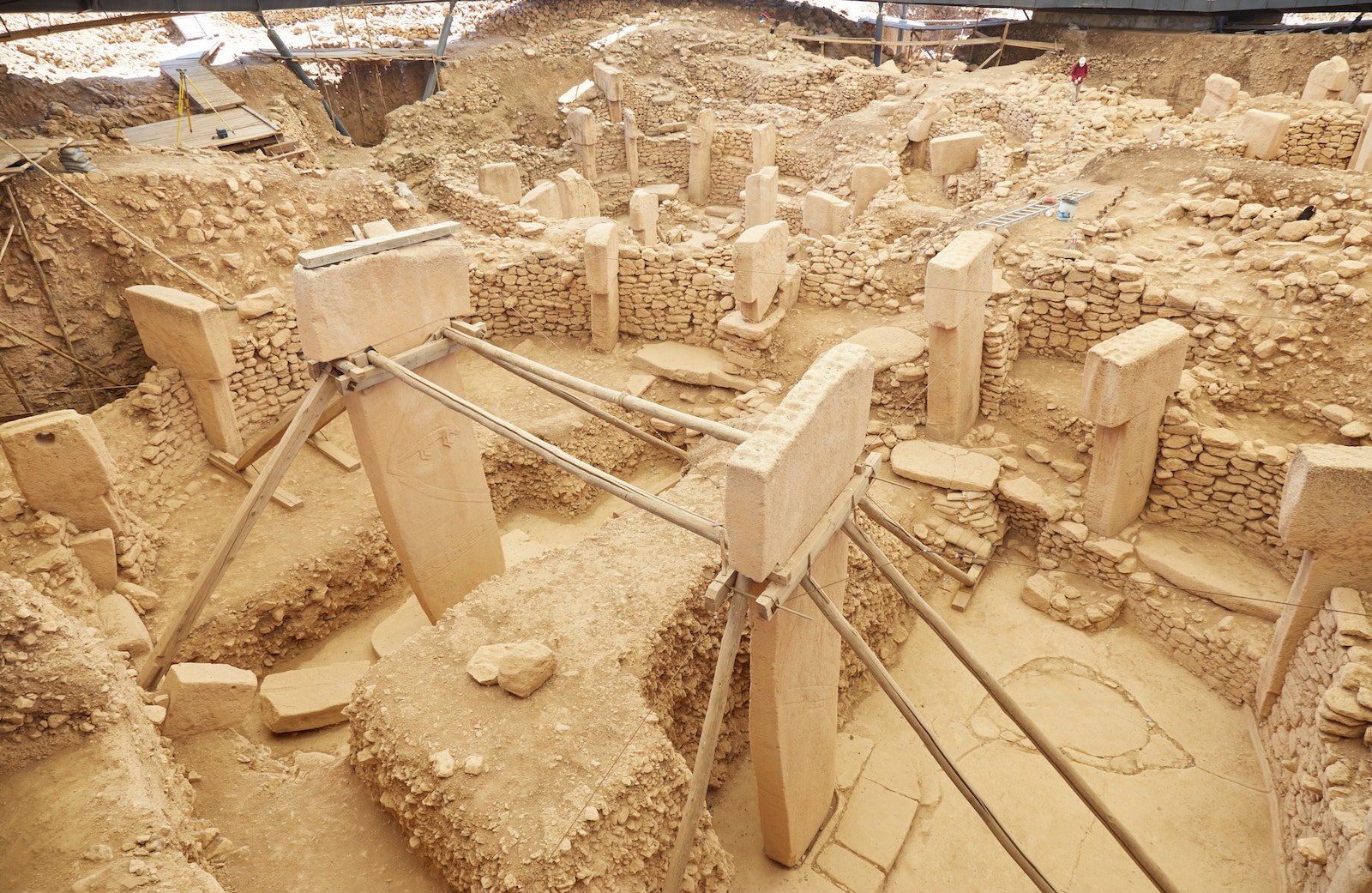
German Archaeological Institute, Göbekli Tepe Project, Enclosure D, Göbekli Tepe, Copyright: DAI — used with permission, via .
And the details that don't fit are quietly left out
The most telling objection is about method. To make the picture read as death and catastrophe, the theory treats the headless man as a symbol of extinction — but it passes over the fact that the same figure has an erect phallus, which is hard to square with 'lifeless'. It reads the front face of the pillar while ignoring the further reliefs carved on its narrow sides. And it treats the animals as a star pattern when, across the site, animals cluster by enclosure — snakes in one building, foxes in another — which the excavators read as group or clan emblems, not a zodiac.
Independent critics have been harsher still. The archaeologist André Costopoulos called the 2024 calendar paper 'scaffolded speculation' — a tower of untestable guesses — and pointed out that its own argument leans on the phrase 'if this interpretation is correct' at load-bearing moment after load-bearing moment. The core move, matching a carved animal to a planetarium stick-figure by eye, is never independently tested; everything else is built on top of it.
There is one more foundation problem. The whole 'memorial' reading assumes a comet actually struck — the 'Younger Dryas impact hypothesis' — and that idea is itself rejected by most specialists in the relevant sciences. A memorial to an event that most experts doubt happened is standing on sand.
But doesn't the statistics prove it?
The star-map papers wrap themselves in numbers, and that is a large part of why they persuade people. Sweatman reports a statistical significance for his constellation matches and argues that this makes rival readings very unlikely. It sounds decisive. It is not, and understanding why is the key to the whole debate.
The problem is what the statistics are calculated on. The claim that a carved vulture 'is' Sagittarius, or a scorpion 'is' Scorpius, is not an independent measurement — it is a judgement made by eye, by looking at a stick-figure in planetarium software and deciding it resembles the relief. Sweatman himself concedes that the underlying ranking of these matches is, in his words, subjective. Every number downstream — the date, the impact, the calendar — is then built on top of those hand-made matches. Run a statistical test on a subjective starting point and you get a confident-looking answer to a question that was never objectively posed. That is the circularity critics keep pointing to.
The excavators put the deeper objection more simply. Symbols made by human beings, they wrote, cannot really be treated as a purely statistical case — because the same image can carry many meanings, and creativity does not obey the rules of a coin toss. A high 'significance' for a match you chose yourself is not evidence that Stone-Age hunter-gatherers were drawing the Greek zodiac.
One pillar, and the sixty it ignores
It is worth dwelling on the cherry-picking, because it is the theory's deepest flaw. Pillar 43 is not a unique text waiting to be decoded; it is one carved stone in a vast, shared visual language. More than sixty monumental pillars are known at Göbekli Tepe alone, and Pillar 56, in Enclosure H, is carved nearly as densely as the Vulture Stone, with its own crowd of snakes and birds. Beyond the pillars, the very same animals appear on stone bowls, shaft-straighteners and small plaquettes, at Göbekli and at contemporary sites across the whole region.
A code that only its authors can read, on a single object, while sixty near-identical objects are set aside, is not much of a code. And even Pillar 43 is not read in full: the reliefs carved on its two narrow sides are quietly left out of the astronomical account, along with anything that complicates the constellation story. A theory that must ignore most of its own evidence to work is telling you something — just not what it claims to be telling you.
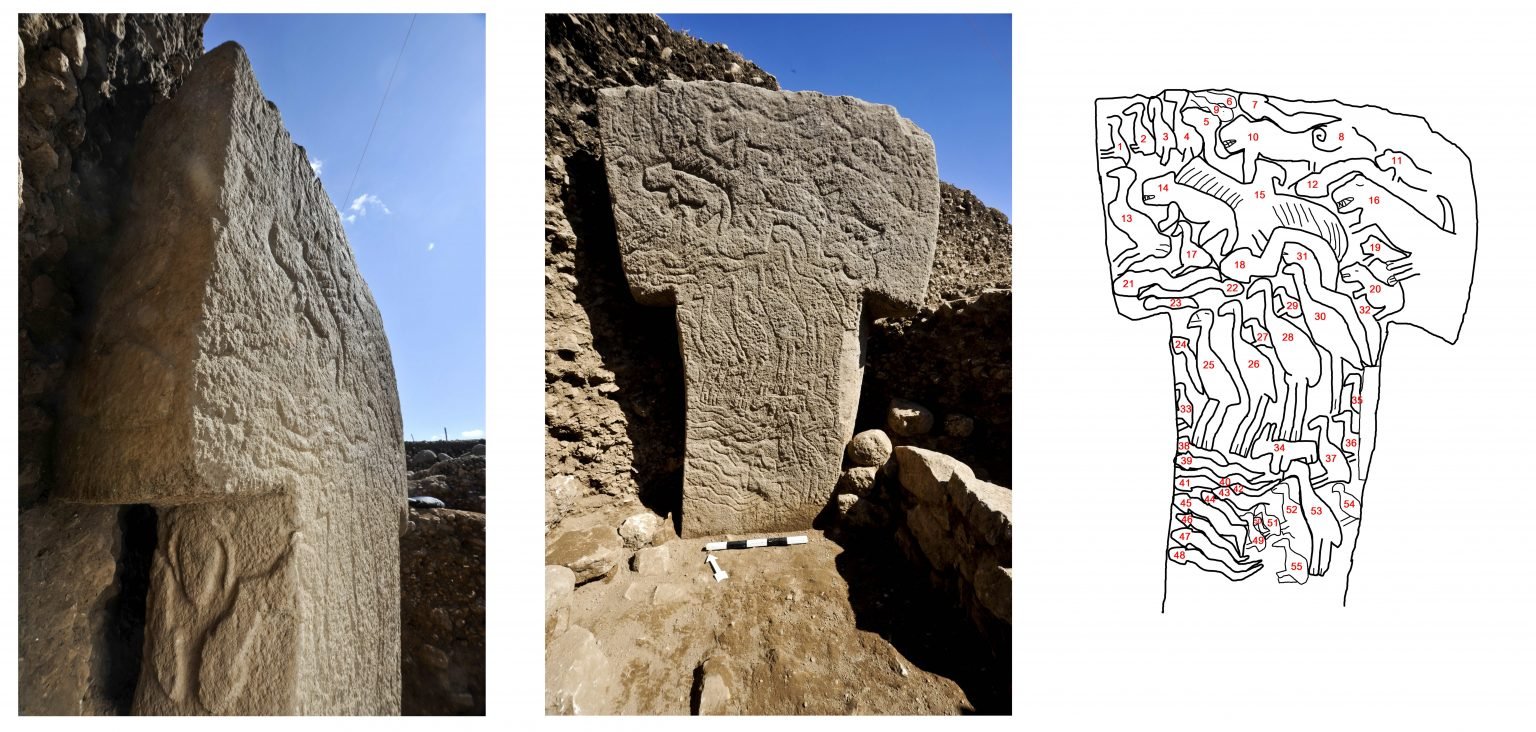
German Archaeological Institute, Göbekli Tepe Project, Pillar 56, Enclosure H, Göbekli Tepe, Copyright: DAI — used with permission, via .
Where the idea came from, and why it travels
It helps to see the theory's route into the world. It was published not in an archaeology journal but in one devoted to archaeometry — the physical-science side of the field — by authors whose training is in engineering, not prehistory. It was then launched to the public by a university press release, picked up largely uncritically by major outlets, and folded into the far larger machine of 'lost civilisation' entertainment, above all Graham Hancock's television work, where Göbekli Tepe is a recurring star witness.
There is a separate strand worth naming to avoid confusion: the writer Andrew Collins promotes a different star-map idea centred on the constellation Cygnus and a supposed alignment of the enclosures. It is not Sweatman's comet theory, and it is rejected by the excavators for the same underlying reasons. The lesson is that 'Göbekli Tepe is astronomical' is less a single finding than a family of appealing claims, each reverse-engineered from the wish that this astonishing site also be a coded message to the future.
None of this is to sneer. The site really is astonishing, the Vulture Stone really is enigmatic, and the desire to decode it is human. But popularity, press coverage and statistical dressing are not the same as evidence — and on the evidence, the people who dug the trench are unpersuaded.
So what do the people who dug it think the stone shows?
Not a sky map. The excavators read Pillar 43 as belonging to the Neolithic cult of the dead — the same world as the carved and drilled human skulls found elsewhere at Göbekli Tepe. Vultures stripping the flesh from the dead, a headless human figure, scavenging birds: this is a recognised mortuary theme across the Pre-Pottery Neolithic, not a coded catastrophe.
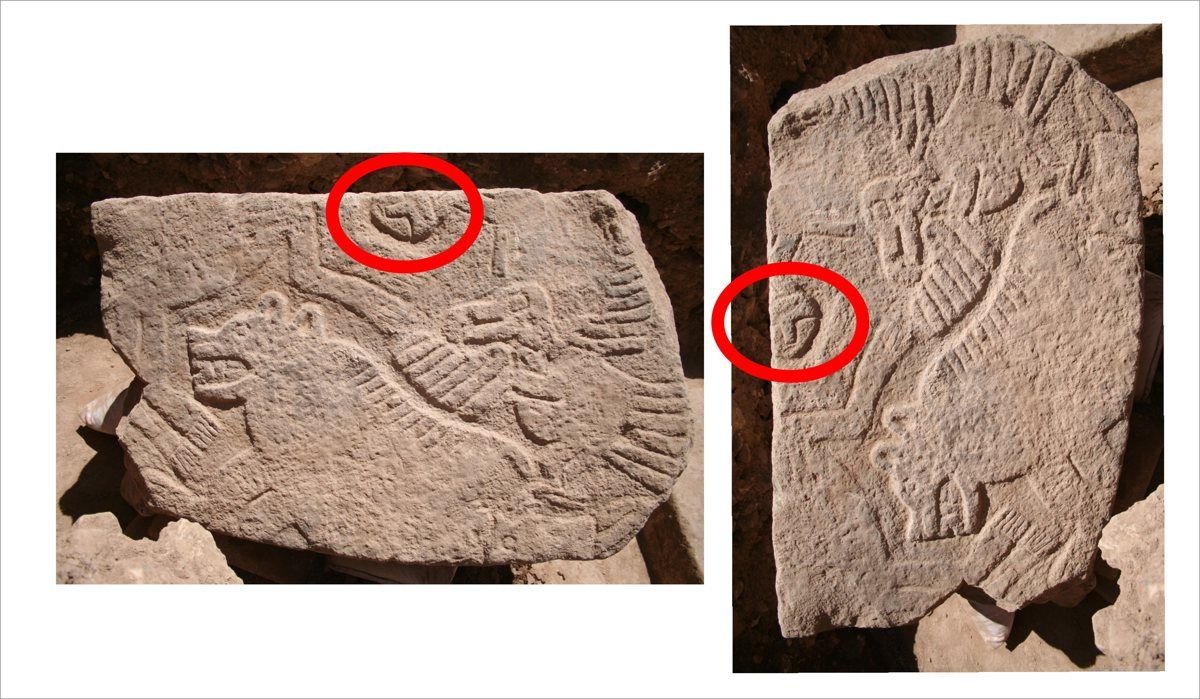
They are candid that some elements stay ambiguous. The disc above the vulture's wing could be an egg, or the sun or moon — or the missing head of the headless man. The row of 'bag' shapes along the top may even be schematic pictures of the enclosures themselves, each with its emblem animal on the roof. That honest uncertainty is the opposite of a decoded star chart. It is a description of a genuinely strange, genuinely important carving whose full meaning we do not yet have.
What is uncertain — on both sides
Fairness cuts both ways. The star-map papers are peer-reviewed, and dressed in the language of statistics, so they deserve an argument rather than a sneer. And archaeology does not have a proven alternative reading of every symbol on Pillar 43 — the mortuary interpretation is the best-supported reading, not a closed case.
But 'we don't fully know' is not the same as 'therefore, a comet'. The star-map theory is a minority claim, made outside its authors' field, published away from archaeology journals, amplified by television and by pseudo-archaeology, and rejected by the excavation team on chronology, method and cherry-picking. When you weigh a striking idea against the people who spent their careers in the trench, and their reasons are this concrete, the honest verdict is not a shrug. It is that the Vulture Stone is a masterpiece of Neolithic art and belief — and almost certainly not a star map.
Common questions
Is Göbekli Tepe a star map or observatory? There is no accepted evidence that it is. The idea comes from one 2017 paper reading a single pillar; the site's excavators reject it, and note the buildings were likely roofed — the opposite of an open-air observatory.
What is the Vulture Stone (Pillar 43)? A real, elaborately carved T-pillar in Enclosure D showing a vulture, scorpion, snake, birds, abstract symbols and a small headless human figure. Its imagery is most likely tied to a Neolithic cult of the dead.
Did a comet hit the Earth and get recorded at Göbekli Tepe? The 'Younger Dryas comet' idea is itself rejected by most specialists, and the proposed date is older than the building. The comet-memorial reading has no support among the site's archaeologists.
Why is the theory so popular then? It is vivid, it was pushed by a university press release and by television, and it flatters the wish for a lost advanced civilisation. Popularity is not evidence.
Key takeaways
- The 'star map' comes from a single 2017 paper (Sweatman & Tsikritsis) reading one pillar — the Vulture Stone — as constellations and a comet 'date stamp' of 10,950 BC.
- The Göbekli Tepe excavation team formally rejected it ('More than a vulture', 2017): it cherry-picks one pillar of 60+, the date is ~1,000 years older than the building, and it assumes modern constellations existed in the Stone Age.
- It also omits inconvenient details (the figure's phallus, the pillar's other carved faces) and depends on the separately-rejected 'Younger Dryas comet' idea.
- The excavators read Pillar 43 not as a sky chart but as part of the Neolithic cult of the dead — vultures and a headless man, the same world as the site's carved human skulls.
Sources
- Notroff, J., Dietrich, O., Clare, L. et al. (2017). More than a vulture: a response to Sweatman and Tsikritsis. *Mediterranean Archaeology and Archaeometry* 17(2)
- Göbekli Tepe Research Project (DAI), 'More than a vulture' (plain-language summary), Tepe Telegrams (2017)
- Göbekli Tepe Research Project (DAI), 'Of animals and a headless man: Göbekli Tepe, Pillar 43', Tepe Telegrams (2016)
- Sweatman, M.B. & Tsikritsis, D. (2017). Decoding Göbekli Tepe with archaeoastronomy. *Mediterranean Archaeology and Archaeometry* 17(1)
- Costopoulos, A. (2024). The Göbekli Tepe calendar and the Younger Dryas Impact: another major media fail. ArcheoThoughts
This article is written from the primary literature and excavators' reports cited above. Interpretations are attributed; uncertainties are stated in the text.