Short answer
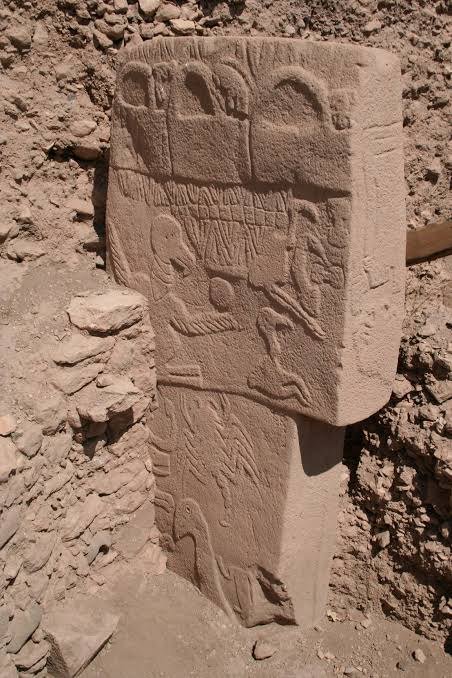
The 'handbags' are three purse-shaped carvings near the top of Pillar 43 (the Vulture Stone) whose meaning is unknown — the excavation team treats them as undeciphered.
To modern eyes they look like handbags, and similar rounded-top, flat-bottomed shapes appear in later art worldwide, which has made them an internet favourite. Serious readings treat them as symbolic — perhaps sky over earth, or schematic shrines — but nothing is confirmed, and the 'global connection' theory is almost certainly coincidence.
The famous 'handbags'
Near the top of Pillar 43 — the Vulture Stone — sit three rectangular objects with rounded tops. To modern eyes they look uncannily like handbags or purses, and that resemblance has made them one of the most talked-about details at Göbekli Tepe. Similar shapes turn up in later art from Mesopotamia to Mesoamerica, which is why the internet loves them.
So what are they? The honest answer is that no one knows for certain. But there are serious ideas.
What surrounds them on the stone
The handbags do not float alone. They sit in a band across the top of Pillar 43, above the pillar's crowded main scene — a vulture, a scorpion and a headless human figure, the imagery that gives the Vulture Stone its name. Below each of the three shapes, some readings make out a small animal.
That context is a caution against lifting the handbags out as a standalone 'artefact.' They belong to one of the most deliberately composed surfaces at Göbekli Tepe, and whatever they meant, they meant it in company with the death-laden scene beneath them — not as a detachable message to be matched against carvings on other continents.
What they might be
Here it's important to be careful. The excavation team at Göbekli Tepe — the German Archaeological Institute — treats the 'handbags' as undeciphered. Their consistent position is that we don't know what they mean, and they caution against reading too much into them. So the honest headline is that nobody has proven what they are.
Several ideas have been floated. One is symbolic: the rounded top might stand for the sky and the flat base for the earth, making each shape a shorthand image of the cosmos or of a shrine. Others read them as schematic buildings, or as literal containers that mattered to the people who carved them. These are informed guesses, not conclusions — and the more elaborate 'cosmic' or astronomical versions come largely from outside the excavation team, from researchers such as Martin Sweatman, whose broader claims the Göbekli Tepe archaeologists do not accept. The sky-and-earth idea is worth knowing, but it belongs in the 'possible' column, not presented as the answer.
The internet's favourite theory
Because similar shapes appear in Sumerian and later art, some claim a hidden global connection across thousands of years. Archaeologists are skeptical: a rounded-top, flat-bottomed shape is simple enough to be invented independently many times, and there's no chain of evidence linking these separate cultures. The resemblance is real; the connection is almost certainly not.
What makes the Göbekli 'handbags' genuinely fascinating is simpler — they are among the oldest carved symbols we have that we still can't decode. They're a direct message from the Neolithic mind that we can see clearly and still cannot read.
Why they matter even undeciphered
Strip away the speculation and something genuinely remarkable is left: the handbags are among the oldest deliberate, repeated symbols humans ever carved that we can still see plainly and still cannot read.
They are proof that these people were already thinking in abstract, shareable signs eleven thousand years ago — a whole symbolic system, most of which has not survived. That is a more interesting fact than any cross-continental conspiracy, and it is one we can actually stand on.
Common questions
What are the handbags carved at Göbekli Tepe?
Three rectangular objects with rounded tops carved near the top of Pillar 43. They resemble modern handbags. Their meaning is unknown — the excavation team treats them as undeciphered. Symbolic readings have been proposed (for example sky and earth), but none is confirmed.
Are the Göbekli Tepe handbags connected to Sumerian handbags?
Probably not. Similar shapes appear in many later cultures, but the resemblance is most likely coincidence — a simple shape reinvented independently — rather than a hidden connection.
Do we know what the handbags mean?
No. They're one of Göbekli Tepe's genuine unsolved mysteries. Various symbolic readings have been proposed, but the excavation team treats them as undeciphered and no reading is confirmed.
Sources & further reading4 references
- Schmidt, K. (2012). Göbekli Tepe: A Stone Age Sanctuary in South-Eastern Anatolia. Berlin: ex oriente. The foundational monograph by the site's first excavator.
- Sweatman, M. B. & Tsikritsis, D. (2017). Decoding Göbekli Tepe with archaeoastronomy: What does the fox say?. Mediterranean Archaeology and Archaeometry 17(1): 233–250. link The comet / 'Younger Dryas impact date-stamp' reading of Pillar 43 — a published claim the excavators dispute.
- Notroff, J., Dietrich, O., Dietrich, L., Tvetmarken, C. L., Kinzel, M., Schlindwein, J., Sönmez, D. & Clare, L. (2017). More than a vulture: A response to Sweatman and Tsikritsis. Mediterranean Archaeology and Archaeometry 17(2): 57–63. link The Göbekli Tepe excavation team's point-by-point rebuttal of the comet interpretation.
- The Tepe Telegrams (official research blog of the Göbekli Tepe Project, DAI). The Tepe Telegrams. Deutsches Archäologisches Institut. link Accessible, authoritative running commentary from the excavation team.
Full bibliography: the Taş Tepeler reference library →