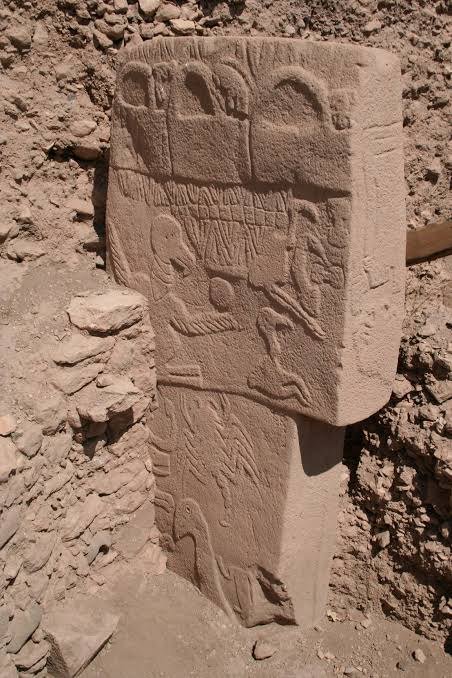
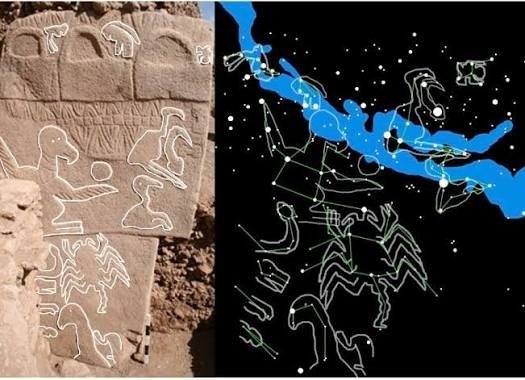
Pillar 43 stands against the north-western wall of Enclosure D at Göbekli Tepe, still in the place its builders set it some 11,000 years ago. Carved across its broad face is one of the richest single scenes in all of Neolithic art: a vulture with an outstretched wing, a scorpion, snakes, birds, a row of bag-shaped objects, and — small, damaged, and unmistakable — a headless human figure. Most archaeologists read it as a picture about death and the dead. A few have argued it records the date of a comet. It is, either way, the most argued-over stone at the most argued-over site in prehistory.
What's carved on it
Read the pillar from top to bottom and a scene emerges. Across the upper register stand large birds — long-legged waders and, dominating everything, a great bird of prey usually identified as a vulture. Its near wing bends sharply upward, and balanced just above that wingtip is a small round disc, as though the bird were holding, lifting, or offering a ball.
Below the birds runs a row of three rectangular objects with rounded tops — the famous 'bags' or 'handbags,' so called because that is precisely what they resemble to a modern eye. The same motif turns up much later across the ancient Near East, which is part of what makes it so tantalising, and so easy to over-read. Beneath the bags come smaller creatures: a scorpion, a snake, and further birds and reptiles crowded into the available stone.
And at the bottom right, carved small and now partly broken, is a human figure — headless, its body shown with an erect phallus. In place of the head sits a small disc or ball. The missing head is not simple accident: headlessness recurs throughout Göbekli Tepe's imagery, and the deliberate separation of head from body is echoed in the site's treatment of real human remains.
Where it stands, and how we know its age
Pillar 43 is not a museum piece removed to a case. It is one of the wall pillars of Enclosure D — the best-preserved and most completely exposed of Göbekli Tepe's great circular buildings — and it remains exactly where Neolithic hands installed it, which is why its scene can still be read as a composition rather than a fragment.
Enclosure D belongs to the earliest, Pre-Pottery Neolithic A phase of the site, built in the centuries around 9500 BCE and radiocarbon-dated through organic material and wall plaster in known stratigraphic positions. That makes the pillar and its carving roughly eleven thousand years old — raised, used, and eventually buried by hunter-gatherers who had neither farming, pottery, nor metal tools. The excavation and its dating are the work of the Göbekli Tepe Project of the German Archaeological Institute, begun by Klaus Schmidt in 1995 and continued since.
Pillar 43 shows a vulture with an upraised wing and a disc above it, a scorpion, snakes, wading birds, a row of three bag-shaped objects, and a small headless, ithyphallic human figure.
Our reading follows most archaeologists: this is a scene about death and the dead. Across the ancient Near East, vultures are bound up with the treatment of dead bodies — birds that strip the flesh from the bone and, in belief, carry the dead onward. Göbekli Tepe itself has produced human skulls carved with deliberate incisions and, in one case, a drilled perforation — evidence its excavators describe as a 'skull cult' (Gresky, Haelm & Clare 2017). A panel that pairs a vulture with a headless human body sits squarely inside that world.
On this reading the disc where the head should be, and the ball above the vulture's wing, belong to the same idea — the departed head, the soul, the thing carried away — rather than to the sky. The 'bags' remain genuinely mysterious; no one can say with confidence what they are. What is clear is that this was a deliberate composition, a story its makers understood completely and that we can see but not fully translate.
The comet theory — and why the excavators reject it
In 2017 two engineers at the University of Edinburgh, Martin Sweatman and Dimitrios Tsikritsis, published a striking claim: that the animals on Pillar 43 are constellations, that Göbekli Tepe's enclosures functioned as observatories, and that this pillar is a 'date stamp' recording a comet impact around 10,950 BCE — the event some argue triggered the Younger Dryas cold snap (Sweatman & Tsikritsis 2017). It is a genuinely published, genuinely bold idea, and it travelled around the world.
The site's own excavators answered it directly, in the same journal and on their Tepe Telegrams blog, in a paper pointedly titled More than a vulture (Notroff, Dietrich, Dietrich, Clare and colleagues, 2017). Their objections are concrete. The star patterns the theory relies on are a modern way of grouping stars, not a Neolithic one, and constellations are not stable enough across ten thousand years to be read back this way. The imagery is selected out of context: Göbekli Tepe's enclosures were not all standing and in use at one moment, and the very same animals — vultures, snakes, scorpions, foxes — recur on pillar after pillar, so they cannot each be a unique, one-off celestial sign. And everything else about the site points not upward to the sky but inward to the body and the dead.
The honest position, then, is that the astronomical reading is a minority view held largely outside archaeology, and that the weight of evidence and of expert opinion sits with the funerary interpretation. We lay out the full case on both sides on a dedicated page — because the debate itself is part of what makes this stone famous.
What we still can't explain
It would be dishonest to tidy Pillar 43 into a solved picture. We do not know what the three bags are, or whether they are objects, buildings, or something with no modern equivalent at all. We do not know why this particular headless figure was placed here, or whether the scene tells a single story or gathers several. We cannot say what the disc above the wing meant to the people who carved it.
That uncertainty is not a failure of the evidence; it is the true shape of it. Pillar 43 is a message we can read the letters of without knowing the language — a scene composed with total confidence by people who understood it perfectly, and left standing for us to stand in front of, eleven thousand years later, and wonder.
Why it matters
Pillar 43 is the clearest single proof that the people of Göbekli Tepe used carved animals to tell stories, not merely to decorate. It ties the site's art directly to its treatment of the dead, and it is the one image most responsible for Göbekli Tepe's fame around the world.
It is also a lesson in reading the deep past honestly: a stone that genuinely rewards wonder and genuinely resists easy answers — and that is far more remarkable as what it is, a Neolithic picture of death, than as any comet ever made it.
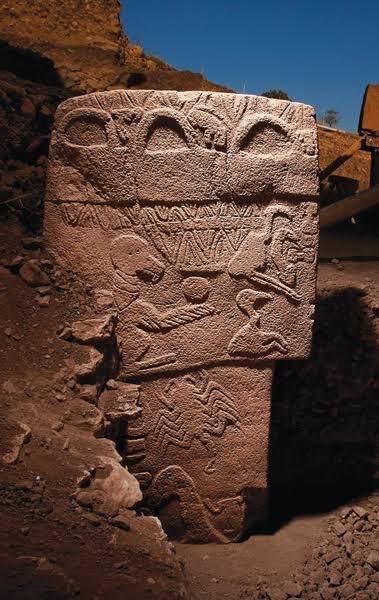
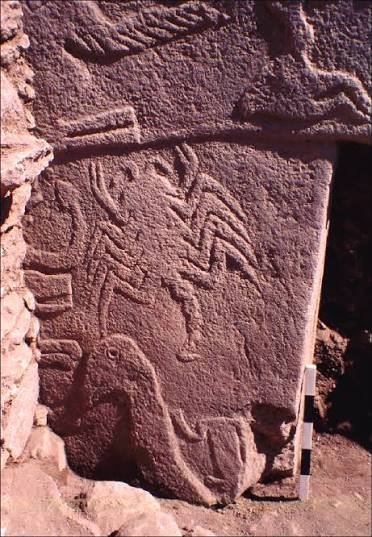
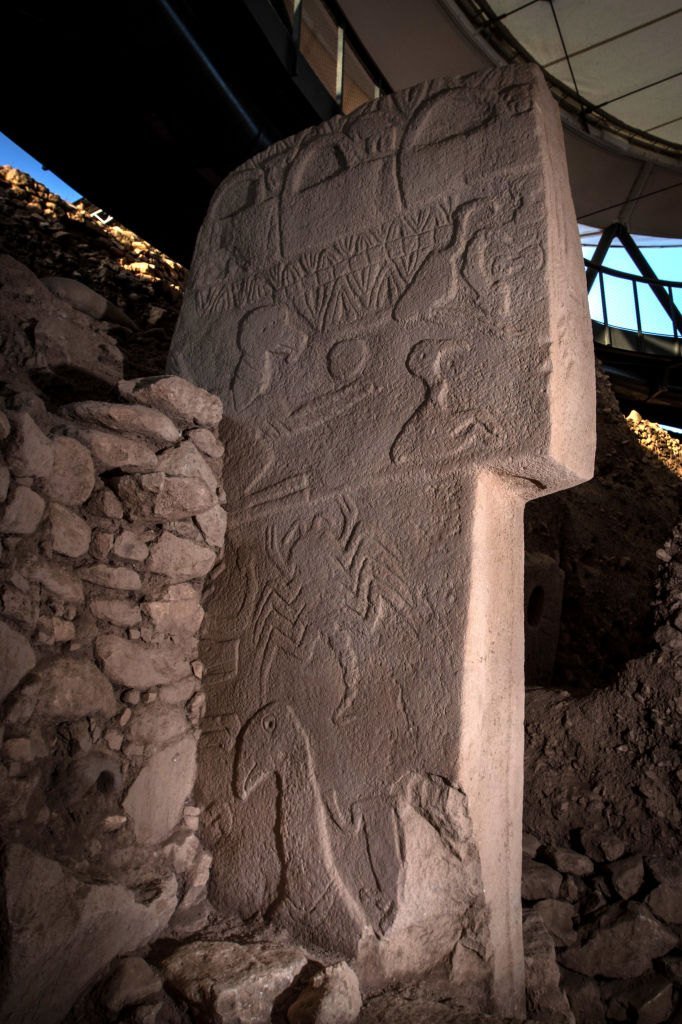
Pillar 43, the Vulture Stone, Enclosure D, Göbekli Tepe. Photos: German Archaeological Institute (DAI), Göbekli Tepe Project.
Sources & further reading7 references
- Notroff, J., Dietrich, O. & Schmidt, K. (2014). Building Monuments, Creating Communities. Early monumental architecture at Pre-Pottery Neolithic Göbekli Tepe. In J.F. Osborne (ed.), Approaching Monumentality in Archaeology: 83–105. Albany: SUNY Press.
- Gresky, J., Haelm, J. & Clare, L. (2017). Modified human crania from Göbekli Tepe provide evidence for a new form of Neolithic skull cult. Science Advances 3(6): e1700564. doi:10.1126/sciadv.1700564
- Sweatman, M. B. & Tsikritsis, D. (2017). Decoding Göbekli Tepe with archaeoastronomy: What does the fox say?. Mediterranean Archaeology and Archaeometry 17(1): 233–250. link The comet / 'Younger Dryas impact date-stamp' reading of Pillar 43 — a published claim the excavators dispute.
- Notroff, J., Dietrich, O., Dietrich, L., Tvetmarken, C. L., Kinzel, M., Schlindwein, J., Sönmez, D. & Clare, L. (2017). More than a vulture: A response to Sweatman and Tsikritsis. Mediterranean Archaeology and Archaeometry 17(2): 57–63. link The Göbekli Tepe excavation team's point-by-point rebuttal of the comet interpretation.
- Dietrich, O., Heun, M., Notroff, J., Schmidt, K. & Zarnkow, M. (2012). The role of cult and feasting in the emergence of Neolithic communities. New evidence from Göbekli Tepe, south-eastern Turkey. Antiquity 86(333): 674–695.
- Schmidt, K. (2012). Göbekli Tepe: A Stone Age Sanctuary in South-Eastern Anatolia. Berlin: ex oriente. The foundational monograph by the site's first excavator.
- The Tepe Telegrams (official research blog of the Göbekli Tepe Project, DAI). The Tepe Telegrams. Deutsches Archäologisches Institut. link Accessible, authoritative running commentary from the excavation team.
Full bibliography: the Taş Tepeler reference library →