Short answer
Gürcütepe is a cluster of four low settlement mounds on the Sirrin stream at the southeastern edge of Şanlıurfa — a later Pre-Pottery Neolithic village site, with houses rather than monumental pillars, first dug by Klaus Schmidt's team in the 1990s.
It is the domestic, everyday counterpart to Göbekli Tepe: no carved enclosures, but rammed-earth houses, burials and, in recent seasons, small figurines. It belongs to the later Neolithic, after Göbekli Tepe's monumental phase, and is being excavated again today within the Taş Tepeler programme.
Four low mounds beside a stream
Gürcütepe sits on the southeastern outskirts of Şanlıurfa itself, and consists of four very shallow tells strung along the Sirrin stream.
It is unspectacular to look at. There are no standing pillars, no monumental enclosures, nothing that photographs well — which is exactly why it is under-visited and under-discussed, and why it fills a gap the famous sites cannot.
Dug alongside Göbekli Tepe
In the late 1990s a German team under Klaus Schmidt — the archaeologist who brought Göbekli Tepe to the world's attention — carried out soundings on all four hills and excavated more extensively on the second hill from the east.
This is a detail worth knowing: the excavation of Göbekli Tepe did not happen in isolation. Schmidt was working the surrounding landscape at the same time, looking for the settlements that must have supported the monuments.
A domestic settlement, not a sanctuary
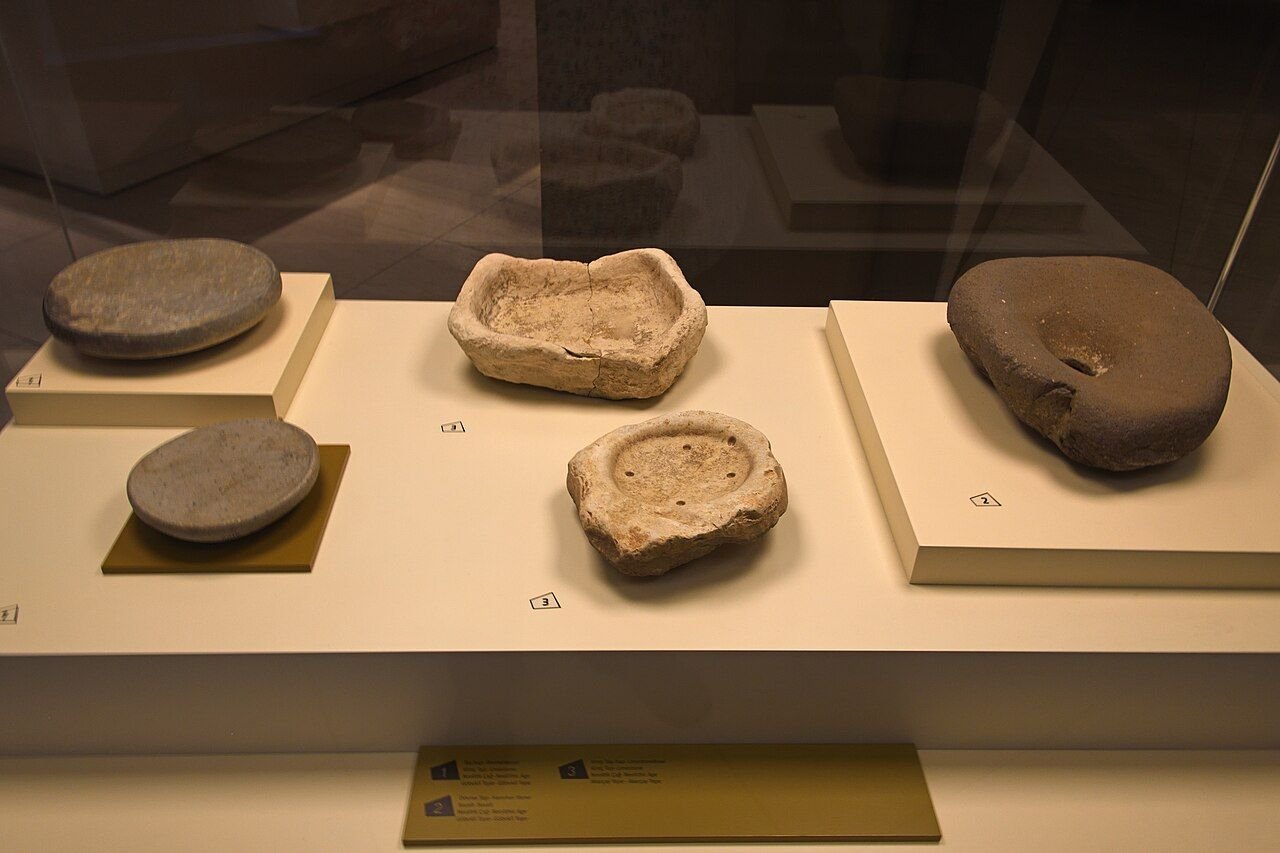
What excavation exposed was ordinary life. Gürcütepe has rammed-earth buildings with internal subdivisions, standing next to larger community buildings — a recognisable Neolithic village layout of partitioned households plus shared space.
There are no T-pillars and no carved enclosures. Where Göbekli Tepe is a place of monumental gathering, Gürcütepe is a place of settled living: houses, hearths and everyday craft.
Later than the monuments
All four hills belong to the Pre-Pottery Neolithic B, with the easternmost hill later still, in the Pre-Pottery Neolithic C. Göbekli Tepe's famous phases are PPNA — older.
So Gürcütepe is not the village of the pillar-builders, as was once hoped. It comes afterwards, and its value is that it shows what the region became once the monumental tradition had passed.
New work, new finds
Gürcütepe is being excavated again as part of the Taş Tepeler programme, under director Mehmet Erdalkıran. Reporting from 2025 describes small figurines and multi-room burials, and suggests the finds may help refine the region's chronology.
These are press-reported field results, not yet a final publication, so treat the details as provisional — but they show a quiet site becoming actively interesting again.
What is settled, and what is not
Settled: Gürcütepe is a cluster of four low mounds on the Sirrin stream, a later-Neolithic domestic settlement, sounded by Klaus Schmidt's team in the 1990s and re-excavated today.
Still open: its precise chronology is being revised as new work continues, its full plan is not published, and there is as yet no good published site photograph — a real gap for a site this important to the story.
Common questions
What is Gürcütepe?
A later Neolithic settlement on the southeastern edge of Şanlıurfa, made up of four very shallow mounds along the Sirrin stream. It has houses rather than monumental pillars, and was first excavated by a German team under Klaus Schmidt in the 1990s.
Does Gürcütepe have T-pillars like Göbekli Tepe?
No. Gürcütepe is a domestic village site — rammed-earth houses with internal partitions alongside larger community buildings — without the carved enclosures or T-shaped pillars of the monumental sites.
How old is Gürcütepe?
All four hills are Pre-Pottery Neolithic B, with the easternmost later still (PPNC). That makes it younger than Göbekli Tepe's PPNA phases.
Who excavated Gürcütepe?
A German team under Klaus Schmidt carried out soundings in the late 1990s. It is being excavated again today within the Taş Tepeler programme, under director Mehmet Erdalkıran.
Sources & further reading5 references
- Schmidt, K. (2012). Göbekli Tepe: A Stone Age Sanctuary in South-Eastern Anatolia. Berlin: ex oriente. The foundational monograph by the site's first excavator.
- Wikipedia contributors (2026). Gürcütepe. Wikipedia. Tertiary summary of K. Schmidt's 1990s soundings (after Bohn, Gerber, Morsch & Schmidt 1998; Schmidt 2000). link
- Erdalkıran, M. & Helwing, B. (2024). Gürcütepe (Taş Tepeler project settlement profile). Şanlıurfa Neolithic Research Project – Taş Tepeler. tastepeler.org/en/settlements/gurcutepe
- Erdoğan, K. (reporting excavation director M. Erdalkıran) (2025). Neolithic figurines, multi-room burials found at Gürcütepe redefine Taş Tepeler chronology. Türkiye Today, 28 November 2025. Field reporting; awaiting full publication. link
- Clare, L. (2020). Göbekli Tepe, Turkey. A brief summary of research at a new World Heritage Site (2015–2019). e-Forschungsberichte des Deutschen Archäologischen Instituts 2020(2): 81–88.
Full bibliography: the Taş Tepeler reference library →