The glass that had to be carried in
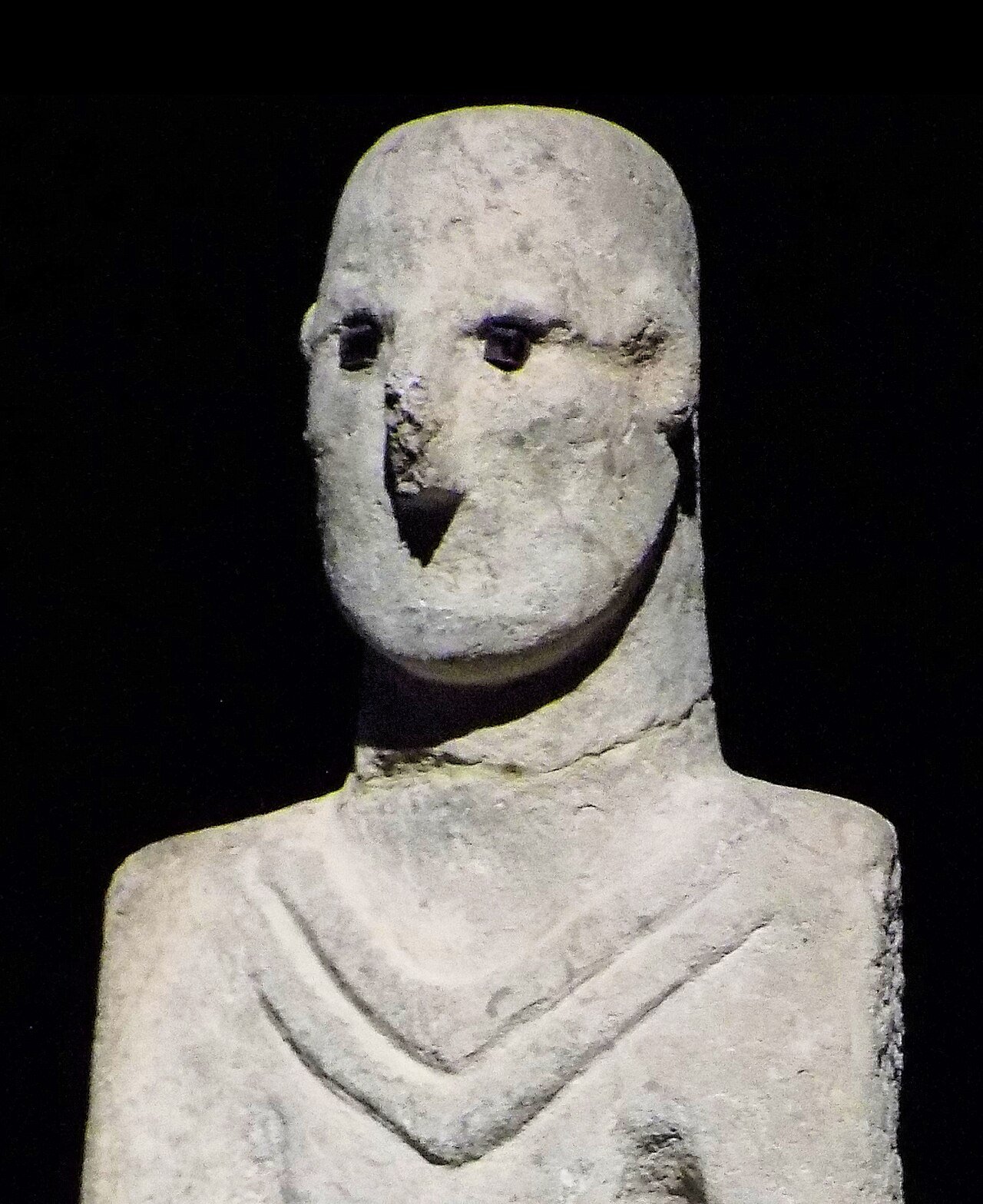
Stand anywhere on the hills around Şanlıurfa and look for a volcano. There isn't one. The nearest sources of obsidian — the black, glassy stone that forms only where lava cools fast — are hundreds of kilometres away. And yet obsidian turns up at Göbekli Tepe, worked into tools and, most memorably, set into the eyes of the region's oldest statues.
That simple fact carries a large conclusion. Every scrap of obsidian at the Taş Tepeler sites was carried in from somewhere else, across a landscape without roads, carts or pack animals, by people who had not yet built a town or planted a field. Obsidian is the hard, physical proof that these communities were connected to a much wider world.
Where the obsidian actually comes from
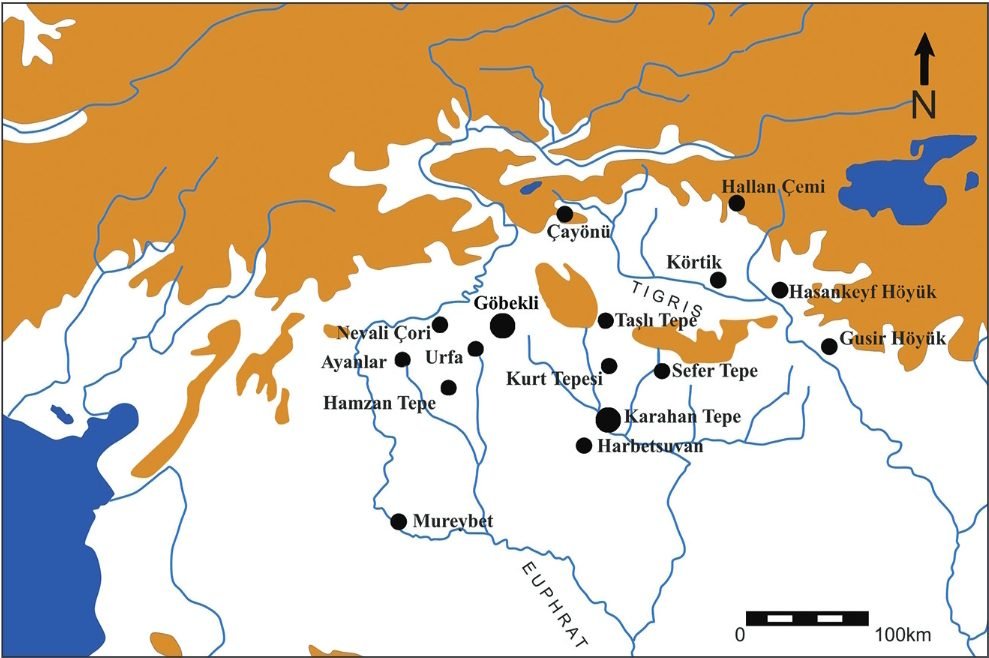
We can be specific about where, because obsidian carries a chemical signature. Each volcano's glass has its own distinct blend of trace elements, a fingerprint that survives being knapped into a blade eleven thousand years ago. By measuring those elements — today usually with a portable X-ray scanner that doesn't even scratch the object — archaeologists can match a single flake to the exact volcano it came from.
Done for the region's obsidian, that analysis points to two distant source areas. One is Cappadocia, in central Anatolia — the volcanoes of Göllü Dağ and Nenezi Dağ, roughly four to five hundred kilometres to the northwest. The other is eastern Anatolia, the Bingöl sources and Nemrut Dağ near Lake Van, some two hundred and fifty kilometres or more to the northeast. The obsidian at Göbekli Tepe has been traced to both regions at once — glass from opposite ends of Anatolia, meeting on one hill in the south.
There is no volcano near Şanlıurfa. So the black glass in the eyes of the oldest statue on Earth is proof of a journey — carried, hand to hand or on someone's back, across hundreds of kilometres of a world without roads.
Rare, and precious
It is important to be honest about the quantities. Göbekli Tepe is not an obsidian site. Its thousands of chipped stone tools are overwhelmingly made of local flint; obsidian is a small minority — present, but scarce. This is not the picture of a bulk raw material flooding in along a trade route. It is the picture of a rare, valued substance, arriving in small amounts and treated accordingly.
You can see that value in how obsidian was used. The most striking piece of imported glass in the whole regional record is not a tool at all: it is the pair of obsidian eyes set into Urfa Man, the life-size statue from the Yeni Mahalle district of Şanlıurfa — the oldest known life-size sculpture of a human being. Someone chose the rarest, farthest-travelled material they had, and used it not for a cutting edge but to make a statue look back at you. That is what a precious import looks like.
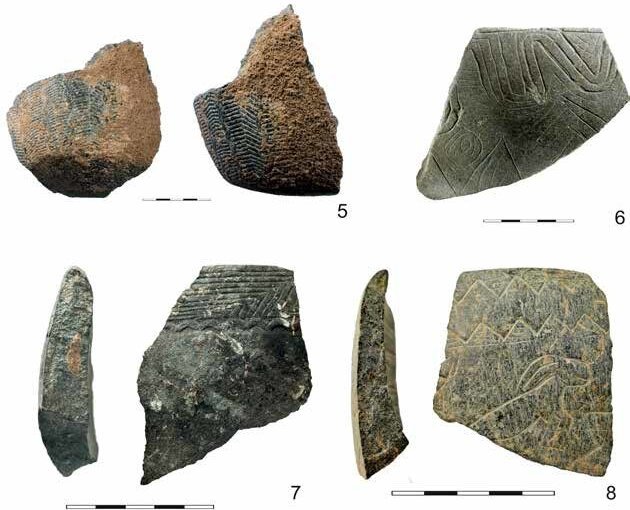
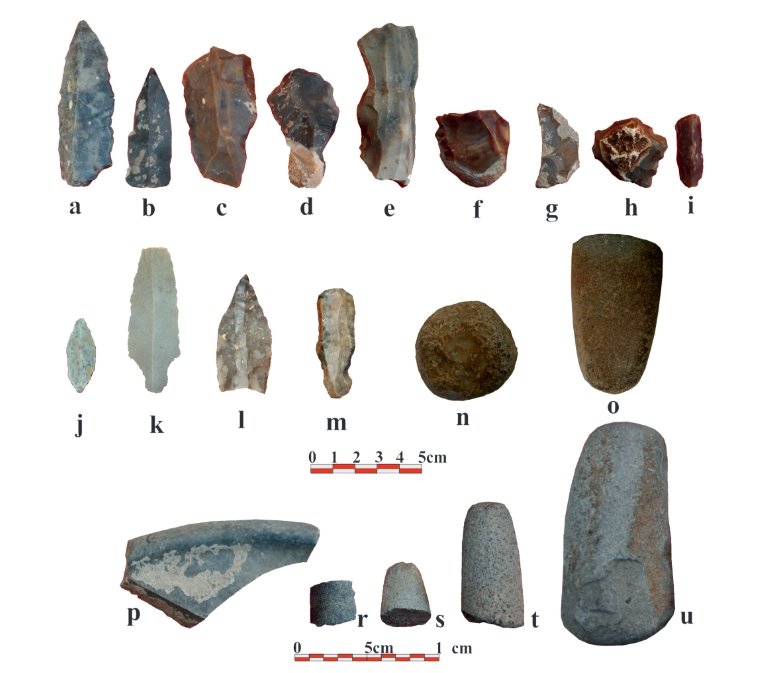
German Archaeological Institute, N. Becker, O. Dietrich, I. Wagner N., K. Schmidt, Greenstone-vessels-from-Goebekli-Tepe-shapes-graphics-L-Dietrich-photos-German (cropped), CC BY 4.0, via Wikimedia Commons.
Not just obsidian: the other things that didn't belong
Obsidian is the clearest tracer, but it is not alone. Across the Taş Tepeler, excavators keep finding materials that have no local source.
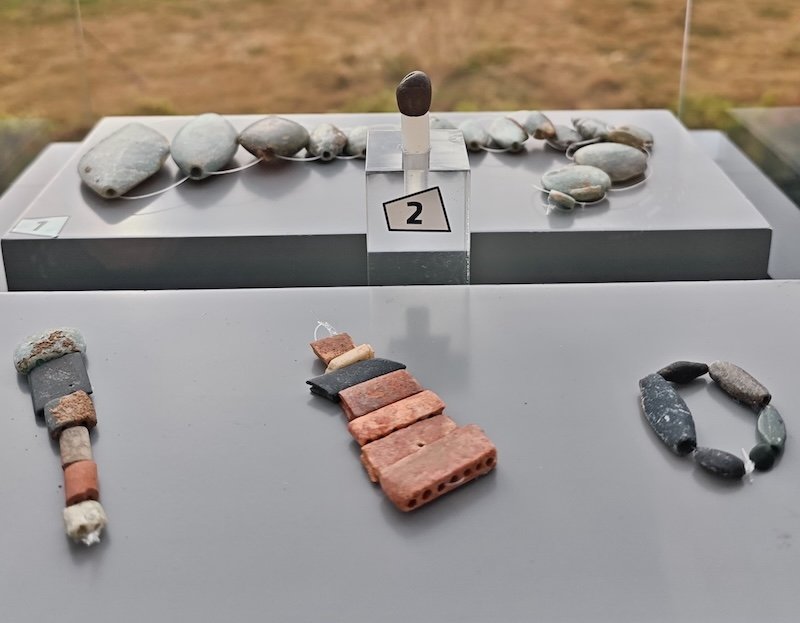
At Sefertepe, beads are among the commonest finds — and some are made of jade and labradorite, stones carried in from far away. At Harbetsuvan Tepesi, the raw materials include non-local obsidian, basalt and jadeite, tying the little site into the same wider exchange world. At Göbekli Tepe and Karahan Tepe there are finely made greenstone vessels — bowls of chlorite and serpentine, a shared material and craft that turns up at site after site.
And then there are beads of shell and exotic stone, the personal ornaments that are, across the whole Neolithic Near East, the surest fossil of long-distance contact — marine shells from distant coasts and coloured stones from distant mountains, strung and worn far from where they were born. Item by item, the message is the same: things were moving, over great distances, between these communities and places we cannot see from the hill.
Trade, or something else?
It is tempting to call all this 'trade', but that word smuggles in a modern world of merchants, markets and money that did not exist. The safer, truer word is exchange — and the mechanism behind it is a genuinely open question.
Obsidian, in particular, may have reached Göbekli Tepe in several different ways. It could have been passed hand to hand, community to community — the classic 'down-the-line' model, in which a material trickles outward from its source, thinning with distance, without anyone ever making the whole journey. It could have moved as gifts cementing alliances or marriages. Or the black glass from two opposite corners of Anatolia might have arrived with the people themselves — travellers gathering at Göbekli Tepe from across a wide region, each bringing the stone of home. On that reading, the mixed obsidian is a fingerprint not of trade routes but of a meeting place.
We cannot yet decide between these. What the obsidian proves is not a specific commerce but a connectedness — that scattered Neolithic communities were in contact across hundreds of kilometres, moving materials, and moving between one another, long before the first village street was laid.
The same roads the ideas travelled
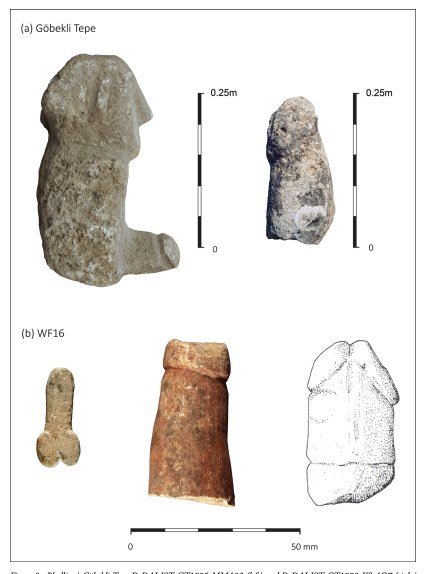
This matters for more than a bag of beads, because the exchange networks proven by obsidian and shell are the same networks along which ideas could travel. A 2023 study comparing Göbekli Tepe with the distant site of WF16 in southern Jordan argued exactly this: that the shared symbols carved a thousand kilometres apart moved through the very webs of contact that the traded materials reveal. The physical exchange is the evidence that the connection was real; the shared imagery is what may have flowed along it.
The caution the authors themselves insist on applies here too: connection is not sameness. A traded piece of obsidian tells you two communities were linked, not that they shared a language, a religion, or a meaning for the snake on the pillar. But the link itself — that is what the black glass makes undeniable.
What is uncertain
Several honest caveats. The exact distances and source list rest on geochemical studies that are still being refined; treat the kilometres as approximate, and note that two of the eastern sources (Bingöl and Nemrut) can be chemically hard to tell apart. The word 'trade' is the wrong default — 'exchange' is safer, and obsidian may well have moved with mobile people rather than between settled ones.
For materials other than obsidian, the case is thinner: greenstone is called 'non-local' from its type and spread, not yet from full chemical sourcing, so 'exchange' there is an inference rather than a measured route. And some site-specific claims — the jade and labradorite at Sefertepe, the jadeite at Harbetsuvan — come from ongoing excavations and await full publication. What is not in doubt is the headline: obsidian has no local source, so its presence is proof that these people reached, or were reached by, a world hundreds of kilometres wide.
Common questions
Is there obsidian at Göbekli Tepe? Yes, but not much — the site runs on local flint, with obsidian a scarce, imported minority. Because obsidian has no local source, every piece was carried in.
Where did the obsidian come from? From volcanoes in Cappadocia (Göllü Dağ, Nenezi Dağ, ~400–500 km northwest) and eastern Anatolia (Bingöl and Nemrut Dağ near Lake Van, ~250 km+ northeast), identified by chemical fingerprinting.
Does this prove trade before farming? It proves long-distance exchange existed before towns and farming. Whether it was 'trade' in any organised sense, gift-giving, or materials moving with mobile people, is still debated.
What else was imported? Beads of jade and labradorite (Sefertepe), jadeite and basalt (Harbetsuvan), shell and stone ornaments, and shared greenstone vessels — all pointing to the same wide networks of contact.
Key takeaways
- Obsidian has no local source near Şanlıurfa, so every piece at Göbekli Tepe was carried in — proof of long-distance connections before towns or farming.
- Its chemical fingerprint traces it to volcanoes in Cappadocia (~400–500 km NW) and eastern Anatolia near Lake Van (~250 km+ NE) — from both regions at once.
- Obsidian is rare at flint-dominated Göbekli, so it was precious — used, tellingly, for the obsidian eyes of Urfa Man, not just for tools.
- Call it exchange, not trade: it may have moved hand-to-hand, as gifts, or with mobile people — and the same networks likely carried the shared symbols found across a thousand kilometres.
Sources
- Göbekli Tepe Research Project (DAI), Tepe Telegrams — the chipped-stone assemblage (flint-dominated, obsidian scarce)
- Networks and Neolithisation: sourcing obsidian from Körtik Tepe (obsidian provenance method). *Journal of Archaeological Science*
- Cappadocian obsidian exchange networks in the Pre-Pottery Neolithic (down-the-line exchange). *Journal of Archaeological Science: Reports*
- Mithen, S., Richardson, A. & Finlayson, B. (2023). The flow of ideas: shared symbolism… WF16 and Göbekli Tepe. *Antiquity*
This article is written from the primary literature and excavators' reports cited above. Interpretations are attributed; uncertainties are stated in the text.