Short answer
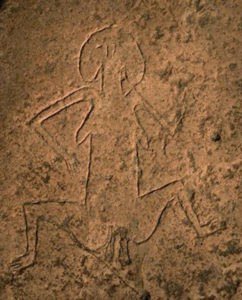
There is exactly one clearly female image known from Göbekli Tepe — a late graffito of a woman giving birth, scratched onto a stone bench — and the site's imagery is otherwise overwhelmingly male.
Where carved animals show sex, they are male; the human figures are male or unsexed. But what survives is only what was carved in durable stone, which is not the same as what these people believed or who took part — an absence in the art is not proof of an absence of women.
The pattern is real
This is not a case of modern readers imagining an absence. The imbalance at Göbekli Tepe is stark and the excavators state it plainly.
Where the sex of a carved animal is indicated, it is male. Among the human depictions, ithyphallic figures — figures with erect phalluses — are numerous. The T-pillars, read as human bodies with arms, hands and belts, carry no features that mark them as female. At Karahan Tepe the pattern continues in architecture itself, with the phallic pillars rising from the floor of the sunken room.
The German Archaeological Institute's own summary of the site's iconography describes a symbolic world dominated by masculinity. That is the starting point, and there is no honest way around it.
The one exception
There is a single clearly female depiction known from Göbekli Tepe, and it is easy to miss.
It is a graffito roughly 30 centimetres high, showing a squatting woman who appears to be giving birth. It is cut into a stone slab in the so-called Lion Pillar Building, on the northern slope of the mound.
Three details about it matter more than the image itself. It is in one of the younger rectangular buildings — Layer II, later than the great round enclosures. It was added afterwards, and was most likely not part of the room's original decoration. And it is a graffito: scratched, informal, nothing like the confident deep relief of the pillar carvings.
So the one woman at Göbekli Tepe was drawn late, casually, by someone working on a surface that was already there.
A convergence worth noticing
Set that beside something Necmi Karul has said about the wider Taş Tepeler region: that female symbolism is not absent, but is few in number and appears especially toward the later part of the period — including motifs involving birth and pregnancy, or a figure carrying a child or an animal.
That is a striking match. The Göbekli graffito is later, and it shows birth. Karul's regional observation, made independently of that single object, describes exactly this: female imagery arriving late, and arriving attached to birth.
It is worth being careful here. This comes from interview material rather than a publication, and we treat it as the excavator's working view rather than a settled finding. But the two observations line up, and if the pattern holds it suggests something more interesting than simple absence — a symbolic world that changed over time, and admitted female imagery as it did.
Absence in stone is not absence in life
Eylem Özdoğan, who excavates Sayburç, makes the caution that most popular accounts skip: what survives is what was carved in stone.
Female or feminine symbolism may have been expressed in materials that do not last — wood, textile, hide, paint, unfired clay, body decoration, song, gesture. The archaeological record does not preserve those things, so their absence tells us about preservation, not about belief.
There is direct support for this. Neolithic sites of the wider region produced clay figurines of both male and female figures. Clay was worked, and both sexes were represented in it. Stone monuments were the domain of one kind of image; that does not mean the whole imaginative world was.
Put bluntly: we know what these people carved into limestone. We do not know what they thought.
And then there is Hilazon Tachtit
The sharpest counterweight comes from just before this period, and from a different region.
At the Natufian cave site of Hilazon Tachtit in the southern Levant, around 12,000 years ago, the most elaborate burial excavated was that of an elderly woman. She was interred with an extraordinary assemblage — tortoise shells, parts of a wild cattle, an eagle wing, a leopard pelvis, a marten skull, and a complete human foot that was not her own. The burial is widely discussed as that of a ritual specialist or shaman.
So in the centuries immediately preceding the Taş Tepeler monuments, in a neighbouring symbolic world, the single most ritually invested burial known belongs to a woman.
That does not tell us who held authority at Göbekli Tepe. It does establish that nothing in this broad cultural horizon prevented a woman from occupying the most exceptional ritual position her community could confer.
What people get wrong in both directions
One error is to read the male-dominated imagery as a straightforward record of male-dominated society. Imagery is not a census. What a community chooses to carve into monuments may reflect ritual roles, mythic subjects, or the concerns of one particular context — not the everyday distribution of power.
The opposite error is the mother goddess. Popular accounts sometimes reach for a great goddess cult at Göbekli Tepe, usually by importing much later material from Çatalhöyük or from Bronze Age religion. There is no evidence for it at Göbekli Tepe. A single late graffito of a woman giving birth does not support it, and the confident scholarship does not claim it.
The accurate position sits between: the carved record is emphatically male, the reason for that is unknown, and the lives of women in these communities are largely invisible in the medium that happened to survive.
What would change the picture
More human remains with reliable sex determination, from clear contexts. Göbekli Tepe has produced only a small number of burials so far.
Systematic study of the domestic areas now known at the site, where food processing, bead production and craft work took place — the activities most likely to reveal who was doing what.
A full pillar-by-pillar register of the imagery, which the excavation's forthcoming imagery volume is expected to supply.
And residue, textile and pigment work capable of recovering traces of the perishable materials where the missing half of this symbolic world may have lived.
Common questions
Are there any female images at Göbekli Tepe?
One. A graffito about 30 cm high showing a squatting woman apparently giving birth, cut into a stone slab in the Lion Pillar Building. It is the only clearly female depiction known from the site.
Why is Göbekli Tepe's imagery so male?
Nobody knows. Where carved animals show sex they are male, and ithyphallic human figures are numerous. Whether this reflects social structure, ritual roles, or mythic subject matter is unresolved.
Was there a mother goddess cult at Göbekli Tepe?
There is no evidence for one. Claims of a great goddess cult usually import material from Çatalhöyük or later periods. The single female graffito is a late addition and does not support it.
Does the male imagery mean women had no power?
It does not establish that. Imagery is not a census, and at the nearby Natufian site of Hilazon Tachtit the most elaborate burial known — widely discussed as a ritual specialist — is that of an elderly woman.
Could female symbolism have existed and not survived?
Yes, and excavators raise this directly. What survives is what was carved in stone. Symbolism in wood, textile, hide, paint or body decoration would leave no trace, and clay figurines of both sexes are known from the wider region.
Is the female graffito the same age as the pillars?
No. It is in a younger rectangular building of Layer II, later than the great round enclosures, and was added afterwards rather than forming part of the room's original decoration.
Sources & further reading7 references
- The Tepe Telegrams (official research blog of the Göbekli Tepe Project, DAI). The Tepe Telegrams. Deutsches Archäologisches Institut. link Accessible, authoritative running commentary from the excavation team.
- Schmidt, K. (2012). Göbekli Tepe: A Stone Age Sanctuary in South-Eastern Anatolia. Berlin: ex oriente. The foundational monograph by the site's first excavator.
- Karul, N. (2025). Public lectures and interviews on Karahantepe and the Taş Tepeler project. Transcribed talks and interviews held in the Taş Tepeler research atlas. Spoken material rather than a peer-reviewed publication; positions may be refined in print.
- Özdoğan, E. (2025). Interviews on the Sayburç excavation and its reliefs. Transcribed interviews held in the Taş Tepeler research atlas. Spoken material, translated from Turkish; paraphrased rather than quoted. See Özdoğan 2022 for the published account.
- Grosman, L., Munro, N. D. & Belfer-Cohen, A. (2008). A 12,000-year-old Shaman burial from the southern Levant (Israel). Proceedings of the National Academy of Sciences 105(46): 17665–17669. doi:10.1073/pnas.0806030105
- Hauptmann, H. (1993). Ein Kultgebäude in Nevalı Çori. In M. Frangipane et al. (eds), Between the Rivers and Over the Mountains: 37–69. Rome: Università di Roma «La Sapienza». The first report of a T-pillar cult building — the key precedent for Göbekli Tepe.
- Clare, L. (2020). Göbekli Tepe, Turkey. A brief summary of research at a new World Heritage Site (2015–2019). e-Forschungsberichte des Deutschen Archäologischen Instituts 2020(2): 81–88.
Full bibliography: the Taş Tepeler reference library →