Short answer
The builders of Göbekli Tepe were not farmers — they lived on wild game and wild plants: gazelle above all, plus aurochs, wild boar, red deer and birds, with wild wheat, barley, pulses, almonds and pistachios.
Wild cereals were processed at large scale for communal feasts, but not sown or tended — domestication came later, nearby. Strikingly, the animals most often carved on the pillars (foxes, snakes, vultures) are not the animals most often eaten, so the imagery was about meaning, not the menu.
The short answer
Wild food. Almost all of it.
The builders of Göbekli Tepe and Karahan Tepe lived in the centuries before farming was established. There were no crops in the modern sense, no herded flocks, no bread made from domesticated wheat. What they had was an unusually rich wild landscape and a great deal of accumulated knowledge about how to exploit it.
That is the single most important thing to hold onto about this period, and it is the thing most often got wrong. The monuments do not sit at the end of an agricultural revolution. They sit before it.
Meat: gazelle, above all
Gazelle is the animal that comes up most consistently. At Karahan Tepe, current reporting from the excavation emphasises gazelle as the clearest identified food animal, alongside legumes.
At Göbekli Tepe, Lee Clare has stressed gazelle movement through the landscape as part of what made the location workable — herds that passed seasonally, in numbers, and could be intercepted.
Aurochs (wild cattle), wild boar and wild sheep also appear. But it is worth noticing something: the animals most often carved are not the animals most often eaten. Snakes, foxes, vultures, scorpions and spiders dominate the imagery and contribute almost nothing to the diet. Whatever the reliefs are, they are not a menu.
Plants: wheat that nobody planted
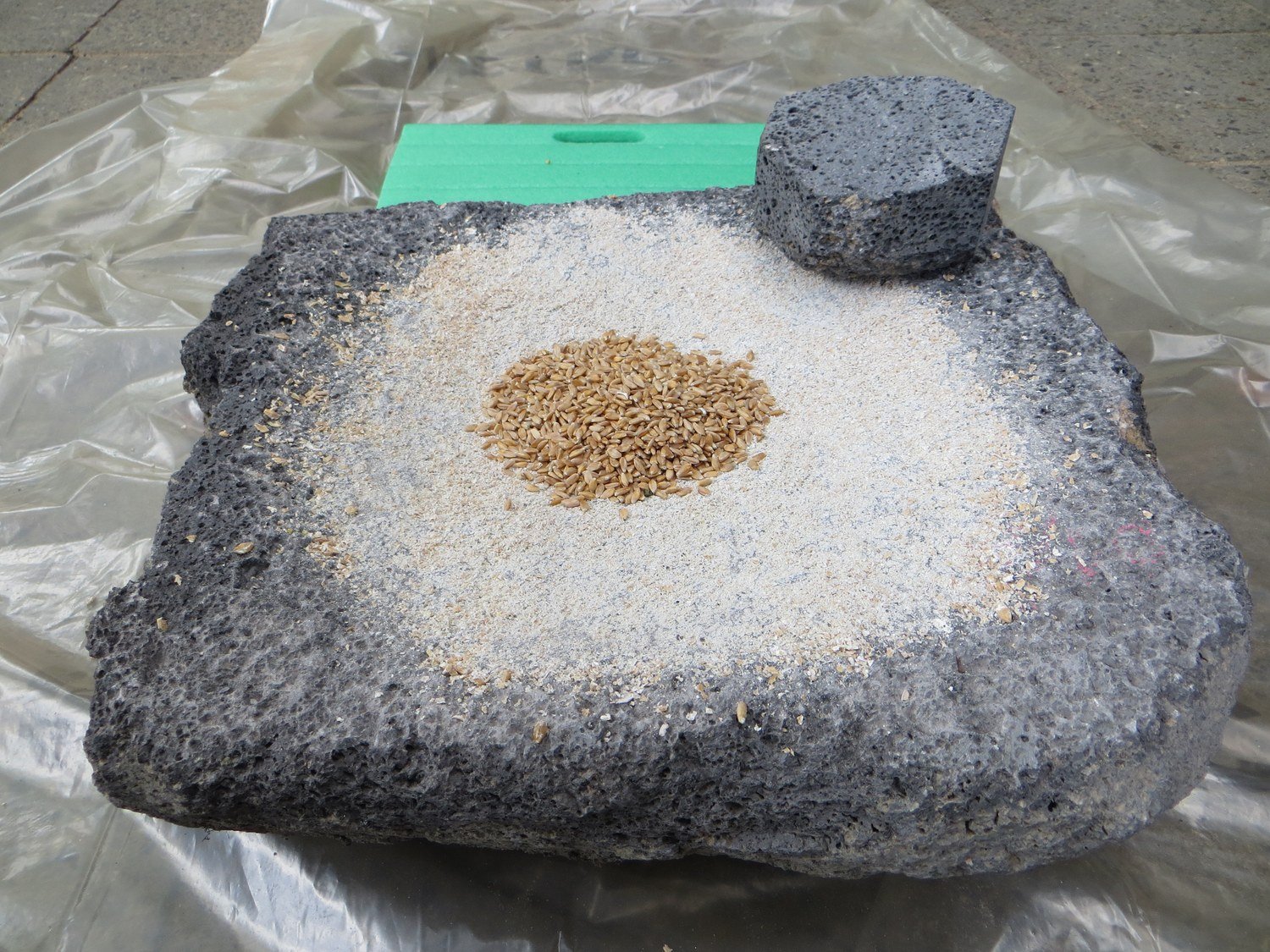
Wild einkorn wheat grows naturally in this region — one of the reasons the area matters so much to the story of agriculture. Göbekli Tepe has produced grinding equipment and cereal-processing evidence in quantity, along with storage vessels and large stone containers.
So there was serious plant work going on: harvesting, grinding, storing, processing. That is labour-intensive and it implies staying put, or at least returning reliably.
This is where the distinction gets subtle and matters. Processing wild cereals at scale is not farming. Nobody was sowing, tending or selecting. But it is the behaviour out of which farming later emerged — and it appears here first, in a population still hunting.
The nuts nobody mentions
The most concrete plant evidence in the wider region comes from Hallan Çemi, in the Taurus foothills, and it complicates the standard picture usefully.
Rosenberg, Nesbitt, Redding and Strasser reported that cereal grasses were scarce in the analysed samples. What was common instead was pulses — lentils and bitter vetch — and nuts: wild almond and pistachio.
The almonds are the detail worth stopping on. Wild almonds contain compounds that make them toxic if eaten raw in quantity. They were nonetheless economically important at the site, and charred concentrations suggest roasting. That means these communities held processing knowledge: they knew a food was dangerous, and they knew what to do to it to make it safe. That is inherited, taught expertise, not opportunistic foraging.
The authors' broader conclusion is the striking one — that sedentism here was not cereal-based. People settled down before wheat was the centre of the diet.
Birds, and how varied the diet really was
The same site produced one of the more remarkable datasets of the period. Zeder and Spitzer's 2016 study of the Hallan Çemi bird bones identified a large and varied avifaunal assemblage drawn from wetland, woodland, rocky, grassland, mountain and wooded-steppe habitats.
Two things follow. First, these people were working many different environments, not one. Second, the seasonal signal in the bird species points to more or less year-round occupation, rather than a brief seasonal camp.
The picture that emerges is not subsistence at the margin. It is a broad, well-managed, deeply informed use of an entire landscape.
Food as ritual: the burnt gazelle skulls
Sometimes food and ceremony are visibly the same act. At Çakmaktepe, 2025 reporting described more than thirty burnt gazelle skulls and five wild sheep heads found outside Special Building 15, in front of the exterior wall, across an area of roughly 10 by 3 metres. The gazelle horns were reported intact and the placement appears deliberate.
This is a deposit, not rubbish. Heads selected, burned, and set down together outside a special building — closure, offering, display, or a marker of approach. The final interpretation is open until the placement plan and faunal analysis are published.
Comparable evidence turns up elsewhere. At Hallan Çemi, an aurochs skull was found apparently placed against a wall facing a building's entrance, and another house held three male sheep skulls with red deer antlers. And at the Natufian burial of Hilazon Tachtit, tortoise shells and wild cattle remains accompanied an elderly woman's interment — a funeral with a feast attached.
So was there feasting at Göbekli Tepe?
Probably. Proving it from a specific deposit is harder than it sounds.
The feasting model — that people were drawn in and rewarded with large-scale eating and drinking, possibly including fermented beverages prepared in the site's big limestone vessels — is a reasonable explanation for how enormous collective labour got organised.
But much of the supporting bone comes from the fill inside the buildings, and Lee Clare now attributes a good deal of that fill to slope collapse and displaced midden material moving downhill rather than to deliberate deposition. Feast residue, ordinary refuse that slid into the room, or a mixture that cannot be separated — the deposit does not currently distinguish between them.
That does not sink the feasting argument. It narrows what any single layer of bone can be said to prove.
What this tells you about the builders
A community that can identify dozens of bird species across six habitats, detoxify wild almonds, process cereals at scale, store food, and intercept gazelle herds on schedule is not a community scraping by.
It is a community with surplus, expertise and time — and, critically, with the coordination problems that come from staying in one place near abundant resources. People have to agree on access, labour, obligation and memory.
That may be the real link between the diet and the monuments. Abundance does not remove pressure; it creates a different kind. Some of what was built at these sites may be the machinery for handling it.
Common questions
Did the builders of Göbekli Tepe farm?
No. The site belongs to the centuries before established agriculture. There is extensive evidence for processing wild cereals — grinding equipment, storage, cereal-processing traces — but not for sowing or tending domesticated crops.
What meat did they eat?
Gazelle most consistently, along with aurochs (wild cattle), wild boar and wild sheep. Notably, the animals most often carved on the pillars — snakes, foxes, vultures — are not the animals most often eaten.
What plants did they eat?
Wild einkorn wheat processed with grinding stones, and at comparable sites pulses such as lentils and bitter vetch, plus wild almond and pistachio.
Did they drink beer?
It has been proposed. Dietrich and colleagues suggested fermented beverages may have been prepared in Göbekli Tepe's large limestone vessels as part of feasting. It remains a debated interpretation rather than an established fact.
Is there evidence of feasting?
Feasting is a leading explanation for how collective labour was organised, but much of the supporting bone comes from building fill that the current excavation attributes substantially to slope collapse and displaced midden — so a given deposit may not prove it.
How did they eat toxic wild almonds?
Wild almonds are dangerous raw in quantity. At Hallan Çemi they were economically important nonetheless, with charred concentrations suggesting roasting — evidence that processing knowledge was held and passed on.
Sources & further reading8 references
- Dietrich, O., Heun, M., Notroff, J., Schmidt, K. & Zarnkow, M. (2012). The role of cult and feasting in the emergence of Neolithic communities. New evidence from Göbekli Tepe, south-eastern Turkey. Antiquity 86(333): 674–695.
- Clare, L. (2025). Public lectures and interviews on Göbekli Tepe (Göbekli Tepe Project, DAI). Transcribed talks and interviews held in the Taş Tepeler research atlas. Spoken material rather than a peer-reviewed publication; positions may be refined in print.
- Karul, N. (2025). Public lectures and interviews on Karahantepe and the Taş Tepeler project. Transcribed talks and interviews held in the Taş Tepeler research atlas. Spoken material rather than a peer-reviewed publication; positions may be refined in print.
- Rosenberg, M., Nesbitt, R. M., Redding, R. W. & Strasser, T. F. (1995). Hallan Çemi Tepesi: Some preliminary observations concerning early Neolithic subsistence behaviors in eastern Anatolia. Anatolica 21: 1–12.
- Zeder, M. A. & Spitzer, M. D. (2016). New insights into broad spectrum communities of the Early Holocene Near East: The birds of Hallan Çemi. Quaternary Science Reviews 151: 140–159. doi:10.1016/j.quascirev.2016.08.024
- Şahin, F. et al. (2023). Çakmaktepe Kazısı 2022 Yılı Kazı Çalışmaları. Kazı Sonuçları Toplantısı (Turkish Ministry of Culture and Tourism excavation reports).
- Grosman, L., Munro, N. D. & Belfer-Cohen, A. (2008). A 12,000-year-old Shaman burial from the southern Levant (Israel). Proceedings of the National Academy of Sciences 105(46): 17665–17669. doi:10.1073/pnas.0806030105
- Schmidt, K. (2012). Göbekli Tepe: A Stone Age Sanctuary in South-Eastern Anatolia. Berlin: ex oriente. The foundational monograph by the site's first excavator.
Full bibliography: the Taş Tepeler reference library →