Short answer
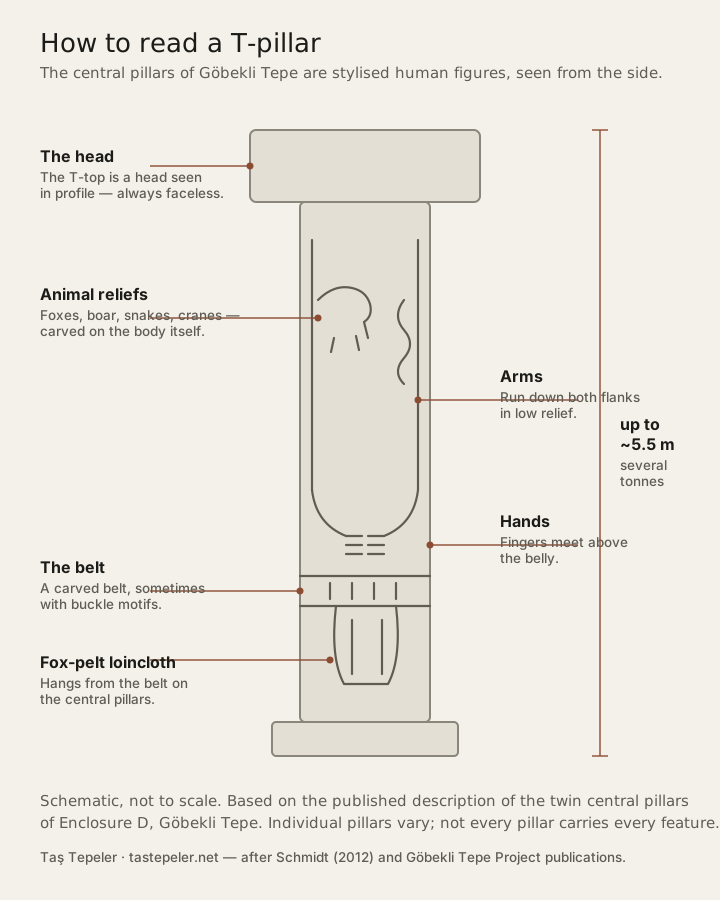
These are the core words for the Taş Tepeler sites — T-pillar (a T-shaped standing stone, the large central ones carved as stylised human figures), PPNA / PPNB (the Pre-Pottery Neolithic phases before pottery and farming), special building (a communal, non-domestic structure), and terrazzo (a hard, polished lime-plaster floor).
The rest of this glossary covers the period names, the architecture, and how finds are described and dated. Keep it open in another tab while you read the site — every term recurs across our pages and in the excavation literature.
The essentials
Taş Tepeler — Turkish for 'Stone Hills'; the name for the cluster of related Neolithic sites across the Şanlıurfa region and for the research program studying them. Tepe / höyük / tell — words for an artificial mound built up by long human occupation ('tepe' is Turkish for hill). Pre-Pottery Neolithic (PPN) — the early Neolithic before pottery was made, split into PPNA (earlier) and PPNB (later). Epipalaeolithic — the hunter-gatherer period just before the Neolithic.
Architecture words
T-pillar — the signature standing stone of the region, a shaft with a broad horizontal top; the central ones are stylized human figures. Special (or communal) building — a structure that isn't an ordinary house, used for gathering or ritual; much of Karahan Tepe is made of these. Enclosure — the term often used for Göbekli Tepe's great round buildings. Terrazzo — a hard, polished lime-plaster floor. Porthole stone — a large stone pierced by a round opening, sometimes used as a doorway between spaces. In situ — found in its original place, not moved to a museum.
How things are described and dated
Relief — carving raised from a flat surface; low relief is shallow, high relief stands boldly out (like the predator on Pillar 27). Stratigraphy / layer — the stacked deposits that record a site's sequence; Göbekli's Layer III is older than Layer II. Calibrated BCE — radiocarbon dates converted to real calendar years before the Common Era. Backfill — deliberate filling-in of a building with soil and rubble, which is how much of Göbekli Tepe was preserved.
The finds, the people, the wider world
Faunal / archaeobotanical — evidence from animal bone and from plant remains, the basis for what people ate. Native copper — naturally pure metallic copper, cold-hammered without smelting (see Çayönü). Urfa Man — the life-sized Neolithic human statue from Yeni Mahalle, in the Şanlıurfa museum. Natufian — the Epipalaeolithic culture of the Levant, partly settled before farming. Fertile Crescent / Upper Mesopotamia — the arc of land, including Şanlıurfa, where farming began.
Keep this page open in another tab while you read the site — every term above appears across our pages and in the excavation literature.
Why 'Pre-Pottery' and 'aceramic' are the same idea
Two labels get used for the same stretch of time, and it helps to see why. Pre-Pottery Neolithic and aceramic Neolithic both mean 'Neolithic, but before people made fired clay pots.' It sounds like a small detail; it is actually a deliberate choice about how to define an age.
For a long time, 'Neolithic' was tied to farming, and pottery was assumed to come as part of the package. The Taş Tepeler sites are precisely what breaks that assumption: monumental buildings, sophisticated stone carving and settled gathering, all with no pottery and no farming yet. Naming the period after the absence of pottery, rather than the presence of farming, is a way of admitting that the old checklist does not describe what actually happened here. When you see 'PPN', 'PPNA', 'PPNB' or 'aceramic', that is the point being made.
'Temple', 'cult building', 'special building': a loaded choice
No terminology on these sites is argued over more than the words for the big non-domestic buildings. 'Temple' is the popular favourite and the one specialists most distrust: it smuggles in priests, gods and organised religion that the evidence does not show. 'Cult building' is softer but still assumes ritual. 'Special building' and 'communal building' are the cautious, now-preferred terms — Necmi Karul, who directs Karahan Tepe, uses 'special building' precisely because it says only what can be seen: a structure set apart from ordinary houses, made for gathering.
So the choice of word is not decoration. It signals how much interpretation the writer is willing to commit to. This site favours 'special' or 'communal' building, and treats 'temple' as a headline word to be handled with care — a small example of the larger habit of separating what is observed from what is inferred.
Common questions
What is a T-pillar?
A T-shaped standing stone — the signature monument of Taş Tepeler. The large central ones are carved as stylized human figures with arms, hands, and belts.
What is a 'special building'?
A structure that isn't an ordinary house — used for gathering or ritual. Much of Karahan Tepe consists of such buildings, often deliberately buried.
What does 'Pre-Pottery Neolithic' mean?
The early Neolithic period before pottery was invented, divided into PPNA (earlier) and PPNB (later). It's when the Taş Tepeler monuments were built.
Sources & further reading5 references
- Schmidt, K. (2012). Göbekli Tepe: A Stone Age Sanctuary in South-Eastern Anatolia. Berlin: ex oriente. The foundational monograph by the site's first excavator.
- Clare, L. (2020). Göbekli Tepe, Turkey. A brief summary of research at a new World Heritage Site (2015–2019). e-Forschungsberichte des Deutschen Archäologischen Instituts 2020(2): 81–88.
- Karul, N. (2021). Buried Buildings at Pre-Pottery Neolithic Karahantepe. Türk Arkeoloji ve Etnografya Dergisi 82: 19–29. link
- The Tepe Telegrams (official research blog of the Göbekli Tepe Project, DAI). The Tepe Telegrams. Deutsches Archäologisches Institut. link Accessible, authoritative running commentary from the excavation team.
- UNESCO World Heritage Centre (2018). Göbekli Tepe (inscription on the World Heritage List). UNESCO. link
Full bibliography: the Taş Tepeler reference library →