Short answer
Taş Tepeler is measured against four other great Neolithic sites — Çayönü, Jericho, Çatalhöyük and Ain Ghazal — and one thing sets it apart: at those sites, monumental building and art accompany or follow the start of farming; at Taş Tepeler the monuments came first, raised by hunter-gatherers.
All five share the deep Neolithic preoccupations — the human head, the communal building, the move toward settled life. What Taş Tepeler adds is the timing: it reverses the expected order of monuments and agriculture, which is why Göbekli Tepe became famous.
Why look outside Taş Tepeler at all
The Taş Tepeler sites did not happen in isolation, and they are rarely described without a comparison to somewhere else — usually Çayönü on the Tigris, Jericho in the Jordan Valley, Çatalhöyük on the Konya plain, or Ain Ghazal in Jordan. Those four are not part of the Şanlıurfa group, and this site does not cover them in their own right. But knowing roughly what each one is makes the distinctive thing about Taş Tepeler much easier to see.
The short version: the same Neolithic preoccupations — the human head, the communal building, the shift toward settled life — turn up right across the Near East. What Taş Tepeler adds is when.
Çayönü — architecture and the first metal
Çayönü Tepesi, on a tributary of the Tigris in southeastern Türkiye, is one of the most fully excavated Pre-Pottery Neolithic settlements anywhere, occupied across much of the ninth and eighth millennia BCE. It is famous for a sequence of increasingly sophisticated building plans and for a skull building that held the remains of large numbers of people, some of the clearest evidence of the period's concern with the dead.
Çayönü is also where people worked native copper — naturally pure metal, cold-hammered and annealed into beads and pins long before anyone smelted ore. That is metalworking, not yet metallurgy, and it makes the site a landmark in the story of technology. Of the four comparisons here, Çayönü is the closest to Taş Tepeler in both region and date.
Jericho — the tower and the plastered skulls
Tell es-Sultan, ancient Jericho, in the Jordan Valley, is the site that made the pre-farming Neolithic famous long before Göbekli Tepe. Kathleen Kenyon's excavations in the 1950s exposed a great stone tower and wall built in the Pre-Pottery Neolithic A, around the same horizon as Göbekli Tepe's oldest enclosures, and — in the following period — the celebrated plastered skulls, human heads with faces modelled back onto them in lime plaster.
Those skulls are the single most direct parallel to the Taş Tepeler concern with the head: at Göbekli Tepe, crania were carved and drilled; at Jericho, they were plastered and kept. The same idea, treated two different ways, hundreds of kilometres apart.
Çatalhöyük — the Neolithic town
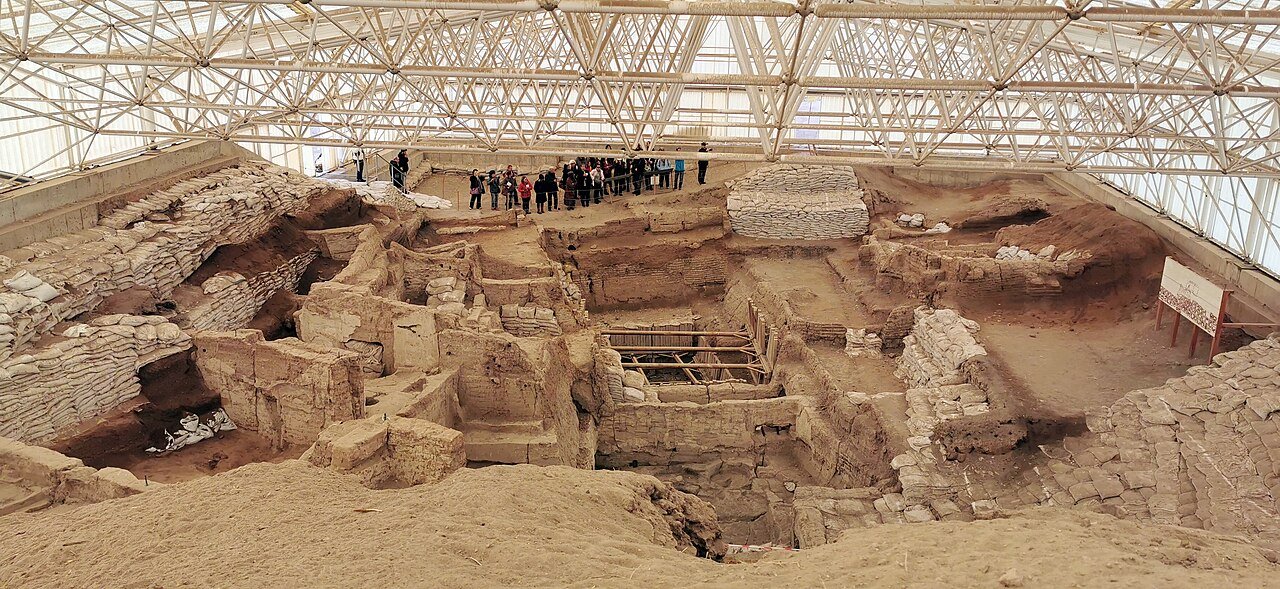
Çatalhöyük, on the Konya plain in central Anatolia, is later than the Taş Tepeler monuments — broadly the seventh millennium BCE — and it represents a different stage: not a gathering place raised by hunter-gatherers but a large farming town of mud-brick houses packed so tightly that people moved across the rooftops and entered their homes through the roof. Its walls carry paintings, its rooms hold bull skulls set into benches, and its dead were buried beneath the floors.
Excavated by James Mellaart and later, at length, by Ian Hodder, Çatalhöyük shows what settled Neolithic life looked like once farming was established. It is the after to Göbekli Tepe's before.
Ain Ghazal — the plaster people
Ain Ghazal, on the edge of modern Amman in Jordan, is a large Pre-Pottery Neolithic B settlement best known for its lime-plaster statues — among the oldest large representations of the human figure ever made, some nearly a metre tall, with wide staring eyes rimmed in bitumen. They were found buried in caches, apparently retired rather than discarded.
Where Taş Tepeler carved the human figure in stone and Jericho modelled it onto real skulls, Ain Ghazal built it up in plaster. Together the three make the point that representing the human body was a central, shared Neolithic project — pursued in whatever material each community favoured.
What the comparison shows about Taş Tepeler
Line the four up and a pattern appears. Jericho has farming and a tower; Çatalhöyük is a farming town; Ain Ghazal is a farming village with statues; Çayönü is a long-lived settlement moving toward agriculture. In every case the monumental or artistic achievement sits alongside or after the beginnings of settled, food-producing life.
Taş Tepeler reverses that order. Its greatest architecture — the raised T-pillar enclosures of Göbekli Tepe — was built by communities that were still, on the current evidence, hunter-gatherers. The monuments come first, and farming follows. That is the claim that made Göbekli Tepe famous, and setting it beside Jericho, Çatalhöyük, Çayönü and Ain Ghazal is the clearest way to understand why it mattered.
None of this makes the other sites lesser — they are extraordinary, and far more is known about daily life at Çatalhöyük or Ain Ghazal than at any Taş Tepeler site. It simply locates Taş Tepeler in the story: not the whole Neolithic, but its startling opening chapter.
Common questions
How does Göbekli Tepe compare to Çatalhöyük?
Çatalhöyük, on the Konya plain, is a farming town of the seventh millennium BCE — later than Göbekli Tepe and representing settled, food-producing life. Göbekli Tepe's monuments were raised earlier, by hunter-gatherers, before farming was established.
How does Göbekli Tepe compare to Jericho?
Both have monumental Pre-Pottery Neolithic A construction — Jericho's tower and wall, Göbekli Tepe's enclosures. Jericho's later plastered skulls are the closest parallel to the Taş Tepeler concern with the human head.
What is the skull building at Çayönü?
A structure at Çayönü Tepesi on the Tigris that held the remains of large numbers of people — among the clearest evidence of the early Neolithic preoccupation with the dead.
What are the Ain Ghazal statues?
Lime-plaster human figures from a Pre-Pottery Neolithic B site in Jordan, among the oldest large human statues known, found buried in caches.
What makes Taş Tepeler different from these sites?
At Jericho, Çatalhöyük, Çayönü and Ain Ghazal, monumental or artistic achievement accompanies or follows the start of farming. At Taş Tepeler the monuments came first, built by hunter-gatherers before agriculture — the order is reversed.
Sources & further reading6 references
- Özdoğan, M., Başgelen, N. & Kuniholm, P. (eds) (2011). The Neolithic in Turkey: New Excavations and New Research. Istanbul: Archaeology & Art Publications. Standard reference covering Çayönü, Körtik Tepe, Hallan Çemi and other early sites.
- Kenyon, K. M. (1957). Digging Up Jericho. London: Ernest Benn. The classic account of the Jericho excavations, including the tower and plastered skulls.
- Hodder, I. (2006). The Leopard's Tale: Revealing the Mysteries of Çatalhöyük. London: Thames & Hudson. A leading account of the Çatalhöyük excavations.
- Rollefson, G. O. (1998). 'Ain Ghazal (Jordan): Ritual and Ceremony III. Paléorient 24(1): 43–58.
- Clare, L. (2020). Göbekli Tepe, Turkey. A brief summary of research at a new World Heritage Site (2015–2019). e-Forschungsberichte des Deutschen Archäologischen Instituts 2020(2): 81–88.
- Mithen, S., Richardson, A. & Finlayson, B. (2023). The flow of ideas: shared symbolism during the Neolithic emergence in Southwest Asia — WF16 and Göbekli Tepe. Antiquity. doi:10.15184/aqy.2023.67
Full bibliography: the Taş Tepeler reference library →