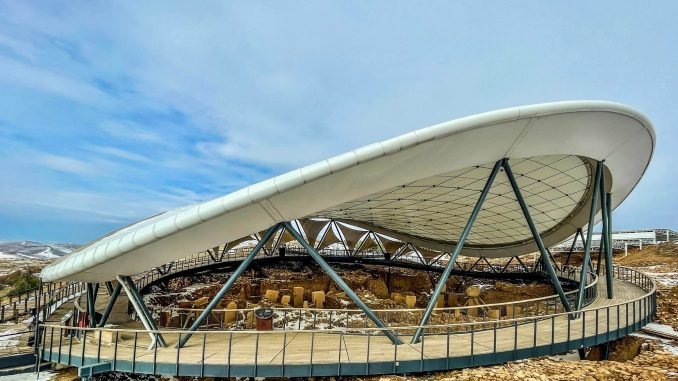
Göbekli Tepe was recognised by Klaus Schmidt in 1994 and excavated from 1995 by the German Archaeological Institute (DAI) with the Şanlıurfa Museum. Work continues today under Lee Clare (DAI) with Istanbul University, inside the Taş Tepeler programme. A permanent protective shelter opened in 2017, the site became a UNESCO World Heritage Site in 2018, and — importantly — most of the hill is still unexcavated, left in the ground on purpose.
From a dismissed mound to a global monument
The story starts with a near miss. A joint Istanbul–Chicago survey walked over the mound in 1963, recorded it, and moved on — the broken limestone on the surface was read as a later cemetery. It took thirty years for someone to look again. In 1994 Klaus Schmidt, who had worked at nearby Neolithic sites, examined the worked flint and T-shaped stones and understood he was standing on something Stone Age.
Excavation began in 1995 under the German Archaeological Institute with the Şanlıurfa Museum. What followed reordered the timeline of monumental building: carved pillars and enclosures raised around 9500 BCE, thousands of years before farming towns, writing, or metal. The chain of recognition that followed — a permanent shelter in 2017, UNESCO World Heritage status in 2018 — turned a working dig into one of the most visited archaeological sites in Türkiye.
How the hill is excavated
Excavation here is slow, layered work, not treasure-hunting. Teams remove deposits in controlled stages, recording where every stone, bone, and flint sat before it is lifted, because the position of a find often matters more than the find itself. That record is what lets researchers reconstruct how the enclosures were built, used, and eventually filled in.
The work is seasonal and continuous: since 1995 there has been no year when Göbekli Tepe was considered finished. Each campaign adds to an enormous archive of material that the project is still studying and publishing — a reminder that digging a site and understanding it are two different, overlapping jobs.
Protecting what has been uncovered
Limestone that lay buried for eleven thousand years is fragile the moment it meets sun, rain, and frost. Conservation is therefore not an afterthought here; it runs alongside the digging. The main enclosures now sit under a permanent protective canopy, opened in 2017, and visitors are kept to raised walkways so the stones are seen but not touched.
The care is physical as well as environmental. In the 2026 season, conservators reinforced the great central pillars of Enclosure D against earthquakes — the kind of intervention that treats these carvings as monuments to be stabilised for the long term, not just exposed and admired.
A site deliberately left mostly buried
Perhaps the most surprising fact about Göbekli Tepe is how little of it has been dug. Geophysical survey has mapped many more enclosures still underground — as many as fifteen to twenty in all. Rather than rush to expose them, the project leaves most in the ground, both to protect them and to preserve them for future methods that will read them better than ours can.
So Göbekli Tepe is not a finished excavation. It is a site being deliberately, patiently kept — which is why new discoveries keep emerging season after season, and why the current emphasis under Lee Clare is as much on conservation and careful publication as on uncovering more.
What's established, and what's still open
Established: the 1963 survey noted the mound; Schmidt recognised its true age in 1994 and began excavating in 1995; the permanent shelter opened in 2017; UNESCO inscribed the site in 2018; and only a fraction has been dug. These are firm points in the record.
Still open: much of what the buried enclosures contain, how the whole complex developed over time, and what the vast unstudied material will finally show. The honest position is that Göbekli Tepe is early in its telling, not late — a monument being read one careful season at a time.
Sources & further reading4 references
- Clare, L. (2020). Göbekli Tepe, Turkey. A brief summary of research at a new World Heritage Site (2015–2019). e-Forschungsberichte des Deutschen Archäologischen Instituts 2020(2): 81–88.
- UNESCO World Heritage Centre (2018). Göbekli Tepe (inscription on the World Heritage List). UNESCO. link
- Schmidt, K. (2012). Göbekli Tepe: A Stone Age Sanctuary in South-Eastern Anatolia. Berlin: ex oriente. The foundational monograph by the site's first excavator.
- Notroff, J., Dietrich, O. & Schmidt, K. (2014). Building Monuments, Creating Communities. Early monumental architecture at Pre-Pottery Neolithic Göbekli Tepe. In J.F. Osborne (ed.), Approaching Monumentality in Archaeology: 83–105. Albany: SUNY Press.
Full bibliography: the Taş Tepeler reference library →