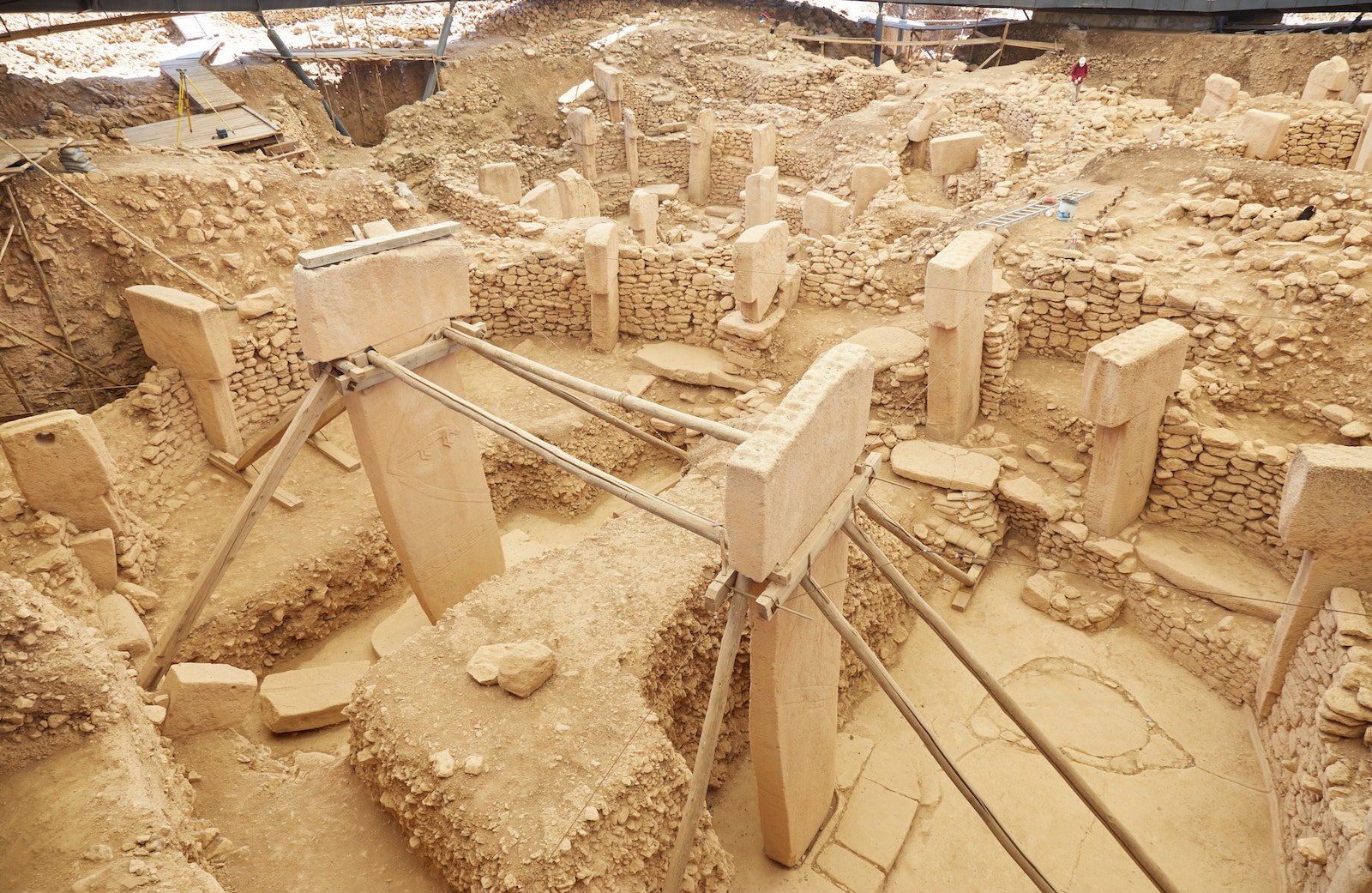
The mound was noted in a 1963 Istanbul–Chicago survey but dismissed as a medieval cemetery. The real discovery came in 1994, when the German archaeologist Klaus Schmidt recognised the worked flint and T-shaped stones as Neolithic — among the oldest monuments ever found. He began excavating in 1995 and led the site until his death in 2014; work continues today under the DAI (Lee Clare) with Istanbul University.
The 1963 survey that walked past it
Göbekli Tepe was not hidden. A joint Istanbul–Chicago survey recorded the mound in 1963, walking over the same broken limestone that would later make the site famous. But the fragments on the surface were read as later graves, and the hill was filed away as a medieval cemetery of no great interest.
It is worth being fair to that team: surface survey is a blunt tool, and a scatter of broken stone on a hilltop rarely announces itself as the oldest monumental architecture on earth. The evidence was there for anyone to see. What was missing was the question that would make sense of it.
What Klaus Schmidt saw
That question arrived with Klaus Schmidt, who had already worked at nearby Neolithic sites and knew what early worked stone looked like. When he examined Göbekli Tepe in 1994, the flint and the T-shaped slabs told him plainly that this was not medieval at all — it was Stone Age, and on a scale nobody expected for that period.
He began excavating in 1995. Within a few seasons the enclosures and their carved pillars had overturned a long-held assumption: that monumental building had to wait for farming, villages, and settled surplus. Here were great carved monuments raised by people who were still hunters and gatherers.
A joint Istanbul–Chicago survey recorded the mound in 1963 but misread the broken limestone as later graves. In 1994 Klaus Schmidt, who had worked at nearby Neolithic sites, examined it and understood the worked flint and T-shaped pillars were Stone Age. He led excavations there from 1995 until his death in 2014; the work continues today under the German Archaeological Institute, with Istanbul University, inside the Taş Tepeler programme.
The 1963 miss is the human part of the story: the evidence lay on the surface for thirty years, and it took someone asking a different question to see it. Schmidt's insight wasn't luck — he came with the right frame, from digging older sites, and trusted what the stones were telling him. Discovery here was less about finding the hill than about believing its age.
This is our reading of the record.
From Schmidt to today
Schmidt directed the excavations until his death in 2014, by which time Göbekli Tepe had become one of the most discussed sites in world prehistory. The project did not end with him. It continues under Lee Clare of the German Archaeological Institute, working with Istanbul University, and since 2021 it has formed part of the wider Taş Tepeler programme across the Şanlıurfa region.
The emphasis has shifted with the leadership — from first revelation toward conservation, precise dating, and the careful study of everyday life on the hill — but the through-line is unbroken. Most of the site, tellingly, remains unexcavated to this day.
- 1963: surveyed by an Istanbul–Chicago team, but dismissed as a medieval cemetery.
- 1994: Klaus Schmidt recognises the worked flint and T-pillars as Neolithic.
- 1995: Schmidt begins excavations with the German Archaeological Institute.
- 2014: Schmidt dies; the work continues under the DAI with Istanbul University.
- Today: research runs within the Taş Tepeler programme — and most of the hill is still unexcavated.
So who really discovered it?
Established: the mound was noted in 1963, recognised as Neolithic by Schmidt in 1994, and excavated by him from 1995 until 2014. Those dates and people are firm.
Where it gets more of a judgement call is the word 'discovered'. The 1963 survey found the hill; Schmidt discovered what it was. If discovery means locating a mound, others got there first. If it means understanding it — seeing eleven thousand years in a scatter of flint — the credit is clearly Schmidt's, and that is how the record almost always frames it.
Sources & further reading2 references
- Schmidt, K. (2012). Göbekli Tepe: A Stone Age Sanctuary in South-Eastern Anatolia. Berlin: ex oriente. The foundational monograph by the site's first excavator.
- Clare, L. (2020). Göbekli Tepe, Turkey. A brief summary of research at a new World Heritage Site (2015–2019). e-Forschungsberichte des Deutschen Archäologischen Instituts 2020(2): 81–88.
Full bibliography: the Taş Tepeler reference library →