Short answer
Harbetsuvan Tepesi matters because a 2025 whole-mound geophysical survey found it lacks the large circular monumental buildings that Göbekli Tepe, Karahan Tepe and Sayburç all share — even though it has the same T-pillar tradition and sits just 7 km from Karahan Tepe.
That absence is the point. It shows the Taş Tepeler communities used a shared symbolic vocabulary while organising their settlements differently, turning the region from a set of copies into a network of related communities making local choices. Whether Harbetsuvan was a small cult centre or an ordinary settlement is still debated.
The finding that makes it matter
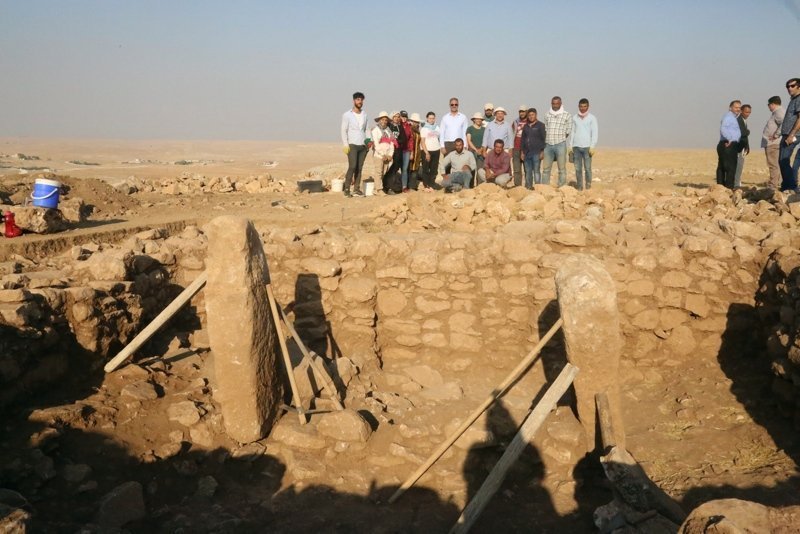
In 2025 a geophysical prospection study in Archaeological Prospection mapped the whole of Harbetsuvan without digging it — topographic survey, magnetometry and ground-penetrating radar across the entire mound.
The result was a negative, and a significant one. The survey found a dense cluster of small rectangular rooms near the centre, with no large open spaces and no oversized monumental buildings anywhere on the site.
A pattern, broken
That sets Harbetsuvan directly against its neighbours. At Sayburç, at the upper layer of Göbekli Tepe, and at Karahan Tepe, large circular monumental structures occur alongside clusters of smaller dwellings.
Harbetsuvan has the shared vocabulary — the T-pillars, the sculptural tradition — but not that architectural signature. It is the same idea without the monument, only 7 km from one of the region's greatest monumental sites.
Cult centre, or ordinary settlement?
This is where Harbetsuvan gets genuinely interesting, because two pieces of published work point in different directions. Çelik (2016) interpreted it as a small-scale cult centre, a reading built on the T-pillars and the character of the excavated building.
The 2025 whole-mound survey found no monumental architecture anywhere on the site. Those findings can be reconciled — a settlement can hold a modest special building without containing anything monumental — but they pull the interpretation in different directions, and no one has resolved it. Read anyone who tells you flatly what Harbetsuvan was with that in mind.
Why a negative result is valuable
It is easy, looking at Göbekli Tepe and Karahan Tepe, to assume the Taş Tepeler communities shared a single template: a monumental circular building, T-pillars, a sunken floor, houses around it.
Harbetsuvan says otherwise. Communities in this landscape used the shared symbolic language while organising their settlements differently. That turns the region from a set of copies into a network of related communities making local decisions — and a small site with no monuments shows what the ordinary version looked like, which the giants cannot.
What is still unknown
The full chronology of the site, and how its phases relate to Karahan Tepe's, remain open. So does the reason for the absence of large buildings — a different function, a different date, a smaller population, or a genuinely different social arrangement.
What the renewed Turkish–Japanese excavations will show is not yet published, and how much was lost to looting before salvage work began may never be known. Harbetsuvan is an active project; the picture is likely to change.
Common questions
Why is Harbetsuvan Tepesi important?
A 2025 whole-mound geophysical survey found it lacks the large circular monumental buildings that characterise Sayburç, upper Göbekli Tepe and Karahan Tepe — despite sharing the same T-pillar tradition and sitting only 7 km from Karahan. It shows the region was not uniform.
Was Harbetsuvan a cult centre?
Çelik (2016) interpreted it as a small-scale cult centre. A 2025 whole-mound geophysical survey found no monumental structures anywhere on the site. Both are published, and the interpretation is not settled.
How close is Harbetsuvan to Karahan Tepe?
About 7 km. That nearness is part of why its differences matter: the two communities can hardly have been unaware of each other, so the differences look like choices, not isolation.
What does Harbetsuvan tell us about Taş Tepeler?
That the communities shared a symbolic vocabulary — T-pillars, sculpture — while organising their settlements differently. It reframes the region as a network of related communities making local decisions rather than copies of one template.
Sources & further reading5 references
- Çelik, B. (2016). A small-scale cult centre in Southeast Turkey: Harbetsuvan Tepesi. Documenta Praehistorica 43: 421–428. doi:10.4312/dp.43.21 link
- Archaeological Prospection (2025). The Layout and Size of an Early Pre-Pottery Neolithic B Small Settlement Revealed by Geophysical Prospection at Harbetsuvan Tepesi in Southeastern Anatolia. Archaeological Prospection. doi:10.1002/arp.70037 link
- Çelik, B.. Differences and similarities between the settlements in Şanlıurfa region where 'T' shaped pillars are discovered. Comparative survey of the Şanlıurfa T-pillar sites. Consulted via open repository copy; full bibliographic details not verified.
- Karul, N. (2021). Buried Buildings at Pre-Pottery Neolithic Karahantepe. Türk Arkeoloji ve Etnografya Dergisi 82: 19–29. link
- Clare, L. (2020). Göbekli Tepe, Turkey. A brief summary of research at a new World Heritage Site (2015–2019). e-Forschungsberichte des Deutschen Archäologischen Instituts 2020(2): 81–88.
Full bibliography: the Taş Tepeler reference library →