Short answer
The mortars and grinding stones cut into Çakmaktepe's bedrock show that people here were processing wild plant food — especially cereals — intensively, long before anyone farmed.
That heavy, repetitive food-work is the unglamorous engine of the Neolithic: it supported staying in one place and feeding gatherings, and it is part of the long road from gathering toward cultivation in the very region where einkorn wheat was later domesticated. On their own, though, mortars are evidence of work, not automatically of ritual — they are best read alongside where they sit and what surrounds them.
What the mortars are
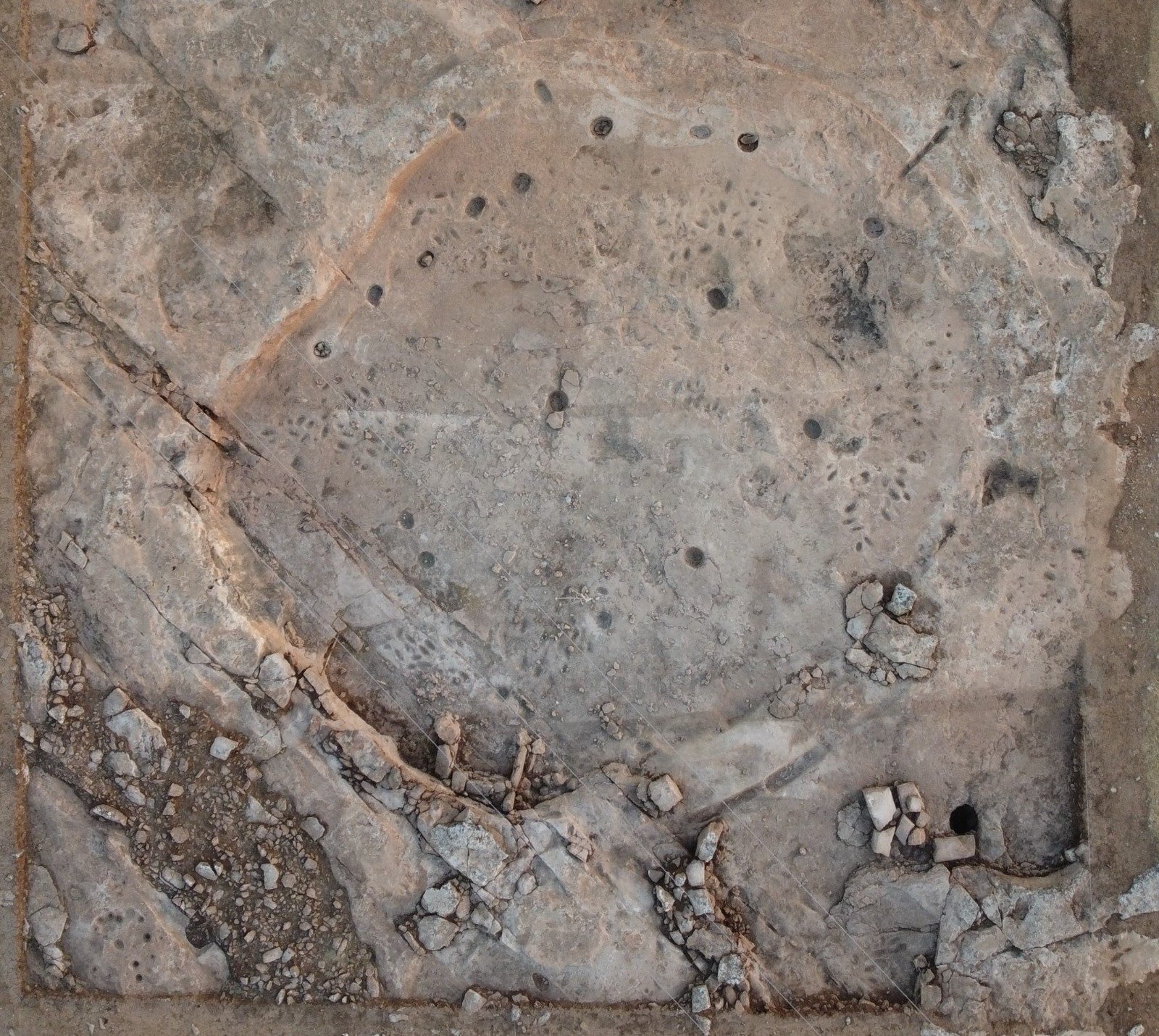
Two kinds of equipment turn up at Çakmaktepe. There are mortar holes — rounded hollows cut directly into the bedrock floors of buildings — and there are portable grinding stones, the hand tools used to pound and grind against them.
Together they make up a food-processing kit. Some of the hollows sit in the floors of the rock-cut houses; others cluster where communal work seems to have happened. They are among the most visible traces the site has left.
What they show: processing wild plants at scale
Mortars and grinding stones are how you turn tough wild seeds and cereals into something edible. In quantity, and this early, they signal that plant food was being processed intensively — not casually gathered and eaten, but harvested, pounded, ground and prepared in a systematic way.
That is significant because it happened before farming. The people doing this work were still hunter-gatherers; the intensity of the processing is a behaviour, not yet an economy.
Why it matters for the origins of farming
This region is central to the story of agriculture. The wild ancestor of einkorn wheat grew nearby, and the intensive handling of wild cereals — grinding, storing, feasting — is part of the long road that led, over generations, from gathering toward cultivation.
Çakmaktepe catches that process in an early, pre-agricultural phase. The mortars are, in effect, a snapshot of the groundwork: the habits and technologies that would eventually make farming possible were already in place.
Everyday life beside the monuments
The mortars are a useful corrective to a monuments-only picture of Taş Tepeler. Alongside the carved pillars and ritual deposits, people were doing the daily, essential work of turning wild plants into food.
The monuments at Göbekli Tepe were raised by people who fed large gatherings. Sites like Çakmaktepe show the food technology that made those gatherings possible — the practical base beneath the ceremony.
Reading them carefully
It is worth resisting the urge to make the mortars more than they are. A grinding hollow is evidence of work, not automatically of ritual, and it should be read together with where it sits, what is found around it, and how the tools are distributed across the site.
What is settled is that these tools show intensive processing of wild plant food. What is not settled is the precise scale of that work, whether any installations had a ceremonial dimension, and exactly how it fits the site's chronology. Those depend on analysis and publication still to come.
Common questions
What do the Çakmaktepe mortars show?
That people were processing wild plant food, especially cereals, intensively — part of the long road from gathering toward farming in the region where einkorn wheat was later domesticated.
Does this mean the people of Çakmaktepe farmed?
No. The mortars show intensive processing of wild plants by hunter-gatherers, before domestication. It is the behaviour out of which farming later grew, not farming itself.
Were the mortars ritual objects?
Not necessarily. On their own, mortars are evidence of food-work rather than ceremony. Any ritual reading would need supporting context, and that has not been established.
Sources & further reading4 references
- Şahin, F. et al. (2023). Çakmaktepe Kazısı 2022 Yılı Kazı Çalışmaları. Kazı Sonuçları Toplantısı (Turkish Ministry of Culture and Tourism excavation reports).
- Clare, L. (2020). Göbekli Tepe, Turkey. A brief summary of research at a new World Heritage Site (2015–2019). e-Forschungsberichte des Deutschen Archäologischen Instituts 2020(2): 81–88.
- Dietrich, O., Heun, M., Notroff, J., Schmidt, K. & Zarnkow, M. (2012). The role of cult and feasting in the emergence of Neolithic communities. New evidence from Göbekli Tepe, south-eastern Turkey. Antiquity 86(333): 674–695.
- Şahin, F. & Massa, M. (2025). Mass-hunting in South-west Asia at the dawn of sedentism: new evidence from Şanlıurfa, south-east Türkiye. Antiquity.
Full bibliography: the Taş Tepeler reference library →