Short answer
The T-shaped pillar is a regional signature, not a Göbekli Tepe invention — it appears across the Şanlıurfa area at sites large and small, including three barely written about in English: Taşlı Tepe, Kurt Tepesi and Hamzan Tepe.
That distribution is the real story. A single extraordinary site is a mystery; the same designed object repeated across a dozen settlements is a shared building tradition — a culture. The three under-covered sites carry the same pillar form but have almost no accessible excavation record.
The T-pillar is a regional signature, not a Göbekli Tepe invention
The T-shaped pillar is the single most recognisable thing about this landscape, and it is easy to assume it belongs to Göbekli Tepe. It does not. It is a regional form, and it turns up across the Şanlıurfa area at sites of very different sizes.
Counting the sites where T-pillars have been recorded gives a list considerably longer than the two famous ones: Göbekli Tepe, Karahan Tepe, Nevalı Çori, Sefer Tepe, Harbetsuvan Tepesi, Ayanlar Höyük, Sayburç, Yeni Mahalle — and three that almost nobody writes about in English: Taşlı Tepe, Kurt Tepesi and Hamzan Tepe.
That distribution is the actual story. A single extraordinary site is a mystery. A shared architectural idea appearing across a dozen settlements in one region is a culture.
Taşlı Tepe
Taşlı Tepe lies in the Siverek district of Şanlıurfa province, well to the north of the Tek Tek Mountains cluster that holds Karahan Tepe and Harbetsuvan.
It was published in 2011 by Bahattin Çelik with Mustafa and Gül Güler as a new Pre-Pottery Neolithic settlement. What makes it worth knowing is the pillars: the T-pillars recorded there are described as having features identical with those at Nevalı Çori, Göbekli Tepe, Karahan Tepe and Hamzan Tepe.
That word — identical — is doing real work. It means these are not loosely similar standing stones that happen to be roughly T-shaped. They are the same designed object, made to the same conventions, at sites spread across a wide landscape.
Kurt Tepesi
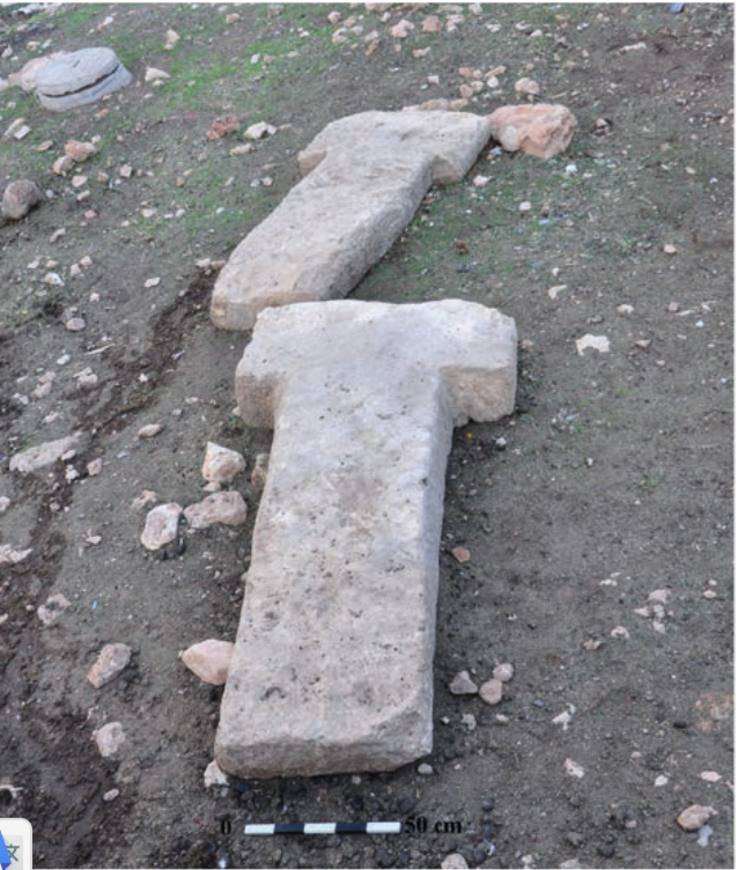
Kurt Tepesi is an eastern site in the same network, and T-shaped pillars from it have been photographed and published in comparative surveys of the region's pillar sites.
Beyond that, the public record is thin. It appears in lists of Şanlıurfa's Pre-Pottery Neolithic centres and in comparative work on T-pillar settlements, but it has nothing like the excavation literature attached to the flagship sites. Even its spelling and precise location are handled cautiously in mapping work.
We are including it rather than quietly leaving it out, because a site being under-published is not the same as a site being unimportant — and the gap itself is worth knowing about.
Hamzan Tepe
Hamzan Tepe is the third of the under-covered T-pillar sites, and it appears constantly as a comparandum — the site others are measured against when pillar form is being discussed. Taşlı Tepe's pillars are compared to it; Harbetsuvan's surface finds are linked to the same group.
It is a good illustration of how this field actually works. A site can be central to the comparative argument among specialists while remaining almost invisible to general readers, simply because no popular account has ever been written about it.
Why the small sites change the picture
The temptation with Göbekli Tepe is to treat it as a singular event — one astonishing place, built by people who otherwise left little behind. The T-pillar distribution makes that reading hard to sustain.
If the same specific architectural form appears at a dozen sites across Şanlıurfa, from monumental enclosures down to small hilltop settlements like Harbetsuvan, then what we are looking at is a shared building tradition held in common by many communities — not one anomalous site.
It also reframes the smaller places. Taşlı Tepe, Kurt Tepesi and Hamzan Tepe are not lesser versions of Göbekli Tepe. They are the evidence that the idea travelled, and that ordinary settlements participated in it.
What is genuinely unknown
For all three of these sites the honest position is that very little has been published in English, there are no accessible radiocarbon series, and their phasing relative to the flagship sites is not established.
None of them should be described with confident dates or firm interpretations. What can be said is that they carry the regional pillar form, that specialists treat them as part of the same group, and that they remain among the least-documented parts of the Taş Tepeler landscape.
Common questions
Which sites in Şanlıurfa have T-shaped pillars?
Göbekli Tepe, Karahan Tepe, Nevalı Çori, Sefer Tepe, Harbetsuvan Tepesi, Ayanlar Höyük, Sayburç and Yeni Mahalle, plus three far less documented sites: Taşlı Tepe, Kurt Tepesi and Hamzan Tepe.
Where is Taşlı Tepe?
In the Siverek district of Şanlıurfa province. It was published as a new Pre-Pottery Neolithic settlement in 2011 by Çelik, Güler and Güler.
What is Kurt Tepesi?
An eastern Taş Tepeler network site with photographed T-shaped pillars. It is very thinly published; even its precise location is treated cautiously in mapping work.
What is Hamzan Tepe?
A Şanlıurfa T-pillar site used repeatedly as a comparison point in specialist literature on pillar form, but with almost no general-audience coverage.
Does the T-pillar belong to Göbekli Tepe?
No. It is a regional form recorded across many sites in the Şanlıurfa area, which is why the landscape is better understood as a shared building tradition than as one exceptional site.
Sources & further reading5 references
- Çelik, B., Güler, M. & Güler, G. (2011). A new Pre-Pottery Neolithic settlement in southeastern Turkey: Taşlı Tepe. Anadolu / Anatolia 37: 225–236. doi:10.1501/Andl_0000000387
- Çelik, B.. Differences and similarities between the settlements in Şanlıurfa region where 'T' shaped pillars are discovered. Comparative survey of the Şanlıurfa T-pillar sites. Consulted via open repository copy; full bibliographic details not verified.
- Çelik, B. (2016). A small-scale cult centre in Southeast Turkey: Harbetsuvan Tepesi. Documenta Praehistorica 43: 421–428. doi:10.4312/dp.43.21 link
- Hauptmann, H. (1993). Ein Kultgebäude in Nevalı Çori. In M. Frangipane et al. (eds), Between the Rivers and Over the Mountains: 37–69. Rome: Università di Roma «La Sapienza». The first report of a T-pillar cult building — the key precedent for Göbekli Tepe.
- Clare, L. (2020). Göbekli Tepe, Turkey. A brief summary of research at a new World Heritage Site (2015–2019). e-Forschungsberichte des Deutschen Archäologischen Instituts 2020(2): 81–88.
Full bibliography: the Taş Tepeler reference library →