The short answer
Karahan Tepe is open, with visitor infrastructure in place. It sits in the Tektek Mountains southeast of Şanlıurfa, and is usually visited as a second stop after Göbekli Tepe.
Excavation began in 2019 and the site is still very much active, so what is visible has expanded considerably in recent years and continues to change.
What you actually see
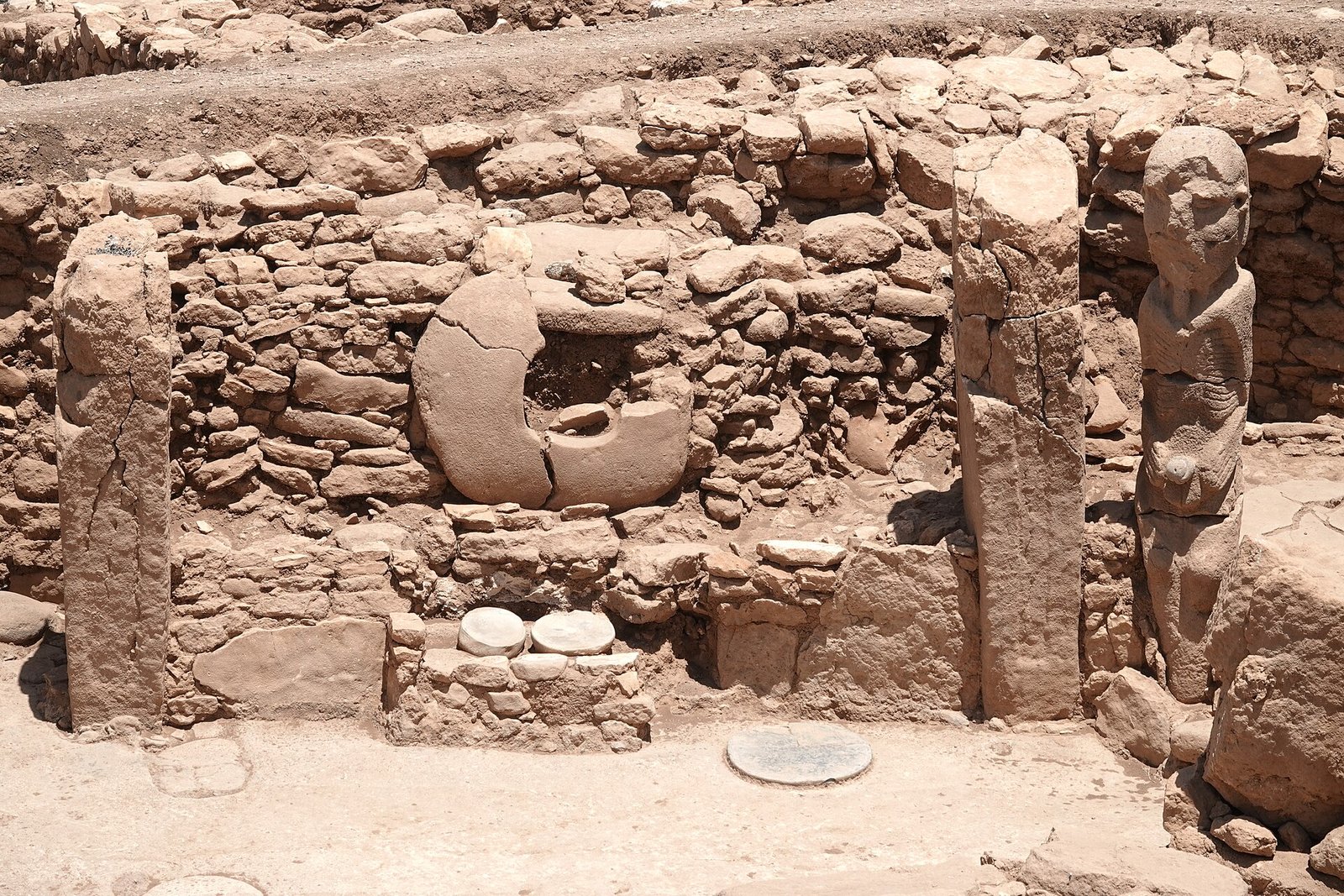
The centrepiece is the rock-cut chamber often referred to as Structure AB. It is cut down into the bedrock, with pillars that were not carried in and erected but left standing as the surrounding rock was removed around them.
In the wall, a human head emerges from the living rock, leaning out into the room and turned toward the entrance. Anyone descending into the chamber is met by it. It is the detail most visitors remember.
You can also see the channel cut into the bedrock connecting the chamber to the adjacent structure, and the wider excavated area with its other buildings and domestic zones.
Why it feels different from Göbekli Tepe
At Göbekli Tepe you look down into the enclosures from a raised walkway under a large protective shelter. It is impressive and slightly remote — you observe the site from above, at a distance.
Karahan Tepe puts you closer to the level of the architecture, and the architecture itself is different in kind. Göbekli Tepe's pillars were quarried, moved and raised; Karahan Tepe's were carved out of the ground in place, by removing everything that was not the pillar.
That difference is worth understanding before you go, because it is the thing you are looking at. Subtractive architecture allows no corrections. Every element had to be planned before the first cut.
Practical notes
Getting there. Karahan Tepe is roughly an hour and a half from Şanlıurfa by road, further out than Göbekli Tepe and through emptier country. There is no practical public transport; you need a car or a tour.
Combining the two. Göbekli Tepe and Karahan Tepe can be done in one day from Şanlıurfa, but it is a long day. Splitting them across two gives you the Şanlıurfa museum as well, which is where the actual objects are.
Season. Spring and autumn are much better than summer. The site is exposed and Şanlıurfa summers are severe.
Facilities are more limited than at Göbekli Tepe. Bring water and sun protection.
The site is live. Areas can be closed while work is under way, and what is accessible varies between seasons.
Is it worth the extra drive?
If you have come to the region for Göbekli Tepe, yes — with one qualification.
Karahan Tepe is less explained on the ground than Göbekli Tepe. It has less interpretation, fewer decades of published work behind it, and a great deal that is genuinely unresolved. Standing in front of the carved head without knowing what is and is not established about it is a thinner experience than it needs to be.
It rewards preparation, or a guide, more than Göbekli Tepe does. What it gives back is the sense — harder to get at the more managed site — that you are looking at something still being worked out.
Common questions
Can you visit Karahan Tepe?
Yes. It is open with visitor infrastructure in place, in the Tektek Mountains southeast of Şanlıurfa, and is usually visited as a second stop after Göbekli Tepe.
How far is Karahan Tepe from Şanlıurfa?
Roughly an hour and a half by road — further out than Göbekli Tepe. There is no practical public transport, so a car or a tour is needed.
Can you visit Göbekli Tepe and Karahan Tepe in one day?
Yes, but it makes for a long day. Splitting them across two days also allows time for the Şanlıurfa Archaeology Museum, where the excavated objects are held.
What can you see at Karahan Tepe?
The rock-cut chamber with pillars left standing from the bedrock, the human head carved into the chamber wall, the channel connecting the chamber to the adjacent structure, and the wider excavated area.
Is Karahan Tepe better than Göbekli Tepe?
Different. Göbekli Tepe is viewed from a raised walkway under a shelter; Karahan Tepe puts you closer to architecture carved directly out of bedrock. Karahan Tepe has less on-site interpretation, so it rewards preparation or a guide.
When is the best time to visit?
Spring or autumn. The site is exposed and Şanlıurfa summers are severe.
Sources & further reading4 references
- Karul, N. (2021). Buried Buildings at Pre-Pottery Neolithic Karahantepe. Türk Arkeoloji ve Etnografya Dergisi 82: 19–29.
- Karul, N. (2025). Public lectures and interviews on Karahantepe and the Taş Tepeler project. Transcribed talks and interviews held in the Taş Tepeler research atlas. Spoken material rather than a peer-reviewed publication; positions may be refined in print.
- Şanlıurfa Neolithic Research Project — Taş Tepeler (2026). Official project site (Istanbul University / Şanlıurfa Museum). tastepeler.org link
- Clare, L. (2020). Göbekli Tepe, Turkey. A brief summary of research at a new World Heritage Site (2015–2019). e-Forschungsberichte des Deutschen Archäologischen Instituts 2020(2): 81–88.
Full bibliography: the Taş Tepeler reference library →