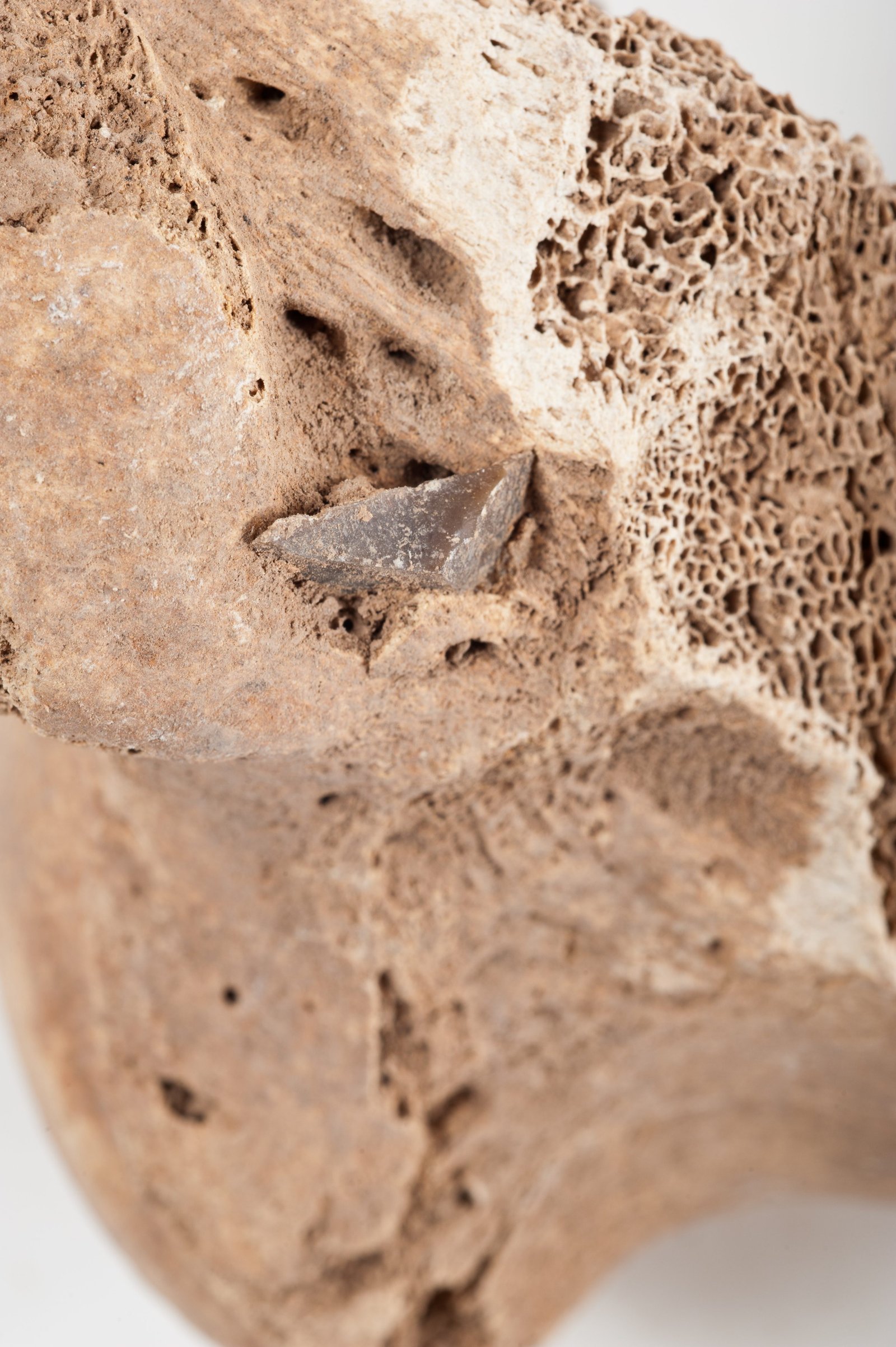
A piece of worked flint is still lodged in the bone. Someone threw or thrust a weapon at an aurochs, the point broke off inside the animal, and the bone kept it for eleven thousand years.
Why this one find matters
Almost everything people know about animals at Göbekli Tepe comes from the carvings — the foxes, boar, cranes and snakes worked into the pillars. Those are images, and images are interpretation. They tell you what mattered to the people who made them, but they do not tell you what actually happened on the hillside.
This bone does. It is not a depiction of a hunt; it is the residue of one. The aurochs — Bos primigenius, the wild ancestor of domestic cattle, standing up to 1.8 metres at the shoulder and long extinct — was hunted with stone-tipped weapons, and at least once the weapon failed in a way that left evidence.
An aurochs bone recovered at Göbekli Tepe retains an embedded fragment of a flint projectile.
The gap between carved animals and hunted animals is one of the more interesting problems at this site. The imagery is dominated by dangerous and largely inedible creatures — vultures, scorpions, snakes, big cats. The faunal remains are dominated by what people ate: gazelle, aurochs, wild boar, birds.
So the pillars are not a menu. Whatever the carvings were for, they were not a record of diet, and this bone is a reminder that the two categories of evidence — what was carved and what was killed — need to be read separately before they are read together.
The aurochs at Göbekli Tepe
The aurochs appears in both registers at once, which is what makes it useful. It is carved on the pillars — Pillar 2 in Enclosure A carries a bull among its vertical sequence of animals — and it turns up in the bone assemblage as food.
Hunting an animal of that size with stone-tipped weapons is not casual work. It requires planning, cooperation and accepted risk, and the meat it yields is far more than one household consumes at a sitting. That has fed the long-running argument that large-scale hunting and communal feasting were bound up with the gatherings that raised these buildings.
What it does not tell us
A single embedded fragment establishes that an aurochs was hunted with a projectile. It does not establish where, by whom, on what occasion, or whether the animal was brought to the site for a feast or simply eaten wherever it fell.
It is one data point of a kind that is rare and vivid, and it is worth being careful not to let it carry more narrative than it can hold.
Sources & further reading4 references
- Dietrich, O., Heun, M., Notroff, J., Schmidt, K. & Zarnkow, M. (2012). The role of cult and feasting in the emergence of Neolithic communities. New evidence from Göbekli Tepe, south-eastern Turkey. Antiquity 86(333): 674–695.
- Peters, J. & Schmidt, K. (2004). Animals in the symbolic world of Pre-Pottery Neolithic Göbekli Tepe, south-eastern Turkey: a preliminary assessment. Anthropozoologica 39(1): 179–218.
- Clare, L. (2020). Göbekli Tepe, Turkey. A brief summary of research at a new World Heritage Site (2015–2019). e-Forschungsberichte des Deutschen Archäologischen Instituts 2020(2): 81–88.
- The Tepe Telegrams (official research blog of the Göbekli Tepe Project, DAI). The Tepe Telegrams. Deutsches Archäologisches Institut. link Accessible, authoritative running commentary from the excavation team.
Full bibliography: the Taş Tepeler reference library →