Short answer
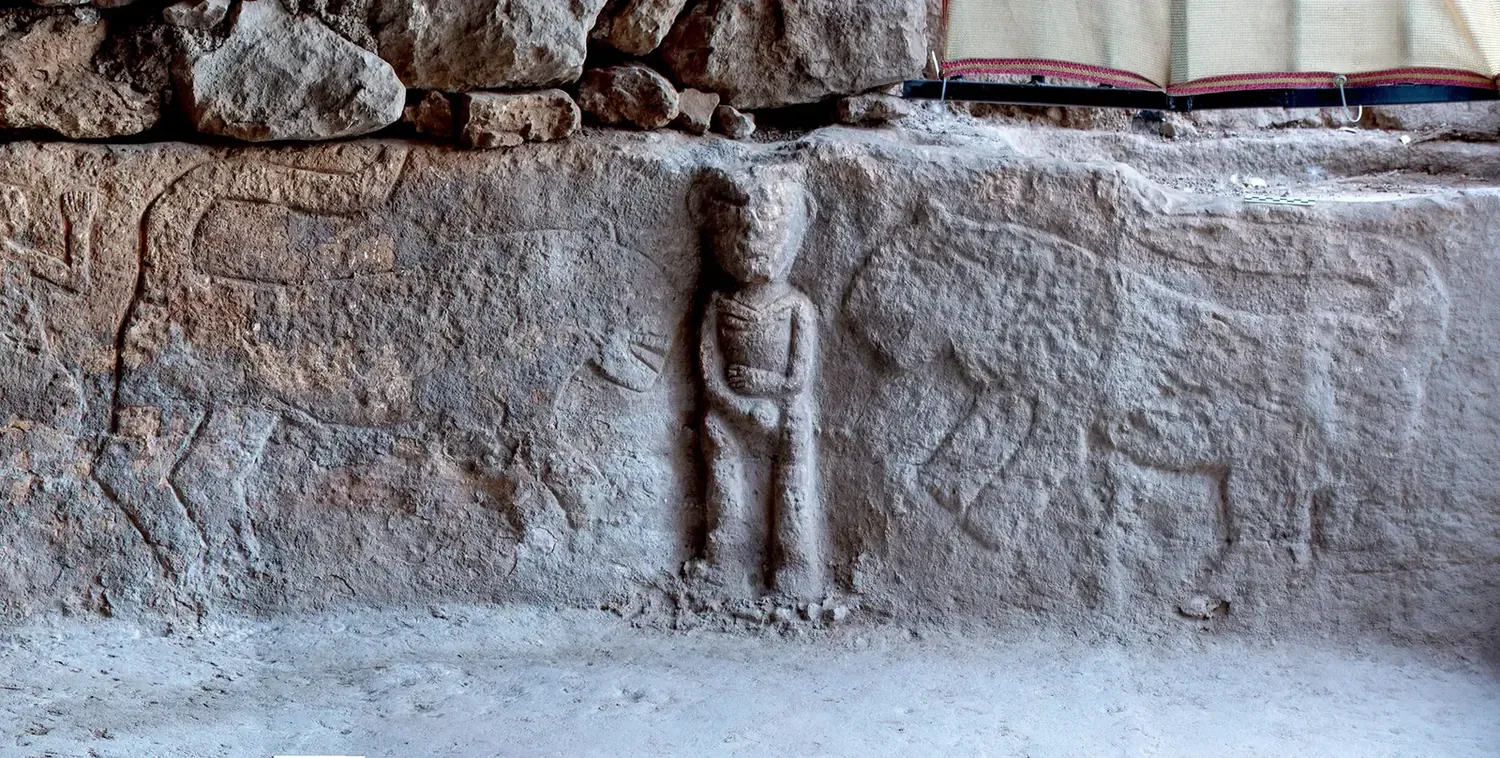
The Sayburç relief is a row of five figures carved along a bench inside a round communal building — a man holding his phallus between two leopards, and a squatting figure facing a charging aurochs — argued to be the earliest known narrative scene in art.
It was published by Eylem Özdoğan in Antiquity in 2022 and dates to the 9th millennium BCE. One human figure is carved fully in three dimensions, projecting from the wall. That the five figures form a single connected scene, rather than separate images, is a strong but debated reading.
Five figures on a bench
The Sayburç relief is a row of five carved figures running along a bench inside a round communal building. It divides into two groups. On one side, a human figure holding his phallus is flanked by two leopards, their teeth and claws shown. On the other, a squatting figure holds an object — a rattle or a snake — before a charging aurochs with enormous horns. One of the human figures is carved fully in three dimensions, projecting from the wall.
Published by Eylem Özdoğan in Antiquity in 2022, it dates to the 9th millennium BCE.
Why it's called a 'narrative'
What makes the relief extraordinary is the argument that these are not five separate images but a single connected scene — figures reacting to one another and to the animals around them. That would make it the earliest known depiction of a narrative, a 'story,' in human art.
We can't recover the story itself. But the sense of confrontation — humans facing dangerous animals — is unmistakable, and it turns a wall of symbols into something closer to a told tale.
How the excavator reads it
Eylem Özdoğan, who excavates Sayburç, describes the building that holds the relief as a round-plan structure carved into bedrock — not a house, but a special-purpose communal building. The reliefs are cut into the front face of an interior bench running around the wall, which means they were made to be seen by people sitting inside the room, at close range.
She counts five figures in two compositions: a leopard–human–leopard group, and a bull–human pair. Not a scattering of animals — two arrangements, deliberately set beside each other.
Her central claim is that this depicts not merely characters but a situation — an event, a story, or a myth. She has described the arrangement as running horizontally like a film strip, something that could be read across, and possibly used to recall a narrative that everyone present already knew.
Why 'narrative' is a strong claim — and a debated one
Neolithic art is full of animals. What is rare is animals arranged so that they appear to be doing something to each other — a scene rather than a set.
That is the whole argument at Sayburç. A human figure holding a snake or a rattle-like object between two leopards, and a second human facing a bull, read as two moments of a single story. If that holds, this is among the earliest narrative scenes known anywhere. It is best treated as a strong, widely reported interpretation rather than a closed case — the figures are real and in place; that they add up to one 'story' is the part still open.
Özdoğan is careful about it in a way that is worth borrowing. She stresses that this imagery has to be interpreted through its archaeological context, and warns that isolated objects — a carving considered on its own, detached from the building and deposit it came from — are exactly what produce false and sensational explanations.
A caution about who is missing
The Taş Tepeler imagery is strikingly male: phallic pillars at Karahan Tepe, male figures at Sayburç, an emphasis some readings connect to power and control rather than simple fertility.
Özdoğan adds a caution that rarely makes it into popular accounts. What survives is what was carved in stone. We cannot conclude that female or feminine symbolism was absent from this world simply because it is less visible in the surviving record — it may have been expressed in materials that did not last.
That is a useful discipline generally: absence of evidence in stone is not evidence of absence in life.
The building and the dead
Sayburç is a short, essentially single-layer occupation spanning the late PPNA into the early PPNB, with radiocarbon framing discussed in the region of 8650–8300 BCE. Its buildings sit directly on bedrock, and the builders worked with the rock rather than against it — cutting where they needed to, filling where that was easier, rather than imposing a rigid plan.
The site has residential buildings, several special buildings and smaller structures of unclear purpose, along with ordinary domestic features: hearths, storage, food preparation. It is a settlement with a remarkable room in it, not a sanctuary standing alone.
Human remains given secondary treatment — crania and long bones, some burnt, from at least nineteen individuals as reported from the excavation — were found on and in front of a bench, handled after death with traces related to defleshing and burning in some contexts. One precise negative is worth recording: Özdoğan states that Sayburç has no confirmed evidence of perforated or suspended skulls comparable to the Göbekli Tepe examples. The regional theme is present; that particular practice is not attested here.
Common questions
What is the Sayburç relief?
A relief of five figures — humans and dangerous animals — carved on a bench inside a communal building at Sayburç, dating to the 9th millennium BCE and argued to be the earliest known narrative scene in art.
Who published the Sayburç relief?
Eylem Özdoğan, in the journal Antiquity in 2022.
What does the Sayburç relief show?
Two linked scenes read along the bench: a man holding his phallus flanked by two leopards with teeth and claws bared, and a squatting figure holding a rattle or snake facing a charging aurochs. One of the human figures is carved fully in three dimensions, projecting from the wall.
What animals are on the Sayburç relief?
Two leopards flanking a male figure and a charging aurochs (a wild bull); the object one figure holds may be a snake or a rattle. Like the rest of Taş Tepeler art, the relief favours powerful, dangerous animals over the gazelle its makers actually ate.
What does the Sayburç relief mean?
It appears to stage humans in direct confrontation with dangerous animals — possibly a myth, an ancestor story, or a ritual — but the specific meaning is unknown. Its importance is that it reads as a connected scene rather than isolated symbols, and that reading is strong but still debated.
Sources & further reading2 references
- Özdoğan, E. (2025). Interviews on the Sayburç excavation and its reliefs. Transcribed interviews held in the Taş Tepeler research atlas. Spoken material, translated from Turkish; paraphrased rather than quoted. See Özdoğan 2022 for the published account.
- Özdoğan, E. (2022). The Sayburç reliefs: a narrative scene from the Neolithic. Antiquity 96(390): 1599–1605. doi:10.15184/aqy.2022.125
Full bibliography: the Taş Tepeler reference library →