Sayburç Object Profile

The Human Between Leopards at Sayburç

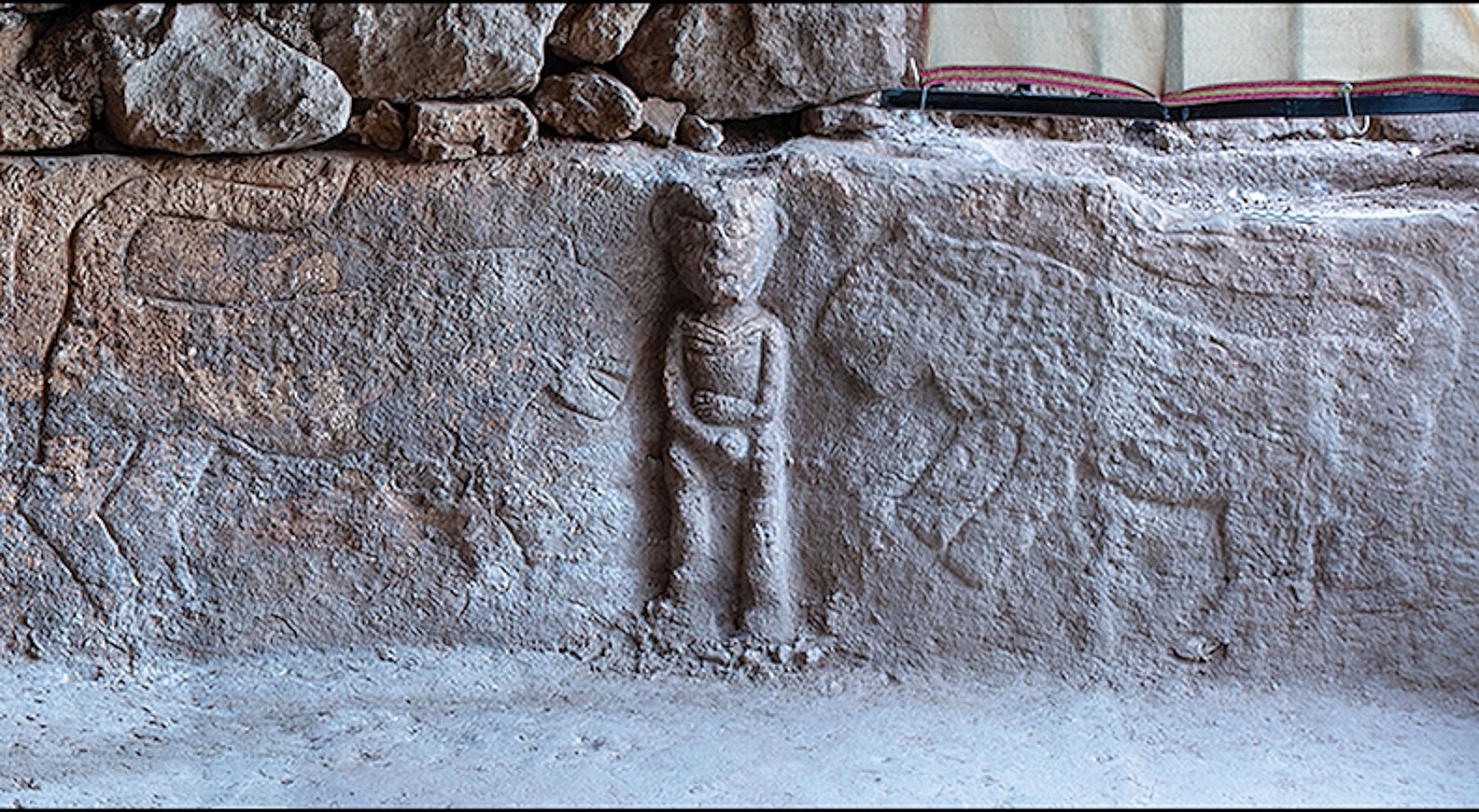
This Sayburç scene focuses on the human figure between two leopards, one of the clearest and most memorable parts of the bench relief.

The Human Between Leopards at Sayburç visual reference
Visual reference for orientation. Use source images only when rights are clear.

Quick Facts

Site
Sayburç
Structure
Northern communal / relief-bearing building
Type
relief scene

What We Know

The second leopard faces the high-relief male, has an open mouth and visible teeth, and a tail curled toward the body; unlike the west leopard, it is not described as phallic. The principal human figure is male, high-relief, room-facing, phallus-holding, seated or bent at the knees, and marked by a triangular neckband. The west leopard faces the high-relief male, has an open mouth and visible teeth, a tail curled toward the body, and is depicted with a phallus.

Main Details

  • Part of the five-figure bench relief panel.
  • Panel dimensions: 0.7-0.9 m high x 3.7 m long
  • East leopard: The second leopard faces the high-relief male, has an open mouth and visible teeth, and a tail curled toward the body; unlike the west leopard, it is not described as phallic.
  • Principal high-relief male: The principal human figure is male, high-relief, room-facing, phallus-holding, seated or bent at the knees, and marked by a triangular neckband.
  • West leopard: The west leopard faces the high-relief male, has an open mouth and visible teeth, a tail curled toward the body, and is depicted with a phallus.
  • Main source: Özdoğan 2022, pp. 1601-1602.

Parent Context

  • Sayburç
  • Northern communal / relief-bearing building
  • The Human Between Leopards at Sayburç
  • The Human Between Leopards at Sayburç belongs to Northern communal / relief-bearing building at Sayburç.

Public Reading Path

  • This Sayburç scene focuses on the human figure between two leopards, one of the clearest and most memorable parts of the bench relief.
  • The second leopard faces the high-relief male, has an open mouth and visible teeth, and a tail curled toward the body; unlike the west leopard, it is not described as phallic. The principal human figure is male, high-relief, room-facing, phallus-holding, seated or bent at the knees, and marked by a triangular neckband. The west leopard faces the high-relief male, has an open mouth and visible teeth, a tail curled toward the body, and is depicted with a phallus.
  • The Human Between Leopards at Sayburç should be read as reported Sayburç evidence first, with scene, domestic, structure, or burial interpretation kept separate from description.
  • The Human Between Leopards at Sayburç should be read as reported evidence first, then compared with the parent structure page.

Physical Evidence

  • Part of the five-figure bench relief panel.
  • Panel dimensions: 0.7-0.9 m high x 3.7 m long
  • East leopard: The second leopard faces the high-relief male, has an open mouth and visible teeth, and a tail curled toward the body; unlike the west leopard, it is not described as phallic.
  • Principal high-relief male: The principal human figure is male, high-relief, room-facing, phallus-holding, seated or bent at the knees, and marked by a triangular neckband.
  • West leopard: The west leopard faces the high-relief male, has an open mouth and visible teeth, a tail curled toward the body, and is depicted with a phallus.
  • Main source: Özdoğan 2022, pp. 1601-1602.

Motifs And Feature Groups

  • relief scene
  • Sayburç evidence group

What To Be Careful About

  • Use reported wording where exact locus, phase, function, or 2025 metadata remain open.
  • Do not assign ritual, identity, contents, liquid type, exchange, or status meanings without source support.
  • Do not reduce the relief, domestic features, structures, or burial evidence to one settled myth or ritual meaning.
  • Keep depiction, placement, body treatment, and interpretation separate.

Source Trail

  • Özdoğan 2022, pp. 1600-1601, Fig. 4

Open Questions

  • Which exact feature, figure, or locus should control future interpretation?

Evidence Review

  • Sayburç research-grade core, structure matrix, relief dossier, or burial matrix controls the deeper review layer.
  • Detailed evidence notes remain available for deeper review.

Object Evidence

What Is Secure

  • The second leopard faces the high-relief male, has an open mouth and visible teeth, and a tail curled toward the body; unlike the west leopard, it is not described as phallic. The principal human figure is male, high-relief, room-facing, phallus-holding, seated or bent at the knees, and marked by a triangular neckband. The west leopard faces the high-relief male, has an open mouth and visible teeth, a tail curled toward the body, and is depicted with a phallus.
  • This Sayburç scene focuses on the human figure between two leopards, one of the clearest and most memorable parts of the bench relief.
  • Part of the five-figure bench relief panel.
  • Panel dimensions: 0.7-0.9 m high x 3.7 m long

Source Trail

  • Özdoğan 2022, pp. 1601-1602
  • Özdoğan 2022, pp. 1600-1601, Fig. 4
  • Site evidence notes

Boundaries

  • Use reported wording where exact locus, phase, function, or 2025 metadata remain open.
  • Do not assign ritual, identity, contents, liquid type, exchange, or status meanings without source support.
  • Do not reduce the relief, domestic features, structures, or burial evidence to one settled myth or ritual meaning.
  • Keep depiction, placement, body treatment, and interpretation separate.

Next Evidence Needed

  • Which exact feature, figure, or locus should control future interpretation?
  • Sayburç research-grade core, structure matrix, relief dossier, or burial matrix controls the deeper review layer.
  • Detailed evidence notes remain available for deeper review.
  • Future updates should add catalogue numbers, exact loci, image rights, and direct evidence locators when publicly supportable.

Open the parent structure

Sources

  • Özdoğan 2022, pp. 1601-1602

Back to Northern communal / relief-bearing building