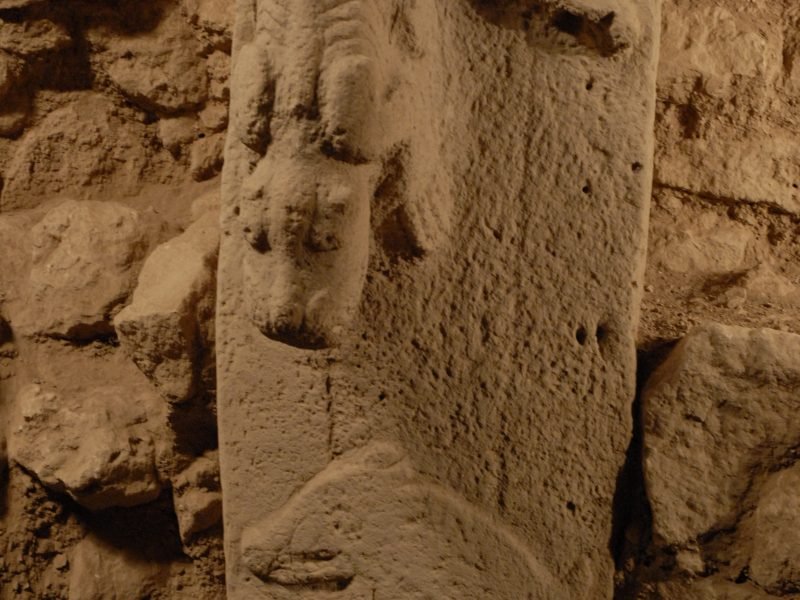
Göbekli Tepe Object Profile
The Predator Slab Near Pillar 36
This slab is a strong Enclosure C research lead because it places predator imagery beside the movement route into the building.
Quick Facts
- Site
- Göbekli Tepe
- Structure
- Enclosure C
- Type
- possible porthole-stone fragment / spatial feature
What We Know
The Pillar 36 porthole-predator lead is a predator high relief found atop the wall east of Pillar 36 in Enclosure C, discussed as a possible limestone-slab fragment from a porthole stone rather than as a predator carved on Pillar 36.
Main Details
- The Pillar 36 porthole-predator lead is a predator high relief found atop the wall east of Pillar 36 in Enclosure C, discussed as a possible limestone-slab fragment from a porthole stone rather than as a predator carved on Pillar 36.
- This object fixes an easy accuracy trap. The source does not say a predator was carved on Pillar 36. It says a predator was found on top of the wall east of Pillar 36, and Schmidt discusses it among high-relief limestone slabs that may originally have belonged to porthole stones.
- Schmidt 2010 refers to a predator found atop the wall east of Pillar 36 in Enclosure C.
- The passage discusses several high reliefs on limestone slabs of unknown size and shape.
- Schmidt says these slabs now seem to have originally been parts of porthole stones, giving the Pillar 36 predator a possible porthole-stone origin.
- The same passage says interpretation of the porthole-stone shape, entrances, and decoration was not yet possible and that it was unclear whether the porthole stone lay in debris or belonged to an architectural context.
- Pillar 36 is a spatial locator. This is not currently evidence for a predator carved on Pillar 36.
- Schmidt explicitly distinguishes slab high reliefs from the predator sitting on the stomach/front of Pillar 27; these must remain separate objects.
- A predator was found atop the wall east of Pillar 36 in Enclosure C.
- The predator is discussed among high reliefs on limestone slabs.
- The slab size and shape were unknown in the cited discussion.
- The find is spatially associated with the wall east of Pillar 36 rather than with Pillar 36's own carved surface.
Public Reading Path
- The Pillar 36 porthole-predator lead is a predator high relief found atop the wall east of Pillar 36 in Enclosure C, discussed as a possible limestone-slab fragment from a porthole stone rather than as a predator carved on Pillar 36.
- This object fixes an easy accuracy trap. The source does not say a predator was carved on Pillar 36. It says a predator was found on top of the wall east of Pillar 36, and Schmidt discusses it among high-relief limestone slabs that may originally have belonged to porthole stones.
- Schmidt 2010 refers to a predator found atop the wall east of Pillar 36 in Enclosure C.
- The passage discusses several high reliefs on limestone slabs of unknown size and shape.
- Schmidt says these slabs now seem to have originally been parts of porthole stones, giving the Pillar 36 predator a possible porthole-stone origin.
- The same passage says interpretation of the porthole-stone shape, entrances, and decoration was not yet possible and that it was unclear whether the porthole stone lay in debris or belonged to an architectural context.
Physical Evidence
- Schmidt 2010 refers to a predator found atop the wall east of Pillar 36 in Enclosure C.
- The passage discusses several high reliefs on limestone slabs of unknown size and shape.
- Schmidt says these slabs now seem to have originally been parts of porthole stones, giving the Pillar 36 predator a possible porthole-stone origin.
- The same passage says interpretation of the porthole-stone shape, entrances, and decoration was not yet possible and that it was unclear whether the porthole stone lay in debris or belonged to an architectural context.
- Pillar 36 is a spatial locator. This is not currently evidence for a predator carved on Pillar 36.
- Schmidt explicitly distinguishes slab high reliefs from the predator sitting on the stomach/front of Pillar 27; these must remain separate objects.
- A predator was found atop the wall east of Pillar 36 in Enclosure C.
- The predator is discussed among high reliefs on limestone slabs.
- The slab size and shape were unknown in the cited discussion.
- The find is spatially associated with the wall east of Pillar 36 rather than with Pillar 36's own carved surface.
Motifs And Feature Groups
- The predator is discussed among high reliefs on limestone slabs.
- The find is spatially associated with the wall east of Pillar 36 rather than with Pillar 36's own carved surface.
- The passage compares the broader category to porthole stones and porthole-stone fragments.
What To Be Careful About
- Use reported wording where exact locus, phase, function, species, image rights, or restoration details remain open.
- Keep object description, placement, motif identification, and interpretation separate unless the source explicitly joins them.
- Pillar 27 predator/leopard high relief
- Dromos porthole slab with boar relief
- Pillar 12 boar relief and sculpture
- Pillar 35 boar cache
- Pillar 36 as a fully decorated pillar record
- predator carved on Pillar 36
- certain porthole-stone origin
- settled architectural placement
Source Trail
- GT-ENC-C-SRC-002
- GT-ENC-C-PILLAR-INVENTORY-001
- GT-ENC-C-SRC-008
Open Questions
- Run an Enclosure C completion audit/public object map now that Pillar 27, Pillar 12, Pillar 35, Pillar 37, the central-pillar destruction packet, the dromos porthole slab, ring-wall phasing, and the Pillar 36 spatial lead exist.
- Not Pillar 36 decoration: Do not describe the predator as carved on Pillar 36; the source places it atop the wall east of Pillar 36.
- Porthole-stone origin not certain: Present porthole-stone origin as possible/source-interpreted, not as established fact.
- Architectural context uncertain: The source says interpretation of porthole-stone shape, entrances, decoration, and architectural context was not yet possible.
- Keep separate from Pillar 27: Pillar 27 is the contrast case for high relief on a pillar, not the same object or motif record.
- Figure recovery needed: Schmidt 2006 Figs. 63-64 No. A35 should be recovered before image display or stronger object morphology claims.
- Which exact source image or excavation figure should be used when public image rights are cleared?
Evidence Review
- source refs
- lineage
- Schmidt 2006 figure recovery
- porthole-stone fragment comparison
- wall east of Pillar 36 plan check
- relationship to dromos porthole slab and Pillar 27 contrast
- Not Pillar 36 decoration: Do not describe the predator as carved on Pillar 36; the source places it atop the wall east of Pillar 36.
- Porthole-stone origin not certain: Present porthole-stone origin as possible/source-interpreted, not as established fact.
Sources
- GT-ENC-C-SRC-002
- GT-ENC-C-PILLAR-INVENTORY-001
- GT-ENC-C-SRC-008