Göbekli Tepe · Şanlıurfa, Türkiye · The first great enclosure uncovered
Enclosure A
PPNA · Layer III · 10th millennium BCE · elongated plan · central Pillars 1 & 2 · the "Snake Pillar Building"
The first of Göbekli Tepe's great ring buildings to be exposed, and the one where the snake takes over the stone — a monumental, unusually elongated enclosure built around two central pillars whose imagery is dominated by serpents.
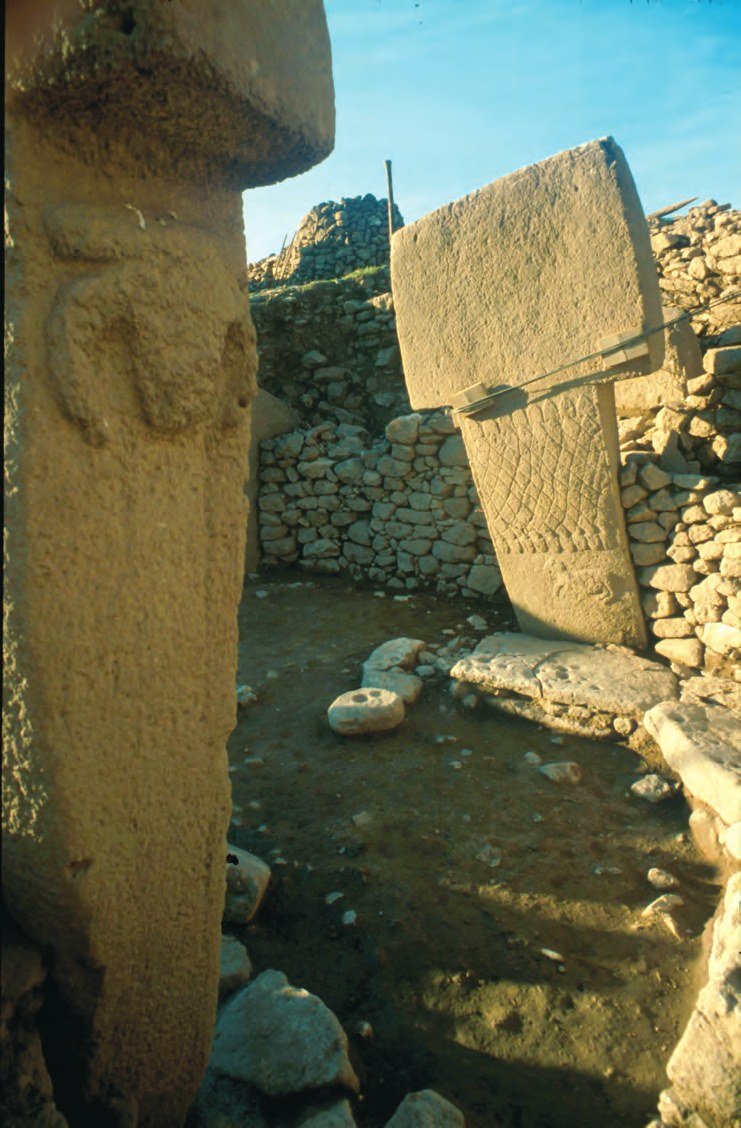
The two central pillars of Enclosure A. At right is Pillar 1 — a net-like mesh of snakes above a ram; the nearer pillar carries a fox in low relief. Photo courtesy of the site owner; Enclosure A central pillars.
A pillar pair, not the building as a whole: no aerial or elevated photograph of Enclosure A's plan exists, and the enclosure is only partly excavated. See the excavation plan under Architecture for the layout.
01
Quick facts
Enclosure A was reached at the very start of the modern excavations, when the recording methods and the site's chronology were both still developing — so several of its basic facts remain provisional, and figures should be read as such.
Period
PPNA — 10th millennium BCE (Layer III); possibly a little younger than C and Dprovisional
Uncovered
from 1996 — pillar heads first exposed by a farmer's plough in 1995
Plan
elongated, more rectangular than round
Central pillars
two — Pillars 1 & 2
Ring pillars
four exposed so far (3, 4, 5, 17); more expected
Dominant animal
the snake
The elongated plan, the central pair (1 & 2) and the snake emphasis are firmly reported (DAI, "Enclosure A — a short overview"). The suggestion that A is slightly younger, and that its rectangular tendency points toward the later Layer II building type, is an open question, not a settled date.
02
The architecture
Enclosure A lies in the south-eastern part of the main excavation area and was the first of the great buildings to come to light. Unlike the clean circles of Enclosures C and D, it reads as elongated — more rectangular than round, with two central pillars (1 & 2) at its heart and a ring of smaller T-pillars around them, of which only a handful have so far been exposed. Like the other enclosures it was raised, used, and then filled in rather than left to collapse; more than one outer wall hints at a long building history with alteration over time.
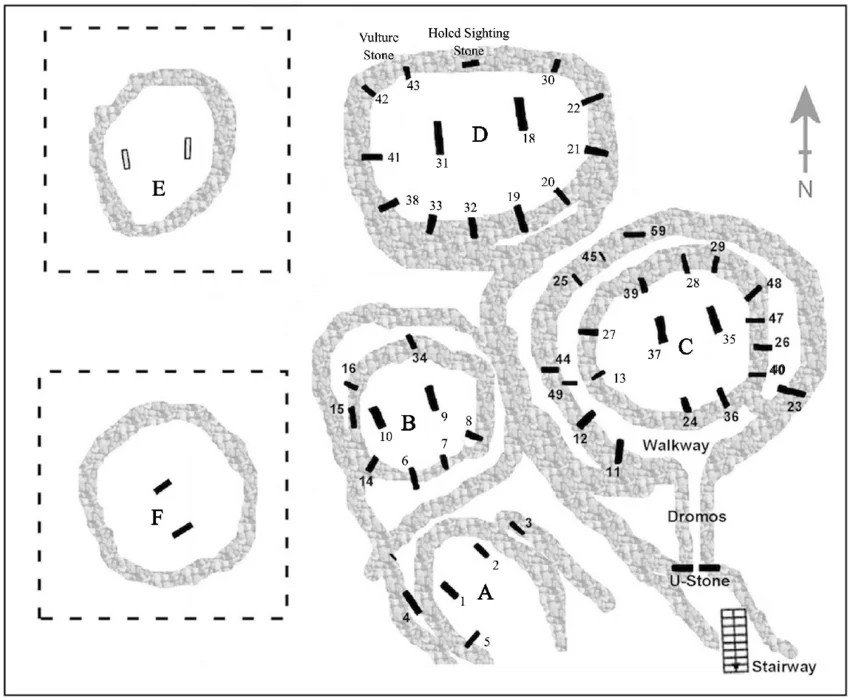
Excavation plan of the main enclosures (A–F). Enclosure A is the elongated building at the lower centre — its central pair (1 & 2) with ring pillars (3, 4, 5) around them, more angular than the circles of C and D. Aerial photography isn't possible under the site's protective roof. Plan: after the Göbekli Tepe Project (DAI).
Key to the building — Central pillars 1 & 2 the two central stones — Pillar 1 (the snake-net and ram) and Pillar 2 (aurochs, fox and crane). Ring / wall pillars the surrounding T-pillars — on the plan, Pillars 3, 4 and 5, with Pillar 17 also reported; the full count is not yet known. Plan elongated and angular rather than a true circle — one of the reasons the excavators ask whether A points toward the later, rectangular Layer II architecture.
The plan above is the architecture visual for A: no photograph shows the building from above, because the site's protective roof rules out aerial photography, and much of the enclosure is still unexcavated.
03
The two central pillars
Enclosure A's two central stones are its best-preserved and most legible carvings. Like the central pillars elsewhere at Göbekli Tepe, the vertical banding down their fronts marks them as stylised, clothed human figures that carry the animal imagery on their bodies.
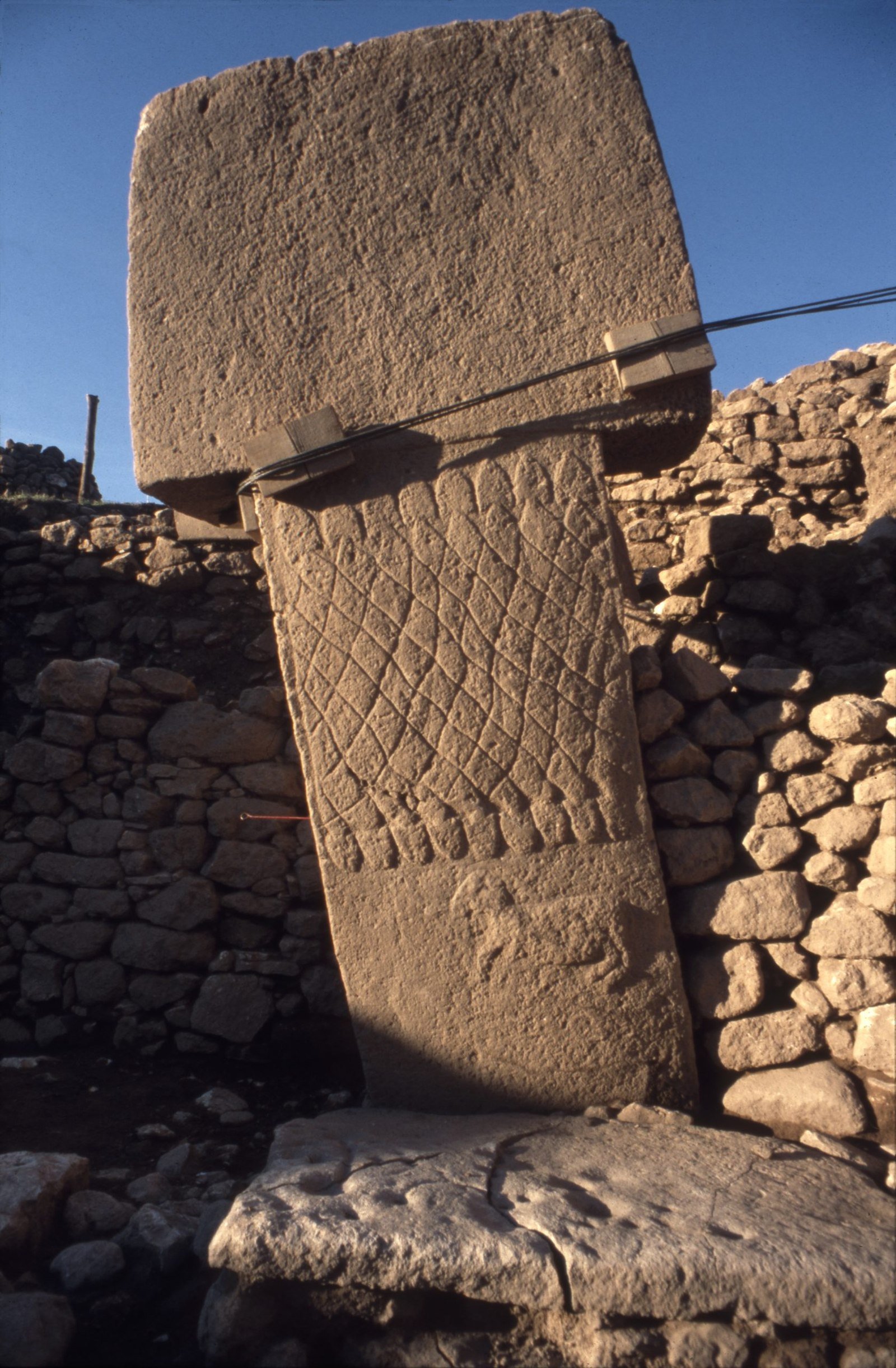
The building's signature stone: a striking net-like pattern read as a mass of interwoven snakes, with a ram below, and a band of five snakes in bas-relief running down the front where a garment would fall.
Pillar 1 in situ — the net of snakes above the ram, the enclosure's emblem concentrated onto one central stone. Photo: DAI, Göbekli Tepe Project.Full page →
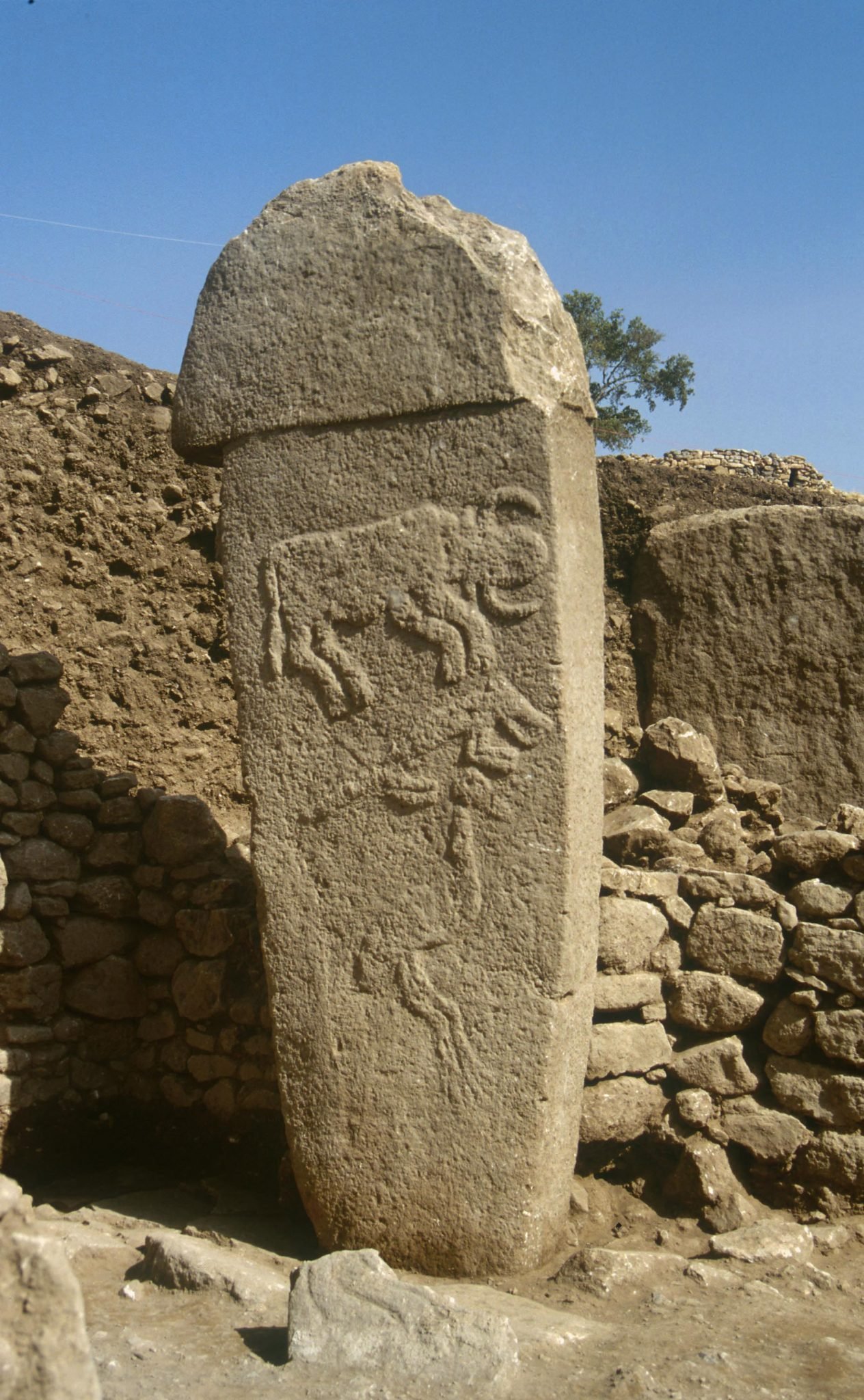
A vertical column of three animals down one side — a wild bull (aurochs), a fox and a crane — and, on the narrow back, a bull's head between the bands of a garment. Its crane has oddly human-like legs, the same trait as Pillar 33 in Enclosure D.
Pillar 2 in situ — the stacked column of aurochs, fox and crane down its side. Photo: DAI, Göbekli Tepe Project.
Four ring-wall T-pillars have been exposed so far (3, 4, 5 and 17), with more expected as the building is dug. Little decoration is recorded for them in the accessible literature; they are listed here for completeness of the wall sequence.
Note · P2
A moved stone — caution
Comparison of its motifs suggests Pillar 2 was shifted from its original position, so even the central pair cannot be read as untouched. A's early excavation and elongated plan mean its arrangement is less securely understood than Enclosure D's.
04
The snake-dominated enclosure
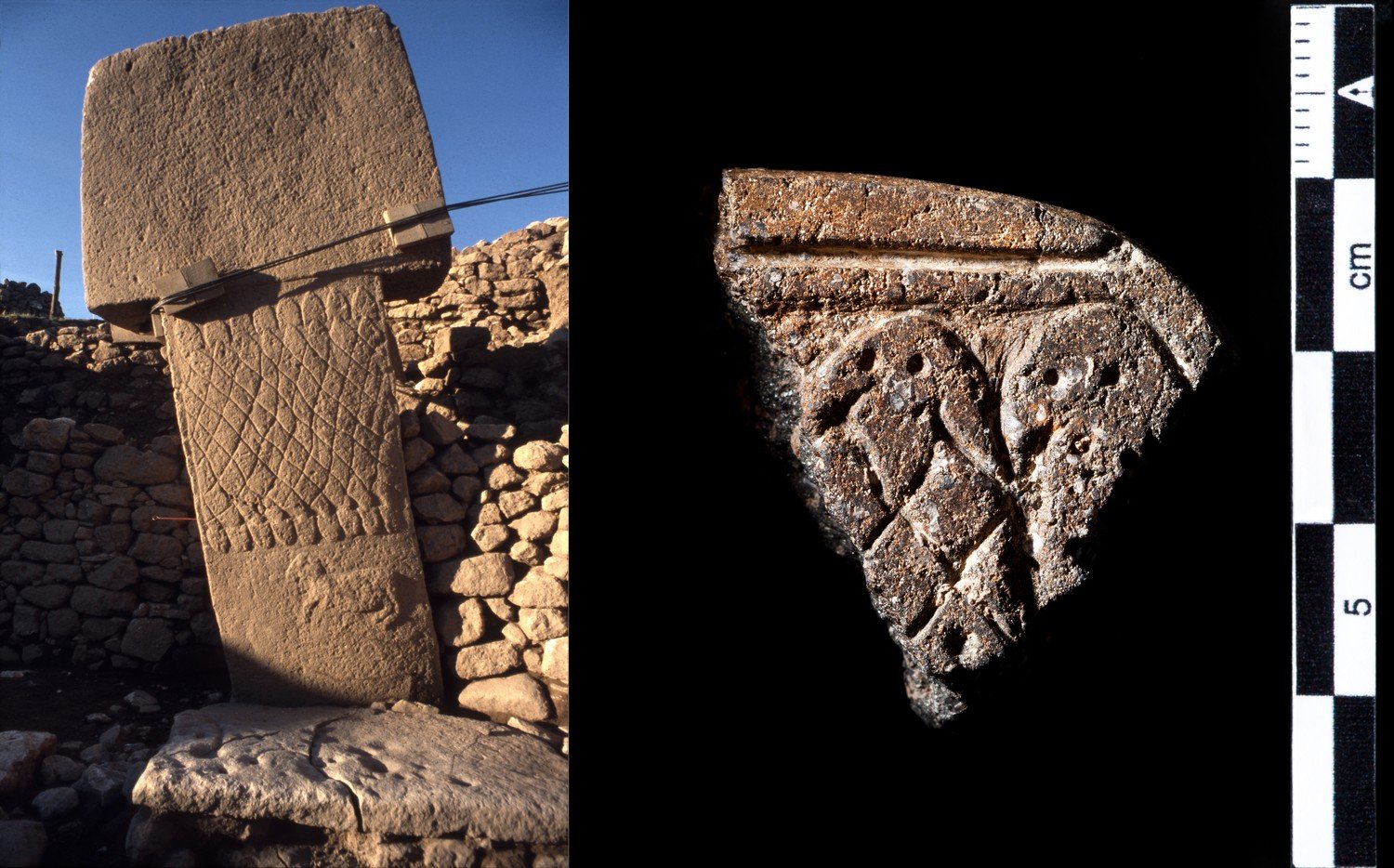
Each of the older enclosures seems led by one animal — the boar in C, the fox in B, and the snake here. The net-carving on Pillar 1 and further snake reliefs give Enclosure A an image field the serpent appears to dominate. The concentration is clearly reported; what it meant is not established. What A does show unusually well is that the same emblem worked at monumental scale on a pillar could also be shrunk to something carried in the hand.
The great wall image beside its miniature: the net of snakes on Pillar 1 (left) and a small stone plaquette found in 2013 in a deep sounding (right), carved with the same motif — two snake heads above a net of interwoven bodies. Photos: K. Schmidt & N. Becker, DAI, Göbekli Tepe Project.
05
The carved stones
The two central pillars and the portable snake plaquette, gathered as one catalogue. Where a full object page exists, it is linked from the card.
Central · P1
Pillar 1 — the snake-net and ram
One of the two central pillars: a net-like mesh made entirely of interwoven snakes, a ram carved below the netting, and a band of five snakes in low relief down the front — the enclosure's dominant serpent theme concentrated into a single emblem at its heart.
The partner central pillar: a vertical column of a wild bull, a fox and a crane down one side, with a frontal bull's head set between garment bands on the narrow back. Its human-legged crane matches Pillar 33 in Enclosure D — a small shared pattern across two buildings.
A small carved stone recovered from a deep sounding, showing two snake heads above a net of interwoven bodies — the same motif as central Pillar 1, rendered as a portable object. It ties the monumental imagery of the enclosure to something that could be held in the hand.
Photos: K. Schmidt & N. Becker, DAI, Göbekli Tepe Project.
All three cards use real archive photographs. Full object pages exist for the two central pillars; the snake plaquette is shown as a photographed find without a separate page. Enclosure A's ring pillars (3, 4, 5, 17) have no verified individual photographs in the archive and are not shown as image cards.
06
What might it have meant?
What we know
Secure — attested by the architecture and the carvings.
Two central T-pillars (1 & 2) at the heart of an elongated, only partly excavated enclosure.
Snakes dominate the imagery — a net of serpents on Pillar 1, further snake reliefs, and the same motif on a portable plaquette.
Pillar 2 carries an aurochs–fox–crane column and a bucranium between garment bands; its crane has human-like legs.
Vertical banding on both central pillars marks them, like the central pillars elsewhere, as stylised clothed human figures.
Possible interpretations
Readings, not facts.
A group / clan emblem — the per-enclosure animal emphasis (snake in A, fox in B, boar in C) read as a marker of the community that built it; offered as a possibility, not a proven fact.
Human-figure central pillars — the clothed-body reading, well supported by the explicit arms, hands and belts of Enclosure D's central pillars, but on A's more worn stones it is inference rather than something the stone spells out.
A bridge to the later buildings? — because A is more rectangular than the circles of C and D, and may be slightly younger, the excavators ask whether its shape points toward the rectangular Layer II building type. A genuine open question.
Handle with care. Enclosure A was dug early and is only partly excavated, and Pillar 2 appears to have been moved — so any strong claim about its original plan or arrangement should carry that caution with it.
07
Sources
The Tepe Telegrams (DAI) 2017. "Enclosure A, a short overview." Deutsches Archäologisches Institut, 5 January 2017. (Elongated plan; snake emphasis; the "possibly younger / bridge to Layer II" question; the snake-net plaquette.)
Schmidt, K. 2012. Göbekli Tepe: A Stone Age Sanctuary in South-Eastern Anatolia. Berlin: ex oriente.
Peters, J. & K. Schmidt 2004. "Animals in the symbolic world of Pre-Pottery Neolithic Göbekli Tepe…" Anthropozoologica 39(1): 179–218. (Cranes and the human-legged birds; the repertoire of dangerous animals.)
Dietrich, O. et al. 2012. "The role of cult and feasting in the emergence of Neolithic communities. New evidence from Göbekli Tepe." Antiquity 86(333): 674–695.
Notroff, J., O. Dietrich & K. Schmidt 2014. "Building Monuments, Creating Communities…," in J. Osborne (ed.) Approaching Monumentality in Archaeology. SUNY Press, 83–105.
08
Related structures
The carved stones of Enclosure A are catalogued above under The carved stones. Below are the neighbouring buildings and ways to visit.
To visit — Göbekli Tepe lies northeast of Şanlıurfa, Türkiye; Enclosure A stands in the main excavation area beneath the protective shelter. Finds from the site are conserved at the Şanlıurfa Archaeology Museum.