Short answer
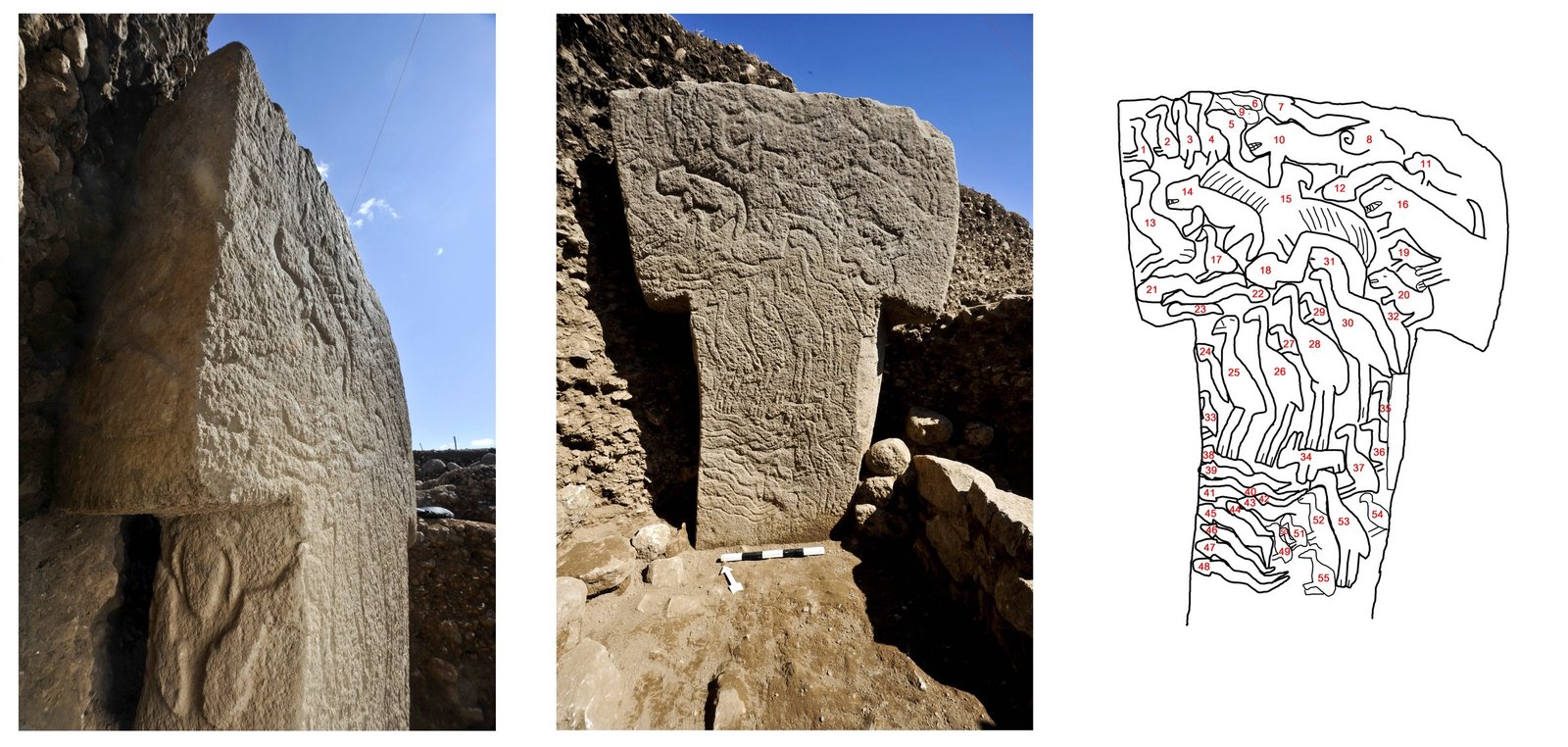
Pillar 56 is one of the most densely carved pillars at Göbekli Tepe — a single stone in Enclosure H packed almost edge to edge with dozens of animals, dominated by snakes and birds.
Where most pillars carry a few chosen creatures, Pillar 56 is crowded with them, a reminder that the site's imagery runs far beyond its handful of famous scenes. What the swarming composition meant is unknown — like the rest of Göbekli Tepe's carvings, it can be described but not translated.
A pillar swarming with animals
Pillar 56 stands in Enclosure H, one of the buildings at Göbekli Tepe that lies outside the four most famous circles. It is among the most densely carved stones at the whole site. Where a pillar like the Vulture Stone gathers a few large, deliberate figures into a scene, Pillar 56 does the opposite — it fills nearly every available surface with small animals, packed together across the shaft.
The excavation team, describing it on their own research blog, summed it up as a tale of snakes and birds: those two creatures dominate the crowd, alongside other animals worked into the gaps. The effect is less a single picture than a teeming field of life carved into stone.
Why density is the point
It is easy to build a tidy mental image of Göbekli Tepe from its greatest hits — the twin central giants, the vulture, the snarling predator of Enclosure C. Pillar 56 breaks that image apart.
The sheer number of animals on one stone shows how much richer and stranger the site's symbolic world really was than the postcard version suggests. For every carefully composed scene there are pillars like this one, dense and restless, where the carvers seem to have wanted abundance itself — many creatures, crowded together — rather than a single readable message.
Enclosure H, beyond the famous circles
Pillar 56's home, Enclosure H, matters in its own right. It is evidence that Göbekli Tepe's art and architecture continue well past the best-known enclosures, into buildings that are less excavated and far less discussed.
That is a useful corrective. The site is only a small fraction dug, and pillars like this one — off the usual tour, rarely photographed — are a reminder that most of what Göbekli Tepe has to say is still in the ground.
The same creatures, again and again
Pillar 56 is extreme, but not alien to the rest of the site. The animals crowding it — snakes and birds above all — are the same cast that recurs across Göbekli Tepe's pillars, where wild and dangerous creatures dominate and the everyday prey people actually ate is strangely rare.
That places Pillar 56 squarely inside the site's central puzzle. Whatever the carvings meant, they were a shared visual language used deliberately from pillar to pillar — and Pillar 56 is one of its densest, least legible pages.
Why it takes a drawing to read it
There is a practical reason Pillar 56 is less famous than the Vulture Stone: it is genuinely hard to see. The reliefs are shallow and closely packed, the limestone is weathered, and in a photograph the animals bleed into one another. What looks at first like an abstract texture only resolves into snakes, birds and quadrupeds once the light is raked across it or the surface is traced by hand.
That is why the excavators publish a measured drawing alongside the photograph (see above). The drawing is not a prettier version of the stone — it is an argument about what is there, made line by line by people working at the rock face. Comparing the two is a small lesson in how this site is actually recorded: the photograph is the evidence, the drawing is the reading, and honest work keeps the difference between them visible.
What we can and can't say
Here honesty matters. We can say what is on Pillar 56 — a dense assembly of animals, dominated by snakes and birds — because it is carved there and can be counted and described.
What we cannot say is what it meant. There is no agreed reading of the composition, no key that turns the swarm of creatures into a story or a message. Anyone who offers a confident decoding of Pillar 56 is going beyond the evidence. The honest position is that it is one of the richest, least understood surfaces at the site — a genuine puzzle, not a solved one.
Common questions
What is Pillar 56 at Göbekli Tepe?
One of the most densely carved pillars at the site, in Enclosure H, packed with dozens of animals dominated by snakes and birds — evidence of how rich the site's imagery is beyond its few famous scenes.
What animals are on Pillar 56?
The composition is dominated by snakes and birds, with other animals worked into the spaces between them. The excavators have described it as a tale of snakes and birds.
What does Pillar 56 mean?
No one knows. Like the rest of Göbekli Tepe's carvings it can be described in detail but not translated; there is no agreed reading of the crowded composition.
Sources & further reading3 references
- The Tepe Telegrams (Göbekli Tepe Project, DAI) (2016). A tale of snakes and birds: Göbekli Tepe, Pillar 56. Deutsches Archäologisches Institut, 12 December 2016. link
- Schmidt, K. (2012). Göbekli Tepe: A Stone Age Sanctuary in South-Eastern Anatolia. Berlin: ex oriente. The foundational monograph by the site's first excavator.
- Peters, J. & Schmidt, K. (2004). Animals in the symbolic world of Pre-Pottery Neolithic Göbekli Tepe, south-eastern Turkey: a preliminary assessment. Anthropozoologica 39(1): 179–218.
Full bibliography: the Taş Tepeler reference library →