Short answer
The most striking thing about death at the Taş Tepeler monuments is how few whole bodies there are. No cemeteries, no laid-out graves in the great enclosures — instead, fragmentary human bone worked into the fabric of the buildings, and treatment of the dead in stages rather than a single act of burial.
The famous skull evidence is only one part of this; whole-body burial, secondary (multi-stage) burial and grave goods are the wider, less-told story. The clearest full graves appear later and elsewhere — in the domestic villages like Gürcütepe and at neighbouring sites — not in the monuments themselves. (The skull material has its own pages, linked below.)
The missing dead
Start with what is not there. The great enclosures of Göbekli Tepe contain no cemetery, no laid-out graves, no bodies arranged for burial. For a place used across more than a thousand years, that absence is astonishing — where did everyone go?
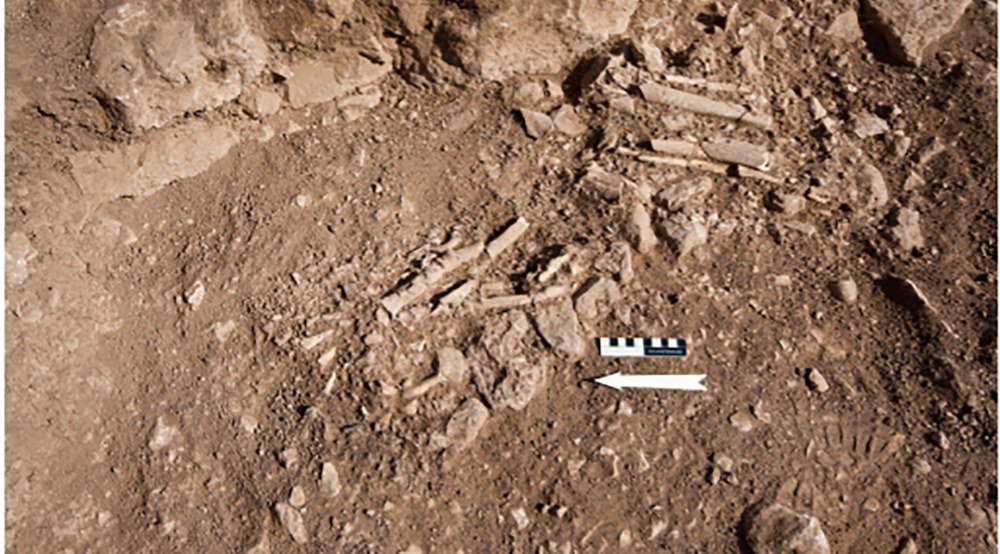
What the buildings do contain is fragmentary human bone: pieces, scattered and mixed into the fill, walls and floors rather than deposited as intact individuals. This is not sloppy preservation. It is a positive fact about how these people treated their dead — the body was not meant to survive as a whole, laid-out person in a grave. Whatever happened to the dead happened somewhere else, in some other way, and only fragments came back into the monument.
Death in stages: secondary burial
The pattern points to what archaeologists call secondary burial — treatment of the dead in more than one step. A body is first left to decompose or is actively de-fleshed; then, later, selected bones are gathered, moved, curated and finally deposited, sometimes long after death and often somewhere other than where the flesh was lost.
This is a fundamentally different relationship with the corpse than a single funeral. It means the dead had an extended afterlife as material — bones handled, kept, carried and placed by the living over months or years. The fragmentary, mixed human remains in the fill of these buildings are best read as the end point of that long process, not as careless disposal.
It also explains the emphasis that turns up again and again on particular body parts. Once you are handling bones rather than burying bodies, you can choose what to keep — and the choices these communities made are a study in themselves.
The head is one chapter, not the whole book
The best-known of those choices is the head. Göbekli Tepe produced human skull fragments deliberately carved and, in one case, drilled — the evidence Gresky, Haelm and Clare (2017) called a Neolithic 'skull cult' — and at Sefertepe skulls were gathered together into chambers. It is genuinely important, and it is the part everyone knows.
But it can crowd out everything else. This page is deliberately about the rest: the bodies, the stages, the grave goods, the places the dead do and don't appear. For the head material in full — the cut marks, the drilled perforation, the gathered skulls, the carved heads in stone — follow the dedicated pages, which go deep on exactly that and are linked at the foot of this one.
Grave goods, and the things buried with people
Where intact burials do occur in this wider world, they can be lavish — which throws the austerity of the monuments into relief. At Körtik Tepe, a slightly earlier site to the east, the dead were buried under house floors with hundreds of finely carved stone vessels, beads and ornaments: one of the richest early-Neolithic funerary records anywhere.
The precedent runs back further still. The Natufian 'shaman' grave at Hilazon Tachtit, more than a thousand years before Göbekli Tepe, held an elderly woman laid with fifty tortoise shells and parts of a leopard, an eagle and a wild boar (Grosman et al. 2008). Against that, the Taş Tepeler monuments are strikingly poor in grave goods — because they are not really burial sites at all. The wealth of the dead, where it exists in this world, is found in houses and cemeteries, not in the enclosures.
Where the dead finally appear: the villages
If you want actual graves in the Taş Tepeler landscape, you have to leave the monuments and go to the domestic sites — and, usually, later in time. At Gürcütepe, the cluster of village mounds outside Şanlıurfa that post-dates Göbekli Tepe's monumental phase, 2025 excavation reported multi-room structures containing burials alongside figurines and everyday material — the settled, domestic treatment of the dead that the great enclosures never show.
That contrast is the real chronological story. In the earlier monumental world, the dead are fragmented, curated and worked into communal buildings — Karul's 2025 report on Karahan Tepe makes the point sharply: across the whole excavated site there is only one complete skeleton, set into a chamber in the inner corner of a building wall, against numerous scattered, burned and scratched skull fragments. In the later village world, by contrast, people are buried within and beneath the houses they lived in. The relationship with the dead moved indoors and became domestic as the world itself did.
What is settled, and what is not
Settled: there are no formal cemeteries at the monumental sites; human remains there are fragmentary and deliberately handled; secondary burial was practised; and full, sometimes richly furnished burials belong to the domestic and neighbouring sites rather than the enclosures.
Not settled: whether the fragmentary bone represents reverence, something closer to trophy-taking, or both at once; how the missing majority of the dead were actually disposed of; and how much the later village burials at Gürcütepe should change our picture of the earlier monumental practice. Much of the newest evidence — Gürcütepe's burials, Sefertepe's chambers — is still field reporting awaiting full publication. What is not in doubt is that death sat at the centre of this world; the specific beliefs behind it are exactly what remains open.
Common questions
Are people buried at Göbekli Tepe?
Not in formal graves. There's no cemetery; instead, fragmented human bone appears scattered in the fill of the buildings, pointing to a treatment of the dead focused on body parts, especially the skull.
What is the Göbekli Tepe skull cult?
A practice inferred from human skull fragments bearing deliberate carved grooves and a drilled hole (Gresky, Haelm & Clare 2017), interpreted as skulls modified to be decorated, carried, or displayed.
Why are there headless figures in the carvings?
Headlessness is a recurring theme, most famously on the Vulture Stone. It ties the art to the community's treatment of the dead and its focus on the human head.
Sources & further reading5 references
- Gresky, J., Haelm, J. & Clare, L. (2017). Modified human crania from Göbekli Tepe provide evidence for a new form of Neolithic skull cult. Science Advances 3(6): e1700564. doi:10.1126/sciadv.1700564
- Grosman, L., Munro, N. D. & Belfer-Cohen, A. (2008). A 12,000-year-old Shaman burial from the southern Levant (Israel). Proceedings of the National Academy of Sciences 105(46): 17665–17669. doi:10.1073/pnas.0806030105
- Erdoğan, K. (reporting excavation director M. Erdalkıran) (2025). Neolithic figurines, multi-room burials found at Gürcütepe redefine Taş Tepeler chronology. Türkiye Today, 28 November 2025. Field reporting; awaiting full publication. link
- Schmidt, K. (2012). Göbekli Tepe: A Stone Age Sanctuary in South-Eastern Anatolia. Berlin: ex oriente. The foundational monograph by the site's first excavator.
- Notroff, J., Dietrich, O. & Schmidt, K. (2014). Building Monuments, Creating Communities. Early monumental architecture at Pre-Pottery Neolithic Göbekli Tepe. In J.F. Osborne (ed.), Approaching Monumentality in Archaeology: 83–105. Albany: SUNY Press.
Full bibliography: the Taş Tepeler reference library →