Short answer
The Younger Dryas — a roughly 1,200-year cold snap that ended around 9700 BCE — is the climatic backdrop to Taş Tepeler, not its cause. Göbekli Tepe's oldest monuments rose just afterwards, in the warming Holocene world.
Climate set the stage; people built the monuments. The popular claim that a comet caused the Younger Dryas and that the Vulture Stone records it is contested science plus a reading of the carving rejected by the excavators — the pillar was carved centuries after the supposed event.
What the Younger Dryas was
Around 10,900 BCE, as the last Ice Age was ending, the climate lurched violently back toward cold for roughly 1,200 years — a period called the Younger Dryas. When it ended, around 9,700 BCE, the world warmed rapidly into the stable, mild Holocene we still live in. That warming is the backdrop against which people across the Near East began to settle down.
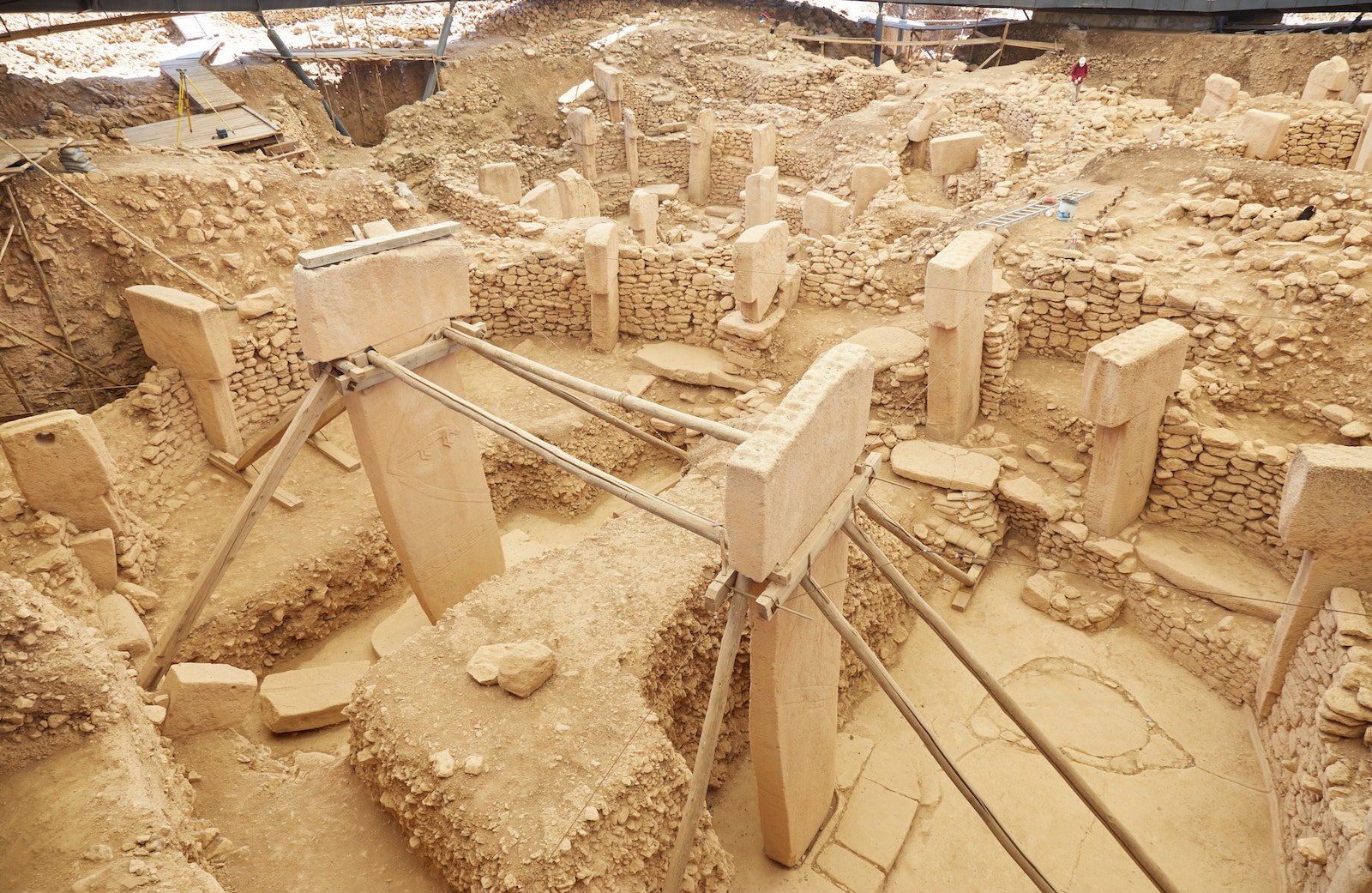
Göbekli Tepe's oldest monumental buildings date to just after this transition, around 9500 BCE. So climate is genuinely part of the setting: the monuments rose in the fresh, warming world that followed the last great cold.
Where it gets overstated
From there, the story is often pushed too far. One popular claim is that a comet impact caused the Younger Dryas and that Göbekli Tepe's Vulture Stone records it. The comet-impact idea for the Younger Dryas is itself contested among scientists, and the reading of Pillar 43 as a dated star-map of that event was formally rejected by the site's excavation team in a 2017 response, More than a vulture (Notroff, Dietrich, Dietrich, Clare and colleagues) — not least because the pillar was carved centuries after the supposed event. We cover that debate in full on its own page.
The careful position is this: climate change set the stage, but it does not simply explain the monuments. People built Göbekli Tepe; a warming climate gave them the world in which to do it.
How to read a Younger Dryas headline
Two different claims travel under the same name, and it helps to keep them apart. The modest claim — that a changing climate reshaped where and how people could live, feeding into the settling-down that led to these sites — is mainstream and well supported. The strong claim — that a specific catastrophe caused the Younger Dryas and that Göbekli Tepe was built as a response to it, encoded in its carvings — is not.
When you see 'Göbekli Tepe and the Younger Dryas comet' in a headline, it is the strong version being sold. The excavation team does not accept it, and the dating does not fit.
How we even know there was a cold snap
The Younger Dryas is not inferred from Göbekli Tepe; it is read off the planet's own archives, far from Şanlıurfa. Layered ice cores from Greenland record a sharp drop and later rebound in temperature and snowfall. Pollen sequences from lake beds across the Near East show vegetation retreating toward cold, dry, steppe conditions and then recovering. Marine and lake sediments tell the same story.
That independence matters. Because the climate signal comes from ice and pollen rather than from the archaeology, we can line the monuments up against the climate curve honestly, instead of using one to prove the other. And when we do, the oldest enclosures fall clearly after the cold reversed — in the warming, not during the freeze.
What the warming actually did here
The modest, well-supported story is about opportunity, not trauma. As the early Holocene turned warmer and wetter, the hills of Upper Mesopotamia filled with dense stands of wild cereals, nut trees and abundant game — a landscape rich enough to support large gatherings of people in one place for weeks at a time without farming.
That abundance is the quiet precondition for everything else. You cannot assemble the crowds needed to quarry and raise multi-ton pillars, or feast them, in a marginal environment. The warming did not cause the monuments — people caused the monuments — but it produced the fat, forgiving landscape in which raising them became possible. Climate set the table; the builders decided what to do at it.
Climate and the birth of farming
Where climate matters most is the deeper story. The stable, wetter early Holocene made intensive gathering of wild cereals — and eventually their cultivation — viable in this landscape. Taş Tepeler sits right at that hinge: monument-building hunter-gatherers in exactly the time and place where farming began. Climate didn't build the temples, but it opened the door to the settled, farming world that followed them.
Common questions
Did climate change cause Göbekli Tepe?
Not directly. The site rose in the warming world after the Younger Dryas cold period, so climate set the stage — but people, not climate, built the monuments.
Was Göbekli Tepe built because of a comet?
No. The claim that a comet caused the Younger Dryas and that the Vulture Stone records it is contested science plus a rejected reading of the carving, which post-dates the supposed event by centuries.
What is the Younger Dryas?
A roughly 1,200-year return to cold conditions at the end of the last Ice Age (about 10,900–9,700 BCE), just before the stable Holocene in which the Taş Tepeler monuments were built.
Sources & further reading3 references
- Sweatman, M. B. & Tsikritsis, D. (2017). Decoding Göbekli Tepe with archaeoastronomy: What does the fox say?. Mediterranean Archaeology and Archaeometry 17(1): 233–250. link The comet / 'Younger Dryas impact date-stamp' reading of Pillar 43 — a published claim the excavators dispute.
- Notroff, J., Dietrich, O., Dietrich, L., Tvetmarken, C. L., Kinzel, M., Schlindwein, J., Sönmez, D. & Clare, L. (2017). More than a vulture: A response to Sweatman and Tsikritsis. Mediterranean Archaeology and Archaeometry 17(2): 57–63. link The Göbekli Tepe excavation team's point-by-point rebuttal of the comet interpretation.
- Clare, L. (2020). Göbekli Tepe, Turkey. A brief summary of research at a new World Heritage Site (2015–2019). e-Forschungsberichte des Deutschen Archäologischen Instituts 2020(2): 81–88.
Full bibliography: the Taş Tepeler reference library →