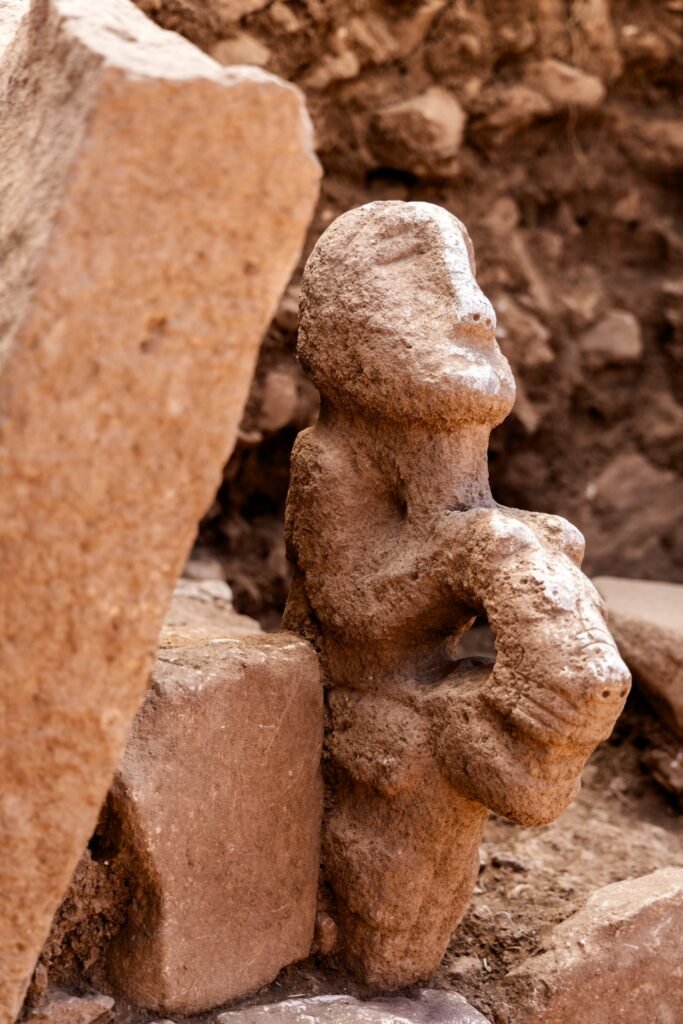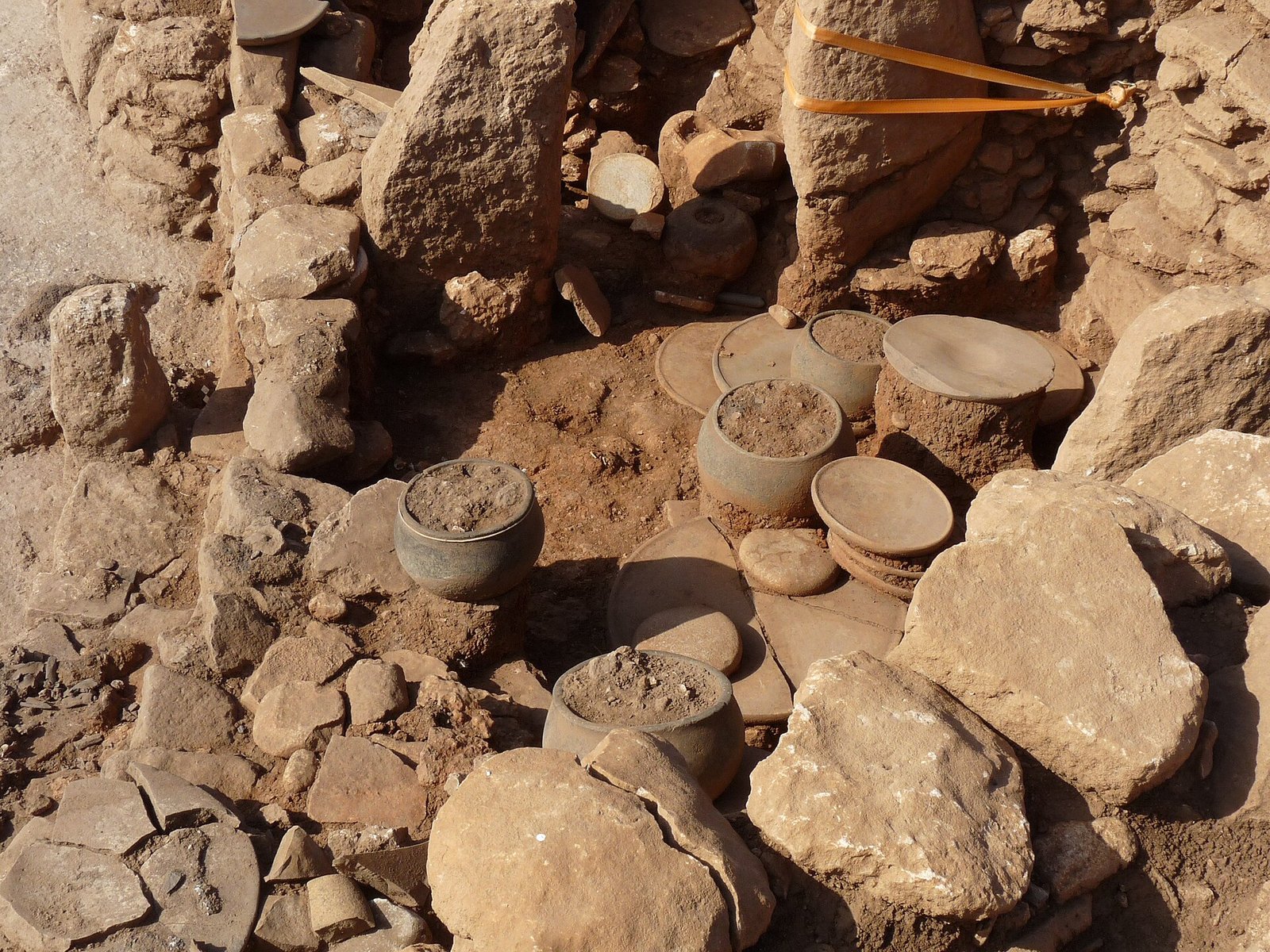
The discovery
At Karahan Tepe, excavators found three miniature carved animals — a fox, a vulture and a wild boar, each about 3.5 centimetres tall — arranged deliberately on a plate, placed inside a container, sealed with a stone lid, and set within a larger vessel. The figures are roughly 11,500 years old.
Necmi Karul, who leads the excavations, described the arrangement to Reuters as a staged scene rather than three separate objects — which is why it is being called the earliest story told in three dimensions.
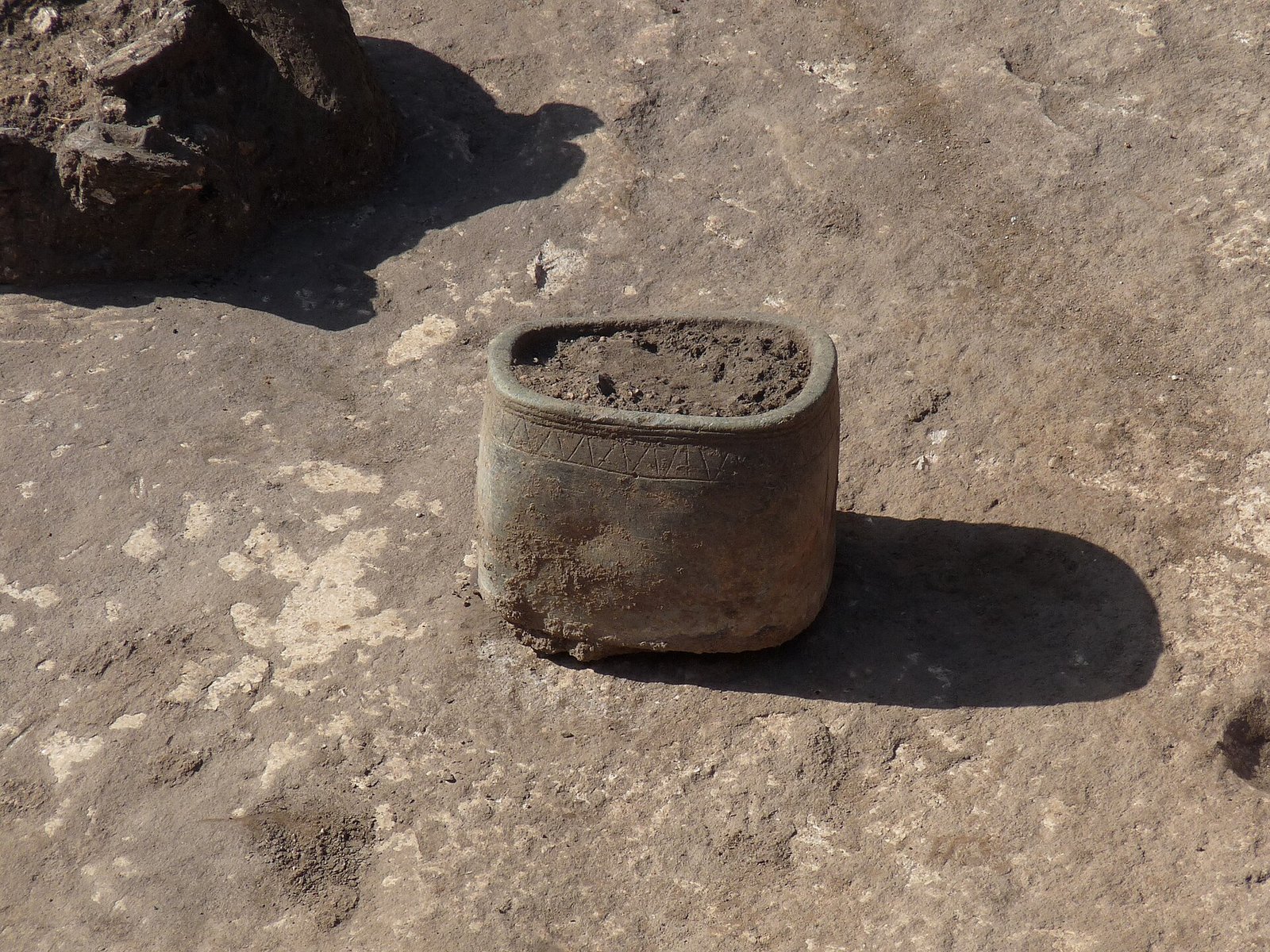
Frantisek Trampota, Karahan Tepe in-situ small stone vessel, Public domain, via Wikimedia Commons.
Why it matters — and what's interpretation
The fox, vulture and boar are among the most loaded animals in this world's art — the same creatures carved on the pillars of Göbekli Tepe. To find them shrunk to fingertip size and composed into a single sealed scene suggests story-telling that could be handled and hidden, not just displayed.
The objects are real and carefully recorded; the reading of them as a deliberate 'narrative' is Karul's interpretation, and a compelling one. As always, we flag interpretation as interpretation — but this is a extraordinary find.
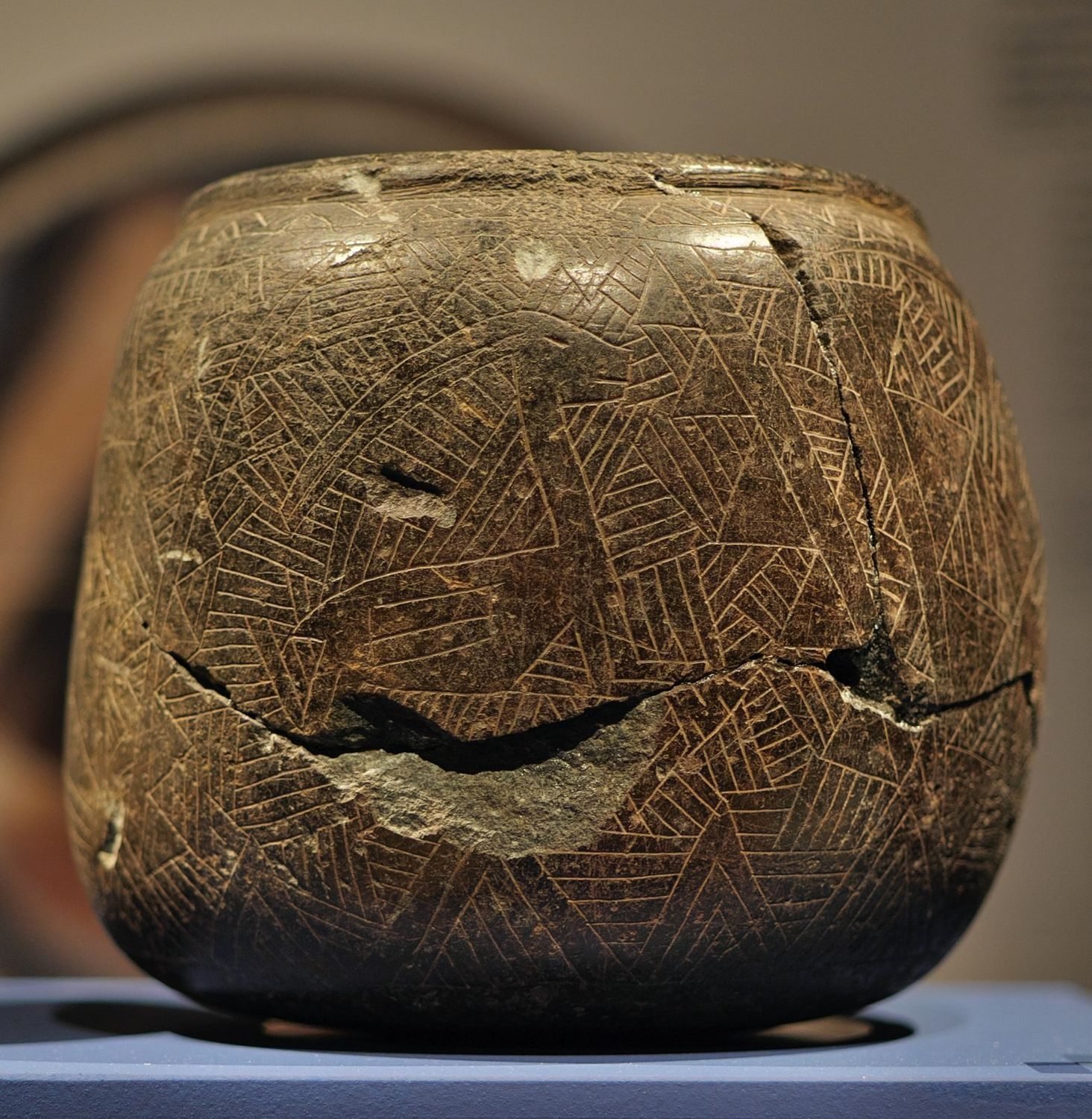
Bautsch, Steingefaess.Chlorit.Karahantepe.MNR.25365.P1067751, CC0, via Wikimedia Commons.
Why the packaging is the point
What separates this from a stray group of figurines is how it was contained. The three animals sat on a plate, inside a lidded container, set within a larger vessel — a scene composed to be closed, moved and hidden rather than displayed. That is a very different mode from the pillars, whose imagery is fixed and public: here the same charged animals are made portable and concealable.
It also scales the region's art down to the hand. The fox, vulture and boar are the headline creatures of Göbekli Tepe's enclosures; finding them at roughly 3.5 cm, arranged as a set, suggests the symbolic vocabulary worked at every size — monumental on the walls, intimate in a sealed pot.
The same animals, made portable
The fox, the vulture and the wild boar are among the most loaded animals in this world's art — the same creatures carved onto the great pillars of Göbekli Tepe, about 35 km west of Karahan Tepe, in the Şanlıurfa region roughly 12,000 years ago. On the pillars they are monumental and fixed in public view.
To find those same charged animals shrunk to about 3.5 centimetres each and composed into a single set suggests the region's symbolic vocabulary worked at every scale — monumental on the walls, intimate in the hand. It is the kind of find that quietly widens what we thought this art could do.
Why the packaging is the point
What separates this from a stray group of figurines is how it was contained. The three animals sat on a plate, inside a lidded container, set within a larger vessel — a scene composed to be closed, moved and hidden rather than displayed. That is a very different mode from the pillars, whose imagery is public and permanent; here the same creatures are made portable and concealable.
The objects are real and carefully recorded, but the reading that carries the headline — that this is a staged 'story' rather than three deposited objects — is Necmi Karul's interpretation, given in interviews ahead of a full excavation report. A narrative implies a sequence and meaning that the arrangement alone cannot prove; it could equally be an offering, a cache, or a symbolic grouping with no story in our sense. Species identifications of figures this small can also be revised on closer study.
What is uncertain
The reading that carries the headline — that this is a staged 'story' rather than three deposited objects — is Necmi Karul's interpretation, given in interviews ahead of a full excavation report. A narrative implies sequence and meaning that the arrangement alone cannot prove; it could be an offering, a cache, or a symbolic grouping with no story in our sense.
The ~11,500-year age and the details of the nested container come from press and interview material, not yet a peer-reviewed publication, and species identifications of figures this small can be revised on closer study. 'Earliest 3D story' is a striking claim precisely because narrative in prehistoric art is so hard to demonstrate.
Common questions
What is the Karahan Tepe nested vessel? Three tiny carved animals — a fox, a vulture and a wild boar, each about 3.5 cm tall — arranged on a plate, sealed in a lidded container, and set inside a larger vessel, roughly 11,500 years old.
Why is it called the earliest 3D story? Excavation leader Necmi Karul reads the arrangement as a deliberately staged scene rather than three separate objects — a story composed in three dimensions. This is his interpretation, given ahead of a full report.
What is certain and what is not? The objects are real and carefully recorded. Whether they form a 'narrative' is interpretation, and the age and container details come from press and interview material, not yet a peer-reviewed publication.
Key takeaways
- The fox, vulture and boar are the same charged animals carved on the pillars of Göbekli Tepe — here shrunk to fingertip size.
- How it was contained is the point: a scene composed to be closed, moved and hidden, not displayed.
- It suggests the symbolic vocabulary worked at every scale — monumental on the walls, intimate in a sealed pot.
- A 'narrative' implies sequence and meaning the arrangement alone cannot prove; it could be an offering or a cache.
Sources
- The Collector — 'The Earliest 3D Story', Necmi Karul on Karahan Tepe's latest discoveries
- Artnet News — 11,500-year-old figurines could be earliest known storytelling objects
This article is written from the primary literature and excavators' reports cited above. Interpretations are attributed; uncertainties are stated in the text.