Short answer
By hand — Göbekli Tepe was built with stone tools, timber, rope and human muscle, with no metal, wheel or draft animals, by teams who quarried, carved, dragged and levered up limestone pillars weighing up to ten tonnes.
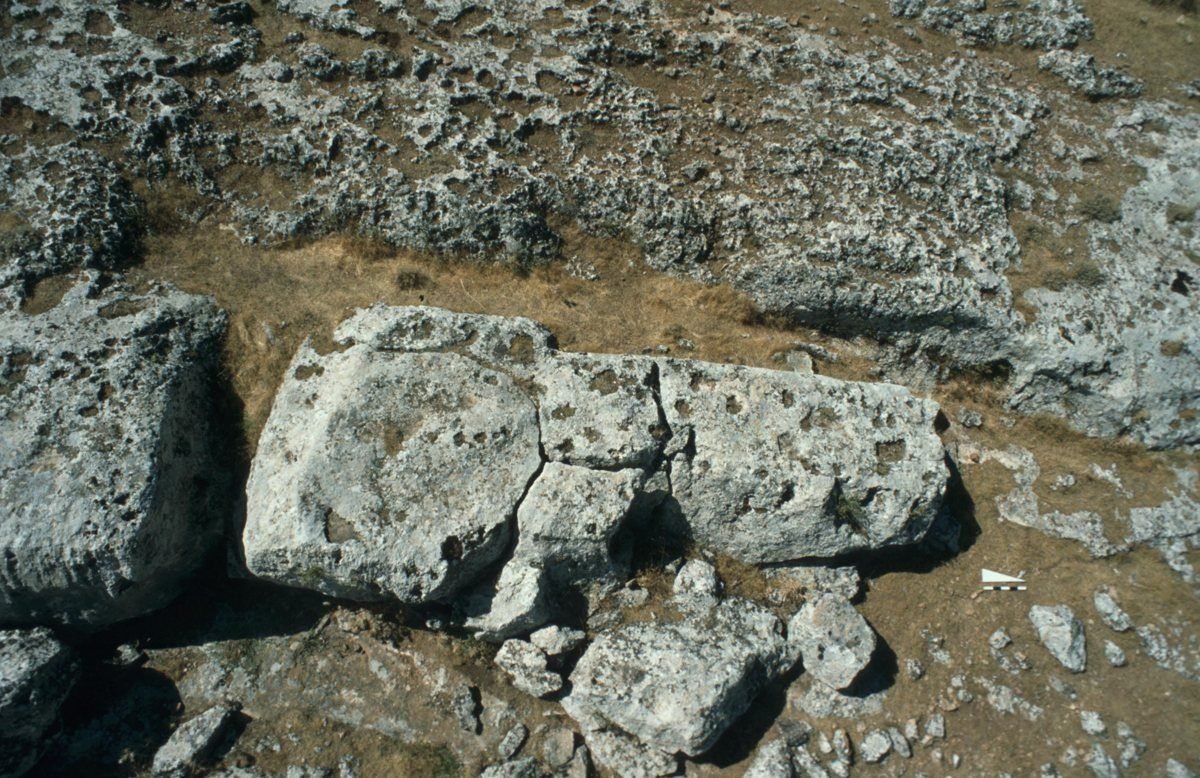
The quarrying is proven: an unfinished seven-metre pillar still lies half-freed in the bedrock nearby, and pillar sockets are cut into the rock. The moving and raising are reasoned from what other pre-industrial peoples did — sledges, rollers and levers hauled by large coordinated teams — because no rope, sledge or ramp has survived.
By hand, with stone tools
Göbekli Tepe was built without metal, the wheel, draft animals, or writing. Its people had stone tools, timber, rope, and their own muscle — and with those they quarried, carved, moved, and raised limestone pillars weighing up to ten tons. How they did it is partly known from evidence and partly reconstructed from what's physically possible.
The quarrying we can see directly. The pillars were cut from limestone outcrops near the site, and at least one unfinished pillar still lies in the bedrock, showing exactly how a block was outlined and freed using stone picks and hammers. That abandoned giant would have stood about seven metres tall — cracked or given up on before it could be moved, and the clearest sign of stone-working pushed to the very limit of what people could do by hand.
Moving and raising the pillars
The hardest part — moving multi-ton stones — leaves less direct evidence, so here archaeologists reason from method. The likeliest techniques are the ones used by other pre-industrial peoples: dragging blocks on wooden sledges over rollers or greased tracks, hauled by large teams with ropes, then levering them upright into prepared sockets in the bedrock with timber and stone packing.
None of this needs advanced technology. It needs organisation — many people, coordinated, over time. That's the real 'how': the engineering was social as much as mechanical.
Was there a design behind it?
Raising the stones is one question; deciding where they go is another. In 2020 the archaeologists Gil Haklay and Avi Gopher argued that the three main enclosures were not laid out piecemeal but planned as a group: the centre-points of Enclosures B, C and D, they found, sit at the corners of a near-perfect equilateral triangle, as if set out from a single geometric scheme before building began.
If they are right, it implies something striking — an abstract plan, held in the mind or sketched on the ground, guiding a project too big to improvise. It would also fit the hint of standard units in the spacing of the central pillars. But this is an interpretation, not a proven fact: critics note that with enough points and some freedom in choosing centres, geometric patterns can be found by chance, and the enclosures were rebuilt and reused over centuries rather than raised in one act. Treat it as a serious, debated possibility — evidence that these builders may have designed, not just stacked.
Why the 'how' matters
The construction is the whole point of Göbekli Tepe's fame. It proves that hunter-gatherers could marshal the labour, planning, and skill once thought to require farming and cities. The pillars aren't just art — they're evidence of a society able to pull together for a shared, monumental purpose, thousands of years earlier than anyone expected.
The toolkit that did it
The tools were unremarkable and entirely local. Flint and harder hammerstones and picks did the quarrying and the fine carving; the animal reliefs were pecked out and then ground smooth. Wooden levers, timber sledges and plant-fibre rope did the moving.
Nothing in that kit is exotic, and that is the point. Every material found at the site is limestone, flint and bone — there is no metal, no machinery, and no trace of anything the builders could not have made themselves. The achievement is one of organisation and skill, not of some lost technology.
How many people, and how long
There is no headcount and no timetable. Raising a single enclosure was a major undertaking for a large group, and the hill as a whole was built, altered and returned to across many centuries — well over a thousand years of work on the same ridge.
What can be said is that the labour was episodic and communal rather than industrial: gatherings that quarried and raised stones, probably alongside the feasting the site is known for, repeated over generations rather than driven through in one campaign.
What we actually have, and what we're reconstructing
It's worth being clear about which parts of the 'how' are evidence and which are informed reconstruction. The quarrying is evidence: an unfinished T-pillar still lies in the bedrock, outlined and half-freed, showing the picks and hammerstones at work. The pillar sockets cut into the rock are evidence too.
The moving and raising are reasoned, not excavated. No sledge, roller, rope or earthen ramp has survived, so the standard reconstruction — dragging blocks on timber sledges, hauled by large teams, then levering them upright — comes from what pre-industrial peoples elsewhere demonstrably did. It is the most plausible method, not a recovered one. The honest 'how' is: quarried by hand (proven), moved and raised by organised human muscle (inferred).
Common questions
How was Göbekli Tepe built without metal tools?
The builders used stone tools to quarry and carve limestone, and human labour with wooden sledges, rollers, ropes, and levers to move and raise the pillars into bedrock sockets. No metal, wheel, or draft animals were involved.
How heavy are the Göbekli Tepe pillars?
The largest weigh on the order of ten tons and stand over five metres tall — moved and raised entirely by human effort.
How long did Göbekli Tepe take to build?
There's no single answer — the site was built, modified, and reused across many centuries. Each enclosure represents a major coordinated effort by a large group.
Sources & further reading4 references
- Haklay, G. & Gopher, A. (2020). Geometry and Architectural Planning at Göbekli Tepe, Turkey. Cambridge Archaeological Journal 30(2): 343–357.
- Schmidt, K. (2012). Göbekli Tepe: A Stone Age Sanctuary in South-Eastern Anatolia. Berlin: ex oriente. The foundational monograph by the site's first excavator.
- Notroff, J., Dietrich, O. & Schmidt, K. (2014). Building Monuments, Creating Communities. Early monumental architecture at Pre-Pottery Neolithic Göbekli Tepe. In J.F. Osborne (ed.), Approaching Monumentality in Archaeology: 83–105. Albany: SUNY Press.
- Clare, L. (2020). Göbekli Tepe, Turkey. A brief summary of research at a new World Heritage Site (2015–2019). e-Forschungsberichte des Deutschen Archäologischen Instituts 2020(2): 81–88.
Full bibliography: the Taş Tepeler reference library →